The Glenlivet 12: Single Malt and Double-Oak Maturation
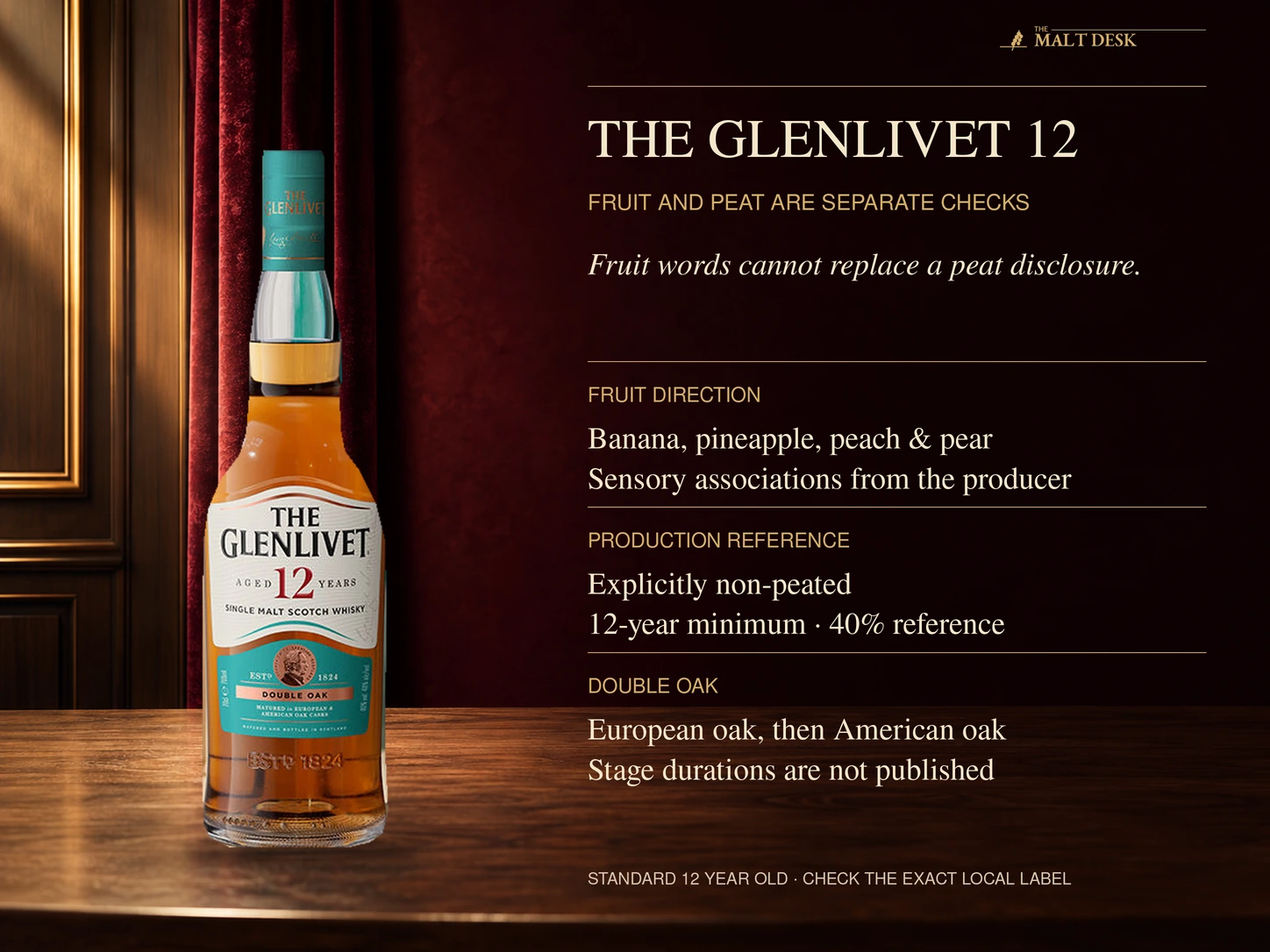
For a reader who wants fruit-led Scotch while avoiding a peat-led direction, The Glenlivet 12 supplies two different kinds of evidence. Its banana, pineapple, peach and pear vocabulary describes the producer’s intended profile. More decisively for the second requirement, its own FAQ explicitly identifies the expression as non-peated. I would not ask the fruit words to do both jobs.
That distinction matters because fruit and smoke can appear together in another whisky’s official notes. Bowmore 12 combines fruit and honey with smoke. A fruit-led shortlist therefore needs a second check if avoiding that smoke direction is essential; a cheerful fruit description alone does not settle it.
The Glenlivet 12 Year Old is single malt Scotch from Speyside. The producer’s product page lists 40% ABV and maturation in European and American oak. Its 12-year age statement and double-oak description explain different things: minimum age and maturation program.
Product Facts
| Category | Single malt Scotch whisky |
|---|---|
| Distillery | The Glenlivet |
| Region | Speyside, Scotland |
| Age statement | 12 years |
| Official reference ABV | 40% |
| Cask description | European and American oak |
| Peat | Producer identifies the expression as non-peated |
The producer’s U.S. page lists a 70 cl reference alongside 40% ABV. This website presentation does not establish the size of every local bottle. Read the specific bottle’s strength and volume; an abbreviated retailer listing should not override its label.
What Single Malt Means
Single malt Scotch comes from one Scottish distillery and is made from malted barley using pot stills. A bottling can combine many casks while retaining the single malt designation. It is not a single-barrel claim.
The 12-year statement refers to the youngest whisky in the bottle, not an average. The whisky does not acquire further cask age after bottling. These definitions are useful when comparing The Glenlivet 12 with a blend or another age-stated malt.
Understanding Double Oak
The Glenlivet’s U.S. specification table names European and American oak, while its age FAQ describes European-oak maturation followed by further time in American oak. No stage durations are stated there. This does not mean twelve years in each wood: the label remains a twelve-year minimum for the youngest whisky.
Wood origin, previous cask contents and maturation sequence are separate details. “American oak” alone does not establish an ex-bourbon percentage. Likewise, a double-oak phrase is not a universal category requiring every brand to use the same process.
Producer Flavor Profile
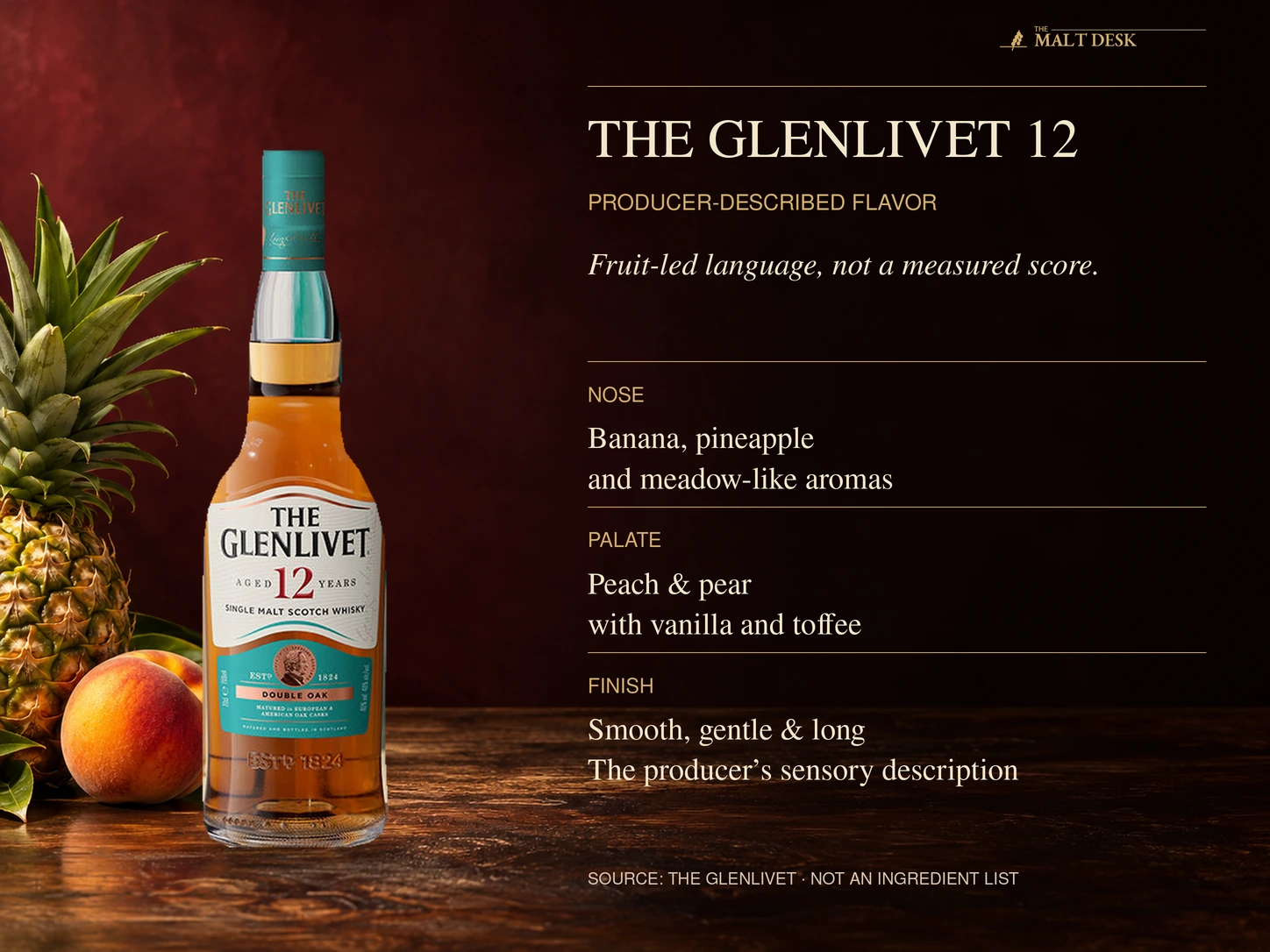
The official notes describe banana and pineapple with floral associations on the nose, followed by peach, pear, vanilla and toffee on the palate. The producer describes a gentle, lingering finish.
Fruit and toffee are aroma and flavor associations rather than added ingredients. Different serving conditions and individuals can produce different observations.
Non-Peated Does Not Mean Flavorless
The producer identifies the standard 12-year expression as non-peated. This distinguishes it from whiskies intentionally characterized by peat smoke; it is not a claim that it lacks flavor or belongs to a lower level of whisky knowledge.
Region alone cannot predict every flavor. Speyside contains many cask programs and production choices, so the individual expression is more useful than a general regional stereotype.
Fruit Vocabulary Cannot Do the Work of a Peat Disclosure
The Glenlivet’s profile names tropical and orchard-fruit associations, and its FAQ separately says the standard 12 is not peated. Bowmore’s core twelve-year account names lemon, honey and warm fruit while explicitly retaining earthy smoke and a smoky finish. These are producer descriptions. They nevertheless provide a concrete counterexample to equating fruit vocabulary with an absence of smoke.
| Reader requirement | Relevant evidence for The Glenlivet 12 | Evidence that would be insufficient on its own |
|---|---|---|
| A fruit-led direction to investigate | Producer notes naming banana, pineapple, peach and pear | Twelve years or a Speyside location |
| A non-peated production reference | The expression-specific non-peated FAQ | Fruit, honey, smooth or a missing smoke word |
| A twelve-year minimum | The age statement | An approachable profile or a double-oak name |
Suppose the objection to a previous Scotch was its peat-led profile, while the fruit associations were welcome. Choosing solely from a honey-and-fruit description could repeat the unresolved part of that decision. The Glenlivet’s explicit non-peated account is more relevant to changing that part. It does not promise that every reader will detect no smoky association whatsoever; it establishes the named producer’s production and style reference rather than a personal sensory guarantee.
Keep the Wood Question Separate From the Smoke Question
Double oak answers another inquiry. The U.S. FAQ describes European-oak maturation followed by further maturation in American oak, without publishing the stage durations. That sequence is useful production detail, but neither the count of woods nor their origins is a substitute for the peat disclosure. A whisky can combine cask histories and still follow a smoky spirit direction.
The same distinction helps a reader avoid solving the wrong shopping problem. If the desired change is away from peat-led whisky, I would first retain the explicit non-peated expression on the shortlist. If the desired change is a particular sherry-seasoning program, I would check the exact cask account instead. The Glenlivet’s two oak origins do not by themselves reproduce Macallan Double Cask’s explicitly sherry-seasoned American-and-European-oak account.
An actual serving can then answer whether this complete expression is enjoyable for the reader. Keep the initial preparation consistent with the one whose smoke was unwanted, and write the fruit, smoke and liking observations separately. Enjoying the fruit does not require liking every accompanying feature; disliking one feature does not erase the others.
Compare With Other 12-Year Malts
Glenfiddich 12 shares the age statement and region but comes from a different distillery. Its producer emphasizes pear. A common age and bottling strength do not establish an identical spirit or cask program.
The three-way single-malt comparison also includes Macallan Double Cask 12. The differences are explained through casks and producer descriptions rather than an unsupported smoothness order.
Strength and Serving
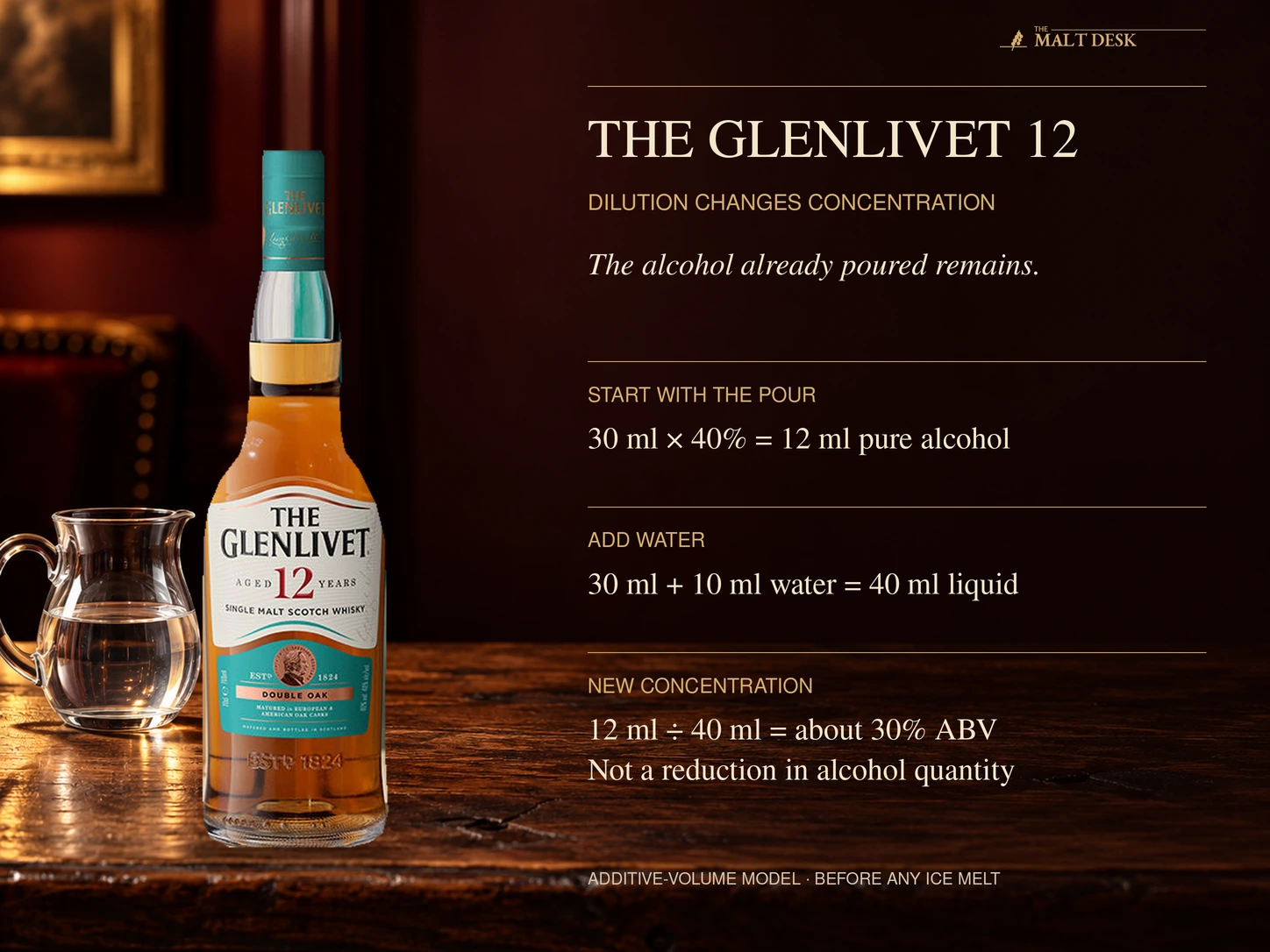
Forty percent ABV is 80 US proof. A 30 ml measure contains 12 ml of pure alcohol. Adding 10 ml water gives approximately 30% ABV in 40 ml total liquid, assuming additive volumes. This lowers concentration without removing alcohol.
Ice changes both temperature and dilution. A fixed cube or resting time does not guarantee that a particular fruit note appears. To make observations comparable, record the pour, glass, temperature and added water or mixer.
Price and Label Information
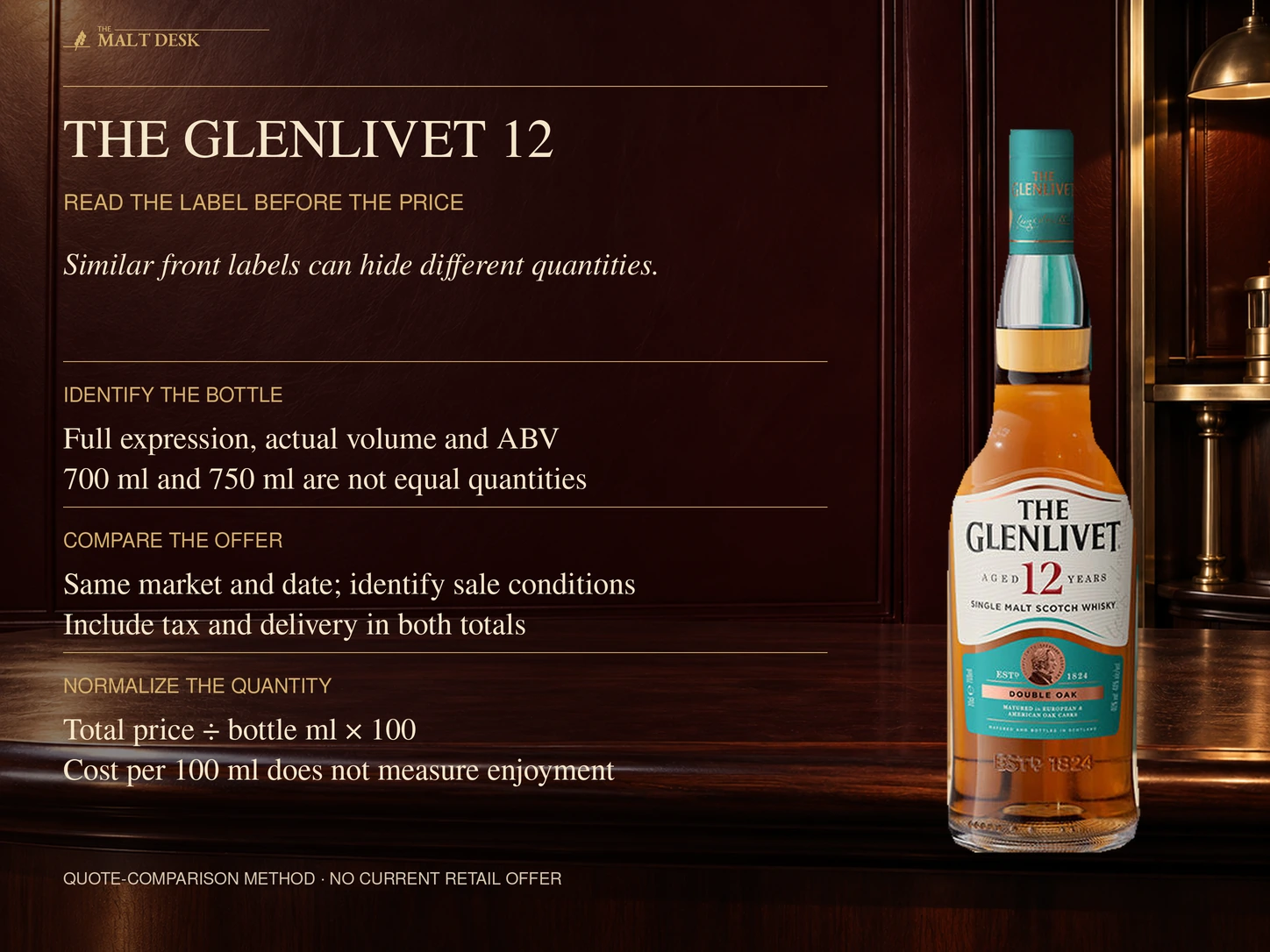
A price comparison needs the same expression, bottle volume, market and date. Historical sale prices should not be presented as current nationwide availability. A 700 ml bottle and a 750 ml bottle contain different quantities even when their front labels look similar.
The budget guide explains volume normalization. The beginner guide covers label terms without presenting one expression as a mandatory first purchase.
Use the Peat Disclosure to Resolve a Smoke Objection
The Glenlivet 12 is a relevant starting point when fruit-led producer notes and an explicitly non-peated expression match the brief. When comparing it with another fruity malt, check that malt’s peat account separately. This makes the choice useful for a reader avoiding smoke while leaving room to explore different fruit and cask profiles within that preference.
Common Questions
Does double oak mean double the age?
No. It describes the maturation program. The youngest whisky is at least 12 years old.
Is it a single cask?
Single malt identifies one distillery, not one cask.
Does 40% prove it is smoother than a stronger whisky?
ABV records alcohol concentration. For smoothness, consider the specific texture and alcohol warmth you prefer, alongside the expression and serving conditions.
Are color and filtration confirmed?
No claim of natural color or non-chill filtration is established here. Appearance alone cannot confirm either.
Do the tropical-fruit notes mean fruit is added?
No. They are sensory associations in the producer’s description.
Sources
The Glenlivet, The Glenlivet 12 Year Old product information; Scotch Whisky Regulations 2009; Scotch Whisky Association guidance on single malt Scotch whisky and age statements. The producer’s U.S. page was checked October 3, 2026. Flavor descriptions are attributed and are not treated as ingredient claims.
Expression comparison checked October 8, 2026: The Glenlivet’s U.S. 12 Year Old FAQ and core Bowmore 12 producer notes. Fruit-with-smoke is an attributed profile counterexample; The Glenlivet’s explicit non-peated disclosure is a separate selection fact. No comparative intensity, individual preference or complete cask recipe is inferred.