Buffalo Trace Bourbon: Label and Production Guide
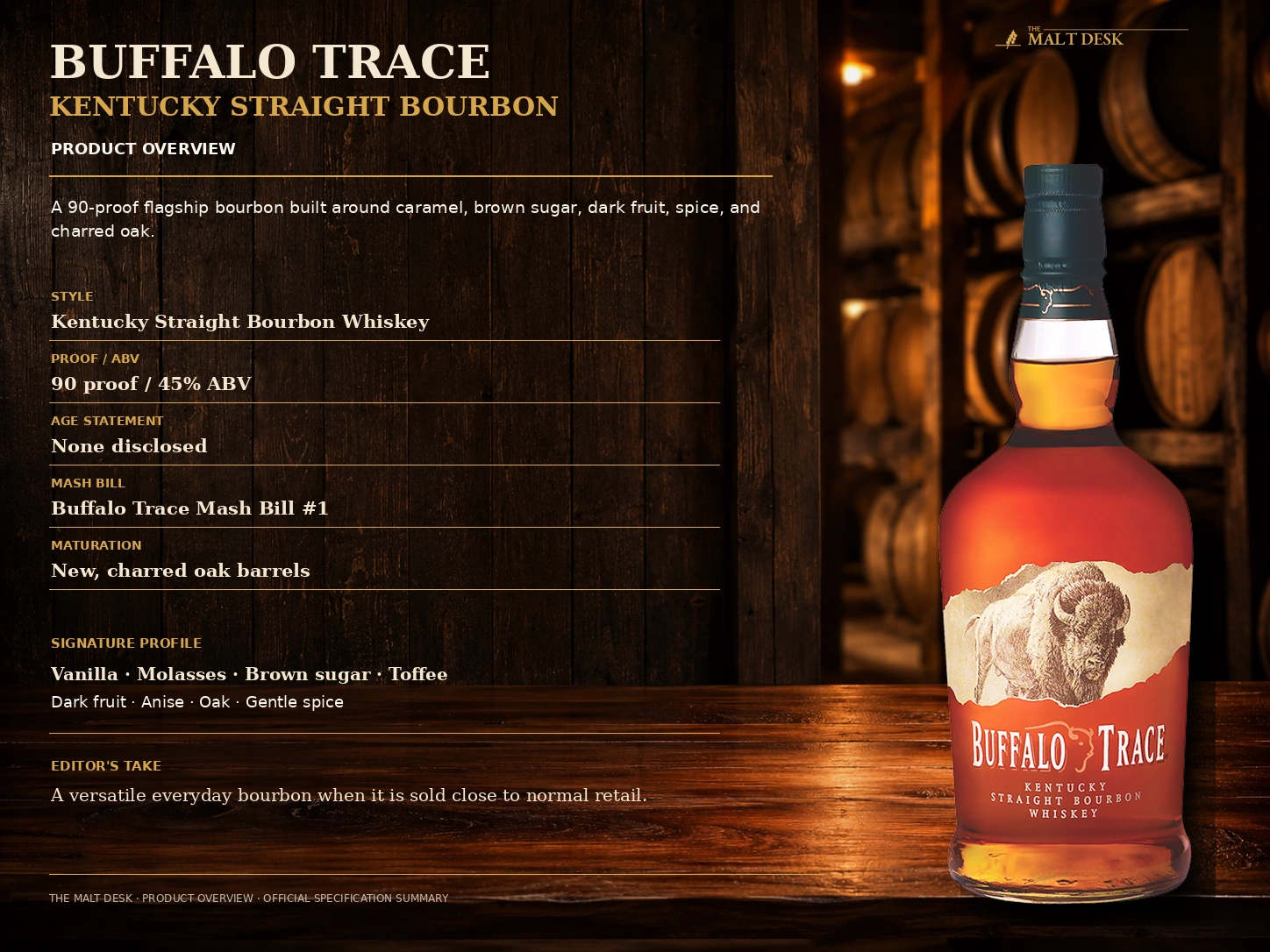
Buffalo Trace Bourbon is Kentucky straight bourbon from Buffalo Trace Distillery in Frankfort, bottled at 90 US proof or 45% ABV. The standard expression has no age statement. Its brand name is also the distillery’s name, so it is important to distinguish this specific bourbon from other products made at the site.
Product Facts
| Expression | Buffalo Trace Kentucky Straight Bourbon |
|---|---|
| Producer | Buffalo Trace Distillery |
| Location | Frankfort, Kentucky |
| ABV / US proof | 45% / 90 |
| Age statement | None |
| Exact grain percentages | Not disclosed here |
| Maturation | New charred oak barrels |
One Distillery, Many Expressions
A distillery name does not identify every whiskey made there as the same recipe or age. Product names can refer to different grain recipes, barrel selections and strengths. The standard Buffalo Trace bottle should be identified by its complete Kentucky straight bourbon name and 90-proof label.
This distinction also matters in comparisons with limited or age-stated releases from the same producer. Their specifications cannot be transferred to the standard expression, even when the distillery is shared.
What the Recipe Does and Does Not Disclose
The bourbon’s precise grain percentages are not stated here. A mash-bill nickname repeated in secondary reporting should not be converted into a numerical recipe without reliable documentation. In particular, an estimate of rye content is not a published specification.
The bourbon category establishes a corn-led production framework and new charred oak maturation. Those shared requirements still allow differences in fermentation, distillation, warehouse conditions and cask selection. Category membership does not make two bourbons taste identical.
Producer Flavor Notes
Buffalo Trace’s product description includes vanilla, mint and molasses in the aroma. Its palate notes refer to brown sugar and spice with oak, toffee, dark-fruit and anise associations. These describe the producer’s intended sensory profile.
Mint, fruit and toffee are not an ingredient list. A sensory reference to caramel or brown sugar should not be read as a claim that those substances were added. Nor can a list of descriptors establish an objective sweetness score.
A reader may notice different associations under different serving conditions. The official description does not support a claim that a particular five-minute rest, glass shape or water addition will reveal exactly the same sequence for everyone.
No Age Statement
The standard expression does not provide a youngest-age statement. Price, color and general information about the distillery cannot supply that missing number. An age estimate should not be repeated as a product guarantee.
Maturation in a barrel and storage in a bottle are separate. Additional years in glass do not create a new age-stated expression. Keep a bottle upright and away from excessive heat or direct sunlight to protect its condition.
Ninety Proof in Context
Ninety US proof means 45% ABV. A 30 ml measure contains 13.5 ml of pure alcohol. The same volume of 40% whiskey contains 12 ml, while 50.5% contains 15.15 ml. These are measurable differences in alcohol quantity, not quality rankings.
With 10 ml water added to 30 ml of Buffalo Trace, approximate ABV becomes 33.75%, assuming additive volumes. The amount of alcohol remains 13.5 ml. Ice adds cooling and a variable amount of meltwater, so a later strength estimate needs that additional volume.
Compare With Other Bourbons
Maker’s Mark shares a common 45% bottling strength while using a wheated recipe. Wild Turkey 101 is 50.5%. These comparisons change recipe or strength, and often several other production variables. It is therefore too simple to attribute every sensory difference to rye content or proof.
The three-bourbon comparison separates those disclosed facts. It avoids treating one expression as the automatic winner for every serving style.
Serving and Mixer Variables
Neat, water, ice and mixed drinks provide different conditions. Soda adds carbonation and dilution; ginger ale and cola add their own flavors and sweeteners. A judgment about the whiskey in one recipe does not necessarily apply to another.
The highball guide explains measured ratios. Keeping the mixer, glass and ice similar makes comparisons easier to interpret than changing every ingredient together.
Understanding Availability and Price Claims
Availability is local and changes with time. A historical listing cannot establish current scarcity, and a high asking price does not prove that the contents are older or different. Avoid treating the distillery’s reputation as evidence for an undisclosed specification.
The budget guide explains how to compare the same volume and offer conditions. Unit cost can be calculated; “flavor per dollar” remains dependent on preference and cannot be derived from proof alone.
For basic category terms, the beginner guide explains age statements, grain recipes and serving language without making a first-bottle purchase mandatory.
Common Questions
Does the standard bottle disclose an age?
No. Leave the age unspecified rather than estimating from color or price.
Is 90 proof the same as 45% ABV?
Yes, using the US proof system.
Does every Buffalo Trace Distillery product use the same recipe?
No such assumption should be made. Identify the specific expression and its disclosed production details.
Are the fruit and mint notes flavor additions?
They are sensory descriptions in the producer’s notes, not an ingredient statement.
Does a higher local price mean a different whiskey?
Not by itself. Check expression, size and strength before drawing conclusions from price.