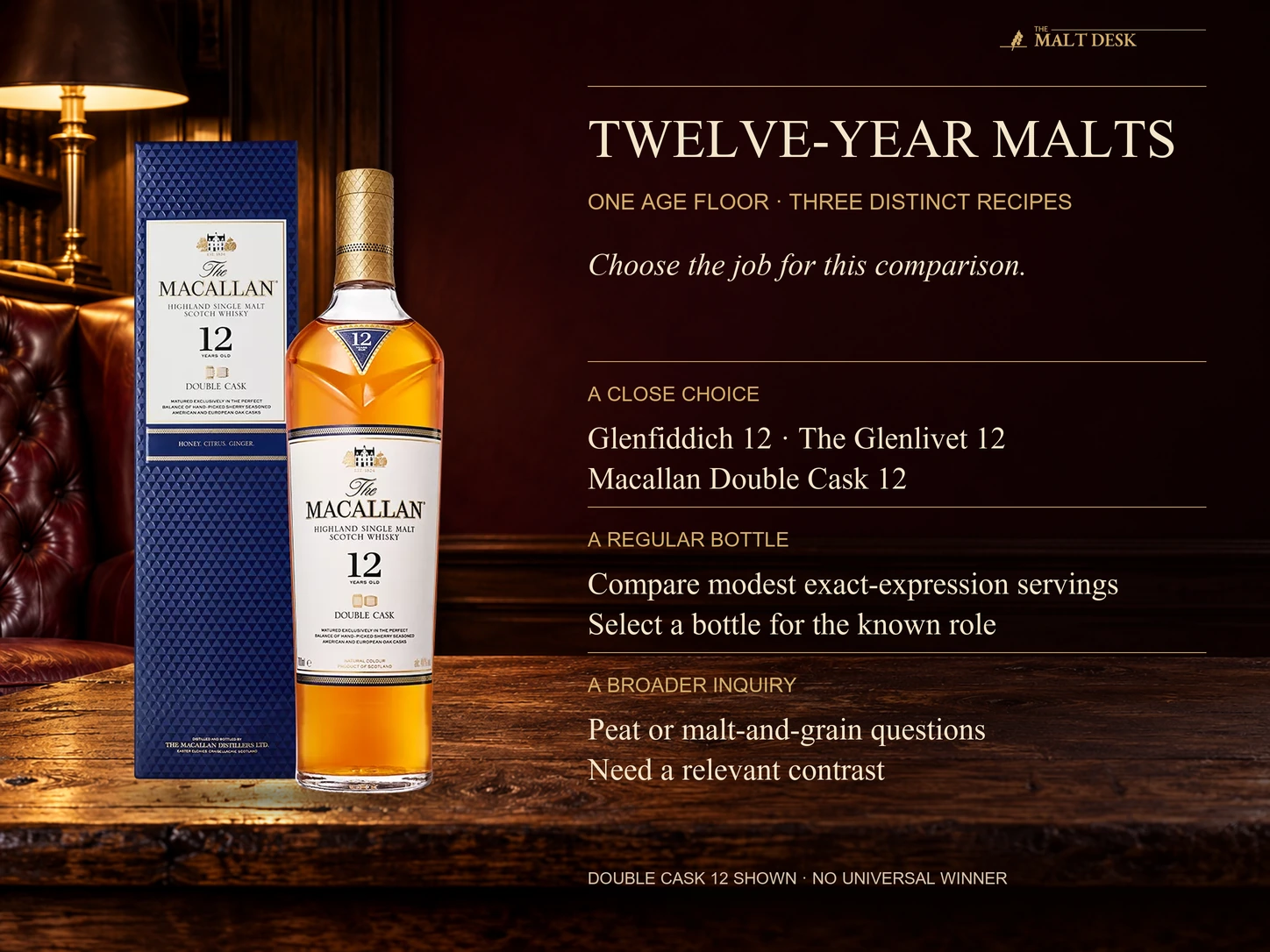
Three 12-Year Single Malts, Different Cask Programs
Glenfiddich 12, The Glenlivet 12 and Macallan Double Cask 12 make a plausible-looking starter set. I would not buy three full bottles of them simply to obtain a broad tour of Scotch. All three are twelve-year Speyside single malts. Their differences are useful for choosing between nearby references, but the set spends three purchases on one shared category and age floor.
That can be exactly the right comparison for someone choosing a regular fruit-and-oak malt. It is a less direct use of the budget for someone wondering whether they prefer peat-led Scotch or a malt-and-grain blend. Before deciding which twelve is best, I would decide whether the task is selecting a favorite within this group or exploring beyond it. The answer changes what is worth acquiring.
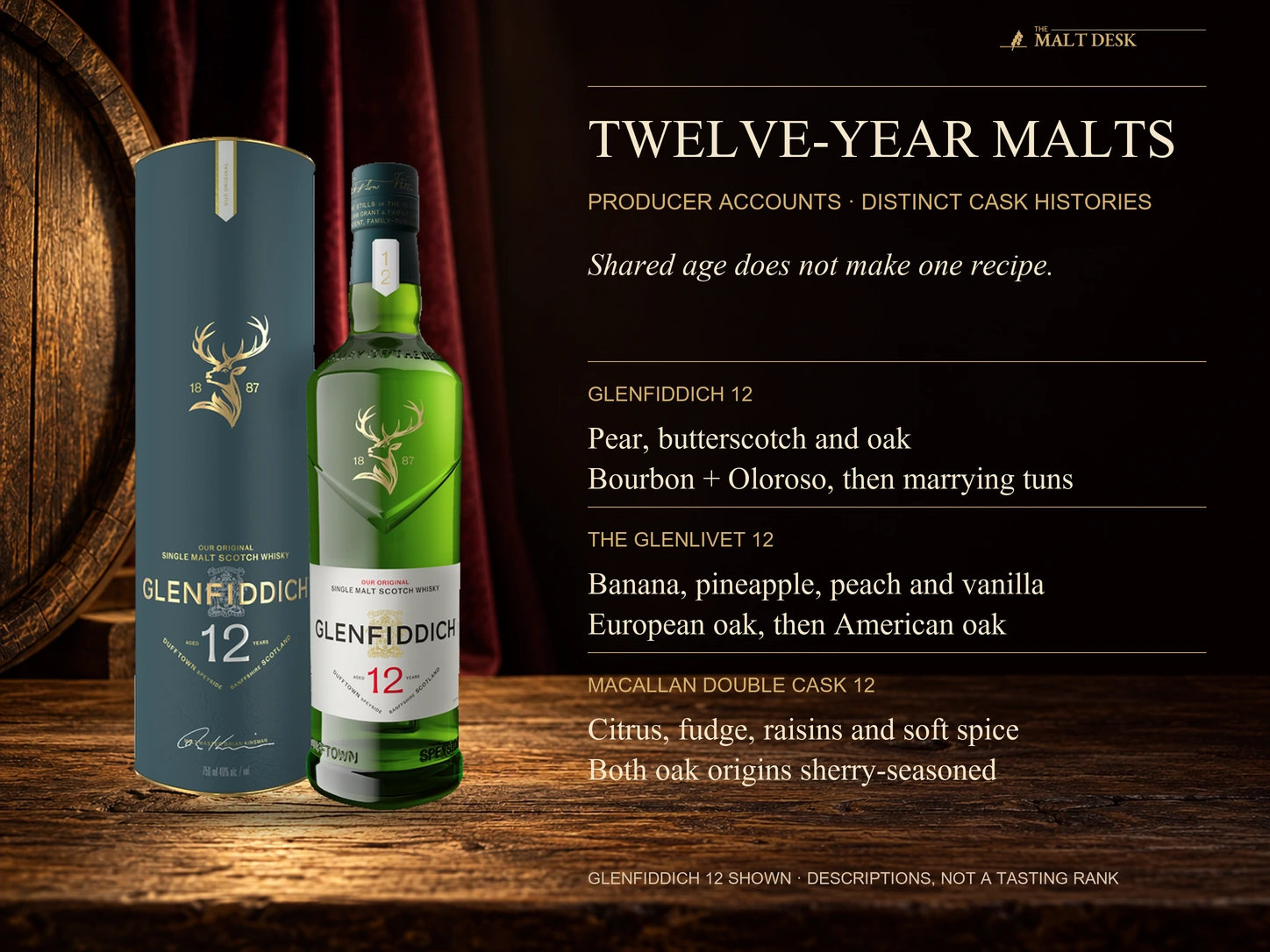
Glenfiddich 12, The Glenlivet 12 and The Macallan Double Cask 12 are single malt Scotch whiskies from Speyside. Their shared age statement makes them a useful comparison, but it does not mean they share a recipe, cask program or sensory profile.
The useful distinction is between what the labels establish and what the producers describe. Each is at least 12 years old; each comes from one distillery. The producers describe different fruit and oak-related aromas. None of those facts establishes a universal winner for smoothness, sweetness or value.
What the Shared Label Terms Mean
Single malt Scotch is made at one Scottish distillery from malted barley and water, with fermentation by yeast and distillation in pot stills. A single malt can combine whisky from many casks. “Single” refers to the distillery, not to one barrel, one production day or one batch.
The 12-year statement refers to the youngest whisky in the bottling. It is not an average. Older whisky may be included without changing that minimum age statement. Keeping a sealed bottle for several more years does not turn a 12-year Scotch into an older age-stated whisky: bottle storage is not cask maturation.
Product Comparison
| Expression | Age statement | Cask description | Producer flavor emphasis |
|---|---|---|---|
| Glenfiddich 12 | 12 years | American bourbon and Spanish sherry oak | Pear, butterscotch and oak |
| The Glenlivet 12 | 12 years | European and American oak | Banana, pineapple, peach, vanilla and toffee |
| Macallan Double Cask 12 | 12 years | Sherry-seasoned American and European oak | Fudge, citrus, raisins and soft spice |
Check the actual ABV and bottle size in your market. Glenfiddich 12 and The Glenlivet 12 are commonly labeled 40%; Macallan Double Cask 12 has market presentations at 40% or 43%. Comparing a 40% bottle with a 43% version introduces a strength difference alongside the production differences.
Glenfiddich 12: Pear and a Bourbon–Sherry Cask Combination
Glenfiddich 12 is associated in the producer’s descriptions with pear, butterscotch and oak. Its maturation description includes American bourbon and Spanish sherry oak. The reference to both cask traditions is useful: this is not a specification for exclusive bourbon-cask maturation.
Pear is an aroma descriptor, not evidence that pears are added. Nor does it mean every reader will identify pear before any other note. Product descriptions offer a vocabulary for the intended style; an individual impression may use different words.
The Glenlivet 12: Fruit and Double-Oak Maturation
The Glenlivet’s official 12-year product page lists European and American oak and 40% ABV. Its aroma description includes banana and pineapple; the palate description includes peach, pear, vanilla and toffee. The producer presents it as a fruity, non-peated single malt.
Read more about the expression in the Glenlivet 12 guide. The term double oak should be read with the producer’s explanation. It is not a universal Scotch category with a fixed cask recipe that every brand must follow.
Macallan Double Cask 12: Two Oak Origins, Both Sherry-Seasoned
The Macallan describes Double Cask 12 as a combination of American and European oak casks seasoned with sherry in Jerez, Spain. American oak in this product does not mean the cask previously held bourbon. Wood origin and previous cask contents are different pieces of information.
Macallan’s current description groups confectionery aromas with candied citrus, vanilla and mild spice. Its palate notes use chocolate-coated raisin, toffee and orange-peel comparisons; the finish is described as medium in length with sweet oak. Macallan also states that its color is natural. These are attributed producer descriptions.
The Macallan Double Cask 12 guide explains the individual expression. “Double Cask” does not imply 12 years in each of two casks or a total age of 24 years.
Oak Origin and Cask History Are Different
A cask description can tell you about the wood, the liquid used to season it, previous fillings, or the sequence of maturation. Those details should not be collapsed into one term. “American oak” names an origin or wood tradition; “ex-bourbon” identifies a previous use; “sherry-seasoned” describes preparation with sherry.
These three products therefore illustrate why two whiskies can both mention American oak without using the same cask program. They also show why a cask label alone cannot quantify sweetness, texture or finish length. Cask condition, maturation time, spirit character and the final combination of casks all matter.
A Close Comparison Has a Different Job from a Broad Introduction
The shared twelve-year minimum and single-malt category put these bottles in a relatively narrow comparison. That is a useful feature when the reader already wants this kind of purchase: three distinct distilleries can compete for the same role. It is not a defect to be repaired by buying an older bottle. The question can simply be which complete expression I want to return to under my usual serving conditions.
Their cask accounts give the comparison substance. Glenfiddich specifies bourbon and Oloroso maturation before marrying tuns. The Glenlivet’s FAQ specifies European oak followed by American oak, without publishing stage durations. Macallan specifies sherry-seasoned American and European oak. In particular, Macallan’s American oak is not the bourbon-cask component disclosed for Glenfiddich. The similar wood language conceals a real difference in previous-content history.
I would use the producer’s pear-and-butterscotch, tropical-and-orchard-fruit, and citrus-and-raisin vocabularies to formulate interests, then record which expression actually serves the intended role. Those descriptions do not let me choose a winner in advance. A preference for Macallan would also not prove that sherry seasoning alone caused it: the distillery and potentially the market strength change with the bottle.
For Greater Breadth, Change the Question Before Adding Another Twelve
Suppose the purpose is discovering whether a peat-led profile is welcome. A second or third bottle from this group is an indirect way to investigate that. The Glenlivet explicitly calls its twelve non-peated; Laphroaig explicitly presents its ten-year malt as peat-led. A small serving of the latter would supply a documented contrast that another fruit-described twelve does not. This concerns two named expressions, rather than a rule that every Speyside or Islay whisky behaves alike.
If the curiosity is about a malt-and-grain Scotch blend, Chivas 12 changes that disclosed category while retaining a twelve-year minimum. That is another kind of breadth. Neither comparison isolates a single cause of flavor, and neither bottle is a compulsory beginner purchase. Their relevance comes from the different question they can answer, not a claim that they are more advanced or universally better.
Choose One Bottle for a Known Role; Use Smaller Comparisons for Unresolved Roles
For choosing a regular bottle within this trio, I would compare modest servings of the exact three expressions before buying the selected one in full. The result can be a personal choice between complete whiskies, which is already useful. Owning all three is unnecessary to that result. If one is already familiar, the first comparison can be just that reference and the alternative whose account raises the most relevant curiosity.
For a broad introduction, I would start with one suitable reference from the trio and direct the next small comparison toward the unresolved category or smoke question. Buying all three first ties more of the budget to a close comparison before establishing whether that is the part of Scotch the reader wants to explore. The ordinary twelve selected at the start can remain the regular bottle while other styles are examined through smaller servings.
There can still be a deliberate reason to own the trio: enjoying each expression for a distinct use, collecting the presentations, or wanting repeated close comparisons. Those are reasons to assess directly. A shared twelve-year number is not one. Price comparisons should follow the chosen task and use actual equivalent-volume totals; a cheaper offer does not make an irrelevant third bottle informative.
Comparing Texture and Alcohol Warmth
People may use the word to mean less perceived alcohol heat, less astringency, a softer texture or simply a familiar flavor. Those are different observations.
At equal volumes, 43% whisky contains 7.5% more alcohol than 40% whisky: 30 ml contains 12.9 ml rather than 12 ml of pure alcohol. That arithmetic does not establish which whisky feels smoother. Serving temperature, added water and individual perception affect the experience.
The same caution applies to “sweetest.” Vanilla, toffee and fruit are sensory descriptors.
How to Make a Useful Comparison
Start with the exact expression name, bottle size and strength. “Macallan 12” is incomplete if the comparison depends on Double Cask versus Sherry Oak. A gift pack, travel presentation or different market bottle may also change the volume or packaging without changing the age statement.
For sensory observation, keep the glass shape, small measured pour and serving temperature consistent. Record an initial aroma before adding water. For a water comparison, record the starting ABV and calculate each measured addition for the concentration you want to compare.
Separate observations into aroma, palate, texture and finish. A whisky may have a noticeable aroma yet a relatively gentle palate. Avoid turning one preferred characteristic into a claim that the entire bottle is objectively superior.
Reading Price Differences Carefully
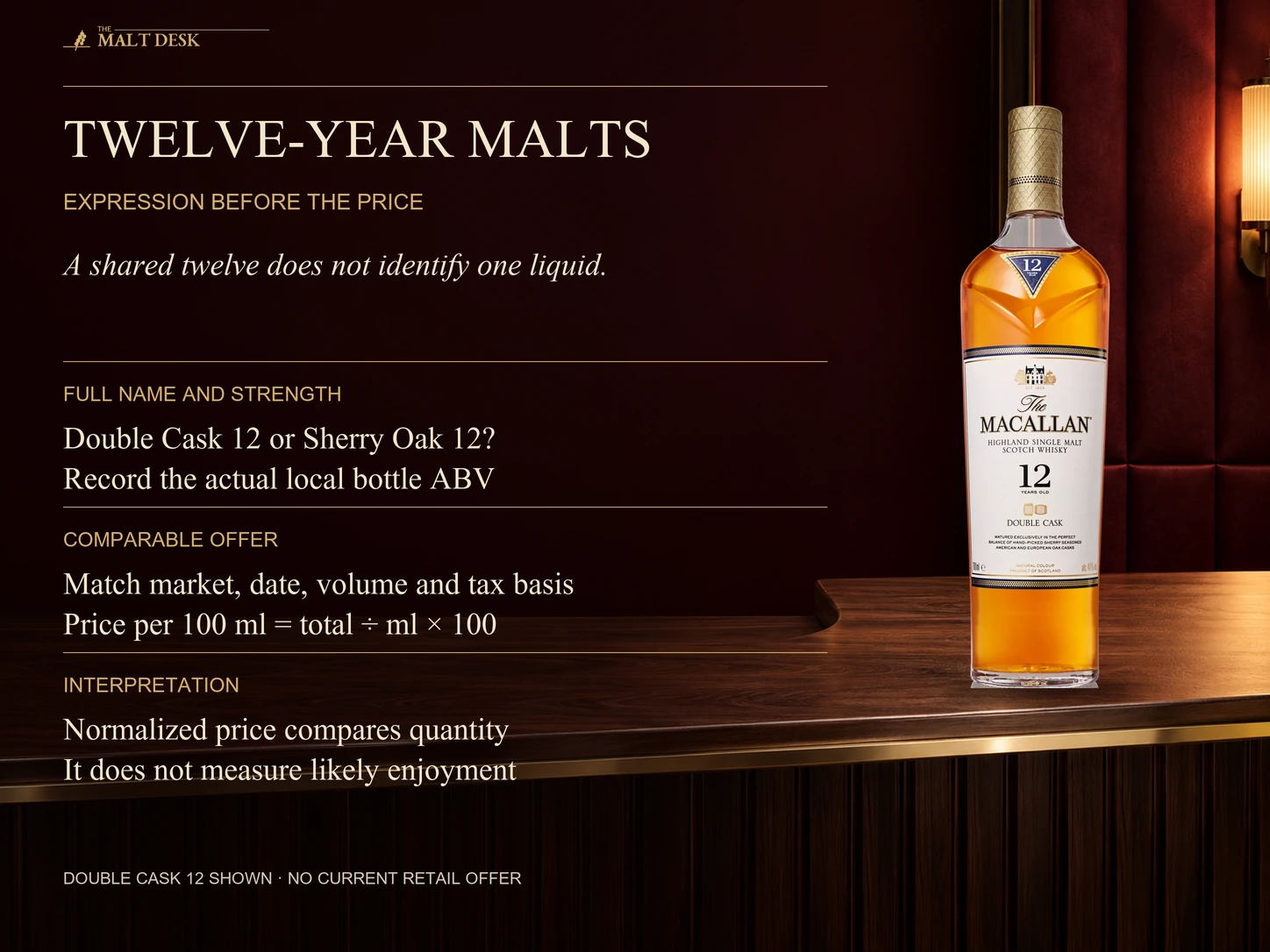
A price comparison needs the same market, date, bottle volume and tax basis. A promotional price for a 700 ml bottle cannot be compared directly with a regular price for 750 ml without adjustment. Dividing the price by the volume and multiplying by 100 gives a price per 100 ml.
Packaging, distribution, brand positioning and local availability affect the amount charged. The factual cask and label differences above are more durable than a fixed “buy below this price” rule.
In Brief
These three 12-year single malts share a minimum age threshold, while their cask programs and producer-described profiles differ. Use the label and cask details to compare them.
Use the Three Malts for a Close Choice
Use this trio to choose among nearby twelve-year Speyside references: Glenfiddich’s pear-led notes, The Glenlivet’s explicitly non-peated fruit profile, and Macallan Double Cask’s two sherry-seasoned oak origins. For a broad introduction to Scotch, choose one relevant member first, then explore a different production category or peat direction. Match the size of the comparison to the breadth you want to learn.
Common Questions
Are all three single malts?
Yes. Each is a single malt Scotch from its own distillery. Combining casks within that distillery’s production does not make it a blended Scotch.
Does the shared age mean equal maturation?
It establishes the same minimum age, not the same maturation conditions or cask history. Different wood and cask programs can produce different styles over that period.
Is Double Cask the same as double distilled?
No. Double Cask is a maturation range name. Distillation count describes a separate production stage.
Which has the most relevant profile for a particular preference?
Use the producer descriptions as starting points: pear and butterscotch for Glenfiddich, tropical and orchard fruit with vanilla for The Glenlivet, or citrus, toffee and sherry-seasoned oak for Macallan Double Cask. These are style descriptions.
Sources
Official Glenfiddich 12, The Glenlivet 12 and Macallan Double Cask 12 product information; Scotch Whisky Association guidance on age statements and categories. Macallan’s current Double Cask description was rechecked October 4, 2026. Reference strengths remain market-specific; compare the printed labels.
Comparison research rechecked October 7, 2026: the three producers’ twelve-year accounts; The Glenlivet’s expression-specific non-peated FAQ; Laphroaig’s ten-year peat-led account; Chivas Regal’s malt-and-grain account. The distinction between a close bottle selection and a broader exploration is The Malt Desk’s editorial analysis.