Whiskey Highballs: Mixer, Ratio and Strength
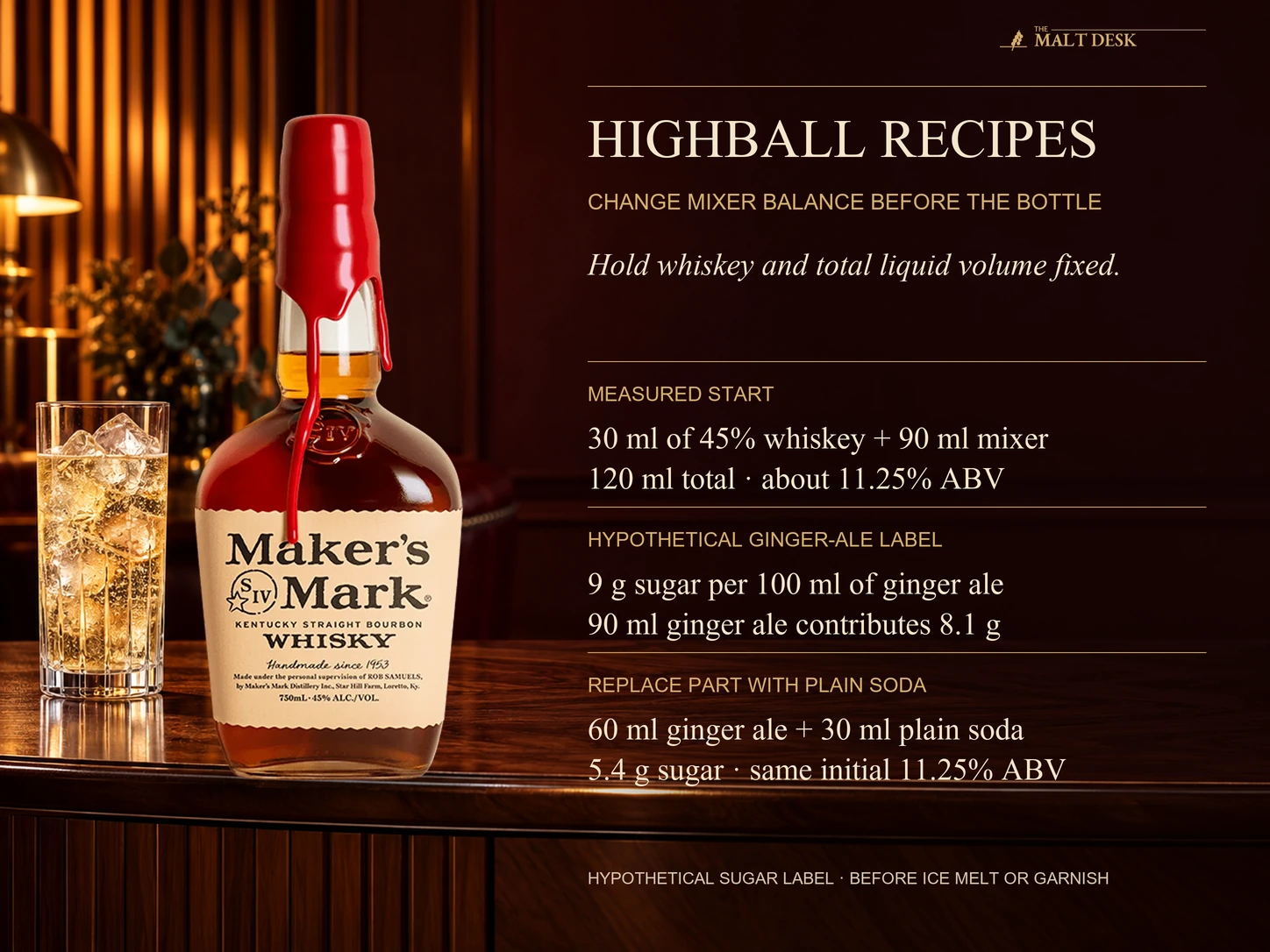
A sweeter-than-wanted highball does not necessarily need a different whiskey. Replacing part of a sweetened mixer with plain soda can reduce the sugar contributed by that mixer while preserving the whiskey measure and total liquid volume. That gives a specific recipe adjustment to try before paying for another bottle.
I would quantify that adjustment from the actual mixer’s nutrition label. The result is a recipe whose sugar input has changed deliberately, rather than a claim that a higher-proof whiskey will somehow cancel sweetness. Perceived sweetness remains a separate observation.
A whiskey highball combines whiskey with a longer measure of mixer, usually carbonated, over ice. The choice of soda water, ginger ale or cola changes the drink substantially: soda adds no sweetness, while the other two introduce their own sugar, acidity and flavor. There is no single bottle that fits every version.
This guide compares seven familiar bottles by category and labeled strength, then explains how to calculate dilution and build a consistent recipe. Bottling strengths can differ by market, so use the percentage on your bottle for any calculation.
Seven Bottles at a Glance
| Bottle | Category | Common labeled ABV | Useful distinction |
|---|---|---|---|
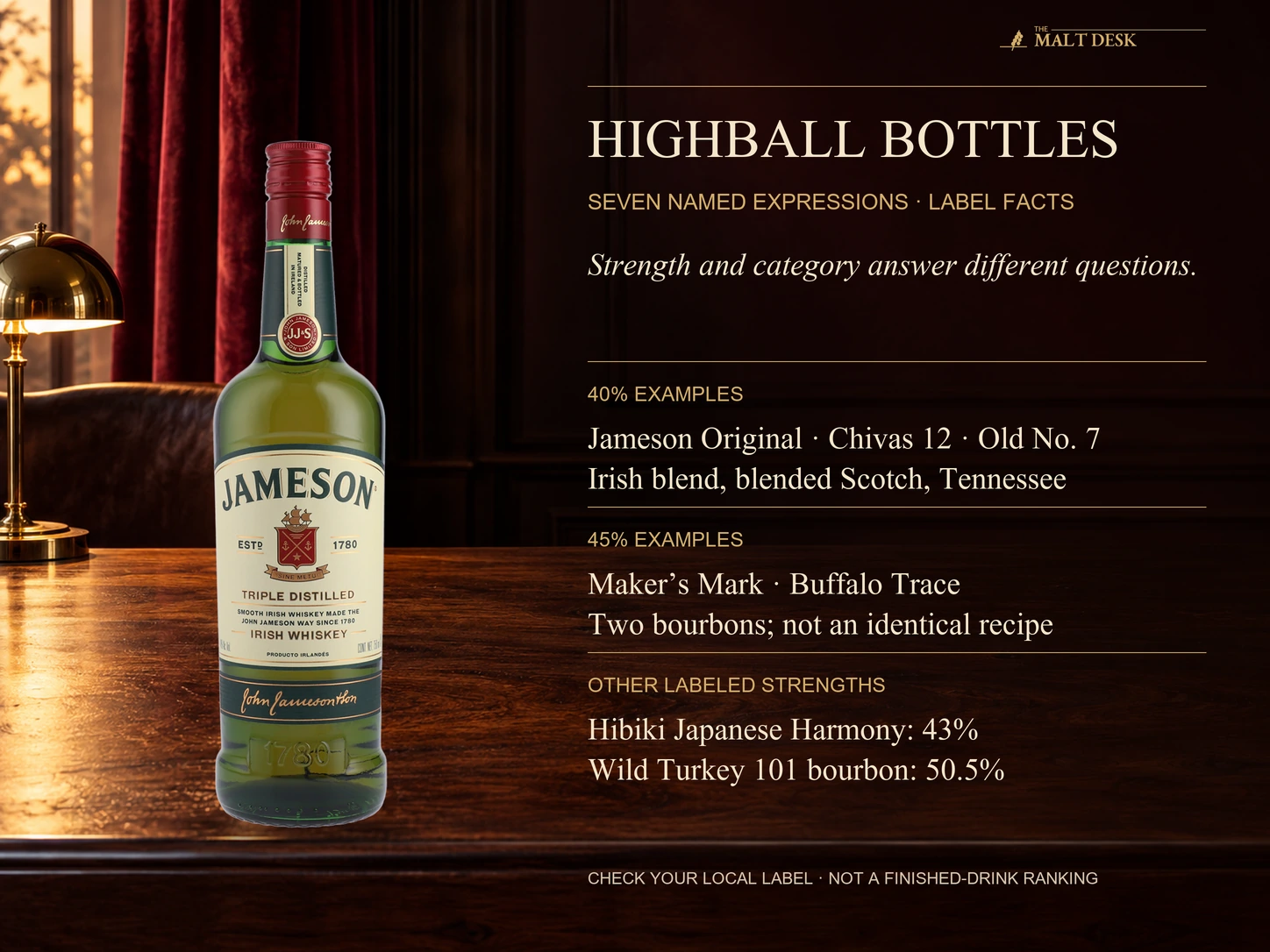
| Jameson Original | Blended Irish whiskey | 40% | Pot still and grain whiskey blend |
| Chivas Regal 12 | Blended Scotch | 40% | 12-year minimum age |
| Jack Daniel’s Old No. 7 | Tennessee whiskey | 40% | Maple-charcoal mellowing before maturation |
| Maker’s Mark | Bourbon | 45% | Wheat in the grain recipe |
| Buffalo Trace | Bourbon | 45% | Same strength as standard Maker’s Mark |
| Wild Turkey 101 | Bourbon | 50.5% | Highest labeled strength in this table |
| Hibiki Japanese Harmony | Blended Japanese whisky | 43% | Malt and grain whisky blend without an age statement |
These are production and label differences. Mixer concentration, temperature, garnish and personal perception all contribute.
How the Mixer Changes the Drink
Soda water
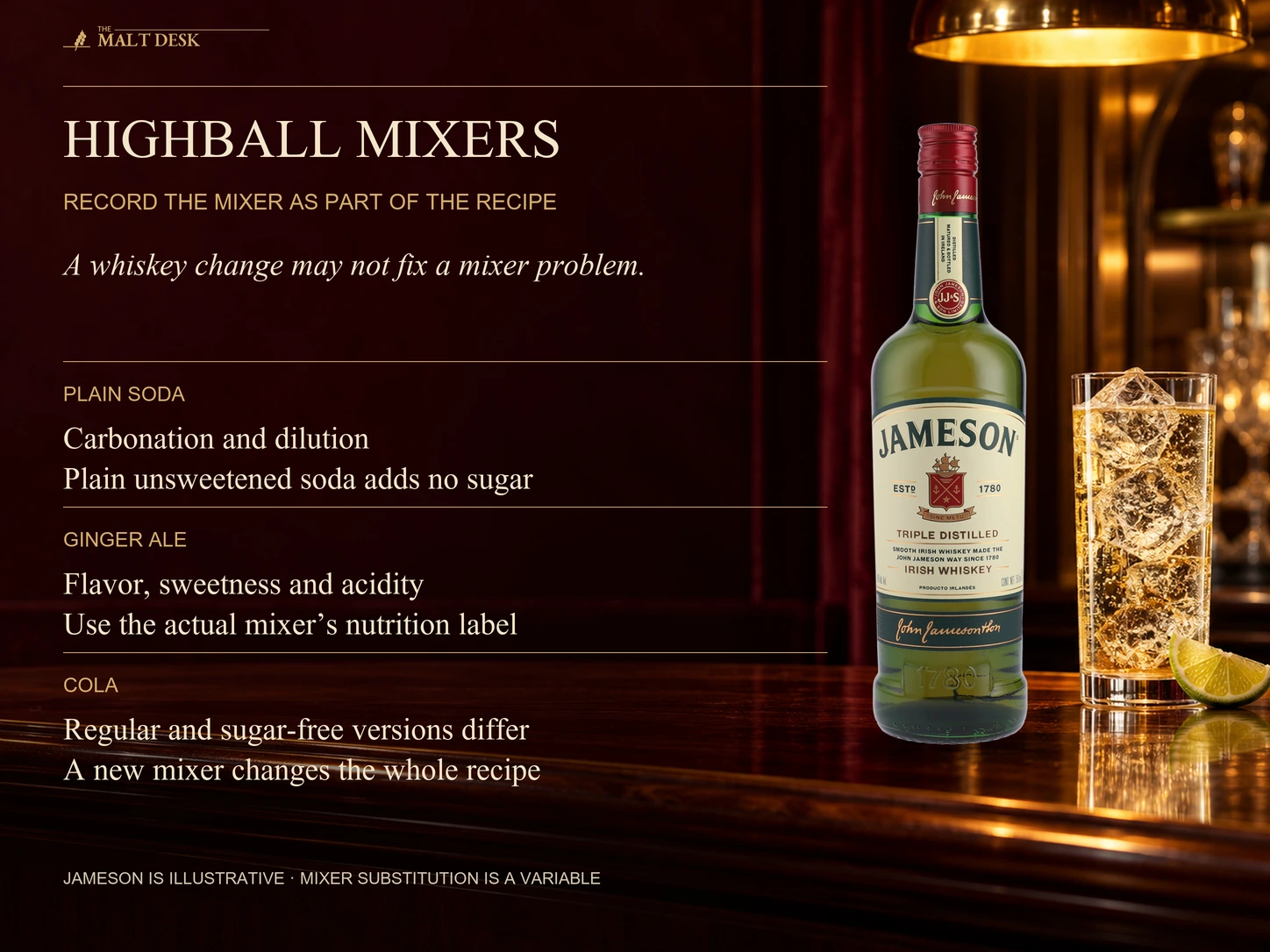
Plain soda water adds carbonation and dilution without the sugar and flavorings of cola or ginger ale. It is useful when the aim is to compare the whiskey component while keeping other ingredients simple. Club soda, seltzer and mineral sparkling water may taste different because their mineral content varies; use the same mixer when comparing recipes.
Ginger ale
Ginger ale adds ginger flavor, sweetness and acidity. Jameson’s published Ginger and Lime recipe uses one part whiskey to three parts ginger ale, with lime. This is a producer recipe, not evidence that Jameson outperforms every other whiskey with ginger. Ginger beer can be more strongly flavored, but intensity and sweetness vary by brand.
Cola
Cola contributes a substantial flavor of its own. The familiar Jack Daniel’s and cola combination is one example of this style. Switching from regular cola to a sugar-free version changes the sweetener as well as the sugar content, so the result is a different recipe even at the same volume ratio.
Understanding the Whiskey Component
Jameson Original combines pot still and grain whiskey. Chivas 12 combines malt and grain Scotch. Their common 40% bottling strength means equal measures contribute equal volumes of alcohol before any mixer is added; their production styles remain different.
Maker’s Mark uses wheat in its bourbon recipe. Buffalo Trace is another 45% bourbon, but the shared strength does not imply an identical grain recipe or aroma. Maker’s Mark describes vanilla and fruit in its product notes; Buffalo Trace describes vanilla, mint and molasses. Those are producer flavor descriptions.
Wild Turkey 101 contains more alcohol per equal-sized pour than the other bottles listed here. That is a measurable difference; the claim that it is automatically more resistant to a particular mixer would require a controlled sensory comparison.
Suntory describes floral notes, honey and candied orange in Hibiki Japanese Harmony. These descriptions can help identify the producer’s intended profile.
A Measured Starting Recipe
For one highball, measure 30 ml whiskey and 90 ml chilled mixer into a tall glass containing ice. This gives a 1:3 ratio. Stir gently just enough to combine, then add an optional citrus peel or a small wedge. Use a glass large enough for the ice and liquid without overflowing.
The same ratio can be scaled, but a larger serving contains more alcohol. Measuring a smaller pour and topping it with more mixer is different from simply increasing both ingredients. A recipe ratio describes proportions, not a recommended amount to drink.
Chill the mixer before opening and use fresh carbonation. Ice amount, cube size, starting temperature and time in the glass all affect meltwater. For consistency, keep these variables similar between preparations. Avoid treating a fixed number of spoon turns or one ice shape as a universal requirement.
Calculate Approximate Finished ABV
Before ice melt, approximate ABV equals whiskey volume multiplied by its ABV, divided by the total liquid volume. This assumes the mixer contains no alcohol and treats the volumes as additive.
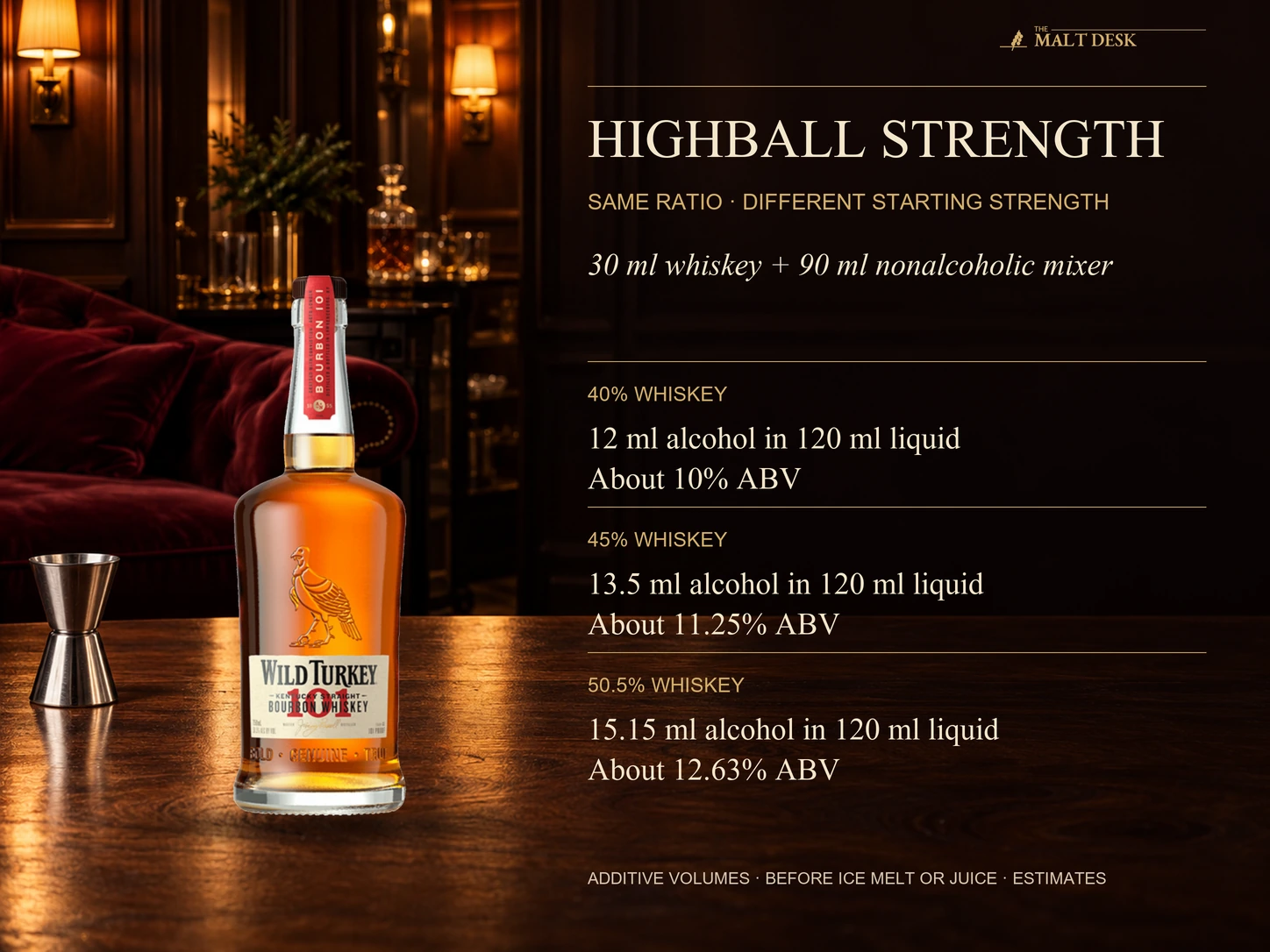
With 30 ml of 40% whiskey and 90 ml mixer, the calculation is 30 × 0.40 ÷ 120 = 0.10, or about 10% ABV. The same recipe using 45% whiskey is about 11.25%; using 50.5% whiskey is about 12.63%.
Adding 120 ml mixer to 30 ml of 50.5% whiskey gives a 1:4 ratio and about 10.1% ABV before ice melt. The whiskey still contributes 15.15 ml of pure alcohol. More mixer reduces the concentration but does not remove alcohol from the glass.
Actual strength becomes lower as ice melts, and a substantial juice addition also changes the calculation. These are recipe estimates. Carbonation and sweetness should not be used to judge how much alcohol a drink contains.
Change Sugar Input While Keeping the Alcohol Calculation Fixed
Start with an illustrative 30 ml measure of 45% whiskey plus 90 ml mixer. Before ice melt or garnish, this contains 13.5 ml alcohol in 120 ml liquid, approximately 11.25% ABV. Suppose the ginger ale’s label states 9 g sugar per 100 ml. This sugar figure is hypothetical; use the label of the product actually being poured.
| Mixer within the fixed 90 ml | Sugar from hypothetical ginger ale | Approximate drink ABV before melt |
|---|---|---|
| 90 ml ginger ale | 8.1 g | 11.25% |
| 60 ml ginger ale + 30 ml plain soda | 5.4 g | 11.25% |
| 30 ml ginger ale + 60 ml plain soda | 2.7 g | 11.25% |
| 90 ml plain soda | 0 g from these mixers | 11.25% |
The intermediate mixtures retain some ginger-ale flavor while reducing its contribution. The calculation does not promise that perceived sweetness falls by exactly one-third or two-thirds: acidity, flavor and individual perception still matter. The example tracks the changed ginger-ale contribution while holding the whiskey measure and total liquid volume fixed.
Replacing ginger ale with a sugar-free flavored mixer answers a different question. A zero-sugar flavored mixer may still contain sweeteners. Use plain unsweetened soda for the specific ginger-ale replacement described here. For the adjustment in this example, use genuinely plain, unsweetened soda and keep the same ginger ale in the portion retained. Keep any citrus addition consistent as well.
Ice introduces uncertainty that the mixer substitution need not create. The table holds only the initial liquid ingredients fixed; it does not assume identical melt or retained carbonation in every glass. Use similar chilled ingredients, ice and elapsed time when assessing the preparations. If the less-sugared version works better, the conclusion is that this mixer balance works better in the recorded recipe, not that the whiskey has become intrinsically drier.
Adjust One Variable at a Time
If the drink is too sweet, replace some of the sweetened mixer with plain soda rather than adding more whiskey. If the garnish dominates, reduce or omit it. If the drink loses carbonation quickly, start with a colder, freshly opened mixer and avoid unnecessary agitation.
To compare soda and ginger ale, keep the whiskey measure, glass and ice similar. To compare whiskeys, keep the mixer and ratio fixed. Changing the bottle, mixer, ratio and garnish together makes it difficult to identify the cause of a difference.
In Brief
A highball reflects the whiskey, mixer, ratio, temperature and dilution together. When comparing bottles, keep the recipe and serving conditions consistent so each difference is easier to identify.
Adjust the Mixer Before Replacing the Whiskey
If a highball is sweeter than wanted, keep the whiskey measure fixed and replace part of the sweetened mixer with plain unsweetened soda. The worked 60 ml ginger ale plus 30 ml soda variation retains the original 90 ml mixer total. Once that balance works, compare another whiskey in the same recipe so the next choice addresses the whiskey component.
Common Questions
Does a higher-proof bottle make a better highball?
It raises the alcohol concentration at a fixed ratio.
Must an expensive whisky be served neat?
No. Serving style is a preference. Its age statement, blend type and strength remain factual characteristics whether the whisky is served neat or mixed.
Is ginger ale interchangeable with ginger beer?
They can be substituted as a recipe variation, but their sweetness, acidity and ginger intensity may differ. Check whether the specific mixer contains alcohol before applying the calculations above.
Which citrus garnish is required?
None is required. Lime adds acidity when squeezed; a peel mainly contributes aromatic oils with little juice. Treat lemon, lime and orange as recipe choices rather than mandatory matches to particular brands.
Recipe reference: Jameson’s Irish-site Ginger and Lime recipe, checked October 5, 2026, provides a 30 ml plus 90 ml reference. The 45% whiskey and 9 g-per-100-ml sugar figure in the adjustment example are explicit illustrations. ABV estimates assume non-alcoholic mixers, additive volumes and no meltwater or juice.
Sources
Producer product information for Jameson Original, Chivas Regal 12, Jack Daniel's Old No. 7, Maker's Mark, Buffalo Trace, Wild Turkey 101 and Hibiki Japanese Harmony. Labeled strengths can vary by market. Recipe and finished-strength calculations use explicitly stated illustrative inputs and additive-volume assumptions.