Whiskey Gifts: Understand the Bottle Before the Brand
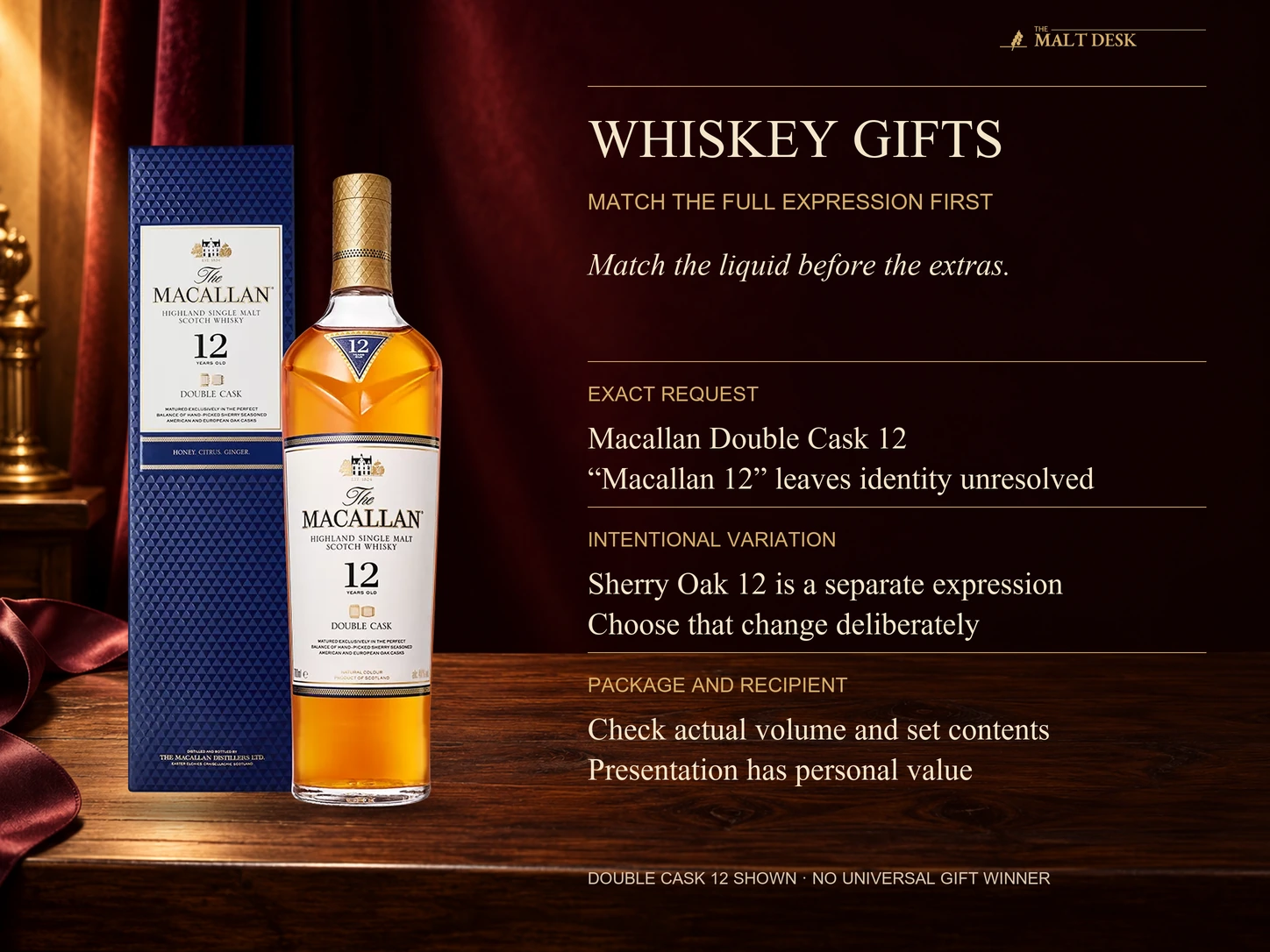
A whiskey gift can miss an exact request even when the brand, age number and gift box all look right. If a recipient has named Macallan Double Cask 12, a box labeled only Macallan 12 leaves the expression unresolved. I would settle that identity before deciding whether a more elaborate set adds anything useful.
The same discipline makes gift-set pricing clearer. The bottle inside, its volume and the extra objects each have their own job. A higher set total can buy less whisky plus an attractive presentation, and that can be a reasonable choice if the giver knows which part of the package is being valued.
Whiskey gift guides often rank bottles by prestige or assume that an expensive label suits everyone. A more useful starting point is whether the recipient welcomes an alcohol gift, which styles they already know, and what the label actually tells you.
The five examples below explain category, age-label and cask differences. The illustration highlights expression names, age labels and package contents. It does not assign a gift winner or a current price.
Five Familiar Labels Explained
| Expression | Category | Age label | Distinction to understand |
|---|---|---|---|
| Chivas Regal 12 | Blended Scotch | 12 years | Combines malt and grain Scotch |
| Glenfiddich 12 | Single malt Scotch | 12 years | Malt whisky from one distillery |
| Macallan Double Cask 12 | Single malt Scotch | 12 years | Sherry-seasoned American and European oak |
| Hibiki Japanese Harmony | Blended Japanese whisky | No age statement | Separate expression from age-stated Hibiki releases |
| Johnnie Walker Blue Label | Blended Scotch | No age statement | Different blend from the age-stated Black Label |
Start With the Recipient’s Existing Preferences
A useful question is “Which bottle or style do you already enjoy?” This supplies more information than assuming a preference from age, profession or the occasion. A person interested in smoky Islay whisky may have different expectations from someone who prefers an unpeated malt or a whiskey-and-soda recipe.
Ask about smoke, bottling strength and serving style separately. Someone may enjoy smoky aromas at a moderate strength, or a higher-strength bourbon without peat smoke. These characteristics are not steps on a single beginner-to-expert ladder.
If the person does not drink or would rather receive something else, whiskey is not an appropriate default. Nor should a gift imply that it must be opened or consumed at the event.
Chivas Regal 12: An Age-Stated Blend
Chivas Regal 12 is blended Scotch: malt and grain whiskies are combined. The age statement establishes that the youngest whisky is at least 12 years old. It does not mean the blend is made at one distillery.
Chivas describes honey, orchard fruit, vanilla and nutty notes in its product information. These are the producer’s sensory descriptions, not a promise that a recipient will find the whisky gentle or identify each aroma. The number 12 is a factual age statement; words such as smooth are subjective descriptions.
Glenfiddich 12: A Single-Distillery Example
Glenfiddich 12 illustrates the single malt category. “Single” refers to one distillery, while the bottling can contain whisky from many casks. It is not a single-barrel claim.
Its producer descriptions emphasize pear, butterscotch and oak. A single malt is not automatically more educational, complex or preferable than a blend; it provides a different way to identify the origin of the whisky. The recipient’s interest in a particular distillery may matter more than the category alone.
Macallan Double Cask 12: Specify the Full Expression
Macallan Double Cask 12 uses sherry-seasoned American and European oak. It is a separate expression from Macallan Sherry Oak 12. Simply writing “Macallan 12” leaves out a distinction that affects the cask program.
The producer describes citrus, fudge, toffee, raisins and gentle spice. The American oak component does not imply an ex-bourbon cask: wood origin and previous cask contents are separate details. Double Cask also does not mean 12 years in each of two casks.
Hibiki Japanese Harmony: No Age Statement
Hibiki Japanese Harmony is a malt-and-grain blend bottled at 43% ABV. It carries no age statement and should not be confused with Hibiki releases that display a number of years.
Suntory’s descriptions include floral aromas, honey and candied orange. The distinctive bottle design is part of its presentation, but neither design nor price reveals the age of the youngest component. An absent age statement should remain unknown rather than being filled in with an estimate.
Johnnie Walker Blue Label: A Blend Without a Declared Age
Johnnie Walker Blue Label is blended Scotch without an age statement. Its position in a brand’s range does not turn its color name into a maturation specification.
A recipient who knows Black Label should not assume Blue Label is simply the same blend with more years of aging. Product names identify different expressions, and their appeal remains a matter of preference. Claims that a label is the safest business gift or guarantees an impressive reaction are not verifiable product characteristics.
Match the Requested Liquid Before Valuing the Gift Set
Double Cask 12 and Sherry Oak 12 share a brand and age statement but have separate producer accounts. Double Cask specifies sherry-seasoned American and European oak; the current Sherry Oak account describes a predominantly European-oak direction. That distinction is enough to make an abbreviated Macallan 12 order incomplete. It does not require claiming Sherry Oak uses only one wood origin or that one expression is a better gift.
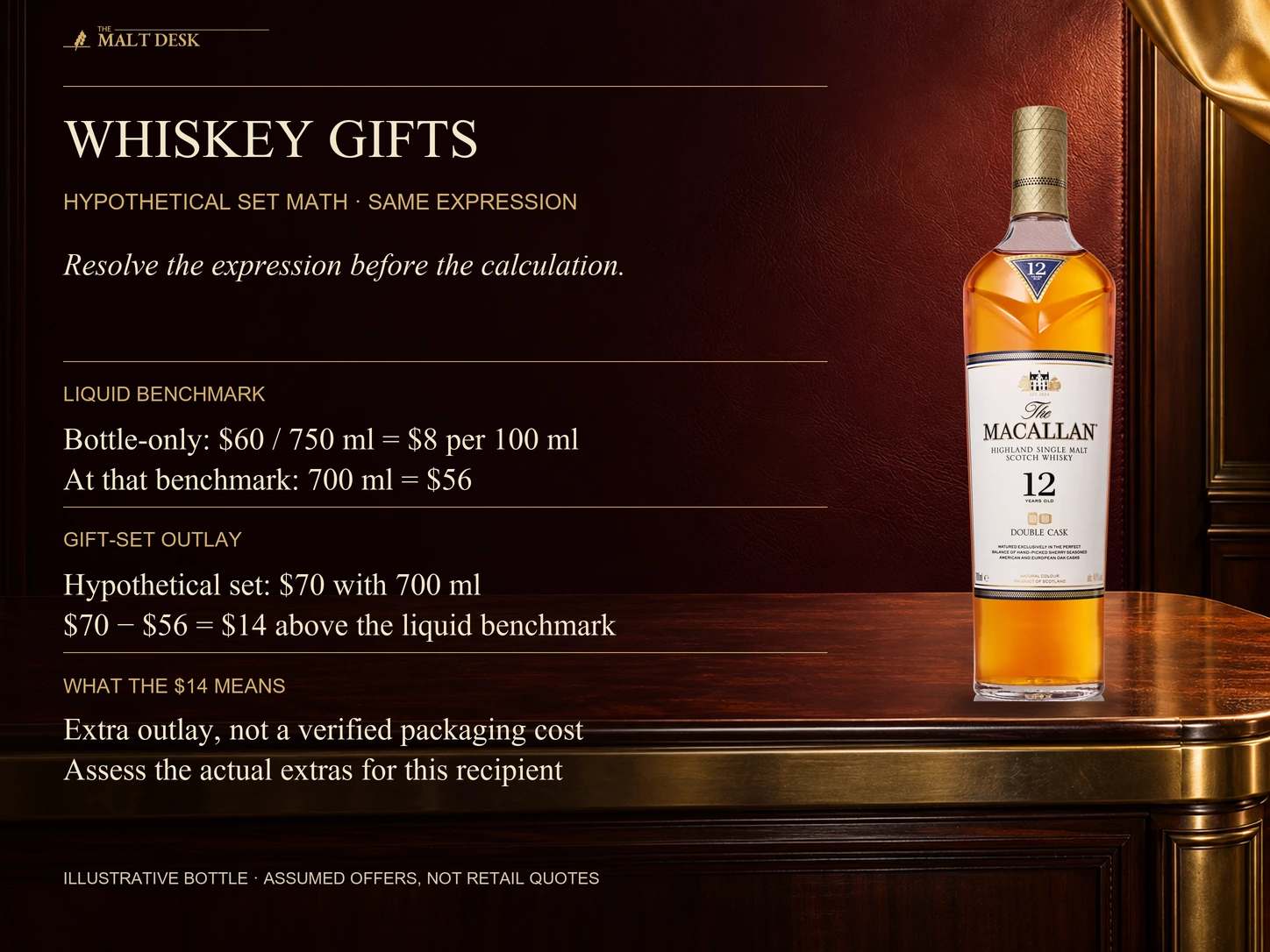
If the requested expression is confirmed, normalize the liquid quantity before considering the extras. Imagine a hypothetical bottle-only offer at $60 for 750 ml and a gift set at $70 containing 700 ml of the same expression. The bottle-only liquid benchmark is $8 per 100 ml, so 700 ml at that benchmark corresponds to $56. The set’s total is $14 above that equivalent-liquid amount.
The $14 is not a verified manufacturing cost for the glasses or box. It is the extra outlay above the chosen liquid benchmark, and it may include different retail terms as well as presentation. But it gives the giver a concrete question: are this set’s actual contents worth that extra amount to this recipient? A person who already owns suitable glasses may value the set differently from someone specifically wanting its design.
If the expressions do not match, stop the quantity calculation. A Sherry Oak set cannot be treated as an exact Double Cask offer with free extras; it proposes a different whisky as well. The choice then requires a reason to change the expression, not just a unit-price adjustment. Asking for the full bottle name or a clear label photograph resolves more than comparing the sizes of the outer boxes.
I would preserve that distinction in the gift note too. For an exact request, identify the expression that was matched. For an intentional variation, say what production difference prompted it without promising the recipient will prefer it. The note can explain the thought behind the gift while leaving its opening date and serving style to the recipient.
Check the Exact Bottle and Package
Read the full expression name, ABV and volume on the bottle. Common formats include 700 ml, 750 ml and 1 liter; similar photographs can conceal a different size. A gift set may include glassware or other packaging, so its total price is not directly comparable with a bottle-only presentation.
A box or tube is packaging, not proof of authenticity. A clean seal and legible labeling are useful condition checks, but visual inspection alone cannot authenticate a bottle. Packaging can also change across markets and releases without establishing that the whisky itself has changed.
If keeping a bottle before the occasion, store it upright, away from strong light and excessive heat. A whisky bottle does not benefit from being laid on its side like some wine bottles. Keep its label and any outer packaging dry.
Compare the Complete Gift Cost
Compare like-for-like volume, tax treatment and package contents. To calculate price per 100 ml, divide the total bottle price by its volume in milliliters and multiply by 100.
For example, a hypothetical $60 bottle containing 750 ml costs $8 per 100 ml, while a $60 bottle containing 700 ml costs about $8.57 per 100 ml. These are arithmetic examples, not current market prices or purchase recommendations.
A higher price can reflect distribution, packaging, brand positioning or local availability. It should not be used to infer that a bottle contains twice the age, flavor or quality of a lower-priced expression.
A Useful Note to Include
A short note can explain the selection without dictating how the recipient should drink it: identify the full expression and one relevant production detail, such as single malt, a 12-year minimum age or a sherry-seasoned cask program. Avoid presenting flavor notes as ingredients or promising a particular reaction.
Serving neat, with water, over ice or in a mixed drink is a choice for the recipient.
In Brief
A useful whiskey gift starts with the recipient’s known preferences, then checks the exact expression, package and budget. Age and category describe the bottle; they do not make one gift universally best.
Choose the Exact Gift Before the Gift Set
Start with the recipient’s named expression or a clearly stated style preference. Match the full product name, age and relevant cask description, then compare the box, accessories and total cost. When the recipient is collecting rather than drinking, make that purpose explicit. This keeps the gift’s presentation connected to what the recipient actually wants to receive.
Common Questions
Does an age statement make a better gift?
It provides a clear maturation fact. It does not establish that an age-stated whisky will be preferred to one without an age statement.
Is single malt always preferable to blended Scotch?
No. The terms describe production categories. A known preference for a blend is more relevant than an assumed hierarchy between the categories.
Can a price guide identify one universally safe gift?
No. Price does not reveal whether the person wants alcohol, likes that style or has any interest in the brand. Ask about preferences before relying on a ranked list.
Additional gift-identity references: The Macallan’s Double Cask 12 and current Sherry Oak 12 product descriptions, checked October 5, 2026. Gift-set prices and sizes used in the comparison are hypothetical; the equivalent-liquid benchmark does not identify packaging production costs.
Sources
Producer product information for Chivas Regal 12, Glenfiddich 12, The Macallan Double Cask 12, Hibiki Japanese Harmony and Johnnie Walker Blue Label, together with Scotch Whisky Association guidance on categories and age statements. Price calculations use explicitly stated hypothetical inputs.