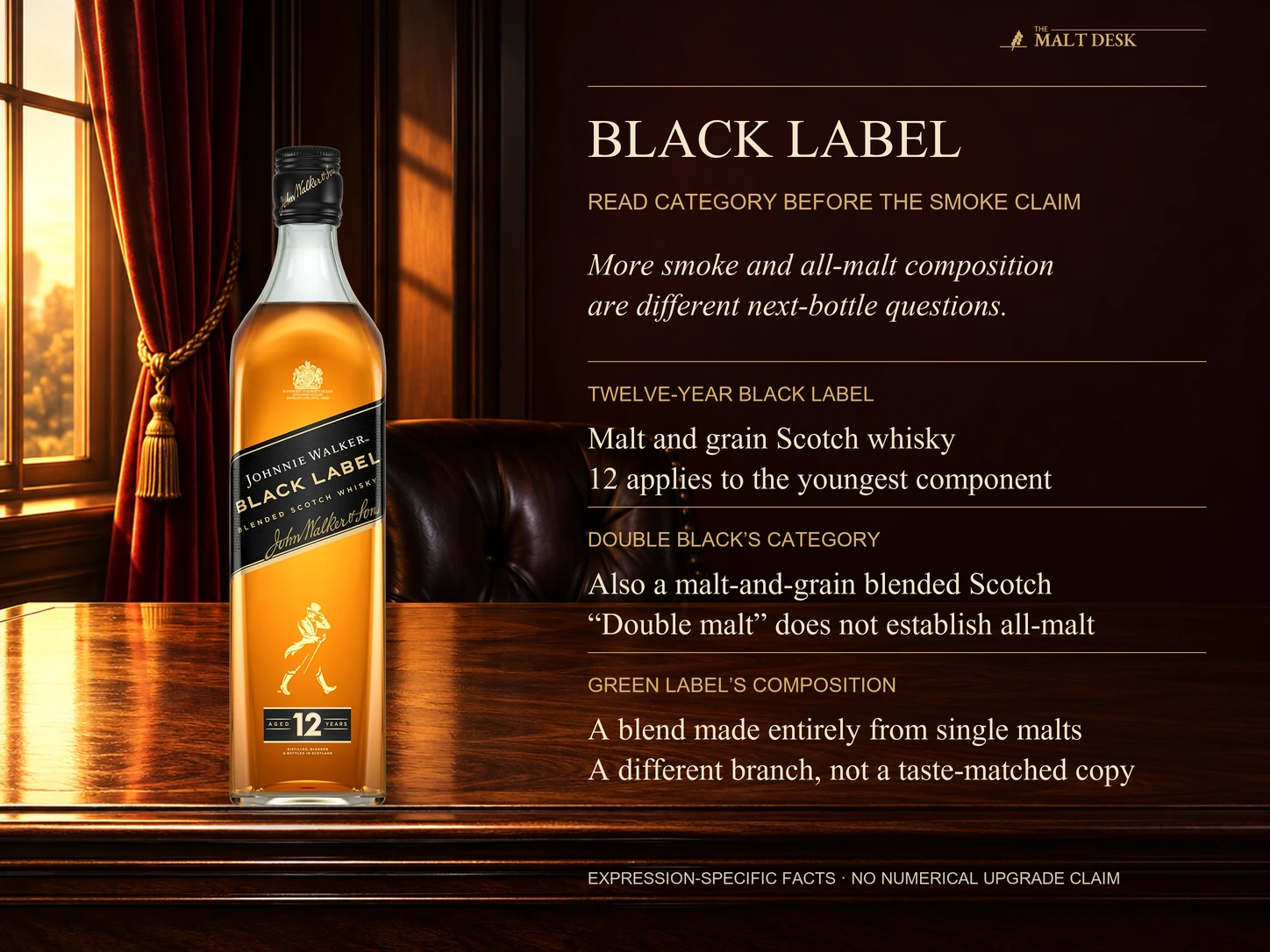
Johnnie Walker’s U.S. Double Black page contains an ambiguity worth resolving before buying: its promotional copy uses the words double malt, while its explicit product designation says Blended Scotch Whisky. Those phrases are not interchangeable category names. Under the Scotch category definition, the latter identifies a combination of malt and grain Scotch. The casual malt wording therefore cannot establish a grain-free alternative to Black Label.
That gives a Black Label reader two different next-bottle questions. More smoke within a malt-and-grain blend points toward Double Black’s disclosed direction. Removing grain from the composition points toward a genuinely blended-malt expression, such as Green Label. I would separate those aims before treating either bottle as a stronger version of Black Label. The precise category answers the composition question even when the full proprietary recipe remains undisclosed.
Johnnie Walker Black Label is a 12-year-old blended Scotch whisky bottled at a standard 40% ABV. It combines malt and grain Scotch whiskies, with the age statement applying to the youngest component. The producer describes its profile through fruit, vanilla, spice and smoke.
Black Label illustrates how a blend can have a defined age and a recognizable flavor description without being a single-distillery expression. Understanding the category, age statement and exact label is more useful than treating it as a lower grade of single malt.
Black Label at a Glance
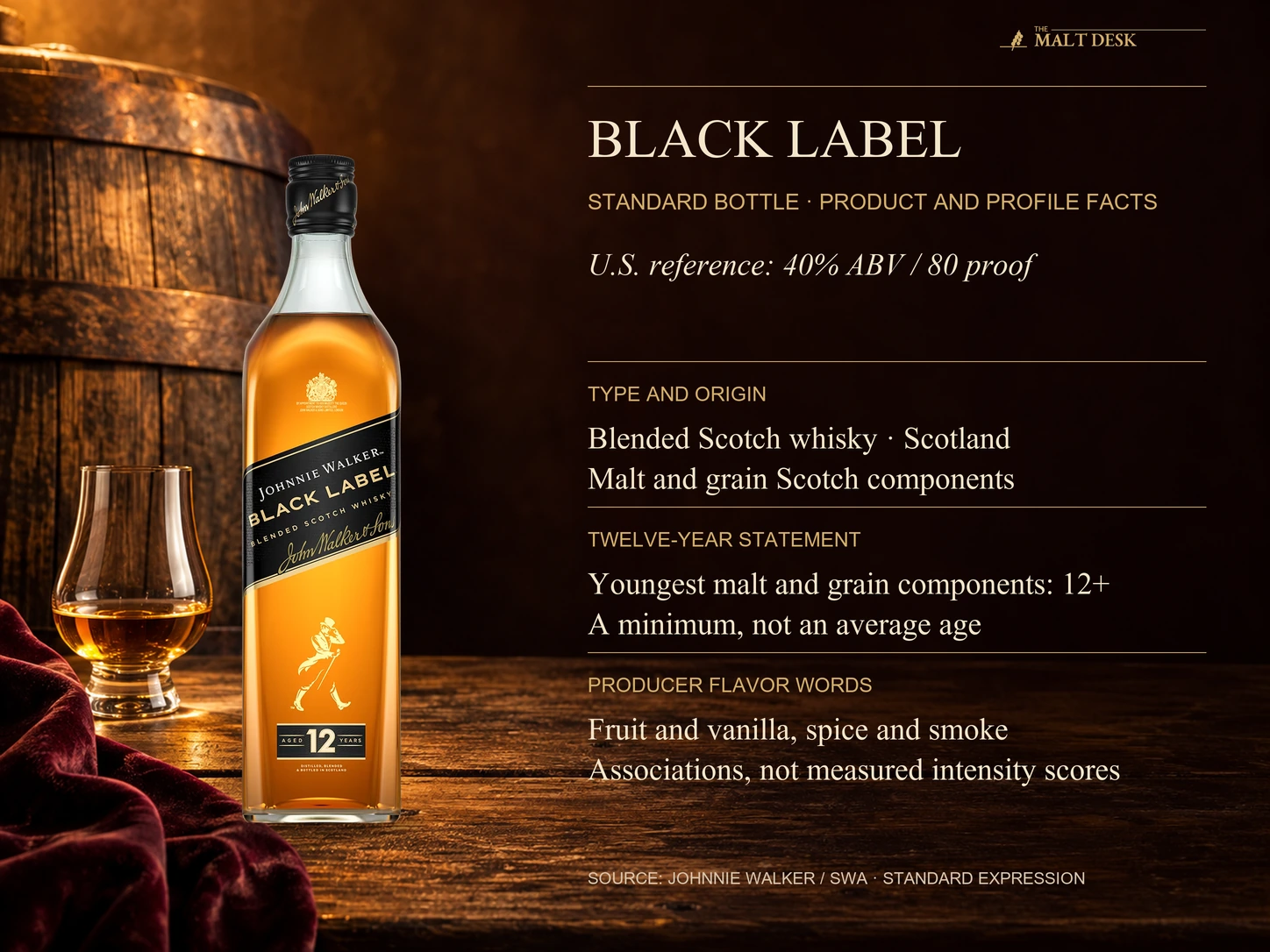
| Feature | Standard Black Label |
|---|---|
| Category | Blended Scotch whisky |
| Origin | Scotland |
| Components | Malt and grain Scotch whiskies |
| Age statement | 12 years |
| Standard strength | 40% ABV / 80 US proof |
| Published flavor emphasis | Fruit, vanilla, spice and smoke |
What the Blend Contains
Blended Scotch combines single malt and single grain Scotch whiskies. The word grain in this category does not mean a neutral filler: the component is itself Scotch whisky with its own production and maturation history.
The blend’s recipe is assembled from qualifying components to create the intended expression. A brand description naming certain distilleries is not necessarily a complete recipe, and an exact percentage for each source should not be inferred unless disclosed.
A standard single malt can also combine multiple casks. The distinction is therefore not “one barrel versus many,” but the category and origin of the component whiskies.
How the Twelve-Year Statement Works
Every Scotch whisky component represented by Black Label’s age statement must be at least twelve years old. The statement applies to both the malt and grain portions. It is neither an average age nor the age of only the most prominent malt.
For example, adding a small older component would not permit a higher age claim if younger whisky remains in the blend. Likewise, the presence of a twelve-year statement does not reveal how much older stock, if any, is included.
The age statement is a maturation disclosure.
Interpreting the Producer’s Flavor Profile
The producer’s description combines fruit and vanilla with spice and smoke. These associations explain several directions within the same profile.
A useful reading keeps the descriptors separate: fruit describes one aroma family, spice another, and smoke another.
Terms such as smooth, rich and balanced are sensory judgments. Attributing them to a source is more precise than generating a numerical score from the bottle’s age and ABV.
Strength and Serving Conditions
Forty percent ABV corresponds to 80 proof under the US convention. It identifies the concentration in the bottle, not the strength of every drink made from it. Adding water or mixer reduces concentration; melting ice also changes temperature and concentration over time.
A producer’s mixed-drink suggestion establishes a serving option, not proof that the whisky outperforms every alternative in that recipe. When comparing sensory notes, record whether the sample was neat, diluted or chilled.
Black Label Within the Johnnie Walker Range
The full expression name matters. Black Label, Double Black, Green Label and Blue Label are different products. Their age and category information should be read separately rather than transferred from the shared brand name.
Blue Label is also a blended Scotch, but its market positioning and specification differ from Black Label. A higher price or different packaging does not change what Black Label’s own twelve-year statement means.
The Category Line Resolves a Question the Recipe Does Not Have to Answer
Black Label is explicitly a twelve-year blended Scotch. The U.S. Double Black page’s designation also explicitly says blended Scotch, alongside 40% ABV. The SWA distinguishes that malt-and-grain category from blended malt, which combines single malt Scotch whiskies from more than one distillery. Knowing the proportions or the names of every component is unnecessary to apply this distinction.
The stronger source for a category requirement is the explicit designation, read with the category definition. By contrast, the producer’s smoky west-coast selection and charred-barrel description provide relevant information about Double Black’s intended profile. Promotional flavor wording can be useful without doing the job of a formal composition statement.
More Smoke and Removing Grain Lead to Different Branches
For someone who enjoys the complete Black Label profile and is curious about a more smoke-focused Johnnie Walker blend, I would investigate Double Black. Both consulted U.S. references are 40%, so this is not a request for twice the alcohol concentration. The disclosed smoky selection addresses the inquiry; it does not quantify a doubling of perceived smoke or guarantee that every reader will prefer it.
For someone who wants all-malt composition, Green Label is the relevant range branch to examine. Johnnie Walker identifies it as a blend made entirely from single malts matured for at least fifteen years. It meets a different production requirement from Black Label and Double Black. This is a reason to consider Green for that requirement, not evidence that grain whisky is a defect or that Green must reproduce Black Label’s flavor.
If the reader wants both all-malt composition and Double Black’s particular smoky identity, the category decision solves only the first part. Green’s eligibility does not make it an all-malt reconstruction of Double Black. The complete expressions use their own whisky selections. I would first confirm the composition requirement, then investigate whether the eligible expression’s actual profile supplies the smoke experience wanted.
Black Label’s twelve-year minimum can remain a reason to keep buying Black Label. It applies to the malt and grain components alike. Double Black’s consulted account does not publish that same minimum, and its name cannot borrow or double Black Label’s age. Keeping the familiar bottle for its existing role is a coherent outcome when neither a smoke-focused branch nor an all-malt requirement is actually the aim.
Other Comparison Points
Chivas Regal 12 supplies a same-age blended-Scotch comparison. Its producer emphasizes honey and fruit. Comparing those published emphases is different from claiming that every person will find Chivas softer or Black Label more complex.
Lagavulin 16 is a single malt rather than a blended Scotch. Its older minimum age, Islay origin and producer-described peat profile provide different reference points. It is not simply Black Label with more smoke.
Reading Price Information
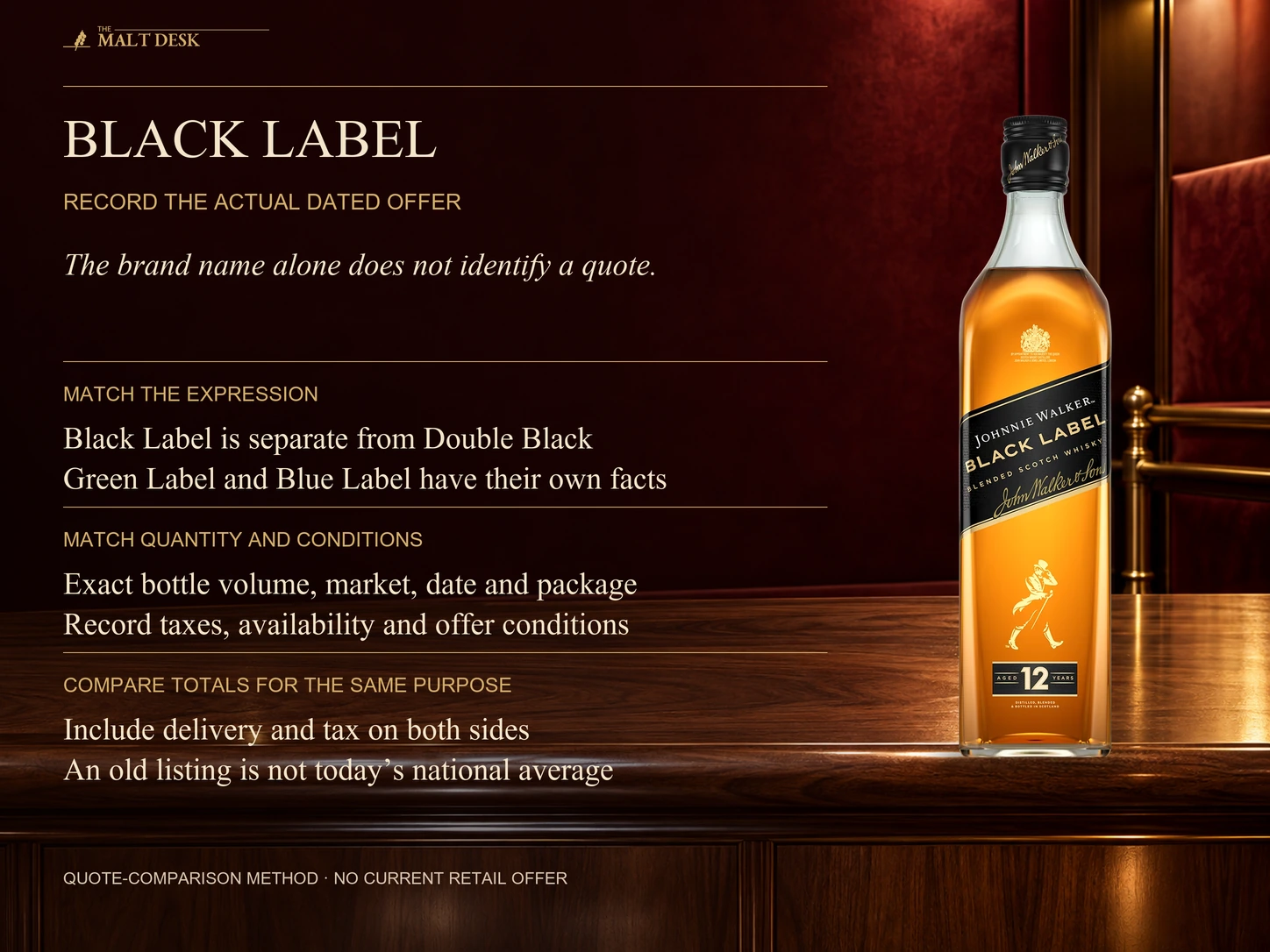
Price records should identify the exact expression, date, location, bottle volume, taxes and stock status. The same brand can appear in different bottle sizes and gift packages, which may prevent a direct comparison.
Historical retailer listings do not establish a current national average or an enduring “strong buy” threshold. Production facts can be compared independently of local prices, while a value judgment also depends on what a reader expects from the product.
In Brief
Johnnie Walker Black Label is a 12-year-old blended Scotch at 40% ABV in its standard presentation. Its published profile combines fruit, vanilla, spice and smoke; age and category identify the bottle, while preference remains personal.
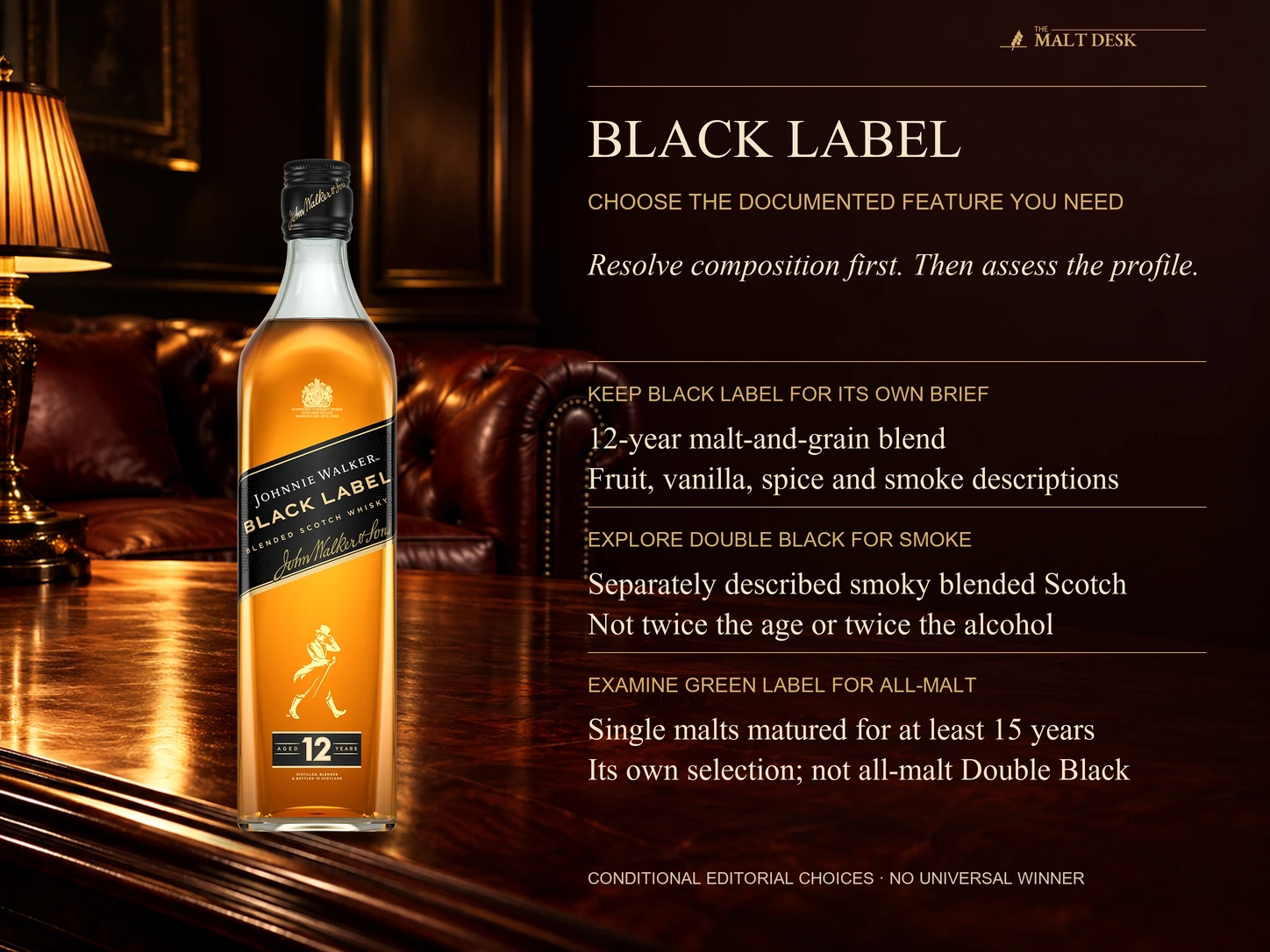
Choose the Johnnie Walker Branch That Fits the Brief
Keep Black Label for its twelve-year malt-and-grain blend identity. Investigate Double Black for the producer’s more smoke-focused selection and barrel account, or Green Label 15 for an all-malt blend with a fifteen-year minimum. These are useful alternative branches: choose the composition or smoke direction first, then compare exact local bottles and costs.
Frequently Asked Questions
Is Black Label a single malt?
No. Standard Johnnie Walker Black Label is blended Scotch made with malt and grain whisky components.
Does twelve years refer to an average?
No. It refers to the youngest Scotch whisky in the blend, including the grain components.
Does Black Label contain smoke in its published profile?
Yes. Smoke appears alongside fruit, vanilla and spice in the producer’s description.
Does the category guarantee smoothness?
No. Blended Scotch describes composition. Perceived alcohol warmth, texture and flavor depend on the particular expression and conditions.
Sources
Johnnie Walker official Black Label product information; Scotch Whisky Association category and age-statement guidance; official Chivas Regal 12 and Lagavulin 16 product information. Flavor descriptions are attributed to the relevant producers.
Category and range research rechecked October 7, 2026: Johnnie Walker’s U.S. Double Black product page, Black Label account and types-of-whisky guide; Scotch Whisky Association category definitions. The category line is distinguished from the page’s casual double-malt wording. Green Label’s all-malt and fifteen-year account establishes a composition alternative. The resulting range choices are The Malt Desk’s editorial analysis.