Lagavulin 16: An Age-Stated Islay Single Malt
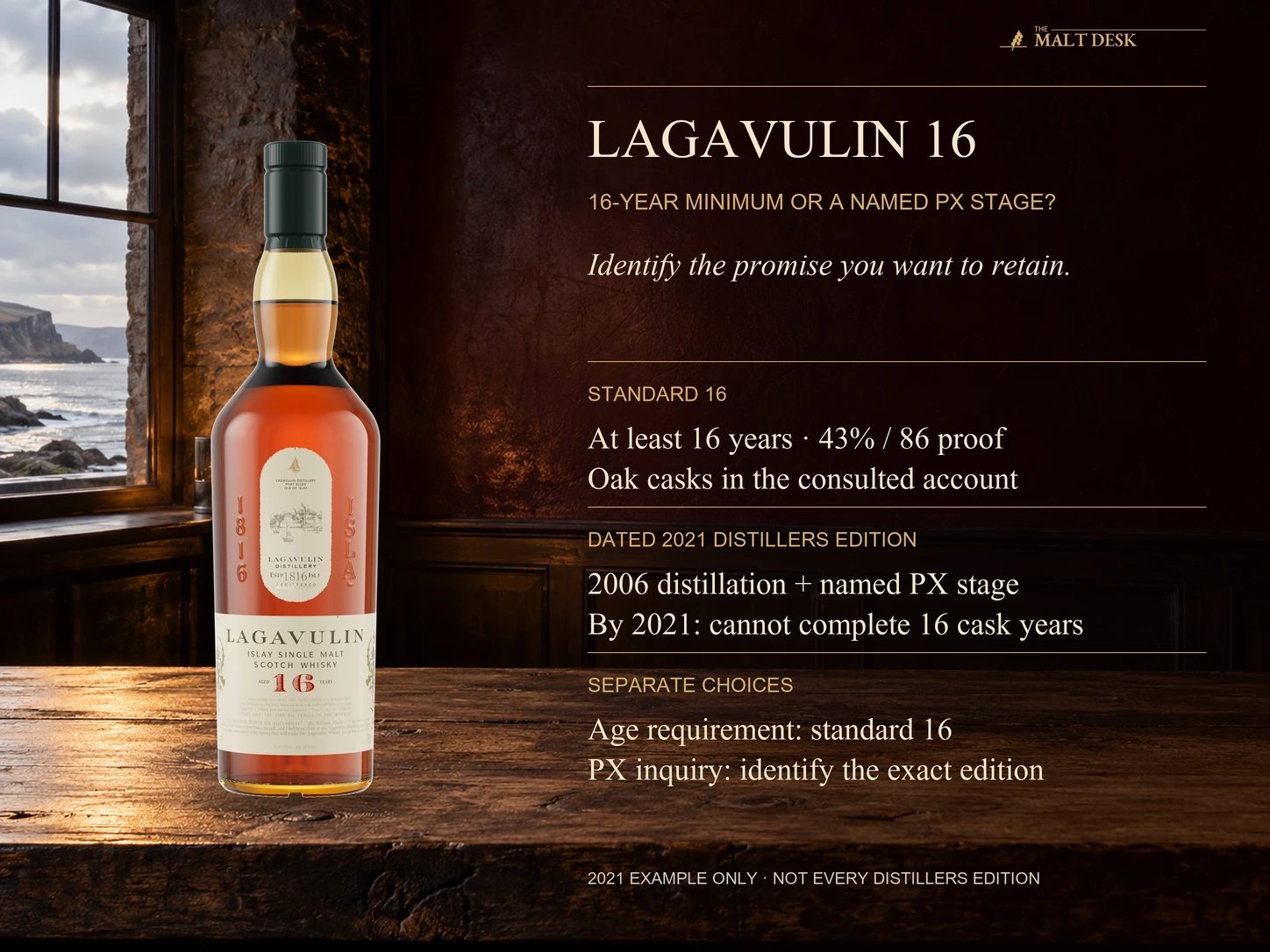
I would keep Lagavulin 16’s age promise separate from the attraction of an extra sherry treatment. There is a concrete reason: Diageo identifies its 2021 Distillers Edition with 2006-distilled Lagavulin and a Pedro Ximénez cask stage. Whisky distilled in 2006 cannot have completed sixteen years in cask by 2021. The special edition is therefore a poor shortcut for a reader whose first requirement is the standard bottle’s sixteen-year minimum.
That does not make the edition a lesser whisky. It changes what the comparison is for. A PX-finishing curiosity and a sixteen-year age requirement are two different requests; this particular historical release shows that one bottle can answer the first while failing the second.
Lagavulin 16 Year Old is single malt Scotch from Lagavulin distillery on Islay, bottled at 43% ABV. Its 16-year statement is a minimum age, and its producer describes a profile centered on peat smoke, maritime associations and sweetness.
The combination of age and smoke makes the expression useful for explaining two separate variables: cask maturation and the use of peated malt.
Core Specifications
| Expression | Lagavulin 16 Year Old |
|---|---|
| Category | Single malt Scotch whisky |
| Origin | Islay, Scotland |
| Age | At least 16 years |
| ABV / US proof | 43% / 86 |
| Producer maturation statement | Oak casks |
What the Age Statement Establishes
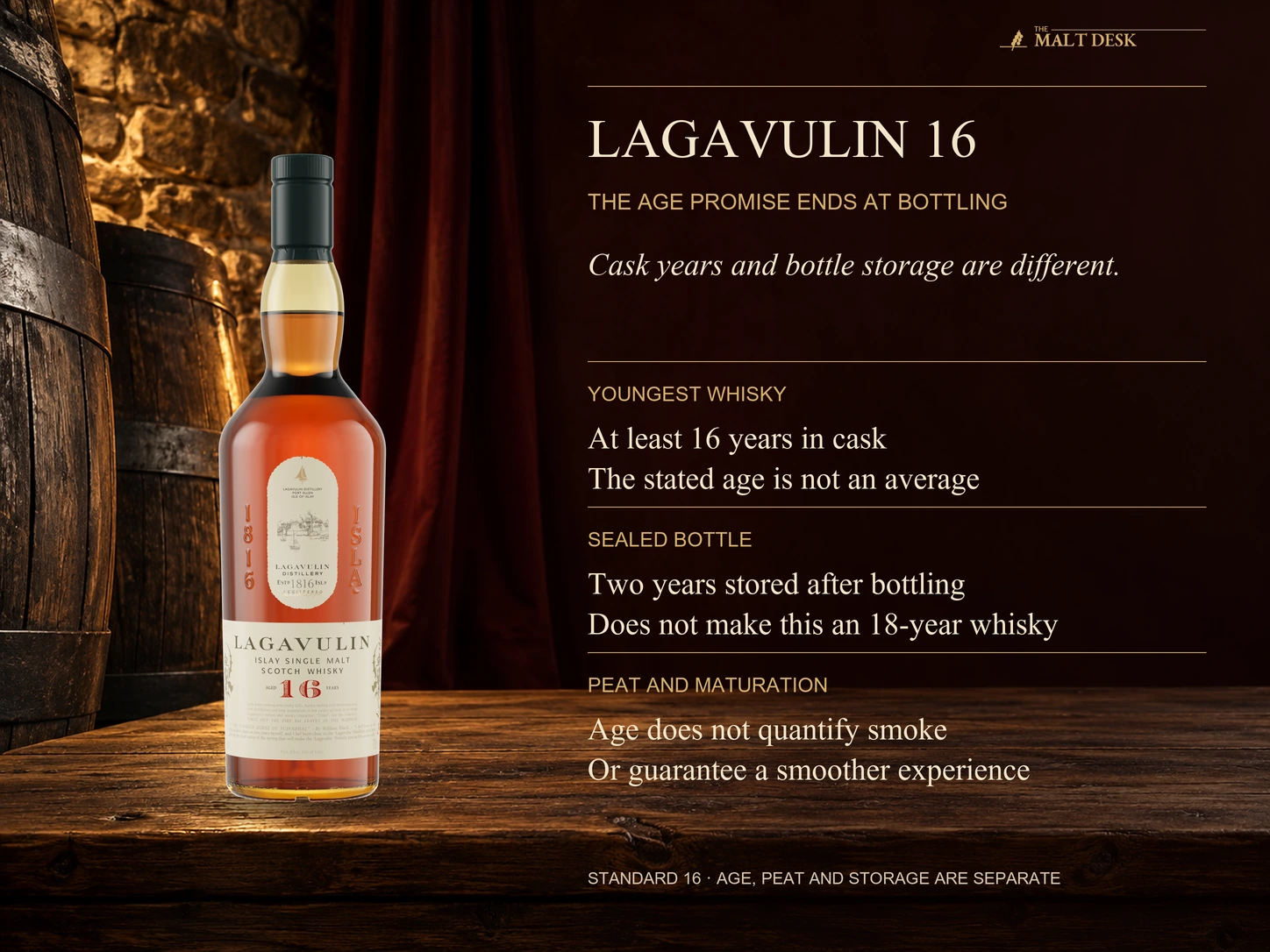
The youngest whisky in the bottling is at least 16 years old. The number is not an average of younger and older casks. A single malt can combine many casks from the same distillery without becoming a blended Scotch.
Two more years in a sealed bottle do not turn Lagavulin 16 into an 18-year cask-aged whisky. The label age records maturation before bottling; time in storage and bottle condition are separate questions.
Sixteen years also does not establish how the whisky will feel compared with a ten-year expression from another distillery. Spirit character, cask history and strength differ. Older does not automatically mean smoother, smokier or longer in the finish.
Peat Smoke and Maritime Descriptions
In peated malt production, smoke from burning peat contacts barley during drying. Smoke-related compounds can contribute to the resulting whisky’s aroma. This is a production explanation.
Terms such as iodine, seaweed and salt are sensory associations used in descriptions of the whisky. They should not be treated as evidence that seawater, seaweed or medicinal iodine is an ingredient.
Producer Flavor Notes
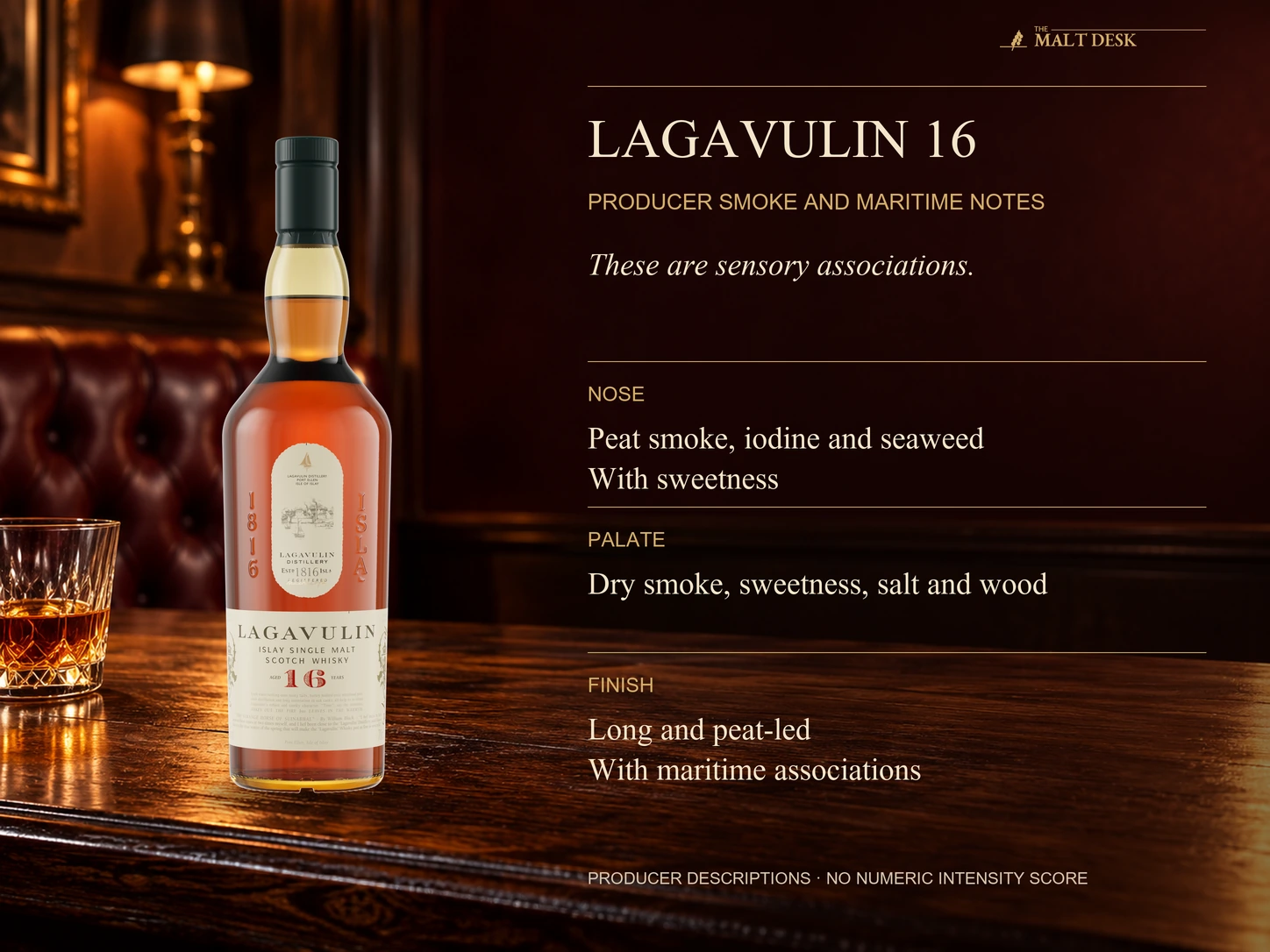
The official Lagavulin 16 description emphasizes peat smoke, iodine and seaweed on the nose, with sweetness. Its palate description contrasts dry smoke with sweetness, salt and wood. The producer describes the finish as long and peat-led, with maritime associations.
The figure groups the producer’s aroma, palate and finish vocabulary without intensity numbers. The published long-finish description does not establish an exact duration or guarantee that every reader will notice the same sensations.
What the Cask Description Does Not Reveal
The product information used here describes oak maturation but does not provide a complete cask recipe. A sherry-like fruit note is not proof of a particular sherry-cask percentage. Likewise, color is not sufficient evidence for age, cask type or the absence of coloring.
Natural color and non-chill filtration should only be described as confirmed when an expression-specific source makes the claim. Neither should be inferred simply because a bottle is a single malt or carries a substantial age statement.
Strength and Serving Conditions
At 43% ABV, a 30 ml measure contains 12.9 ml of pure alcohol. Ten milliliters of added water produces approximately 32.25% ABV in 40 ml of liquid, assuming additive volumes. This changes concentration while retaining the alcohol already poured.
Ice changes temperature as well as dilution, and meltwater increases over time. A comparison between neat whisky and a chilled glass with ice therefore changes more than one variable. Record the conditions if the aim is to understand the difference.
Use producer descriptions as reference vocabulary rather than a required sequence of sensations.
The 2006–2021 Dates Rule Out a Sixteen-Year Starting Whisky
Diageo’s dated product account places 2006 Lagavulin in the 2021 Distillers Edition collection and describes additional maturation in former PX cask wood. Consider even the earliest possible 2006 distillation date: its sixteenth anniversary would fall in 2022. A bottle prepared for the 2021 collection cannot already have reached that anniversary. The calendar therefore excludes sixteen years without needing to guess the distillation month.
This is a one-sided conclusion. The two years alone do not supply the exact completed age: the bottling day and distillation day still matter. I would not turn 2021 minus 2006 into an exact fifteen-year label. But lack of day-level detail does not stop us rejecting the incompatible sixteen-year claim. That is the useful answer the dates add.
| Question | Standard Lagavulin 16 | Identified 2021 Distillers Edition |
|---|---|---|
| Is a sixteen-year minimum directly established? | Yes, by its age statement | No; the 2006-to-2021 chronology rules it out |
| Is a specific additional PX stage described? | Not in the consulted standard account | Yes, in the dated edition account |
| Can the standard 16 be assumed to be the base? | This is the standard expression itself | No; that assumption conflicts with the dates |
Choose Between a Maturation Guarantee and a Different Cask Inquiry
Suppose the reader wants a peated single malt whose youngest whisky is at least sixteen years old. Standard Lagavulin 16 meets that production requirement; this 2021 edition does not. A shop’s more impressive name or higher price cannot repair the missing years. Keeping the standard bottle is then a reasoned choice, rather than settling for the ordinary release.
Now change the question to exploring Lagavulin through a specifically documented PX treatment. The dated edition supplies that feature, while the standard product’s general oak account does not answer it at the same level of detail. It is relevant to that inquiry even though it cannot be described as the standard sixteen-year vatting with one further stage added. A reader may reasonably choose the different process rather than the older guarantee.
Do not extend this verdict to every Distillers Edition. A differently dated release needs its own label and producer record. Nor does the PX disclosure quantify sweetness or show how much smoke a person will perceive. The comparison establishes two different production choices; an actual side-by-side observation would concern the complete expressions, with their own strengths and serving conditions recorded.
How to Compare With Other Scotch
Comparing Lagavulin 16 with a younger Islay single malt changes age, distillery and potentially strength together. Any sensory difference cannot be assigned solely to maturation. A useful comparison begins by recording those specifications separately.
Macallan Double Cask 12 offers a different cask explanation: sherry-seasoned American and European oak. The comparison is about disclosed production and intended style, not an objective contest between smoke and sweetness.
The 12-year single-malt comparison shows how the same age statement can coexist with different cask programs. It helps distinguish age from recipe before moving to an older expression such as Lagavulin 16.
Labels, Price and Presentation
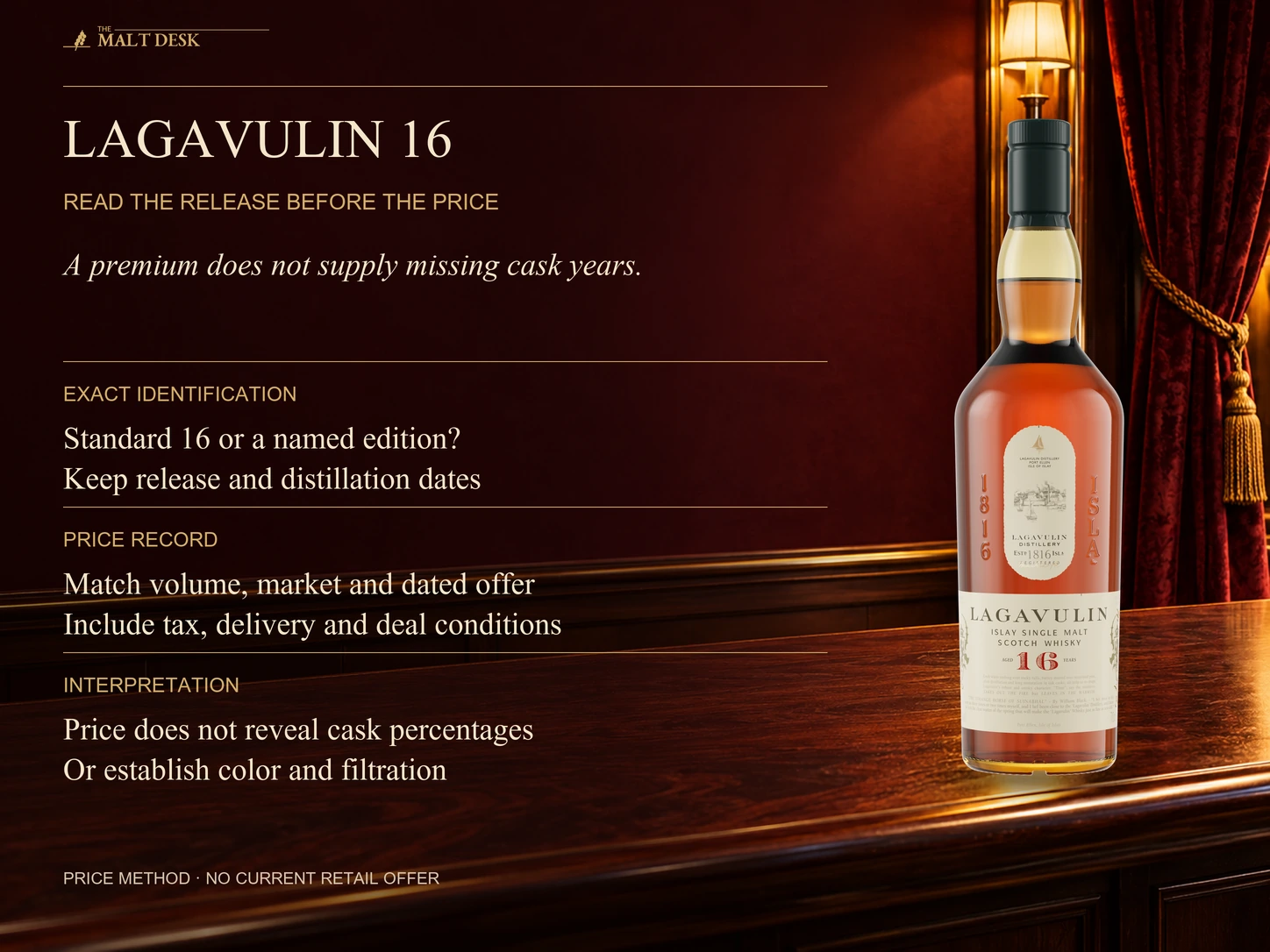
Read the full expression name. Lagavulin releases with other ages or special-edition names are not interchangeable with the standard 16-year bottling. A retailer photograph or abbreviated listing should not override the details on the actual bottle.
A price comparison should match volume, market, date and any offer conditions. An older listing does not justify a permanent buy-or-skip threshold. Price also cannot supply undisclosed filtration or cask details.
For presentation questions, the whiskey gift guide explains why a recipient’s preferences matter more than a famous label. Smoke is a style characteristic.
Choose the Lagavulin Age Floor or the PX Finish
Keep standard Lagavulin 16 as the reference when a sixteen-year minimum is the central requirement. Investigate the cited 2021 Distillers Edition for its PX-cask treatment and its own 2006-distilled identity. Treat those as two distinct reasons to explore the range: a specified maturation floor and an additional finishing stage.
Common Questions
Is Lagavulin 16 a single cask?
Single malt refers to one distillery, not one cask. The standard expression is not identified here as a single-cask release.
Does 16 years remove the peat?
The official profile remains peat-led. Maturation does not mean the absence of smoke, and age alone cannot quantify smoke intensity.
Is the maritime description an ingredient list?
No. Iodine, seaweed and salt describe sensory associations in the producer’s notes.
What does 86 proof mean?
In the US system it means 43% ABV. It is independent of the 16-year age statement.
Does it require neat service?
No. Neat, water and ice are different serving conditions. Describe the conditions without treating one as a mandatory way to appreciate the expression.
Sources
Lagavulin, Lagavulin 16 Year Old product information; Scotch Whisky Regulations 2009; Scotch Whisky Association guidance on single malt Scotch whisky and age statements. Malts product descriptions and SWA age guidance were checked October 3, 2026. Malts’ Taiwan product page explicitly lists the 43% strength reference; verify the local bottle’s strength and volume. Producer flavor descriptions are attributed and sensory terms are not treated as ingredients.
Expression analysis checked October 8, 2026: Diageo’s explicitly dated 2021 Distillers Edition account identifies 2006 Lagavulin and a PX stage. The calendar exclusion of sixteen completed years is The Malt Desk’s inference. It does not establish an exact day-level age, current availability or the specifications of another edition.