Quick Answer
The dilution calculator gives a useful model, but the number on its screen is only as precise as the volumes entered. A target such as 35% provides a comparison point; measured input volumes make the preparation reproducible. I would use the tool to plan a preparation and then report what was actually measured.
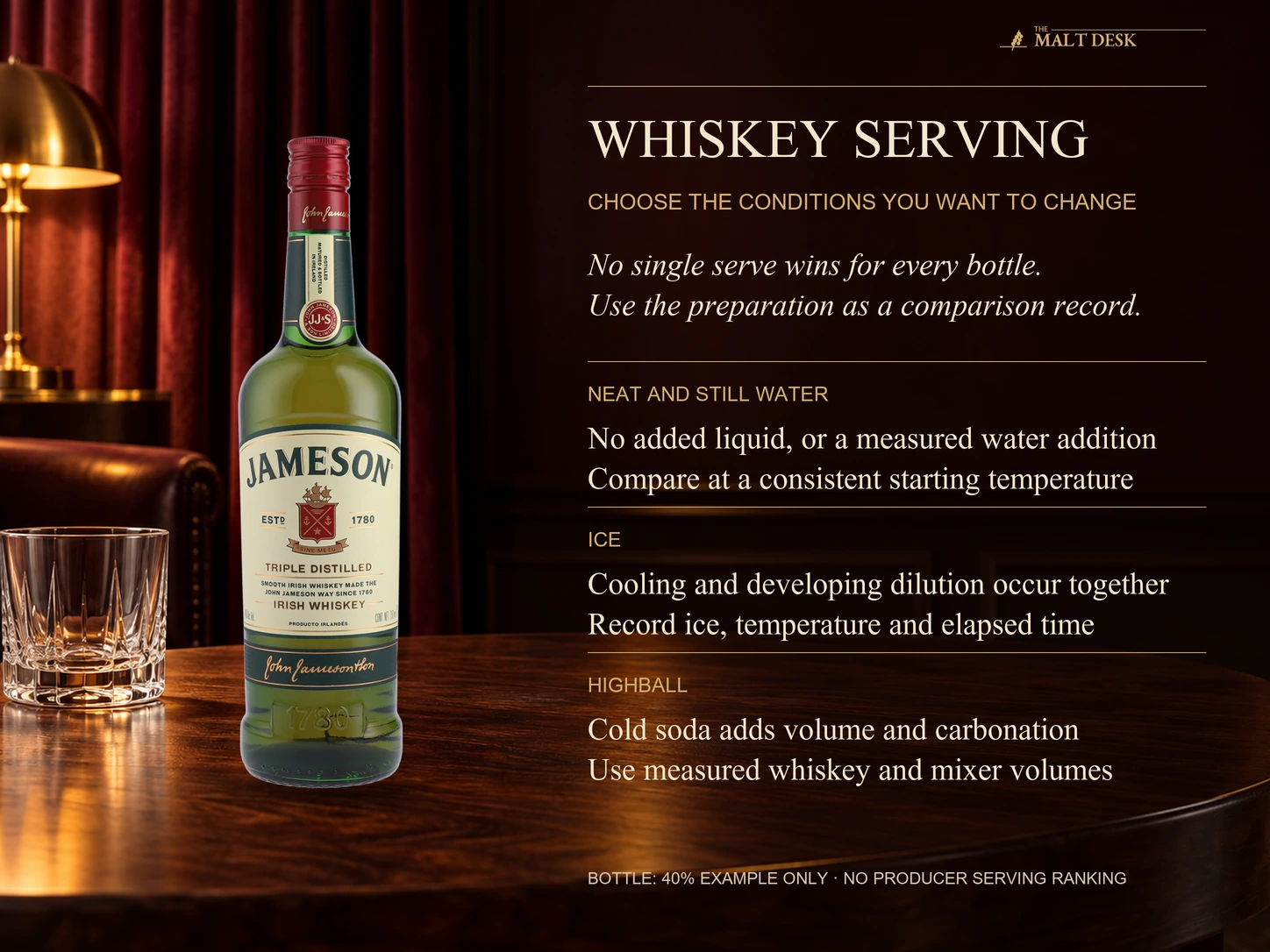
There is no single correct way to drink whiskey. Choose the serve by the experience you want:
- Neat: no water, ice or mixer; the most direct view of aroma, texture and alcohol heat.
- With water: controlled dilution at room temperature; useful for reducing alcohol prickle and testing how the aroma changes.
- On the rocks: cooling plus gradual dilution; colder and progressively diluted, with changes in aroma perception.
- Highball: whiskey lengthened with cold soda and ice; light, fizzy and especially comfortable with food.
For a new bottle, start with 25–30 ml neat, take one or two small sips, then add a few drops of still water. Test ice or soda in a separate pour. This sequence shows what the bottle does before temperature and dilution change it.
Key Takeaways
- Good whiskey does not have to be served neat.
- Neat is the clearest starting point for comparison, not a test of toughness.
- Add water gradually; there is no universal number of drops or perfect final proof.
- Ice lowers temperature and dilutes the whiskey as it melts.
- At equal ice mass, a larger cube has less exposed surface, but dilution also depends on starting temperatures, elapsed time and the final thermal conditions.
- A useful highball starting ratio is one part whiskey to three or four parts cold soda.
- Dilution lowers the strength in the glass, but it does not remove the alcohol already poured.
What Is the Best Way to Drink Whiskey?
The best serve depends on whether you want analysis, comfort or refreshment.
Neat whiskey preserves the bottle’s original concentration. A little water lets you adjust that concentration without chilling it. Ice makes the drink colder and progressively weaker. Soda moves furthest from analytical tasting and toward a long, refreshing drink.
None is automatically more sophisticated. A rare single malt can be enjoyable over ice; an inexpensive blend can be informative neat. The useful question is not “What am I allowed to do?” but “What do I want this pour to do?”
Neat vs Water vs Rocks vs Highball
| Serve | Dilution | Temperature | Controlled change | Example purpose |
|---|---|---|---|---|
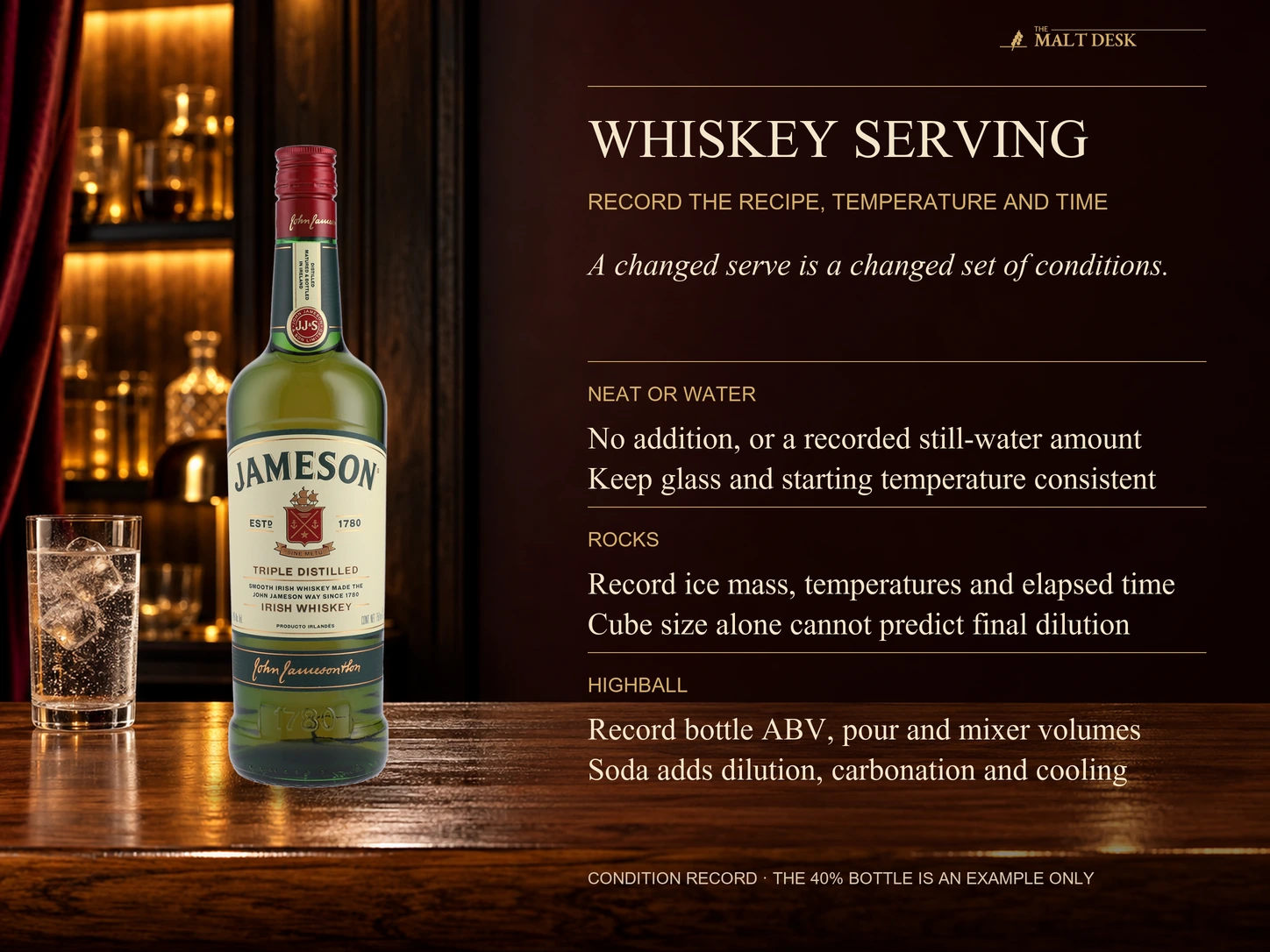
| Neat | None | Room temperature | No added liquid; starting glass and temperature still matter | First taste and bottle comparison |
| Water | Controlled | Room temperature | Lower ABV with measured added water | High proof and fine tuning |
| Rocks | Gradual as ice melts | Cold | Cooling and developing dilution | Relaxed, slow sipping |
| Highball | High; start around 1:3–1:4 | Very cold | Mixer volume, cooling and carbonation | Refreshment and pairing |
The strength in the glass falls as you add water, melting ice or soda. The original whiskey measure contributes the same amount of alcohol after the added mixer.
What Does It Mean to Drink Whiskey Neat?
Neat means whiskey served without added water, ice or mixer. It is commonly served at room temperature, but the term primarily describes the absence of additions. It preserves the concentration in the bottle.
A simple neat-whiskey routine
- Pour 25–30 ml into a tulip-shaped tasting glass or a small glass that narrows at the rim.
- Hold the glass a little below your nose and take short, gentle sniffs rather than one hard inhale.
- Take a small first sip and notice alcohol heat and texture before searching for tasting notes.
- Pause, then use the second sip to look for fruit, sweetness, grain, oak, spice, smoke and finish.
If the alcohol dominates, add water or move to another serve.
Glenfiddich 12, The Glenlivet 12 and Lagavulin 16 provide different producer-described styles to compare. Keep the measure, glass and initial temperature consistent.
Should You Add Water to Whiskey?
Yes—water is a control, not a correction. It lowers concentration without the cooling effect of ice and can change the balance between alcohol sensation and aroma.
The Scotch Whisky Association’s tasting toolkit suggests tasting first, then adding a little still, unchilled water and tasting again. A 2017 Scientific Reports molecular-simulation study found that changing the water–ethanol mixture can influence how guaiacol, one compound associated with smoky aroma, behaves near the liquid surface.
That study is useful context, not proof that water always improves every whiskey. Guaiacol is one molecule, and real bottles contain complex mixtures. Depending on the whiskey and the amount added, water can reveal, rearrange or flatten what you perceive.
How much water should you add?
There is no universal ratio. Start small:
- 40–43% ABV: begin with a few drops.
- Around 46% ABV: add a few drops at a time and compare.
- 50% ABV and above: use a dropper or teaspoon and work in stages.
Use room-temperature still water when the goal is comparison. Cold water changes temperature as well as concentration. You can always add more, but you cannot remove it.
Higher-proof whiskey such as Wild Turkey 101 often gives you more room to experiment. A small amount of water may lower the alcohol prickle enough to make oak, spice and sweetness easier to separate.
What Happens When You Drink Whiskey on the Rocks?
On the rocks means whiskey poured over ice. Two variables change at the same time:
- Temperature drops, which can reduce the perception of alcohol heat and make the drink feel smoother.
- Dilution rises, because melting ice keeps adding water throughout the pour.
Cooling and changing concentration can alter aroma perception. The progression depends on the starting temperatures, ice and time, so there is no universal five-minute flavor pattern.
Is one large ice cube better?
For equal ice mass and comparable starting conditions, a larger piece has less exposed surface area than many smaller pieces. This can slow heat transfer. Actual dilution also depends on starting temperatures, total ice mass, stirring and elapsed time; cube size alone cannot predict how much water is added.
- Record the ice mass, starting temperature and elapsed time; a large cube still melts.
- For equal total ice volume, smaller pieces have more exposed surface; this does not guarantee a fixed dilution rate.
- Use a few drops of water instead when you want dilution without a major temperature drop.
Ice does not “ruin” whiskey. It creates a different serve with a different trade-off. Try the bottle neat first if you want a reference point, then decide whether the colder version is more enjoyable.
How Do You Make a Basic Whiskey Highball?
A simple highball combines whiskey, cold carbonated water and ice in a tall glass. It prioritizes refreshment and food pairing over concentrated aroma.
Reliable starting recipe
- 1 oz / 30 ml whiskey
- 3–4 oz / 90–120 ml very cold soda water
- Plenty of hard ice
- Optional lemon peel
Fill a chilled highball glass with ice, add the whiskey, then pour the soda slowly down the side. Stir once or twice gently so you preserve carbonation. Start at 1:3 and add more soda if the whiskey remains too intense.
A ratio is a preparation choice, not a strength-independent flavor guarantee. Record the starting ABV and the whisky-to-mixer volumes, then keep ice, garnish and temperature consistent when comparing recipes.
Jameson describes floral and spiced-wood notes; Jack Daniel’s Old No. 7 describes vanilla, caramel and toasted oak; Buffalo Trace names vanilla, mint and molasses. These are producer associations. The best whiskeys for highballs guide covers recipe variables.
Which Glass Should You Use?
Glassware changes how aroma reaches your nose and how the serve handles ice or soda.
- Tulip-shaped tasting glass: narrows at the rim and concentrates aroma; best for neat whiskey and water experiments.
- Rocks or Old Fashioned glass: stable, wide and easy to use with a large cube.
- Highball glass: tall and narrow enough for generous ice and soda.
Specialized glassware is useful, not mandatory. A small wine glass can handle neat tasting, a sturdy tumbler can hold ice, and any tall glass can make a basic highball.
Comparing Concentration and Temperature
Water and ice affect different variables. Adding still water mainly changes concentration, while melting ice changes concentration and temperature over time. Soda adds dilution and carbonation. Notes from these serves should record the conditions rather than treating a difference as an automatic improvement.
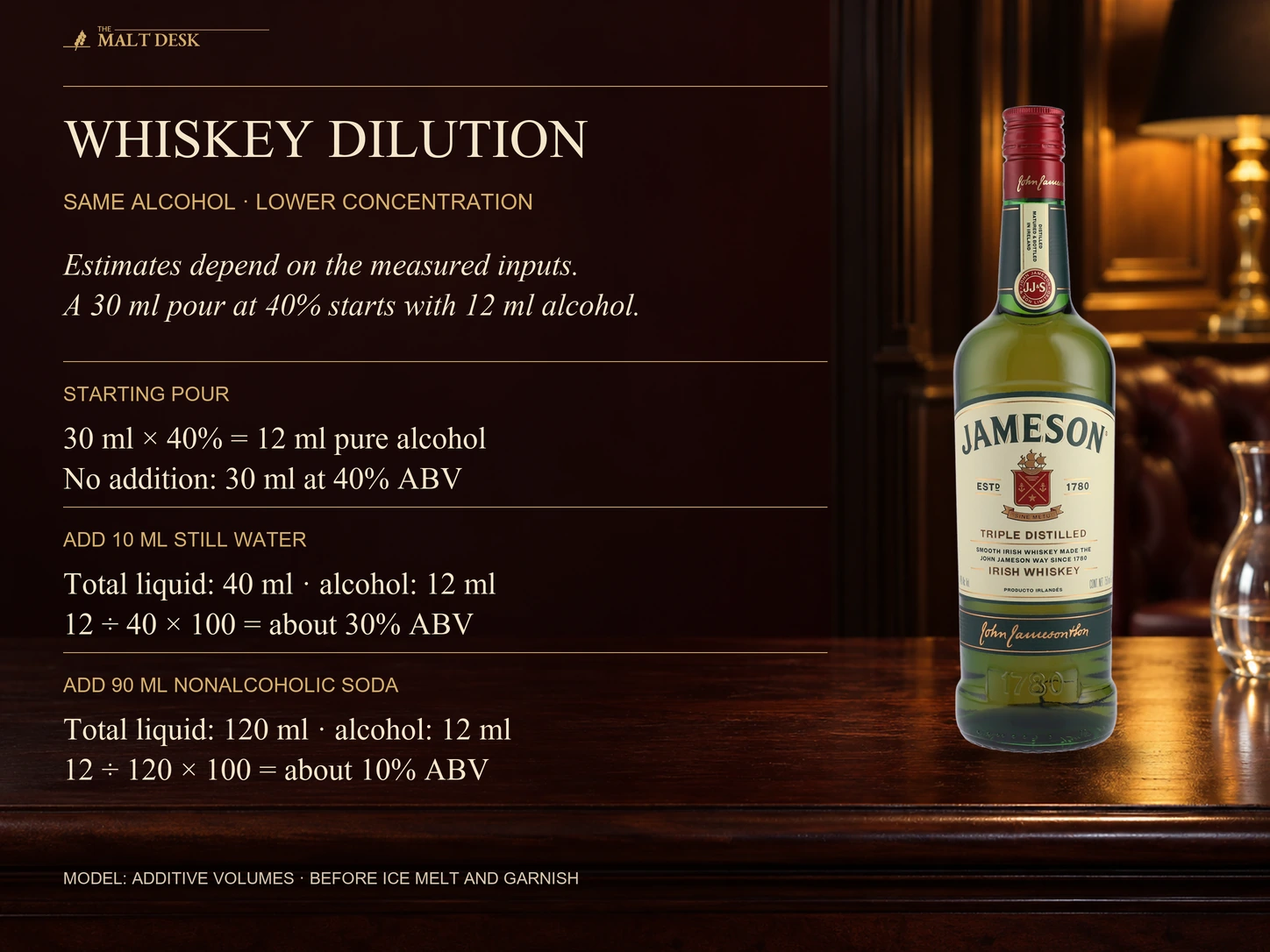
For an approximate dilution calculation, multiply the starting volume by its ABV and divide by the total liquid volume after adding water. For example, 30 ml at 40% ABV contains 12 ml of alcohol. Adding 10 ml of water gives approximately 30% ABV; adding 90 ml of soda gives approximately 10% before further ice melt. These calculations assume additive volumes and are practical estimates.
The amount of alcohol from the original measure remains the same. A longer drink has a lower concentration and retains the alcohol contributed by the original whiskey measure.
Whiskey Dilution Calculator
Enter the bottle strength, the measured pour and the water or non-alcoholic mixer you add. The result estimates concentration before any further ice melt.
Example: 30 ml at 40% ABV plus 10 ml of water gives about 30% ABV in 40 ml of liquid, with 12 ml of pure alcohol.
Formula: final ABV = bottle ABV × whiskey volume ÷ (whiskey volume + added liquid). Volumes are assumed to add approximately. Adding water changes concentration; it does not remove the alcohol already poured.
A Precise Calculation Can Have Imprecise Inputs
For a nominal 30 ml pour at 43%, the model requires approximately 6.86 ml water to reach 35%. If that water measure is one milliliter lower or higher, the model instead gives about 35.97% or 34.07%. The same carefully calculated target spans nearly two percentage points when only this one input varies. Extra decimal places in an output cannot repair an approximate pour.
Those endpoints assume the starting 30 ml and 43% are otherwise fixed and volumes add. These endpoints illustrate sensitivity under the stated additive-volume assumptions. A realistic record might say approximately 7 ml measured water, rather than implying a spoon delivered exactly 6.86 ml. If more precision matters, improve the measurement before improving the displayed rounding.
A Target Above Bottle Strength Cannot Be Reached With Water
Working backward uses added water = initial volume × (initial ABV ÷ target ABV − 1). A positive target below the bottle’s ABV gives a positive water addition. An equal target gives zero. A target above the bottle’s ABV produces a negative number: for 30 ml at 43% aimed at 45%, about −1.33 ml. That is a signal the water-only preparation is impossible, not an instruction to remove water from the poured whisky.
Unmeasured ice melt creates another boundary. For a later concentration estimate, include the additional meltwater volume in the inputs. If the nominal 30 ml, 43%, 6.86 ml-water preparation subsequently receives 10 ml meltwater, the model falls to roughly 27.53%. The ten-milliliter addition is an explicitly hypothetical input to illustrate later dilution.
Common Whiskey-Serving Mistakes
Nosing too aggressively
Pushing your nose deep into the glass and inhaling hard can make ethanol dominate. Start farther away and use short sniffs.
Adding too much water at once
Water cannot be taken back out. Add a few drops, taste and repeat.
Leaving ice conditions unrecorded
Ice melt changes concentration over time. Record ice mass, starting temperatures and elapsed time when comparing serves; a larger cube alone does not guarantee a particular amount of dilution.
Building a highball with warm soda
Warm ingredients melt ice faster and lose carbonation sooner. Chill the glass and soda first.
Final Answer
The best way to drink whiskey is the one that matches the experience you want.
Neat gives you the bottle at its most direct. Water lets you tune concentration while keeping room-temperature aroma. Ice cools and gradually softens the pour. A highball turns whiskey into a long, bright, food-friendly drink.
Start neat, add water in small steps, and test ice or soda in a separate glass. That method respects the bottle without turning preference into etiquette. Expensive whiskey does not have to be neat, and beginners do not have to hide every bottle in a highball.
Use the Calculator to Plan a Measured Preparation
Enter the labeled bottle strength and measured liquid volumes, then round the result to the precision of those measurements. Use measured still water for a reproducible concentration comparison; record ice and elapsed time for a chilled serve that continues changing. A useful result is a recipe you can repeat, with the calculator’s additive-volume assumptions kept beside it.
Frequently Asked Questions
Should beginners drink whiskey neat?
They do not have to, but one small neat sip provides a useful baseline. Add water, ice or soda if the alcohol heat is uncomfortable.
How much water should I add to whiskey?
Start with a few drops. Proof, bottle style and personal preference determine the final amount, so there is no universal ratio.
Does ice ruin whiskey?
No. Ice lowers temperature and adds dilution, which changes the flavor balance. Delicate aromas may become quieter, while alcohol heat becomes softer.
Is one large cube better than small ice?
Under matched conditions, larger ice can transfer heat more slowly because it has less exposed surface area. Final dilution also depends on temperatures, ice mass, time and stirring.
What is a good whiskey highball ratio?
Start with one part whiskey to three or four parts very cold soda water. Use less soda for a lighter whiskey and more for a bold or high-proof bottle.
Does a highball contain less alcohol than a neat pour?
It has a lower alcohol concentration because the drink is larger, but the alcohol in the original whiskey measure remains. Soda does not remove alcohol.
Sources
Scotch Whisky Association tasting toolkit; Karlsson and Friedman, Dilution of whisky – the molecular perspective (2017); House of Suntory highball preparation instructions. Sources checked October 4, 2026. Molecular simulations are not universal preference tests. ABV examples assume approximately additive volumes and non-alcoholic water or soda before ice and garnish.
Calculator analysis note: sensitivity endpoints and inverse-target examples are arithmetic illustrations under an additive-volume model. The hypothetical meltwater quantity is not inferred from a cube or elapsed time. Results describe the entered preparation under the stated assumptions.