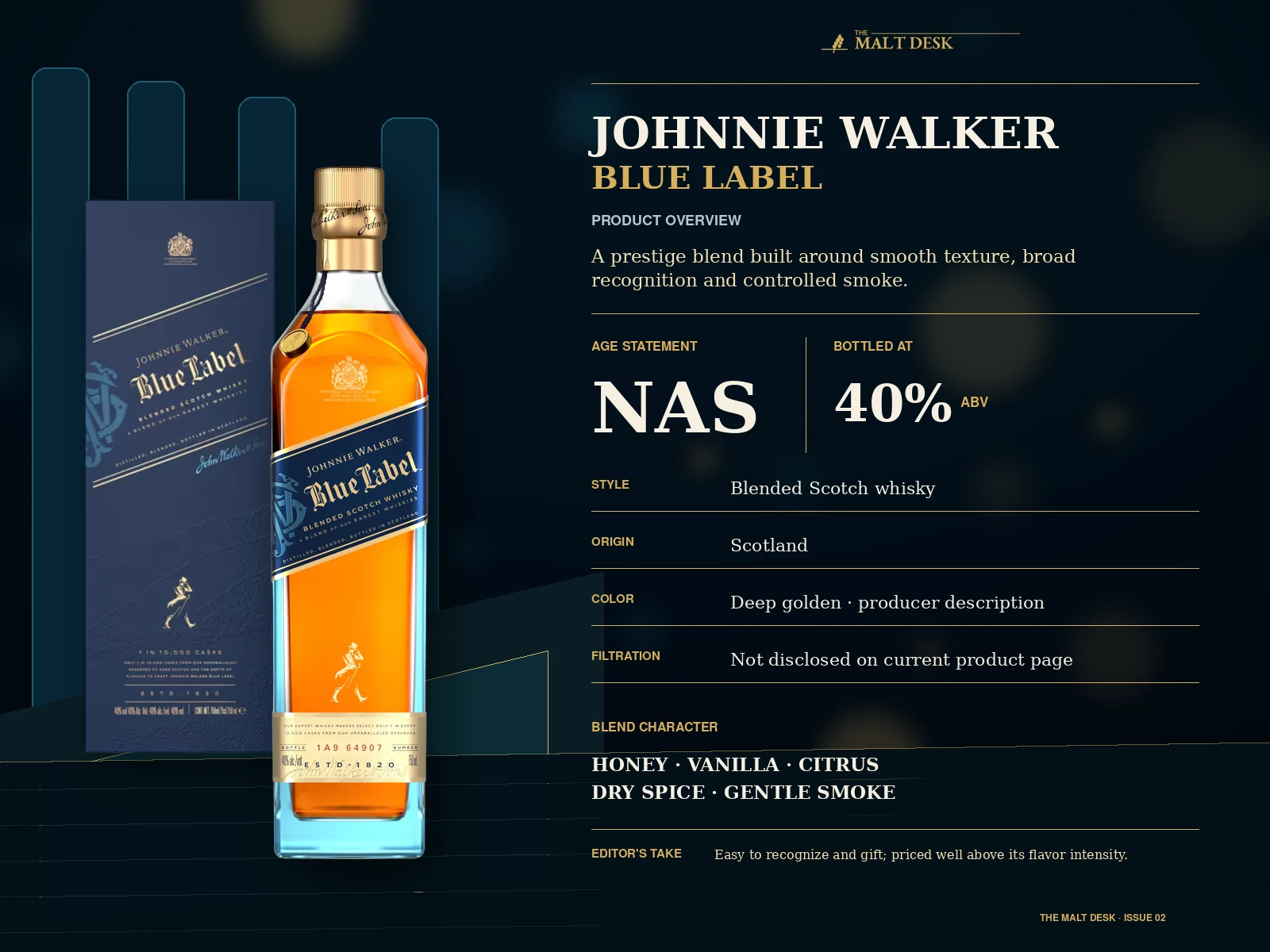
Johnnie Walker Blue Label: Blend and Label Guide
Johnnie Walker Blue Label is blended Scotch whisky containing malt and grain whiskies. The standard expression has no age statement and is commonly bottled at 40% ABV. Its position in the brand’s range does not reveal a youngest-component age or a complete recipe.
Product Facts
| Expression | Johnnie Walker Blue Label |
|---|---|
| Category | Blended Scotch whisky |
| Origin | Scotland |
| Age statement | None |
| Common ABV / US proof | 40% / 80 |
| Complete component recipe | Not disclosed |
What Blended Scotch Means
Blended Scotch combines malt and grain Scotch. It differs from a blended malt, which contains malt whiskies without grain whisky, and from a single malt, which comes from one distillery. None of these terms is an automatic quality ranking.
Blue Label’s components are selected to create an intended blend profile. A brand’s description of rare or specially selected casks does not disclose component proportions, an average age or a guaranteed age for the youngest whisky.
No Age Statement and Rarity Claims
The standard bottle does not declare an age. It should not be described as 21, 25 or another number of years simply because it occupies a premium position. Claims about cask rarity are not interchangeable with an age statement.
Likewise, references to closed distilleries in a brand story or a special edition should not be converted into a fixed recipe for every standard Blue Label bottle. Identify the exact expression and the scope of the producer statement.
Producer Flavor Profile
Johnnie Walker’s descriptions associate Blue Label with hazelnut, citrus, vanilla, honey and smoke. These are producer sensory notes. They do not mean those foods are ingredients or establish a numerical level of sweetness or smoke.
A term such as smooth may describe low perceived warmth, texture or an absence of astringency. It is not a laboratory specification. The 40% bottling strength alone cannot establish that every reader will find the blend smoother than another whisky.
No firsthand score or radar rating is supplied here. A sensory comparison would need an actual method and observations, rather than deriving numbers from descriptive words or a bottle’s price.
Blue Label, Black Label and Green Label
The color names identify different expressions rather than a single whisky with a progressively higher age. Black Label’s 12-year age statement is not an age that can be transferred to Blue Label.
Green Label 15 is a blended malt with an age statement, so both category and age disclosure differ from standard Blue Label. An age-stated expression is more explicit about minimum age, but that does not guarantee an individual will prefer it.
Comparison With Other Blends
Chivas Regal 12 is also blended Scotch, but it declares a 12-year minimum age. The comparison involves disclosed age and different components, not merely a difference in brand presentation.
Hibiki Japanese Harmony is a blended Japanese whisky at 43% without an age statement. Its country, production framework and strength differ even though both expressions lack a stated age.
Macallan Double Cask 12 is single malt Scotch with a stated age and a disclosed sherry-seasoned oak program. It illustrates why an age-stated single malt and a no-age-statement blend should be compared through their actual characteristics rather than a prestige hierarchy.
Strength and Serving Conditions
At 40% ABV, a 30 ml measure contains 12 ml of pure alcohol. Adding 10 ml water gives approximately 30% ABV in 40 ml liquid, assuming additive volumes. More water lowers concentration without removing alcohol already poured.
Ice changes temperature and adds variable meltwater. Those changes can affect aroma and texture, but no cube size or resting time guarantees a particular result. Record the conditions if comparing observations.
Neat service is one reference condition, not a requirement attached to an expensive bottle. A mixed drink introduces additional flavors and dilution, so an observation about that recipe should not be presented as the whisky’s unchanged profile.
Presentation and Price
Packaging is part of the product presentation but does not disclose age, cask proportions or processing details. An outer box or familiar label is not, by itself, an authenticity test. Bottle size and exact edition should be checked separately.
A useful price comparison records volume, market, date and package contents. A historical price is not a permanent buy threshold, and a higher local price does not establish older whisky in the bottle.
The gift guide explains why the recipient’s preferences matter more than assuming a famous label is universally suitable. Neither brand recognition nor cost guarantees that an alcohol gift is welcome.
Undisclosed Processing Details
Color and clarity alone cannot prove natural color or a filtration method. Unless an expression-specific source makes those claims, leave them unspecified. No age statement should likewise remain an explicit unknown rather than an estimate.
Common Questions
How old is standard Blue Label?
It has no age statement. The label does not provide a youngest-component age.
Is it single malt?
No. It is blended Scotch containing malt and grain whiskies.
Does a higher price establish more age?
No. Price cannot supply an undisclosed age or recipe.
Are honey and hazelnut added ingredients?
They are sensory associations in the producer’s description, not ingredient claims.
Does every Blue Label edition have identical specifications?
Do not assume so. Check the complete expression, volume and ABV of the specific bottle, especially for special editions.