Hibiki Japanese Harmony: Product Overview
A limited-edition Hibiki bottle can add a new design without its announcement establishing a new whisky recipe. Japanese Harmony makes this distinction particularly useful: the same producer has announced both an explicitly new Hibiki blend and special Harmony bottle designs. The release name alone cannot tell a reader which kind of change is being offered.
I would read a Harmony edition through the promise that actually accompanies it. Artwork and a collectible presentation can be a real reason to choose the bottle. If the reason is a different liquid or a more prominent Mizunara maturation program, the announcement needs to say so for that exact expression.
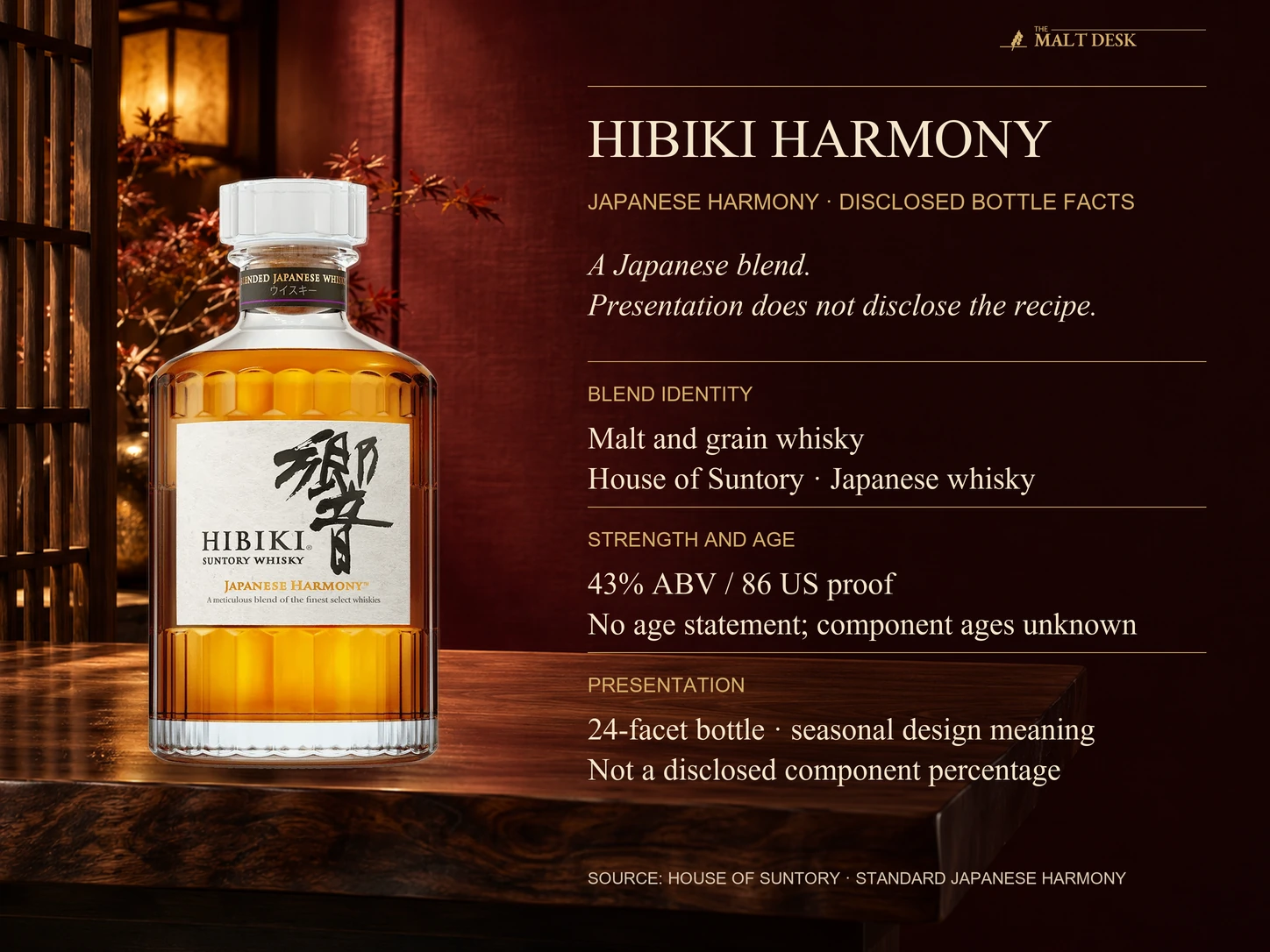
Hibiki Japanese Harmony is a no-age-statement blended Japanese whisky from House of Suntory, bottled at 43% ABV. It combines malt and grain whisky. The key facts are its blend category, disclosed strength and Japanese-whisky labeling statement; the exact component ages and proportions are not disclosed.
Japanese Harmony is the full expression name. It should not be treated as a substitute name for age-stated Hibiki releases, which are separate products.
What Is Disclosed?
| Producer | House of Suntory |
|---|---|
| Category | Blended Japanese whisky |
| Strength | 43% ABV / 86 US proof |
| Age statement | None |
| Component proportions | Not disclosed |
| Japanese-whisky standard | Producer states compliance with JSLMA labeling standards |
Malt and Grain Components
Suntory identifies Yamazaki, Hakushu and Chita in its explanation of Hibiki blending. Yamazaki and Hakushu supply malt-whisky styles; Chita specializes in grain whisky. This describes the production network behind the brand, not a published percentage recipe for Japanese Harmony.
A blended whisky can draw on different distillates and casks to create a consistent expression. Knowing the distilleries does not establish the number of component casks or their ages. Precise claims such as a fixed number of component whiskies should not be substituted for an undisclosed recipe.
Malt and grain are production terms. Grain whisky is not simply a flavorless filler, and a blend does not become less legitimate because it includes grain whisky. The relevant distinction from single malt is how the components are sourced and combined.
Producer Flavor Descriptions
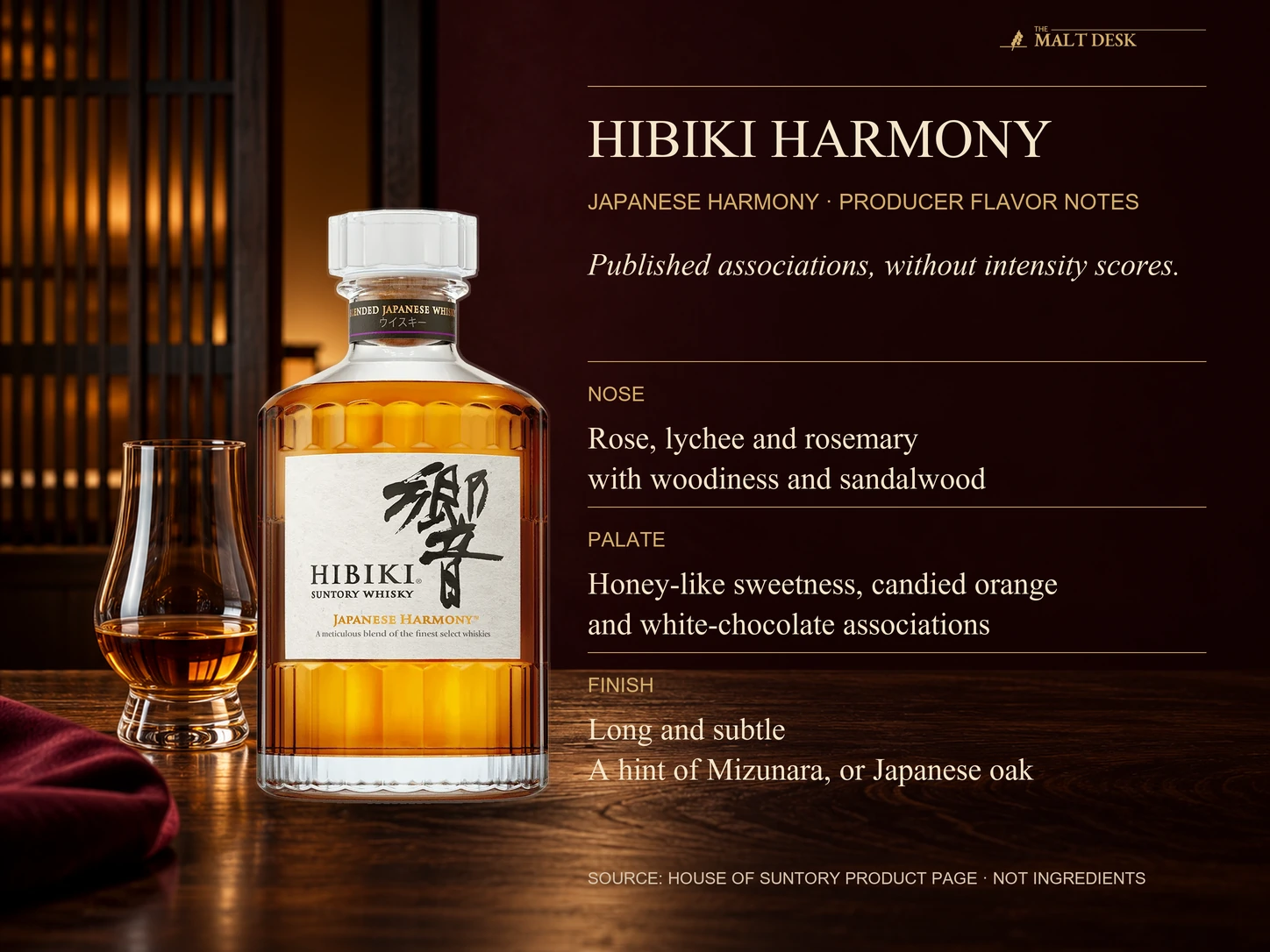
House of Suntory’s official notes place rose, lychee, rosemary and wood-associated aromas on the nose. Its palate description uses honey, candied orange and white-chocolate associations. For the finish, the producer refers to a subtle Mizunara, or Japanese-oak, impression.
These descriptions identify the intended profile. They do not mean flowers, fruit, honey or chocolate are ingredients. Nor does a Mizunara descriptor disclose how much of the blend matured in that wood or for how long.
A reader may identify different aromas, particularly at a different temperature or dilution. Claims that 43% prevents alcohol from dominating, or that a precise resting time reveals a particular note, require more evidence than the bottling percentage alone.
What No Age Statement Means
Japanese Harmony does not declare a youngest-component age. Its name is not a number of years, and price cannot supply the missing age information. It is therefore inappropriate to compare it with a 12- or 21-year expression as though the same age had been disclosed.
No age statement also does not establish that every component is young or that the blend lacks complexity. It limits what can be said about age. Keep that uncertainty separate from any personal preference for the resulting whisky.
The Japanese-Whisky Labeling Statement
The official Japanese Harmony page states that the product meets the Japan Spirits & Liqueurs Makers Association’s Japanese-whisky labeling standards. This is an explicit producer statement about the expression, rather than an inference from its Japanese name or bottle design.
The association’s standard concerns production and labeling. Evaluate each expression’s own statement.
Bottle Design and Its Meaning
Suntory connects Hibiki’s 24 bottle facets with Japanese seasonal divisions, and its Japanese product information identifies the Echizen washi label and calligraphy. Those design details belong to the presentation record; they do not establish the component ages, blend proportions or a changed liquid.
A design feature can explain the visual identity without proving a premium in liquid quality. Packaging may change across markets or releases, so a photograph should not be used as the sole specification for the bottle inside.
For a broader explanation of presentation and label terms, see the whiskey gift guide. A recognizable bottle still needs to suit the recipient’s preferences.
Two Centennial Releases, Two Different Kinds of Change
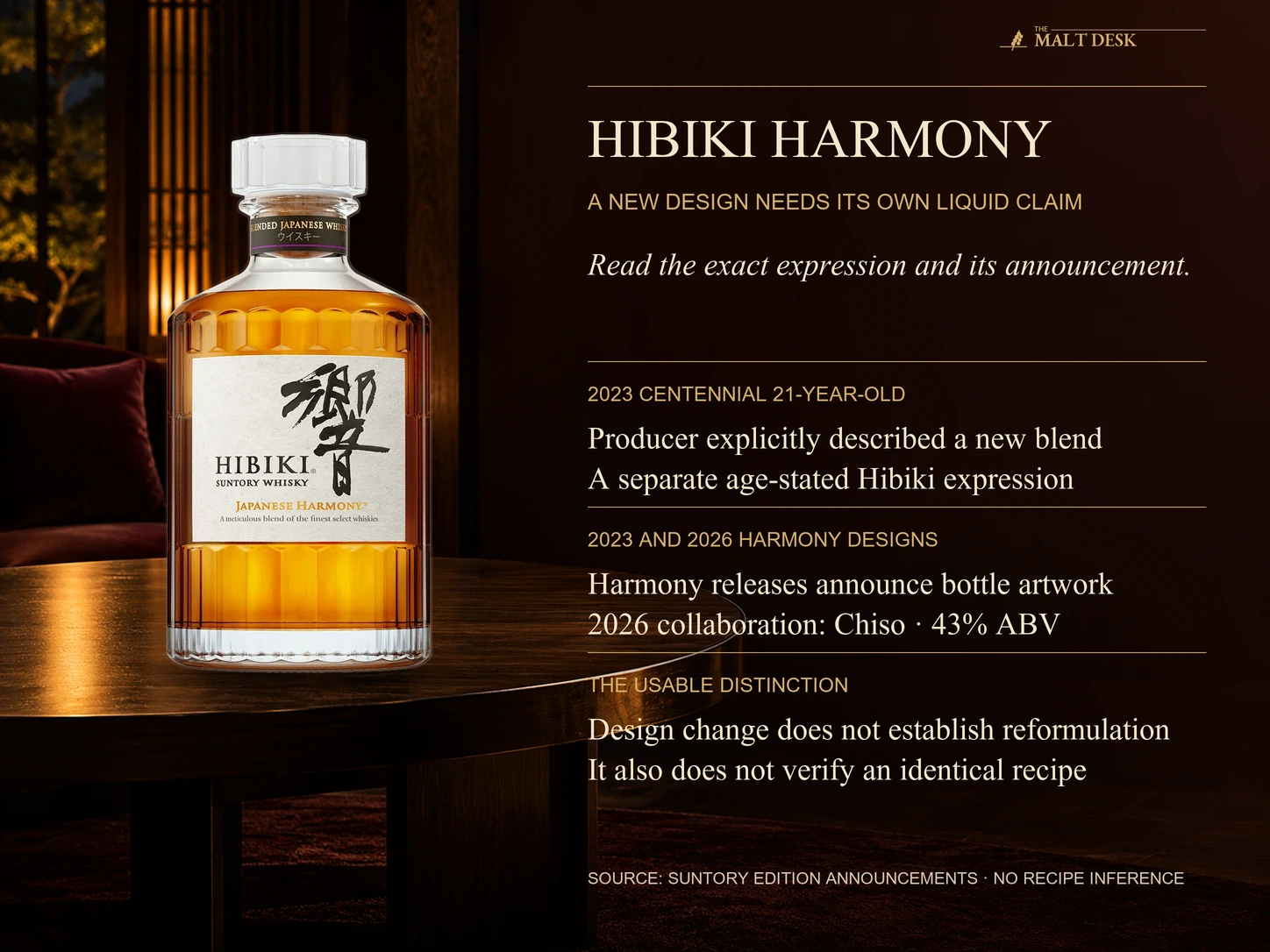
Suntory’s September 2023 announcement introduced a centennial Hibiki 21-Year-Old and a Japanese Harmony bottle design together. For the 21-year expression, it explicitly described creating a new blend with Mizunara placed at the forefront. For Harmony, it described seasonal artwork and a bridge motif. These were two separate releases in one announcement; the new-blend claim belonged to the age-stated expression.
Both were described at 43% ABV. Shared strength and a shared anniversary therefore could not identify which one had the documented new blending approach. Reading only the anniversary headline would lose the most useful distinction. The expression name and the sentence explaining the change must stay attached to each other.
Apply That Reading to the October 2026 Chiso Design
The producer’s October 1, 2026 announcement presents another Japanese Harmony limited-edition bottle design, created with kimono house Chiso. It describes the artwork, the 24-facet presentation and 43% strength. That supplies a concrete design story for this release. It does not supply a new component-age schedule, cask allocation or an explicit reformulation claim.
I would not infer either a different recipe or an independently verified identical recipe from that silence. The usable conclusion is narrower: the stated new feature is the design, while a liquid change remains unestablished by the announcement. A retailer claiming a special new blend needs additional expression-specific evidence; a retailer merely identifying the Chiso artwork is making a different claim.
This is enough to make a practical choice. A reader interested in Chiso’s artwork can compare the actual presentation and total cost with a standard Harmony offer. A reader wanting to explore a disclosed new Mizunara-focused blend should investigate a release that explicitly promises that production change, such as the separately described 2023 centennial 21-year expression, with its own availability and specifications checked.
Serving and Dilution
Neat service preserves the original bottling concentration. Adding water lowers ABV; ice lowers temperature and introduces variable meltwater. Neither a particular cube nor a fixed resting period guarantees a specific aroma.
For example, 30 ml of 43% whisky contains 12.9 ml of pure alcohol. Adding 10 ml water gives approximately 32.25% ABV, assuming additive volumes. Adding 90 ml non-alcoholic soda instead gives about 10.75% before ice melt. Both changes leave the original alcohol quantity in the glass.
The highball guide explains mixer and ratio differences. A recipe with soda and one with sweetened ginger ale are different sensory conditions, even when their ratios match.
Compare Blend Categories and Disclosed Specifications
Chivas Regal 12 is an age-stated blended Scotch; Japanese Harmony is a Japanese blend without an age statement. The country, disclosed age and composition framework differ. Those facts are clearer than asserting that one offers more smoothness per dollar.
Johnnie Walker Blue Label is another blend without an age statement, but it is Scotch. A shared lack of an age statement does not make the two equivalent in recipe, flavor or production.
Price and Expression Checks
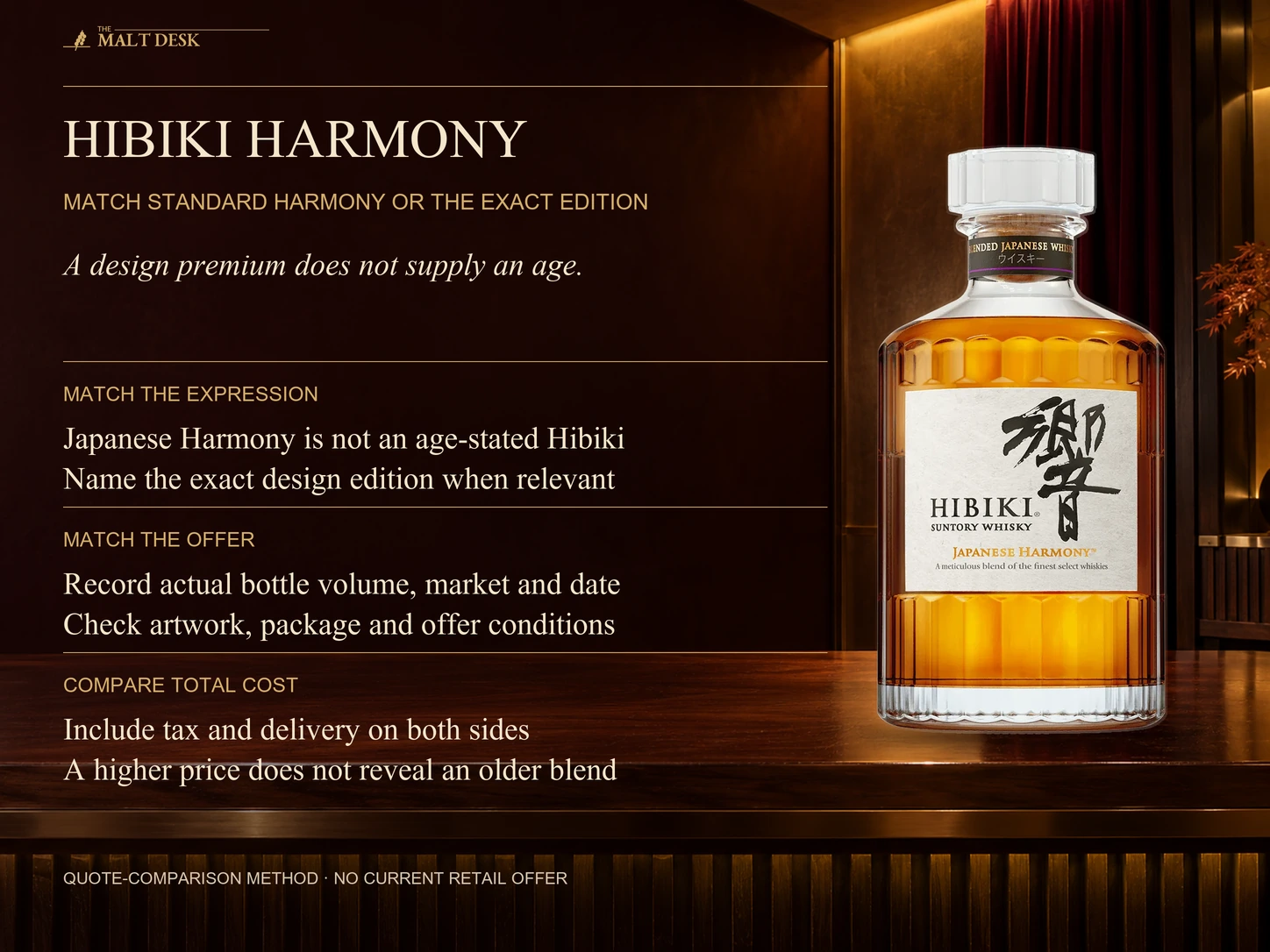
If comparing prices, match bottle volume, market and date. A historical listing should not become a permanent buying threshold, and a higher asking price does not reveal an older component or a stronger formulation.
Separate the Hibiki Liquid From the Presentation
For an interest in Japanese Harmony’s whisky, begin with the standard expression and its disclosed malt-and-grain construction. For a design-led edition, examine what that release’s announcement says about the bottle and the liquid. Value a special presentation as a presentation when that is its documented change, and use a separately identified blend when exploring a different whisky is the aim.
Common Questions
Is Japanese Harmony a single malt?
No. It is a blended whisky containing malt and grain components.
Does it disclose an age?
No. The expression has no age statement, and the component ages should remain unspecified.
Does the flavor description mean Mizunara-only maturation?
No. A note referring to Japanese oak does not establish exclusive maturation or a component percentage.
Does 43% guarantee a gentle taste?
It establishes alcohol concentration. Perceived heat, texture and intensity vary with serving conditions and the individual.
What distinguishes it most clearly on the label?
The Japanese Harmony expression name, blended Japanese-whisky category, 43% strength and absent age statement are the central facts. Keep them separate from packaging appeal and subjective sensory descriptions.
Sources
Suntory, Hibiki Japanese Harmony product information; Japan Spirits & Liqueurs Makers Association standards for Japanese whisky labeling. House of Suntory’s current product page and Suntory’s Japanese product listing were checked October 3, 2026. The Japanese listing supplies the 43% reference and a 700 ml market presentation; it does not establish the volume of every U.S. bottle. The existing Yamazaki/Hakushu/Chita production-network account is retained and is also described in Suntory’s 2018 brand announcement; it is not a complete current blend recipe. Undisclosed component ages, proportions and cask shares remain unspecified.
Additional edition sources: Suntory Global Spirits’ September 18, 2023 centennial announcement and October 1, 2026 Chiso collaboration announcement, checked October 5, 2026. These identify release-specific promises; they do not verify retailer stock, current asking prices or an undisclosed Harmony reformulation.