Bourbon and American Rye: The Core Difference
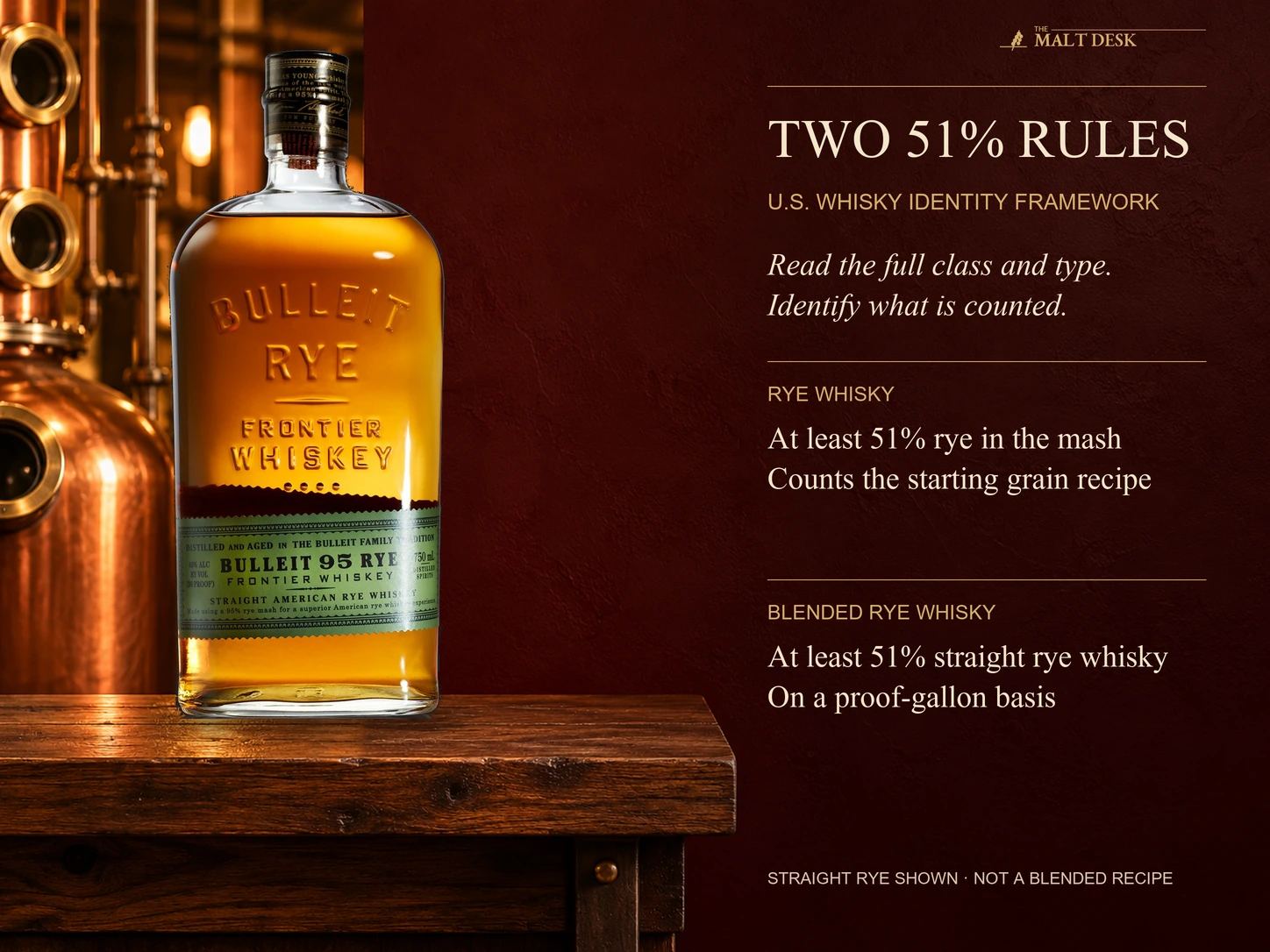
The phrase rye whiskey and the phrase blended rye whiskey should not be reduced to the same 51% statement. For the basic American rye type, the threshold refers to rye in the fermented grain mash. For Blended Rye Whisky, the separate threshold concerns straight rye whiskey’s share of the blend on a proof-gallon basis. The material being counted and the denominator both change.
This matters when choosing a cocktail substitute. Reading only the front-label word rye could hide a different class-and-type composition. I would first identify the full designation, then compare its disclosed recipe and strength. A blending percentage is not a new mash bill for the entire contents.
Bourbon requires a mash containing at least 51% corn; American rye whiskey requires at least 51% rye. Their U.S. production standards share distillation, barrel-entry and new-charred-oak requirements. Grain composition is a category definition.
Caramel and vanilla are common bourbon descriptors, while pepper and herbal notes often appear in rye descriptions. Individual bottles overlap. Proof, maturation, the remaining grains and production decisions all matter, so neither category is automatically smoother or better for a particular cocktail.
Key Takeaways
- Bourbon requires at least 51% corn; American rye requires at least 51% rye.
- Bourbon can be produced anywhere in the United States. It does not have to come from Kentucky.
- This article compares bourbon with rye made under U.S. standards. Rye whisky can also be produced outside the United States when origin is stated appropriately.
- Both categories share a 160-proof distillation ceiling, 125-proof barrel-entry ceiling and new charred oak requirement.
- Basic bourbon and rye standards do not impose a minimum age. The word straight adds a minimum of two years.
- Whiskey aged less than four years requires an age statement under current U.S. labeling rules, unless a specific exception applies.
- Read the recipe, casks and strength alongside the named expression’s producer flavor profile.
- A high-rye bourbon remains bourbon because corn is still the lead grain.
- Compare the named expression’s producer flavor profile alongside its rye percentage.
- At similar proof and price, choose by flavor and cocktail purpose rather than assuming one category is higher quality.
What Is the Main Difference Between Bourbon and Rye?
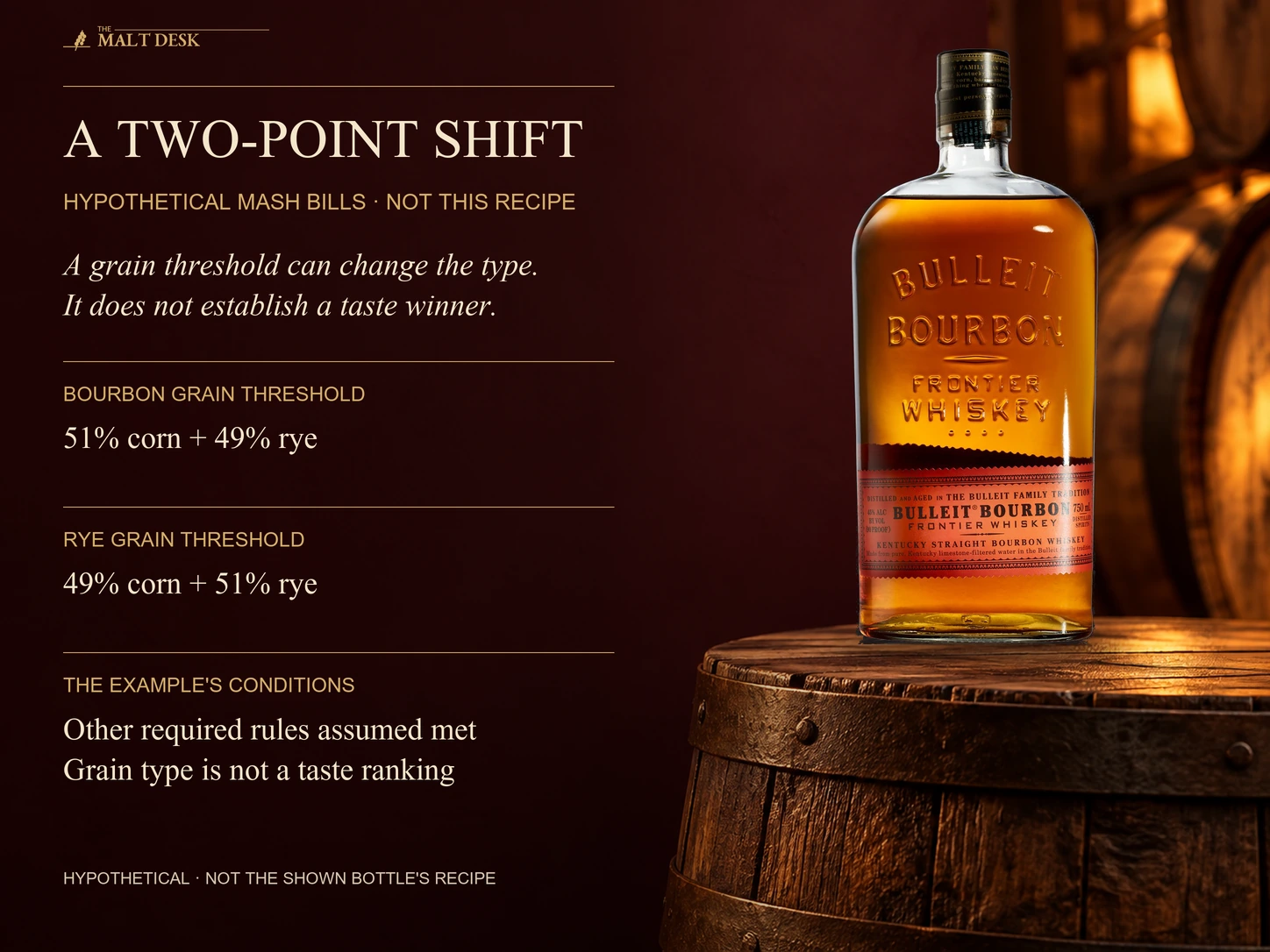
The shortest correct answer is the lead grain. Bourbon begins with at least 51% corn, while American rye begins with at least 51% rye.
The supporting grains are part of the recipe, but they do not establish a universal flavor hierarchy. A hypothetical 51% corn/49% rye mash meets the bourbon grain threshold, while 49% corn/51% rye meets the rye threshold, assuming all other production rules are met. The two-percentage-point shift changes the grain-based classification.
| Comparison | Bourbon | American Rye Whiskey |
|---|---|---|
| Lead grain | Minimum 51% corn | Minimum 51% rye |
| Typical supporting grains | Rye or wheat, plus malted barley | Corn and malted barley |
| Distillation ceiling | 160 proof / 80% ABV | 160 proof / 80% ABV |
| Barrel entry ceiling | 125 proof / 62.5% ABV | 125 proof / 62.5% ABV |
| Required wood | New charred oak | New charred oak |
| Minimum bottling strength | 80 proof / 40% ABV | 80 proof / 40% ABV |
| Minimum age for basic type | No federal minimum | No federal minimum |
| Minimum age with straight | 2 years | 2 years |
| Specific Bulleit producer example | Oak, maple, nutmeg and toffee associations | Oak, vanilla, honey and spice associations |
| Cocktail comparison controls | Measure, mixer, ice and temperature | Measure, mixer, ice and temperature |
The governing U.S. standard of identity for whisky supplies the grain, distillation and storage rules. It also states that bourbon cannot describe whiskey distilled and aged outside the United States.
Does Bourbon Have to Be Made in Kentucky?
No. Bourbon must be distilled and aged in the United States, but it can come from any state. Kentucky is the category’s most famous production center, not the federal boundary of the style.
Regional words create a narrower claim. A label such as New York Bourbon Whisky requires the relevant distillation and aging to occur in New York. Kentucky bourbon similarly makes a location claim on top of the bourbon standard.
Rye requires more careful wording. This article focuses on American rye under U.S. standards. Other countries can make rye whisky under their own rules or use a country-qualified rye designation. Canadian rye, for example, should not automatically be read through the American 51% rule.
Do Bourbon and Rye Use Different Barrels?
Not under the basic U.S. standards compared here. Both go into new charred oak at no more than 125 proof. The common claim that rye uses old bourbon barrels is therefore wrong for whiskey labeled simply as American rye or straight rye under this standard.
The shared barrel rule explains the family resemblance. Both categories can show vanilla, caramelized wood sugars, toast, coconut, baking spice and tannin. Grain changes the starting distillate, but new charred oak gives both an unmistakably American whiskey frame.
Finished whiskey is a separate labeling question. A producer may move mature bourbon or rye into sherry, port, wine or other casks, but the final designation and statement of composition must accurately reflect the treatment. A secondary finish does not erase the original mash bill, yet the label may no longer be as simple as the base type name alone.
Does Bourbon or Rye Have to Be Aged Two Years?
Only when the word straight is used. Straight bourbon and straight rye must spend at least two years in new charred oak. Basic bourbon and rye standards require storage in new charred oak but do not set a federal minimum duration.
There is a second threshold to remember. Under the current U.S. age-statement rule, whiskey aged less than four years must state its age on the label, unless a listed exception such as bottled in bond applies. A straight whiskey with no age statement therefore normally signals at least four years, but that is a label-based regulatory inference rather than a producer’s exact age disclosure.
This distinction prevents two common errors:
- Bourbon must be two years old is false; straight bourbon must be at least two years old is correct.
- NAS straight whiskey is exactly four years old is false; the absent age statement indicates a floor, not an exact recipe age.
Is Straight Rye Different From Regular Rye?
Yes. Straight is not decorative marketing. It adds at least two years of new-charred-oak aging and bars coloring, flavoring and blending materials under the straight-whiskey standard.
The current federal table treats ordinary bourbon and ordinary rye differently on added materials: bourbon does not permit harmless coloring, flavoring or blending materials under its base type, while non-straight rye may permit them. Straight rye does not. In practical shopping, many familiar American rye bottles carry the straight designation, so reading the full class-and-type line matters more than reading the large front-label word alone.
How Does Bourbon Usually Taste?
Specific producer notes are a better reference than a mandatory category flavor. Bulleit Bourbon describes oak, spice, maple, nutmeg and toffee associations. Its product text lists corn, rye and malted barley without a complete percentage recipe.
Recipe, fermentation, distillation, wood and bottling strength are separate facts. Wheat in a bourbon recipe does not guarantee softer perception, and higher proof is an alcohol-concentration statement.
The existing Buffalo Trace vs Maker’s Mark vs Wild Turkey 101 comparison compares product-specific disclosures. It separates the corn-based category, Maker’s wheat distinction and Wild Turkey’s 101-proof reference from attributed sensory vocabulary.
How Does Rye Usually Taste?
Bulleit Rye’s current producer vocabulary includes oak, vanilla, honey and spice associations. Other expressions can have other descriptions. The rye grain threshold does not require mint, dill, a dry finish or an objectively spicier result.
A rye recipe may contain as little as the required 51% rye or a higher disclosed share. Bulleit’s official Rye material identifies 95% rye and 5% malted barley. This is a recipe for that separate expression.
Read the full Bulleit Rye guide for current attributed oak, vanilla, honey and spice descriptions, with expression and label checks. It does not establish mint or dill as mandatory rye-category notes.
Is Rye Always Spicier Than Bourbon?
No. The label identifies a grain threshold. Compare the exact expression’s producer notes and actual strength, using matching preparation conditions if making your own sensory comparison.
The label tells you the legal lead grain. Use mash bill, proof and age together when they are disclosed. If the mash bill is secret, the producer’s notes and a reliable review are more useful than assuming the category answers everything.
What Is High-Rye Bourbon?
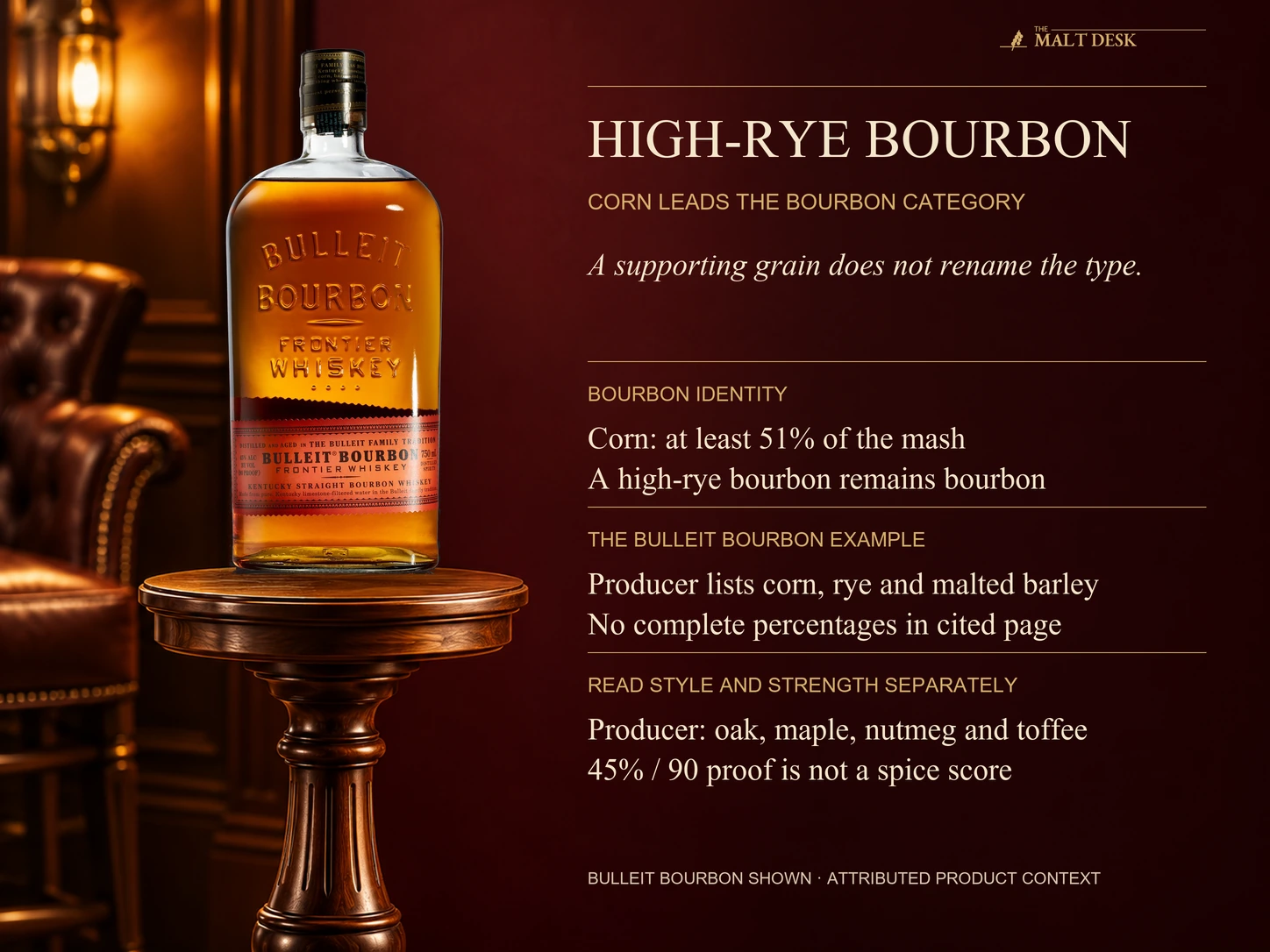
High-rye bourbon is bourbon with a relatively large rye share in the supporting 49% of the mash bill. There is no single federally defined percentage that turns bourbon into high rye. Corn must still remain at least 51%, so the product remains bourbon.
Bulleit Bourbon is a practical example. Its official page describes a high-rye recipe and notes sweet oak, maple, nutmeg and a dry finish. Those attributed notes describe this expression.
Do not confuse these phrases:
- High-rye bourbon: corn remains the lead grain; rye is a large supporting grain.
- Rye whiskey: rye is at least 51% of the mash.
- 95% rye: a rye-heavy grain recipe; read proof in the separate strength field.
What Does Smooth Mean in This Comparison?
Readers may use it to mean low alcohol heat, a rounded texture, restrained spice or familiar sweetness. Those meanings need to be separated before comparing bottles.
Compare the actual ABV and published product descriptions. Keep serving temperature and dilution consistent if making your own comparison.
Two Fifty-One-Percent Rules Count Different Things
Under 27 CFR 5.143, rye’s mash threshold is at least 51% rye grain. The separate Blended Rye Whisky type uses at least 51% straight rye on a proof-gallon basis and can include other whisky or neutral spirits within its framework. This is distinct from Blended Straight Rye Whiskies, another named type. The added words change the identity being described.
For understanding a proportion on a proof-gallon basis, compare the alcohol contributions rather than just the component liquid volumes. In a hypothetical mix of 70 ml straight rye at 40% and 30 ml neutral spirits at 80%, the alcohol contributions are 28 and 24 ml. Straight rye supplies about 53.85% of their combined alcohol contribution, not 70%. This example explains the composition calculation; it is not a brand formula or a full label-approval assessment.
| Invented component mix | Straight rye alcohol contribution | Other alcohol contribution | Straight rye share on the illustrated basis |
|---|---|---|---|
| 70 ml at 40%; 30 ml neutral at 80% | 28 ml | 24 ml | 28 / 52 = 53.85% |
| 60 ml at 40%; 40 ml neutral at 80% | 24 ml | 32 ml | 24 / 56 = 42.86% |
The second mix is majority straight rye by liquid volume, yet falls below the separate 51% composition threshold on that basis. Adding plain water to either would lower final ABV without changing the relative alcohol contributions. Thus a liquid-volume majority and a proof-gallon majority are different tests when component strengths differ.
Read the Finished Type Before Predicting the Cocktail
It explains why a grain-based statement about straight rye cannot be transferred to a differently designated finished blend. The full type and producer account are the starting evidence; an actual cocktail comparison still needs the same measured recipe and the printed ABVs.
Similarly, a Bulleit 95/5 mash disclosure concerns that named rye’s starting grains. It is not a claim that a hypothetical blended rye’s finished contents are 95% rye by either liquid volume or alcohol contribution. Keep raw-material percentages and blending percentages in different fields so the familiar number does not change meaning mid-comparison.
Bourbon and Rye in an Old Fashioned
Both bourbon and rye can be used in an Old Fashioned. Their aroma profiles interact with sugar, bitters and garnish, so the result depends on the entire recipe. A bourbon version is not necessarily sweeter if the recipe uses less sugar or the selected bourbon has a dry profile.
For a useful comparison, keep spirit strength, measure, sweetener, bitters and dilution as similar as possible. Record the result as a preference within that recipe rather than a universal category winner.
Bourbon and Rye in a Manhattan
Rye is a common Manhattan base, and bourbon is also used. Vermouth style, freshness, ratio and bitters can change the balance as much as the choice of category. Pepper or herbal descriptors may help explain a rye selection, but they do not guarantee a drier finished drink.
Bulleit’s published rye Manhattan uses two ounces of rye, one ounce of sweet vermouth and aromatic bitters.
Neat, Water and Ice
Either category can be served neat or with water or ice. Start with the actual bottling strength and individual preference. Adding water lowers alcohol concentration; ice also changes temperature as it melts. Neither method guarantees that every bourbon becomes softer or every rye loses its spice.
Is Rye Whiskey More Expensive Than Bourbon?
Not necessarily. Production scale, age, proof, brand position, inventory and local distribution matter more than the lead grain by itself.
The earlier Target figures do not have complete original location, stock and offer-condition records, so this guide does not use them as a current offer or verified historical price comparison. Match exact expressions, bottle volumes and final local totals.
The lead grain does not supply a retail price rule. Record seller, location, date, stock, tax, delivery and discounts; normalize final totals by bottle volume. A lower unit cost is a quantity comparison, not a universal preference.
How to Compare the Categories
Begin with label information: full type, ABV, age if stated and a disclosed mash bill. Similar strength and preparation make a comparison easier to interpret. Producer flavor notes provide reference vocabulary.
The Woodford Reserve guide and Bulleit Rye profile give individual product examples. They should be read as specific expressions rather than definitions of an entire category.
How Do You Read a Bourbon or Rye Label?
Use this order:
- Read the full type: bourbon, rye, straight bourbon or straight rye.
- Check proof and ABV. Proof is twice the ABV in the United States.
- Look for an age statement. Under four years, one is generally required.
- Find the mash bill only if the producer discloses it; many brands do not.
- Separate finish claims from the base category.
- Compare the current local price with bottles of similar proof and age.
Do not use color as a shortcut. Darker whiskey may reflect age, barrel conditions, proof, batch blending or photography. It does not tell you whether corn or rye led the mash.
Reading the Categories Together
Bourbon and American rye share important production requirements. The main grain threshold distinguishes their categories, while age, proof and production details help distinguish individual bottles. High-rye bourbon remains bourbon; a 95% rye mash is a particular recipe rather than the rye category minimum.
Cocktail preference and neat-serving preference are separate questions. Compare the actual products and preparation instead of turning the grain rule into a quality ladder.
Keep Each Rye Percentage With What It Counts
For American rye whiskey, read the rye share of the fermented grain mash. For Blended Rye Whisky, read the separate straight-rye share on the stated proof-gallon basis. Write the material and denominator beside the percentage before comparing labels. That simple record resolves a composition question more reliably than carrying one 51% rule across different categories.
Frequently Asked Questions
Is bourbon sweeter than rye?
Sweetness perception is not defined by the bourbon or rye grain threshold. Use product-specific descriptions and consistent serving conditions.
Is rye whiskey stronger than bourbon?
Not by definition. Both must be bottled at 40% ABV or higher, and both can appear at much higher proof. Compare the label, not the category name.
Does bourbon have to come from Kentucky?
No. It must be distilled and aged in the United States. Kentucky is a major and historic source, not the only legal state.
Does rye have to contain 95% rye?
No. American rye needs at least 51% rye. Bulleit 95 Rye is a specific 95% recipe, not the category minimum.
Are bourbon and rye aged in different barrels?
Not under the U.S. base standards discussed here. Both require new charred oak. Secondary finishes can add other casks and may require additional label wording.
What does straight bourbon or straight rye mean?
It means at least two years in new charred oak and no coloring, flavoring or blending materials under the straight-whiskey standard. Whiskey under four years also generally needs an age statement.
Is bourbon or rye better for an Old Fashioned?
Both can be used. The selected expression, sweetener, bitters and dilution determine the final balance.
Is bourbon or rye better for a Manhattan?
Rye is a common base; bourbon is also used. Vermouth and recipe proportions are essential to the comparison.
Is rye always more expensive?
No category definition requires rye to cost more. Compare equivalent dated local offers; this guide does not establish a current national price relationship.
Can a high-rye bourbon taste like rye whiskey?
High-rye bourbon remains corn-majority bourbon. A 95% rye expression has a different disclosed grain recipe.
Sources
27 CFR 5.143 for U.S. identity and added-material rules; 27 CFR 5.74 for age labeling; current Bulleit Bourbon and official Rye material, checked October 4, 2026. Hypothetical 51/49 mash bills assume other required production conditions.
Label-composition analysis note: identity distinctions follow 27 CFR 5.143. Component mixes are hypothetical and explain proportional alcohol accounting, not a brand recipe or complete compliance assessment. Mash percentages and blend percentages have different denominators.