Quick Answer
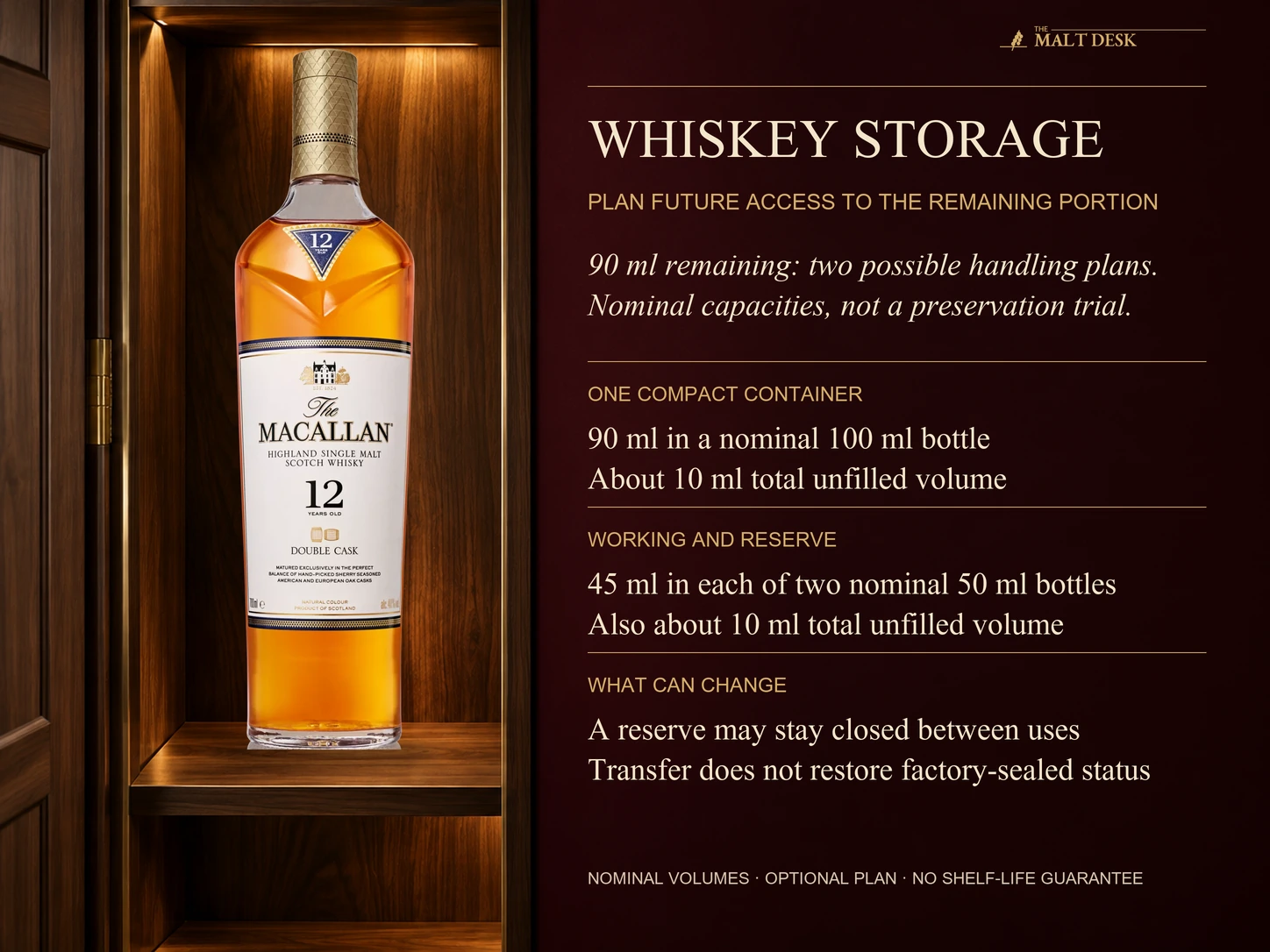
A smaller bottle addresses empty space, but another practical question is how often the saved portion will be opened. If a low-fill whisky is intended for several future occasions, a working portion and a separately closed reserve portion can divide those opening events. This is a storage plan to consider, not a tested promise of longer flavor life.
The distinction is useful because it does not require an invented expiry date. A reader can choose whether one compact bottle is simpler or whether a small reserve should remain closed between uses. Both plans still need sound closures, clean dry glass and the same protection from light and unstable temperatures.
Store whiskey upright, away from direct light, at a cool and stable room temperature, and with the cork or cap tightly closed. The Macallan recommends 15–18°C, while The Glenlivet gives a slightly wider 15–20°C target. In an ordinary home, stability matters more than chasing one exact number: a shaded interior cabinet is better than a hot kitchen shelf, sunny bar cart, balcony or constantly changing garage.
Unopened whiskey does not continue to mature in the bottle. With a sound seal and good storage, it can remain stable for many years. Opened whiskey is also far more shelf-stable than wine, but its aroma and flavor can slowly change as the bottle gains headspace. Oxygen exposure is only part of that change; evaporation and loss of volatile aroma compounds also matter.
Do not assign a fixed six-month expiry to every bottle. Reseal after pouring and track the fill level and conditions. The Macallan’s below-one-third transfer suggestion is a producer quality guideline, not a universal threshold. If transferring, use a clean, fully dry, food-safe glass container with a reliable airtight closure.
Key Takeaways
- Keep whiskey upright. Unlike wine, it should not remain in constant contact with the cork.
- Block direct sunlight and strong UV. Light can fade the whiskey, label and packaging.
- Aim for a cool, stable room temperature. About 15–20°C is a useful producer-backed range.
- Avoid kitchens, radiators, window ledges, balconies, attics, cars and other hot or fluctuating locations.
- A freezer is unnecessary. Very low temperatures can dull aroma, thicken texture and cause temporary cloudiness.
- Unopened whiskey does not age further in glass. Storage preserves it; it does not improve it.
- Opened whiskey has no universal expiration date. Seal quality, fill level, temperature and opening frequency all matter.
- The Macallan’s below-one-third transfer suggestion is a producer guideline rather than a universal cutoff.
- Decorative decanters are for serving unless they seal reliably. Lead crystal should not be used for long-term storage.
- A dark cabinet, sound closure and a few small glass bottles are more useful than complicated preservation gadgets.
What Is the Best Way to Store Whiskey?
The four basic controls are position, light, temperature and seal. They apply to Scotch, bourbon, rye, Irish whiskey and Japanese whisky alike.
| Factor | Best practice | Why it matters | Avoid |
|---|---|---|---|
| Position | Store upright | Limits prolonged high-proof contact with cork | Laying bottles down like wine |
| Light | Use a closed cabinet or original box | Protects liquid color, flavor, label and package | Direct sun and bright window display |
| Temperature | Keep cool and stable, ideally near 15–20°C | Slows evaporation and avoids repeated expansion and contraction | Heat sources and large daily swings |
| Seal | Close firmly and inspect damaged corks or caps | Reduces vapor loss and outside-air exchange | Loose stoppers and cracked corks |
The Macallan storage guide supplies all four principles and gives 15–18°C as its preferred room-temperature range. The Glenlivet’s storage guide recommends a consistent 15–20°C and also advises against refrigerators and freezers.
Should Whiskey Be Stored Upright or on Its Side?
Store it upright. A wine bottle is laid down so low-alcohol wine can keep a natural cork swollen. Whiskey creates a different problem: prolonged contact with 40% ABV or stronger spirit can degrade a closure rather than protect it.
Upright does not mean the cork can be ignored forever. Natural cork can dry, crack or crumble over very long storage. Macallan suggests occasionally tipping a long-held bottle briefly to wet the cork, then returning it upright. Treat that as periodic closure care, not permission to store whiskey horizontally.
For ordinary drinking bottles, the better routine is simpler: keep them upright, remove and replace the cork gently, and replace a damaged closure with a clean, compatible stopper before the seal fails.
Does Light Damage Whiskey?
Direct sunlight is one of the easiest risks to remove. UV exposure can fade the liquid and affect flavor over time. It can also bleach a label and gift box long before the whiskey itself appears obviously damaged.
A glass-fronted cabinet is acceptable only when it is sheltered from direct sun. A closed cabinet or original box offers better protection. A premium bottle displayed for photographs can go back into dark storage afterward; it does not need to live on the brightest shelf.
What Temperature Should Whiskey Be Stored At?
About 15–20°C is a useful target, but a stable location is more important than a perfect thermostat reading. These producer ranges are storage guidelines, not a comparison test for every bottle. Record the location, light exposure, closure condition and temperature variation instead of judging preservation quality from one temperature reading.
Heat accelerates evaporation and stresses the seal. Repeated temperature swings move vapor and liquid inside the bottle and can expose a weak cork or cap. Common bad locations include the top of a refrigerator, a shelf beside the oven, a radiator, a sunny enclosed porch, an attic and a car trunk.
Should whiskey be refrigerated?
No refrigeration is required for preservation. Whiskey’s alcohol level makes it shelf-stable under normal room conditions. A refrigerator is not automatically harmful, but it adds no practical advantage for long-term storage and may mute aroma when the whiskey is served cold.
Can whiskey go in the freezer?
It can become very cold without freezing solid in a typical home freezer, but that does not make the freezer a good storage cabinet. The cold suppresses aroma, makes the liquid more viscous and may create temporary haze. If the goal is a cold pour, chill the glass or use ice at serving time rather than storing the bottle there.
Does Unopened Whiskey Expire?
A properly sealed unopened bottle can remain drinkable for decades when protected from heat and light. It does not continue to gain age, oak character or maturity after bottling because it is no longer interacting with a cask.
That does not make every sealed bottle invulnerable. Corks can shrink, closures can loosen, fill levels can fall and labels can fade. For a collectible bottle, inspect it visually from time to time for seepage, a dropping fill line, a raised or crumbling cork, sticky residue around the neck and unusual cloudiness.
Do not break an intact seal just to check the whiskey. Store the bottle upright in its original packaging, keep purchase records and photographs, and monitor the exterior condition.
How Long Does Whiskey Last After Opening?
There is no single expiration date for every opened bottle of plain whisky. Closure condition, storage temperature, the amount remaining and how often the bottle is opened affect its condition. A quality-preservation suggestion is not a food-safety deadline.
The Glenlivet’s current storage guide describes properly stored opened whisky as lasting a couple of years. The Macallan instead suggests transferring whisky to a smaller container once less than a third remains. These are producer guidelines, not guarantees that a particular bottle changes on a precise day or at a precise fill line.
Reducing empty space is one consideration, but a reliable seal remains essential. A smaller container with a poor closure is not an improvement. Flavor changes can involve loss of volatile compounds as well as chemical changes; “oxidation” is not a complete explanation for every storage effect.
When Should You Transfer Whiskey to a Smaller Bottle?
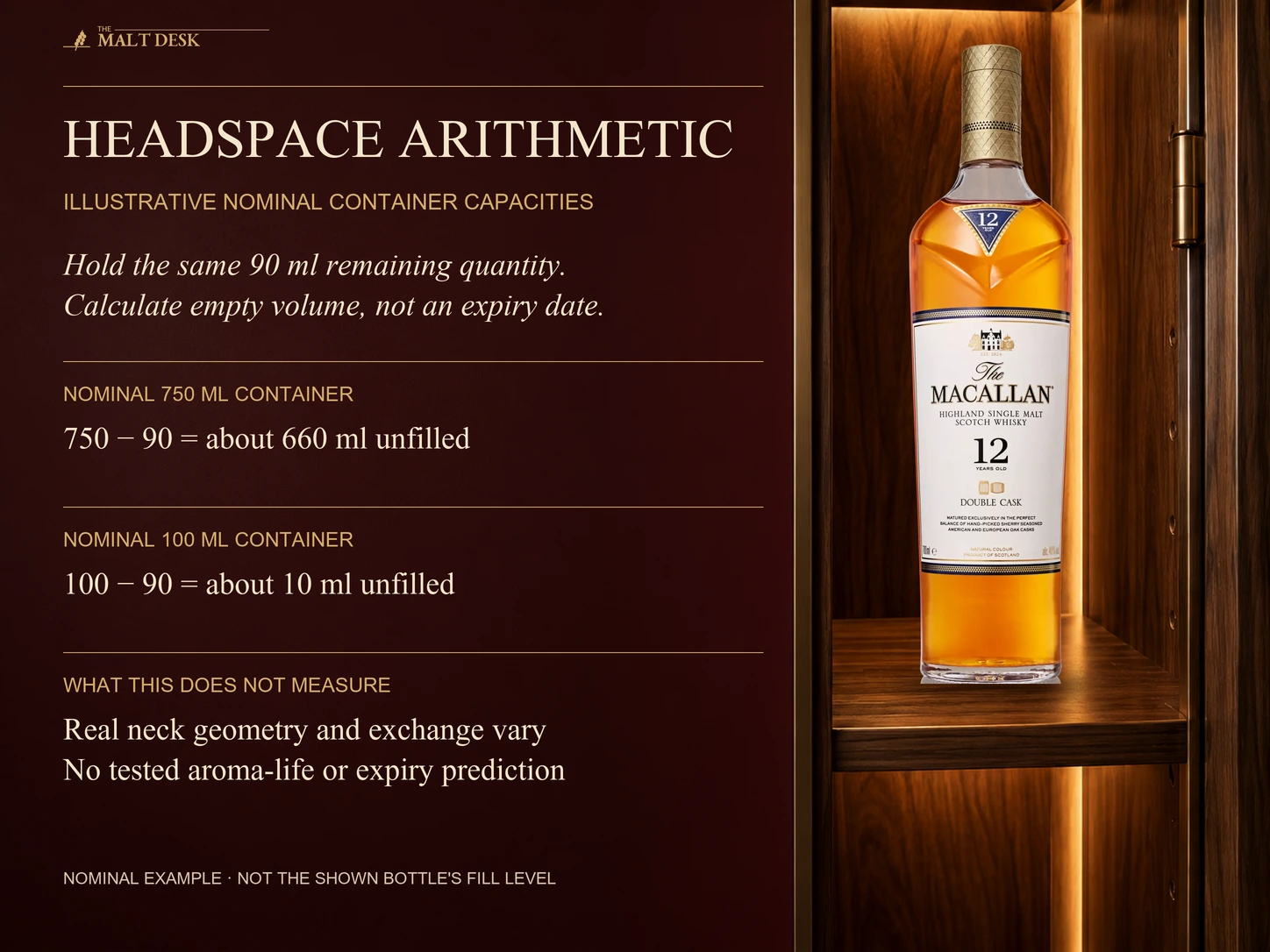
For an illustrative 750 ml container holding 90 ml whisky, the unfilled volume is approximately 660 ml. A 100 ml container holding the same amount has approximately 10 ml unfilled volume. The calculation uses nominal capacities; real bottles have additional neck/headspace geometry. It shows a volume difference, not a guaranteed preservation period or expiry date.
Use a smaller bottle when all three conditions apply:
- The fill level is low and recorded alongside closure condition; one third is a producer suggestion, not a universal cutoff.
- The whiskey is valuable, delicate or worth preserving carefully.
- You do not expect to finish it soon.
If 150ml remains and friends will finish it next weekend, decanting creates work without much benefit. If the same amount is meant to last another year, reducing headspace is reasonable.
How to transfer whiskey safely
1. Choose a food-safe glass bottle close to the remaining volume. Amber glass adds light protection, but clear glass is fine inside a dark cabinet.
2. Use a closure designed to seal tightly. A quality screw cap with an appropriate liner is usually more predictable than a decorative loose cork.
3. Wash the bottle and funnel, then let both dry completely. Residual water dilutes the whiskey; detergent odor can contaminate it.
4. Pour through a clean small funnel without splashing more than necessary.
5. Leave minimal headspace without filling into the closure. Mark the whiskey name, bottling proof or ABV, and transfer date.
6. Store the new bottle upright, dark and stable just like the original.
Avoid unknown plastics for long-term storage, strongly scented containers, reused medicine bottles and anything that cannot be cleaned or sealed reliably.
Are Whiskey Decanters Good for Storage?
Most decanters are better for serving than preservation. Macallan specifically warns against long-term decanter storage unless the stopper seals properly. A loose glass stopper allows gradual evaporation and provides no advantage over the original bottle.
Material matters too. Older lead-crystal decanters can leach lead into alcoholic drinks. Published studies found substantial lead accumulation in beverages stored in lead crystal, including spirits. Use verified lead-free glass for whisky containers rather than relying on the appearance of decorative crystal. The risk is documented in Lead exposure from lead crystal and related public-health research.
If a decanter will be used, choose verified lead-free glass, make sure the stopper is genuinely airtight, keep it dark, and record what is inside. Even then, the original labeled bottle is usually the safer long-term container.
The Same Total Headspace Can Have Different Opening Patterns
Imagine 90 ml remaining. One nominal 100 ml bottle gives about 10 ml empty space. Two nominal 50 ml bottles, each filled with 45 ml, also give about 10 ml empty space in total. This nominal-capacity arithmetic ignores the actual neck geometry, but it shows that merely splitting the amount has not necessarily reduced the aggregate empty volume.
The opening pattern can nevertheless differ. In the single bottle, every pour opens access to the entire remaining quantity. In the two-bottle plan, one can be the working bottle while the reserve remains closed until needed. That describes which portion experiences repeated opening; it does not quantify oxygen exchange, aroma loss or a guaranteed advantage for a particular whiskey.
Only Split When the Reserve Has a Purpose
The extra transfer brings extra handling, another closure to inspect and another label to maintain. If the whisky will be used soon, one suitable container can be the simpler plan. If a portion is being held for a separately planned future comparison, keeping that reserve closed can make the intended handling history easier to record. A poorly sealing second bottle would undermine the point.
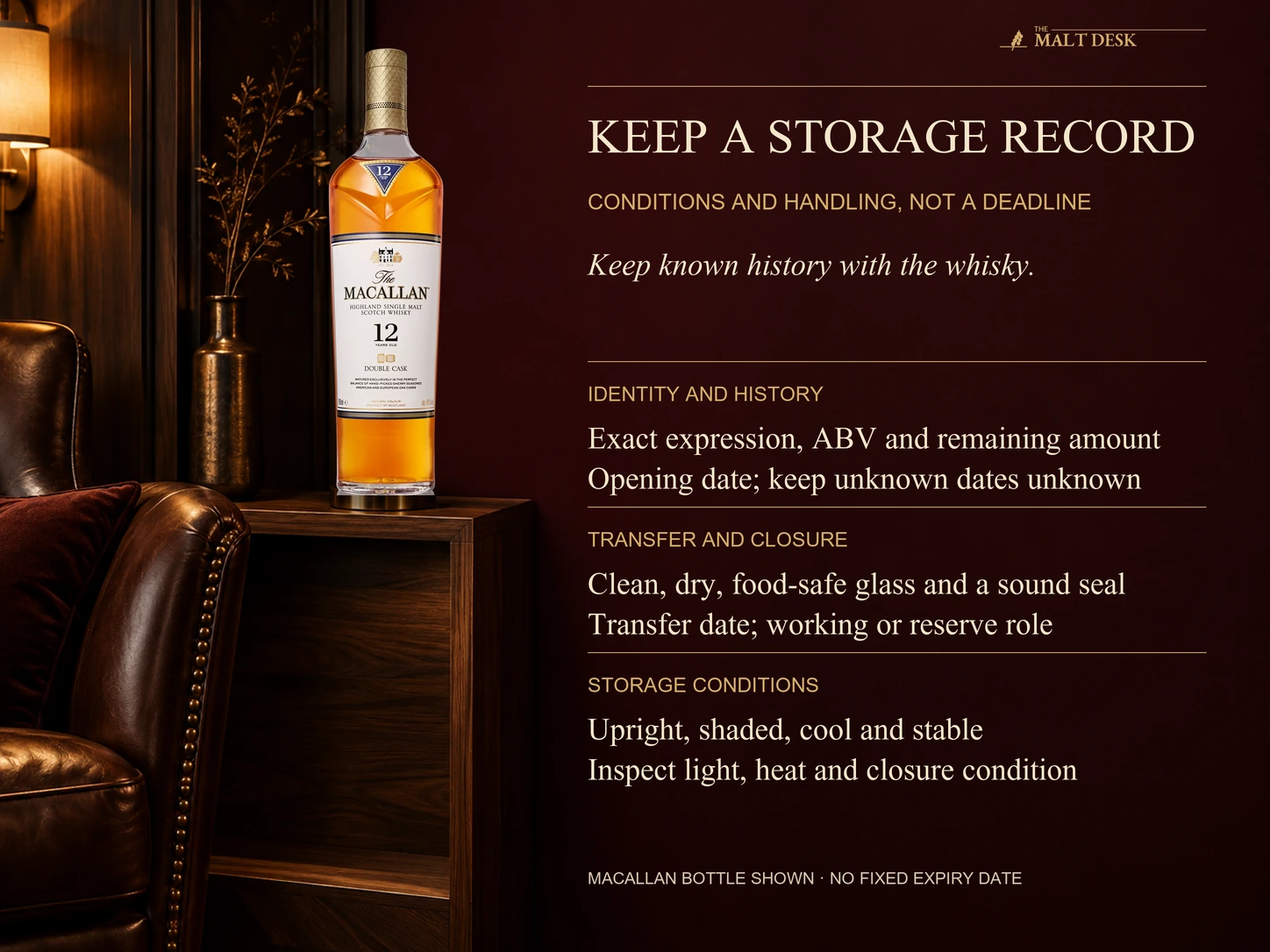
Choose the reserve amount around that known purpose without filling into the closure. Label both with the exact expression, printed ABV, transfer date and any known opening or batch details. Identify which is working and which is reserve. If the original opening date is unknown, retain that uncertainty rather than imply the reserve was never opened before the split.
The reserve is only newly closed in its new container. It has already shared the original bottle’s storage and opening history, and transfer does not undo it. Any later notes should retain that history along with the new container’s handling. The plan changes future access to a portion; it does not restore factory-sealed status or restart maturation.
Which Whiskey Storage Accessories Are Worth Buying?
The useful kit is modest.
| Priority | Item | Best use | Judgment |
|---|---|---|---|
| Essential | Dark cabinet or original box | Light protection | Provides light protection |
| Essential | Sound original cork or cap | Vapor and air control | Replace if damaged |
| Useful | 50–250ml food-safe glass bottles | Low-fill bottles held for months | Reduces headspace when appropriately sized |
| Useful | Small stainless funnel | Clean transfer | Rinse and dry fully |
| Useful | Date labels or bottle log | Track opening and transfer | Simple and effective |
| Optional | Food-grade inert gas | Rare bottles with large headspace | Niche; not a substitute for sealing |
| Low priority | Wine vacuum pump | Designed and tested mainly for wine | No clear need for ordinary whiskey |
| Container check | Verified lead-free glass with an airtight closure | Serving or transfer when a suitable seal is available | Keep the original labeled bottle if the decanter material or seal is uncertain |
Inert gas can reduce oxygen in the headspace, but it must be food-grade, applied correctly and often reapplied after opening. It is a collector’s option, not the first purchase for a normal home bar. A small airtight glass bottle solves the larger headspace problem more directly.
Wine vacuum pumps are also not the default recommendation. Whiskey changes more slowly than wine, and consumer vacuum systems are not designed around retaining a spirit’s volatile aroma balance for years. Spend the money on reliable small bottles and a dark cabinet first.
A Practical Storage Routine for a Home Bar
1. Put every bottle upright in a shaded interior cabinet.
2. Keep bottles away from kitchens, heating vents and bright windows.
3. Close the cork or cap immediately after pouring and wipe sticky residue from the neck.
4. Note the opening month for special bottles.
5. When a bottle reaches one third, decide whether it will be finished soon or held for months.
6. Transfer only long-hold low bottles into clean, dry, airtight glass containers.
7. Inspect valuable sealed bottles occasionally without breaking the seal.
This routine works whether the shelf holds smoky Scotch, high-proof bourbon or lighter Japanese blends. The category changes the flavor, not the basic storage physics. For the category differences, see Types of Whiskey Explained.
Serving methods are a separate question from long-term storage. The how to drink whiskey guide covers neat pours, water, ice and highballs; the highball guide explains mixed-drink preparation.
Final Verdict
Good whiskey storage is less technical than it looks. Keep bottles upright, dark, cool, stable and tightly sealed. Do not lay them down like wine, leave them in direct sun or use the freezer as a cabinet.
Opened bottles do not cross a universal quality-change line at six months or one third full. Inspect the closure and storage conditions, and record the remaining amount. A suitable smaller container reduces headspace.
The best storage accessories are therefore a closed cabinet, reliable closures, a few clean small bottles, a funnel and simple labels. Decorative decanters, vacuum gadgets and elaborate preservation systems come later—if they are needed at all.
Plan Storage Around the Next Opening
Keep a working portion for the next few occasions and a separately closed reserve when the remaining whisky is intended for later use. Use suitable clean glass containers, sound closures and clear expression labels, and store them upright away from heat and sunlight. Choose portion sizes around the expected opening pattern so the storage plan remains practical to maintain.
FAQ
Does unopened whiskey go bad?
Not under normal conditions when the seal is sound. It can remain drinkable for decades, but it does not continue to age after bottling. Heat, light and a failed closure can still damage it.
How long is whiskey good after opening?
There is no universal expiration date. Producer quality guidelines vary and do not establish a universal six-month deadline. Fill level, temperature, opening frequency and closure condition matter more than the calendar alone.
Should whiskey be stored upright?
Yes. Store it upright so high-proof alcohol does not remain in constant contact with the cork. A brief periodic tip for a long-held natural cork is different from horizontal storage.
What temperature is best for whiskey storage?
About 15–20°C is a useful target from official producer guidance. A cool, shaded and stable cabinet matters more than maintaining one exact number.
Can whiskey be stored in the refrigerator?
It does not need refrigeration. A refrigerator adds little preservation benefit and cold serving temperatures can mute aroma. Use a cabinet for storage and chill the pour only when desired.
Can whiskey be stored in a decanter?
Only when the decanter is lead-free and genuinely airtight. Most decorative decanters are better for serving. The original labeled bottle is usually safer for long-term storage.
When should whiskey go into a smaller bottle?
The Macallan suggests transfer below one third remaining. Treat that as producer guidance, alongside anticipated holding time and closure condition. Use a clean, dry, food-safe glass bottle with an airtight cap, retaining the expression and opening/transfer dates.
Does whiskey oxidation make it unsafe?
A change in aroma is not a test of safety. Contamination, a failed closure, debris or unexplained changes require inspection; this storage guide does not establish whether a particular bottle is safe to consume.
Sources
The Macallan, Guidance for Storing Your Whisky; The Glenlivet, How to Store Whisky, checked October 4, 2026. Graziano and Blum, Lead exposure from lead crystal (Lancet, 1991), documents leaching from the tested containers, not every modern glass. Headspace examples are nominal-volume arithmetic and do not establish expiry or a guaranteed flavor-preservation period.
Storage-plan analysis note: container volumes are hypothetical nominal capacities. The working-and-reserve split is an optional plan for managing future openings.