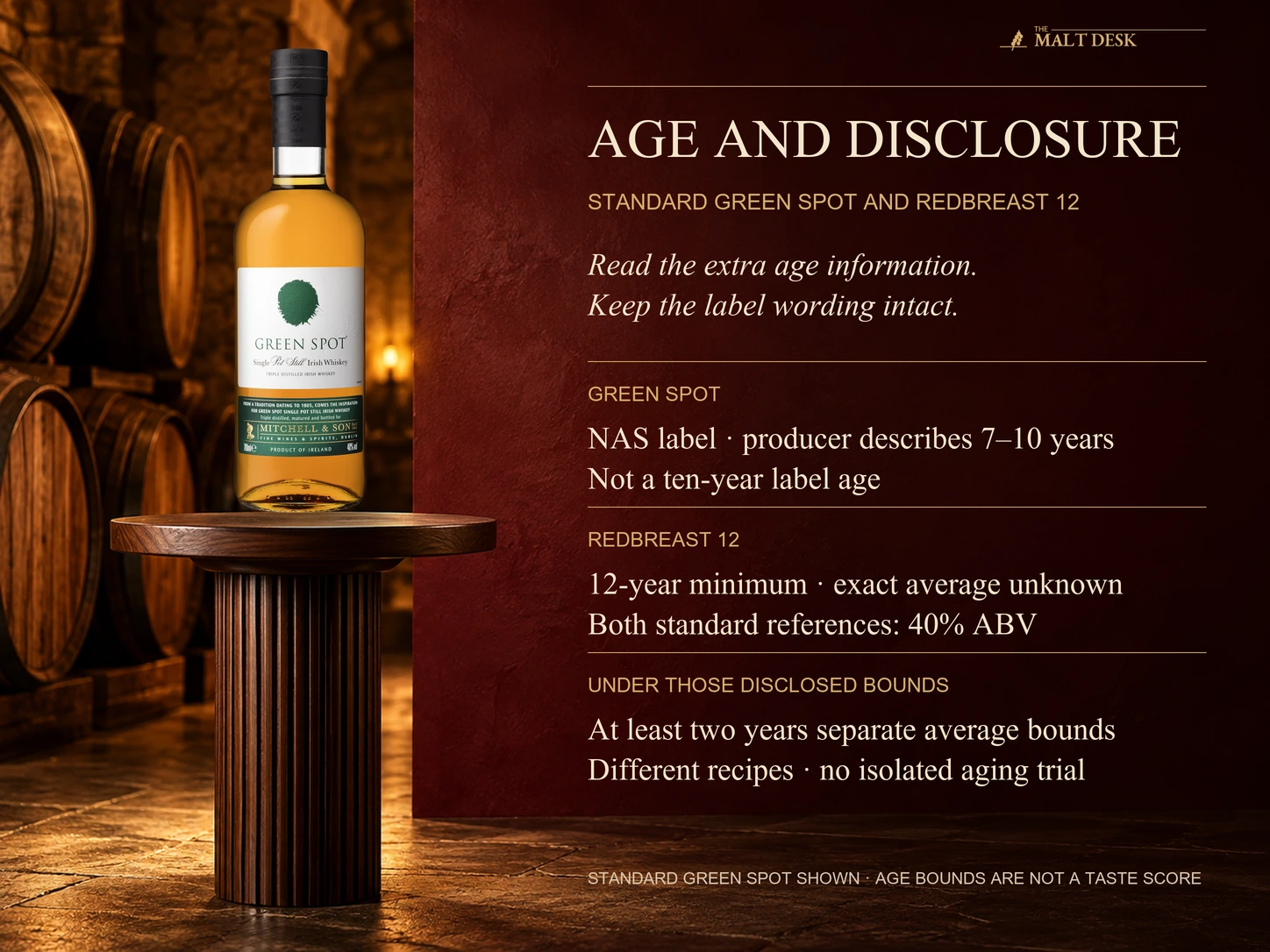
Green Spot versus Redbreast 12 is more informative than an ordinary no-age-statement versus twelve-year comparison. Spot Whiskey supplies a seven-to-ten-year component range for standard Green Spot. Read literally as that production account, the upper end is below Redbreast’s twelve-year minimum. The extra disclosure provides an age distinction that the letters NAS alone would not supply.
I would retain the different sources of those facts: a producer’s component account for Green Spot, and an age statement for Redbreast. They do not have identical status, and the range does not become a new age on Green Spot’s label. But they let a reader ask a more precise maturation question without treating every unstated age as completely unknown.
Green Spot and Redbreast 12 are single pot still Irish whiskeys from Midleton Distillery in County Cork. Both combine malted and unmalted barley, triple distillation and bourbon- and sherry-cask maturation, and both standard expressions are bottled at 40% ABV. Their clearest documented difference is age: Redbreast carries a 12-year statement, while Green Spot has no age statement on its label and its producer describes components aged seven to ten years.
The comparison below separates those production facts from the producers’ tasting descriptions. Green Spot’s published notes emphasize orchard fruit and green apple; Redbreast’s emphasize fruit, spice, sherry and toasted wood. Those descriptions provide a useful vocabulary for understanding the styles, without establishing a universal winner.
Production Details at a Glance
| Feature | Green Spot | Redbreast 12 |
|---|---|---|
| Category | Single pot still Irish whiskey | Single pot still Irish whiskey |
| Distillery | Midleton, County Cork | Midleton, County Cork |
| Standard strength | 40% ABV / 80 US proof | 40% ABV / 80 US proof |
| Age information | No label age statement; producer describes 7–10-year components | 12-year age statement |
| Grains | Malted and unmalted barley | Malted and unmalted barley |
| Distillation | Triple distilled in copper pot stills | Triple distilled in copper pot stills |
| Published cask information | Bourbon, refill bourbon and sherry casks | Bourbon and sherry casks |
What “Single Pot Still” Means
The word single identifies production at one distillery. It does not mean one grain, one barrel or one distillation. Pot still describes the production category, which distinguishes these whiskeys from single malt and blended Irish whiskey. Both Green Spot and Redbreast contain whiskey made with malted and unmalted barley; neither is a single malt.
Triple distillation is a shared feature of these two products, rather than a reason to treat every Irish whiskey as identical. Distillation choices, maturation and the selection of components can produce different expressions within the same category. The single pot still Irish whiskey guide explains the terminology in more detail.
Age Statement: Label Guarantee Versus Producer Description
Redbreast 12’s age statement refers to the youngest whiskey in the bottle. It does not disclose the average age or the age of every component. Green Spot’s seven-to-ten-year range is information supplied by the producer, rather than a seven-year statement printed as the expression’s name.
This difference matters when documenting the bottles: “12 years” and “no age statement, with a disclosed component range” are accurate descriptions. Calling Green Spot simply a ten-year-old whiskey would be misleading. Equally, the absence of a front-label age does not mean that the producer has supplied no maturation information.
Age alone cannot establish which whiskey will be preferred. Cask condition, previous contents and blending decisions also shape the result. An older minimum age is a measurable distinction.
How the Cask Descriptions Differ
Green Spot’s producer lists bourbon, refill bourbon and sherry casks. Its wording includes “new bourbon” casks alongside refill bourbon casks; this should not be casually rewritten as maturation in virgin, previously unused oak. Prior cask use is part of the information being conveyed.
Redbreast’s standard 12-year expression is described as matured in bourbon and sherry casks. The product information does not provide a precise percentage for each cask type. A flavor description mentioning sherry therefore does not establish a numerical sherry-cask share, and a particular dried-fruit note cannot reveal the recipe.
The presence of both cask types is a similarity; their selection and combination are potential sources of difference. It would be too strong to attribute every contrast solely to age or to claim that one component always dominates without supporting production information.
Comparing the Producers’ Tasting Notes
Green Spot: orchard fruit, barley and spice
Green Spot’s published aroma description combines fruit, barley, aromatic oils and wood with spice. Green apple, clove and toasted oak appear in the palate description, with barley and spice continuing into the finish. These are sensory analogies, not a list of ingredients added to the whiskey.
The official vocabulary places fresh fruit near the center of the description. The separate Green Spot product guide covers the expression and its background.
Redbreast 12: fruit, sherry and toasted wood
Redbreast’s producer describes a combination of fruit and spice with wood on the nose, followed by a silky palate incorporating sherry, fruit and toast. It describes the finish as long.
The practical difference in the published language is emphasis: Green Spot explicitly foregrounds green apple and barley, while Redbreast gives sherry a more prominent place. Both descriptions include spice, fruit and wood. See the Redbreast 12 product guide for the standard bottling’s details.
Comparing Texture and Alcohol Warmth
Both standard expressions have the same alcohol concentration. Smoothness can mean low alcohol irritation, a rounded texture or restrained spice, and different readers may use the word for different sensations.
A useful comparison names the actual characteristic: apple-like fruit, sherry-associated notes, toasted wood, spice or texture. Claims that one bottle is automatically easier for every beginner combine several subjective judgments into a single label.
A Disclosed Ceiling Changes the Comparison
If all Green Spot components fall within the producer’s stated seven-to-ten-year range, their weighted average must also fall within that range. Redbreast 12’s components are at least twelve years old, so its weighted average cannot be below twelve. Under those disclosed bounds, the averages are separated by at least two years. Their exact values, and the exact gap, remain unknown.
This differs from comparing a generic ten-year label with a twelve-year label. A ten-year minimum by itself supplies no upper bound: substantial older stocks could raise the average above twelve. Green Spot’s separate upper-range disclosure is the information that permits the tighter inference here. It should not be generalized to all NAS products, or even copied to a wine-cask Green Spot edition with its own finishing history.
| Evidence for this standard-expression comparison | Useful inference | Still unknown |
|---|---|---|
| Green Spot producer range: 7–10 years | Components and their average fall within that stated account | Weights and exact batch average |
| Redbreast 12 label minimum | No component below the twelve-year guarantee | Upper component ages and exact average |
| Both accounts considered together | At least two years separate their average-age bounds under those accounts | A precise average-age gap or the cause of a sensory preference |
More Age Information Does Not Turn This Into an Aging Trial
Neither disclosure holds the casks, component proportions or spirit selection constant between the bottles. Both come from Midleton and are bottled at 40%, but that does not make Green Spot an earlier snapshot of Redbreast. The clarified age relationship is useful evidence about maturation; it is not an experiment isolating the flavor effect of time.
A reader can therefore distinguish two conclusions. Redbreast meets a twelve-year minimum requirement that this Green Spot account does not. Separately, a reader may prefer Green Spot’s orchard-fruit and barley direction or Redbreast’s sherry-and-toast direction. The first conclusion follows the age evidence; the second needs the relevant profile interest or an actual stated evaluation.
Reading Price Comparisons Carefully
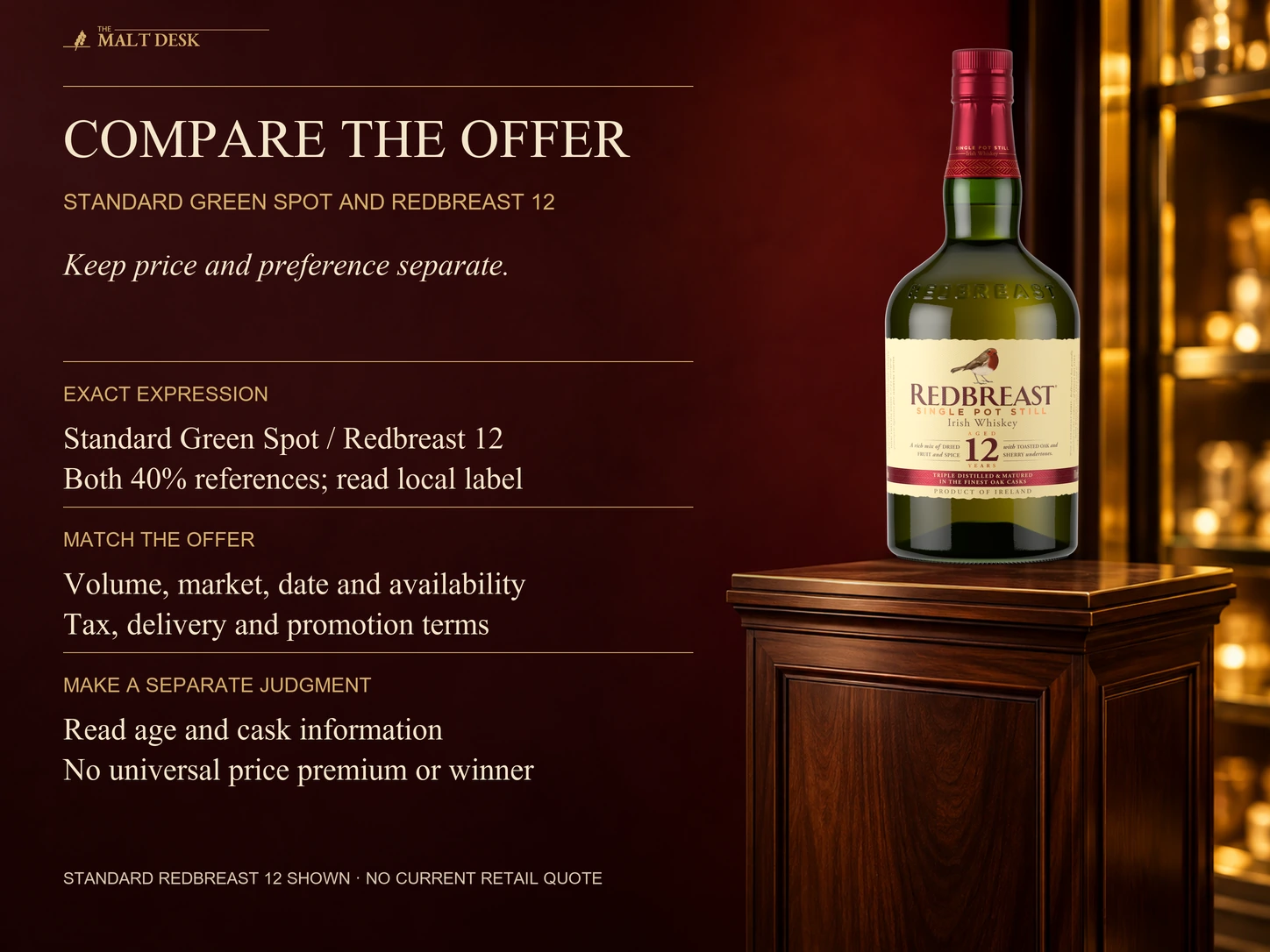
A price comparison needs the same bottle size, market, tax treatment and date. A 700 ml listing and a 750 ml listing are not directly equivalent, and an unavailable listing is not an obtainable price. Promotions and local stock can change the apparent difference without either product changing.
There is no universal price premium that makes one expression preferable. Compare dated local listings for equivalent volumes, then consider the disclosed age and cask information separately. The amount assigned to those differences remains an individual judgment.
Expression Names Matter
This comparison concerns standard Green Spot and standard Redbreast 12 at 40% ABV. Wine-cask Green Spot editions and Redbreast 12 Cask Strength are separate expressions. Their maturation details or bottling strengths should not be transferred to the standard products.
For an accurate record, note the full expression name, bottle volume and printed ABV. A different box or retailer photograph is not enough to establish that the liquid has a different specification.
Use Green Spot's Extra Age Disclosure
Choose Redbreast 12 when a twelve-year minimum is the requirement. Standard Green Spot’s published seven-to-ten-year component range supports a different, more specific age comparison than NAS alone would allow. For a style-led choice, compare each complete pot-still expression’s cask program and producer notes, keeping that age information as one separate part of the decision.
Frequently Asked Questions
Are they made at the same distillery?
Yes. Both are produced at Midleton Distillery in County Cork, Ireland, although they belong to different brands.
Is Green Spot a younger Redbreast?
No. It is a distinct expression with its own component selection. Its disclosed age range is younger than Redbreast 12’s minimum age, but that does not make it simply the same recipe at an earlier stage.
Does the 12-year statement prove that Redbreast tastes better?
The age statement establishes a minimum maturation age. Choose between the resulting styles using their casks, attributed profiles and your preferred serving method.
Are either of these single malt whiskeys?
No. Both are single pot still Irish whiskeys made with malted and unmalted barley.
Sources
Production and attributed flavor information: Spot Whiskey’s official Green Spot product page and Redbreast’s official standard 12-year-old product page.
Age-bounds analysis note: the inference uses the producer’s seven-to-ten-year component account for standard Green Spot and Redbreast’s twelve-year minimum. No exact batch averages or age distributions are supplied, and the component range is not rewritten as a label age.