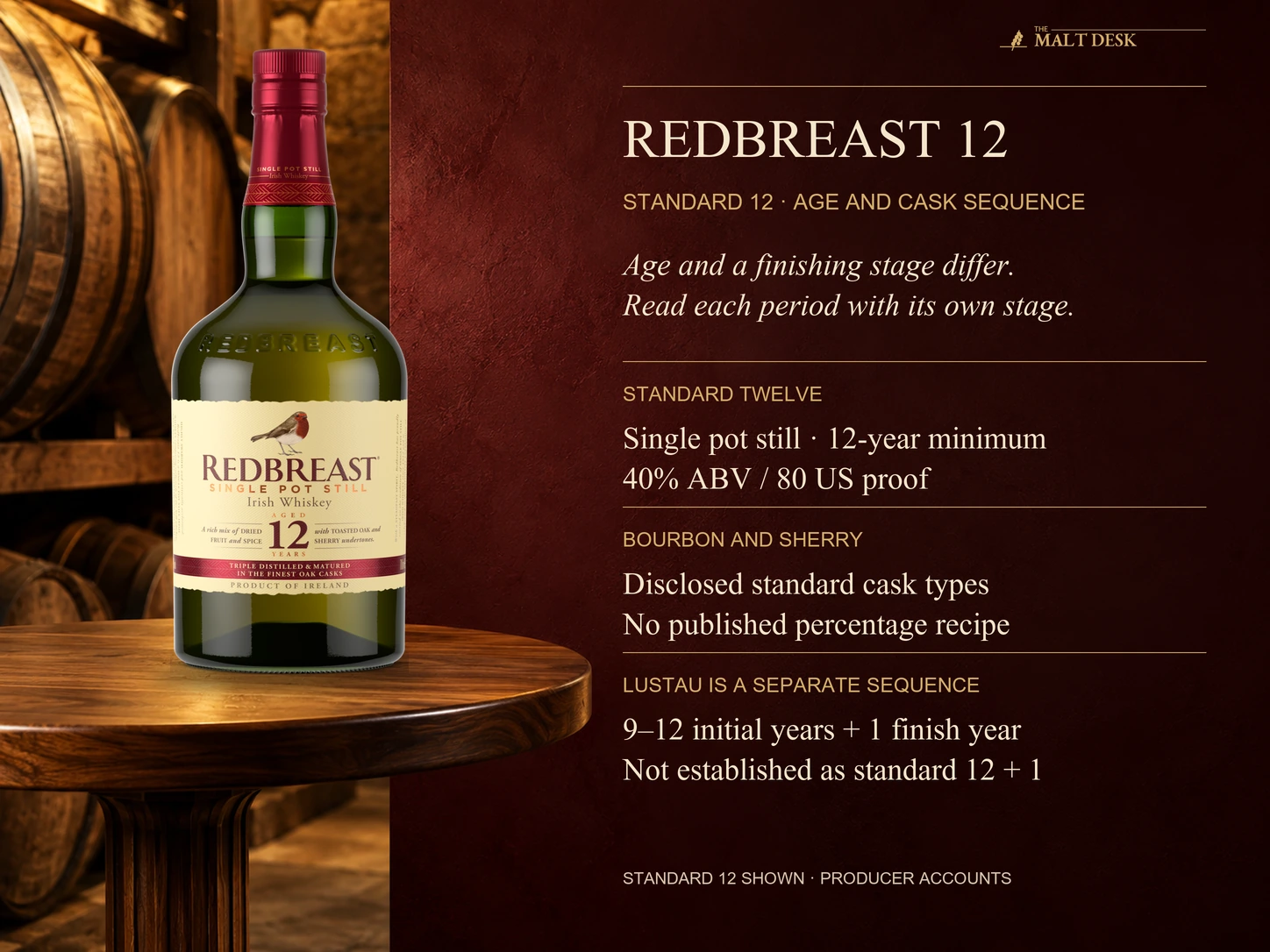
Bourbon and sherry casks appear in both standard Redbreast 12 and Lustau Edition, but the same two cask words do not describe the same timeline. Lustau’s published account includes nine to twelve years of initial maturation followed by one additional year in selected Oloroso-seasoned butts. That is a disclosed sequence, rather than a promise that standard Redbreast 12 was simply moved into another cask.
For a reader drawn to Redbreast’s sherry-and-toast vocabulary, this creates a useful next question: an older minimum guarantee, or a specifically documented finishing stage? Standard 12 provides the first. Lustau explains the second. Treating the finish as an automatic age upgrade would lose that distinction.
Redbreast 12 Year Old is a single pot still Irish whiskey from Midleton Distillery in County Cork. The standard expression combines malted and unmalted barley, triple distillation in copper pot stills and at least twelve years of maturation in bourbon and sherry casks. Its standard bottling strength is 40% ABV, equivalent to 80 US proof.
The bottle provides a useful example of how an Irish pot still expression differs from both single malt and blended whiskey. Its age statement, grain composition and cask information describe the production; the fruit, spice and wood vocabulary in the producer’s notes describes the intended sensory profile.
Redbreast 12 Specifications
| Feature | Standard Redbreast 12 |
|---|---|
| Category | Single pot still Irish whiskey |
| Distillery | Midleton, County Cork |
| Age statement | 12 years |
| Standard strength | 40% ABV / 80 US proof |
| Grains | Malted and unmalted barley |
| Distillation | Triple distilled in copper pot stills |
| Maturation | Bourbon and sherry casks |
| Separate expression | Redbreast 12 Cask Strength has its own bottling specification |
The Name and the Whiskey-Bonding Tradition
Redbreast’s official history records a reference to the name in August 1912, when Gilbey’s was selling a 12-year whiskey under the Redbreast name. The bird imagery refers to the robin and is associated in the brand account with Gilbey’s bird-loving chairman.
This history belongs to the whiskey-bonding trade, in which merchants and distilleries played different roles. A merchant’s name on a historical whiskey does not necessarily identify the distillery that produced its spirit. Redbreast’s modern distillation takes place at Midleton, and the brand records a relaunch by Irish Distillers in 1991.
What Single Pot Still Means Here
The word single indicates one distillery. Pot still identifies a category using malted and unmalted barley and pot still production. A single pot still expression can combine multiple casks and batches, so the phrase is not equivalent to single cask.
This grain combination separates Redbreast from single malt, which uses malted barley alone. It also distinguishes the finished expression from a blend containing grain whiskey. Jameson Original, for example, combines pot still and grain whiskey. The distinction is about composition, not a hierarchy of quality. For a closer comparison within the same category, see the Green Spot guide and the Green Spot vs Redbreast 12 comparison.
For the broader relationship between these labels and other categories, see Types of Whiskey Explained.
Twelve Years: What the Statement Tells You
The age statement provides the minimum age of the whiskey in the bottle. It does not describe an average or require every component to be exactly twelve years old. Time in the sealed retail bottle does not add years of cask maturation to that statement.
Age is one part of the specification.
Bourbon and Sherry Casks
The standard product information identifies maturation in bourbon and sherry casks. Previous cask contents provide context for the producer’s fruit, wood and sherry descriptions. The published information does not give a precise percentage for each cask type.
Sherry-cask maturation and the addition of sherry to the finished bottle are different claims. The cask description identifies maturation history. It also should not be expanded into a specific finishing period or a claim that every component spends its entire life in one cask type without supporting information.
The Producer’s Tasting Description
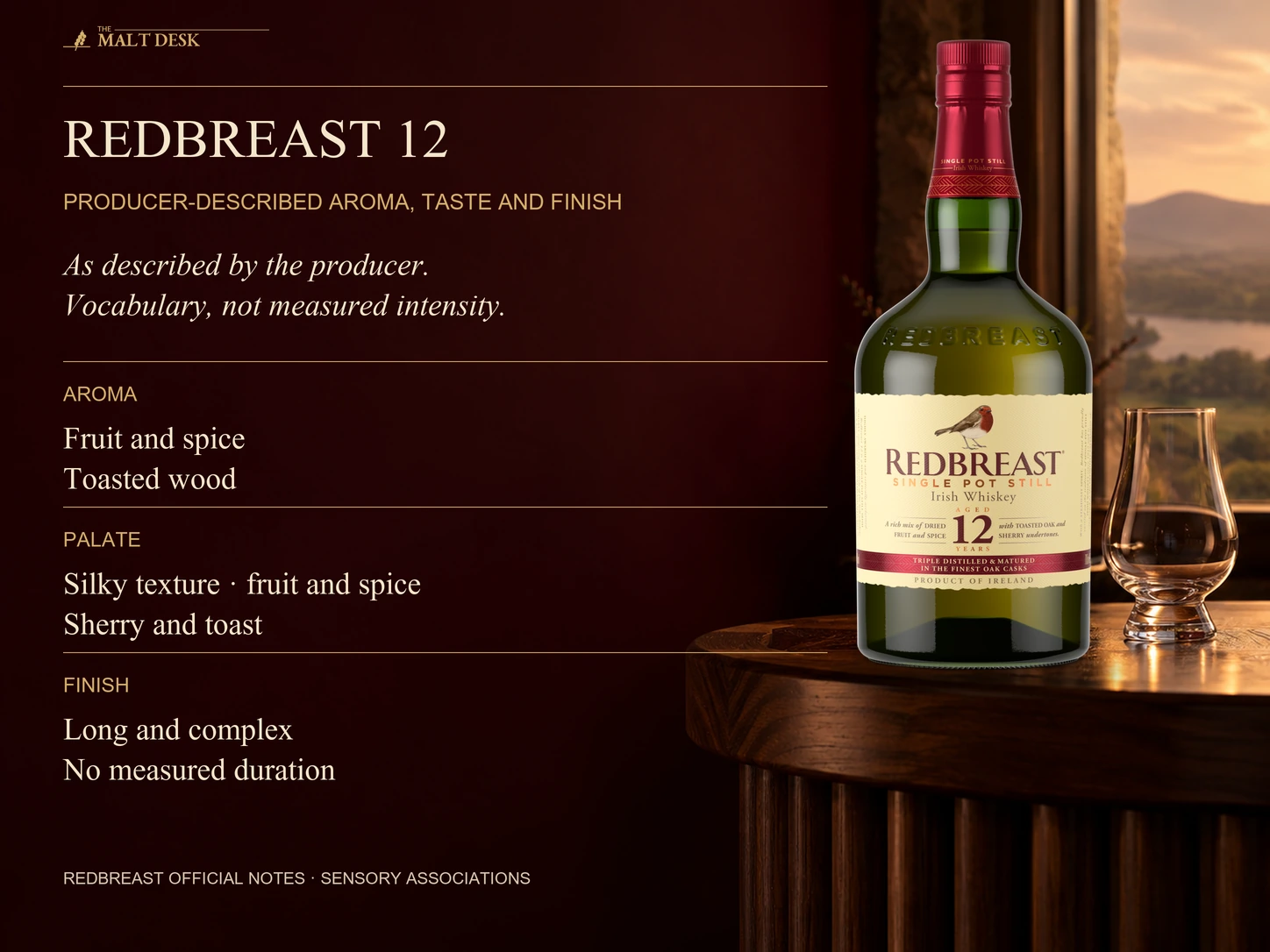
Aroma
Redbreast’s official aroma notes emphasize fruit and spice together with toasted wood. These are reference points for describing the whiskey rather than a complete chemical inventory. They leave room for variation in which association an individual notices first.
Palate
The producer describes a silky texture and a combination of fruit, spice, sherry and toast. Texture and flavor are separate dimensions: silky describes mouthfeel, while fruit and wood describe flavor associations. Reading them separately is more precise than reducing the whole profile to smoothness.
Finish
The official description characterizes the finish as long and complex. That is the producer’s assessment.
One More Year Depends on the Starting Ages
Under Lustau’s stated account, a nine-year initial component followed by one year would reach ten years; a twelve-year initial component followed by one would reach thirteen. Those endpoints explain the published sequence. They do not establish the proportions of components, the actual youngest component in every batch, or a thirteen-year statement for the expression.
| Published account | What is established | What is not established |
|---|---|---|
| Standard Redbreast 12 | A twelve-year minimum and bourbon/sherry maturation | A universal one-year finishing stage |
| Lustau Edition | Nine-to-twelve-year initial account, then one additional Oloroso-butt year | That standard 12 is the starting vatting, or a thirteen-year minimum |
The standard bottle’s twelve-year guarantee therefore cannot be carried across just because both releases share a brand and use bourbon and sherry wood. Nor can the upper end of Lustau’s initial range become the age of every component. This is a useful comparison precisely because the two disclosures answer different questions.
The Finish Is More Specific Than the Word Sherry
Lustau names a collaboration with Bodegas Lustau and first-fill, hand-selected sherry butts seasoned with Oloroso. That identifies the finishing program more closely than the standard 12’s broad bourbon-and-sherry account. It does not tell us an exact flavor contribution, and a one-year finish is not a guarantee that all existing cask character is replaced.
Lustau’s published 46% ABV also differs from standard 12’s 40%. A preference between their usual presentations would include concentration as well as cask selection and age distribution. I would compare them as named expressions and record those differences.
Standard 12 and 12 Cask Strength
Redbreast 12 Cask Strength is a separate bottling, even though it shares the twelve-year age designation. Its printed ABV should be recorded by batch. The standard 40% figure should not be transferred to Cask Strength, and one batch’s strength should not be assumed for every subsequent release.
A strength difference changes the alcohol concentration and may change perceived aroma, texture and heat. It does not turn the higher-strength expression into an automatic quality upgrade. Compare the complete expression name and specification before drawing conclusions from similar packaging.
Interpreting Serving Descriptions
The producer presents neat, ice and cocktail serves. These are different ways of presenting the same whiskey. Temperature, dilution and other ingredients can change what is perceptible, so a tasting description obtained under one set of conditions may differ from another.
There is no expression-specific scientific requirement for a fixed resting time or an exact number of water drops. In any comparative notes, recording the serving conditions makes the account more useful than treating a preferred ritual as a universal rule.
Reading Price Records
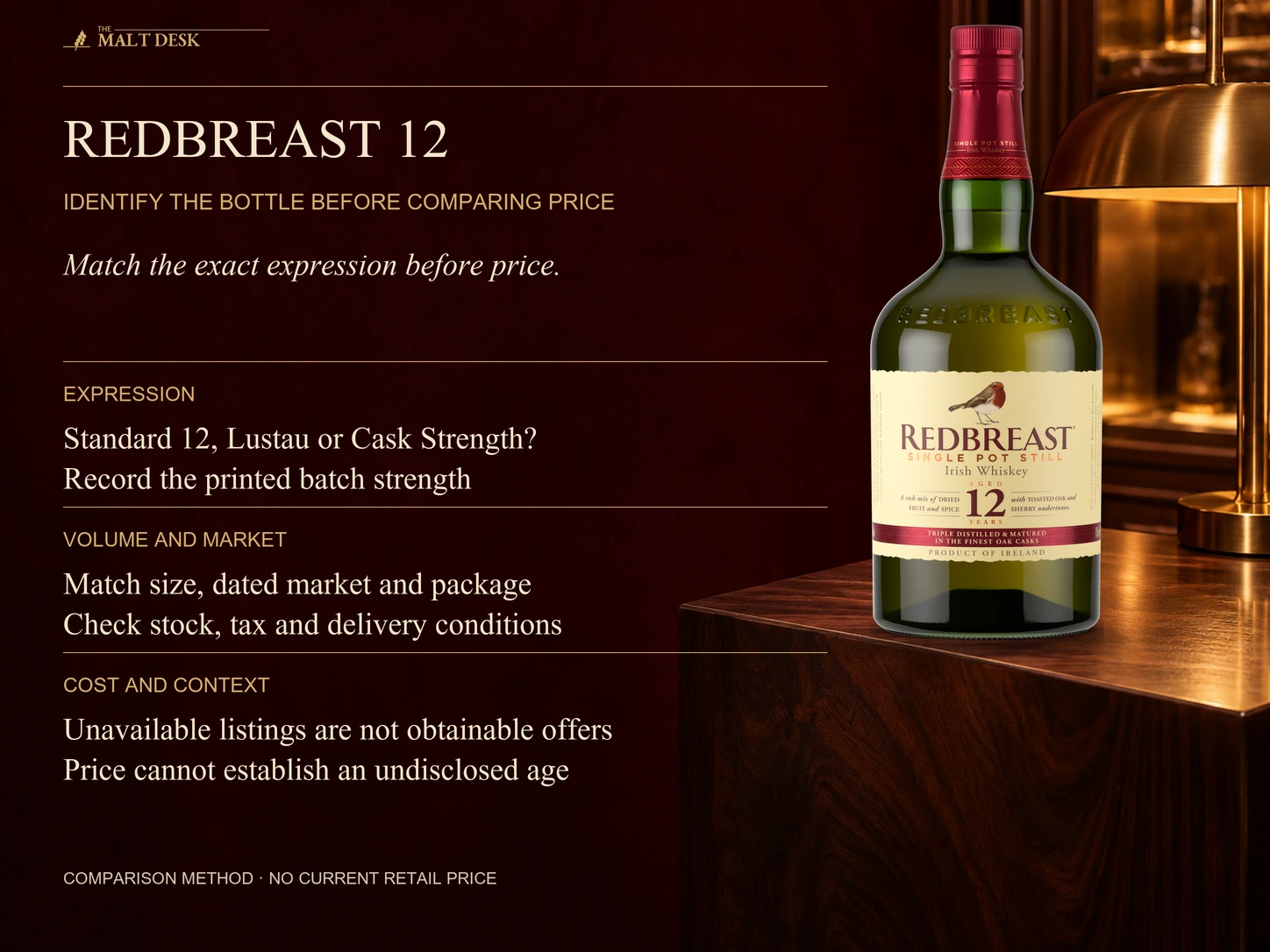
A meaningful price record includes the complete expression, volume, date, location, stock status and tax treatment. Standard Redbreast 12 and the Cask Strength edition should be listed separately. A price for an unavailable bottle does not establish an obtainable market price.
Historical retailer snapshots can document a particular listing, but they are not a national current-price range. Price thresholds also cannot establish whether a reader will prefer the flavor or place value on the age statement. This guide therefore focuses on the product details that can be checked independently of a local shelf price.
In Brief
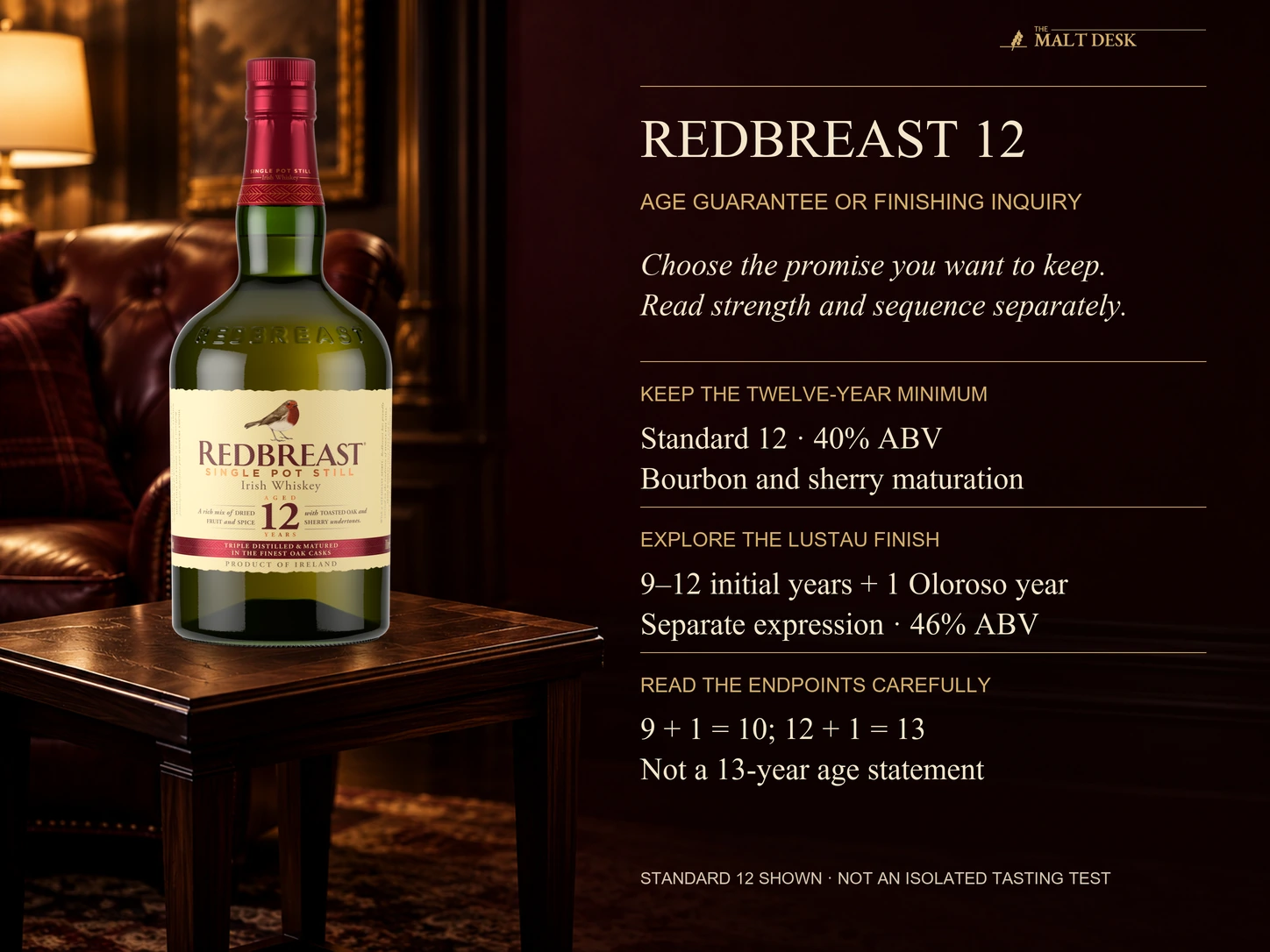
Redbreast 12 is a 12-year-old single pot still Irish whiskey. Published descriptions pair fruit and spice with cask character; the age statement describes maturation.
Choose Redbreast's Age Floor or Lustau's Finish
Choose the standard Redbreast 12 reference when a twelve-year minimum is central to the brief. Investigate Lustau Edition when the documented additional Oloroso stage is the feature you want to explore. Keep each expression’s full maturation timeline beside its price so a finishing inquiry and an age-floor requirement lead to the appropriate bottle.
Frequently Asked Questions
Is Redbreast 12 a single malt?
No. It is single pot still Irish whiskey, using both malted and unmalted barley.
Is standard Redbreast 12 the same as Cask Strength?
No. They are distinct expressions. The standard bottling described here is 40% ABV; Cask Strength carries a batch-specific strength.
Does twelve years mean every component is exactly twelve?
No. It is the minimum age represented by the statement, not a published average or a complete component recipe.
Is it naturally colored or non-chill-filtered?
The standard product page used for this guide does not establish those claims. They should be checked for the exact expression rather than inferred from another Redbreast release.
Sources
Redbreast official standard 12-year-old product information, Cask Strength product information, heritage account and frequently asked questions; Jameson official Original product information. Sensory descriptions are attributed to Redbreast.
Cask-sequence analysis note: Lustau’s timeline and 46% strength are producer disclosures. The ten- and thirteen-year endpoints explain that timeline mathematically; they are not an asserted batch age or component recipe.