Quick Answer
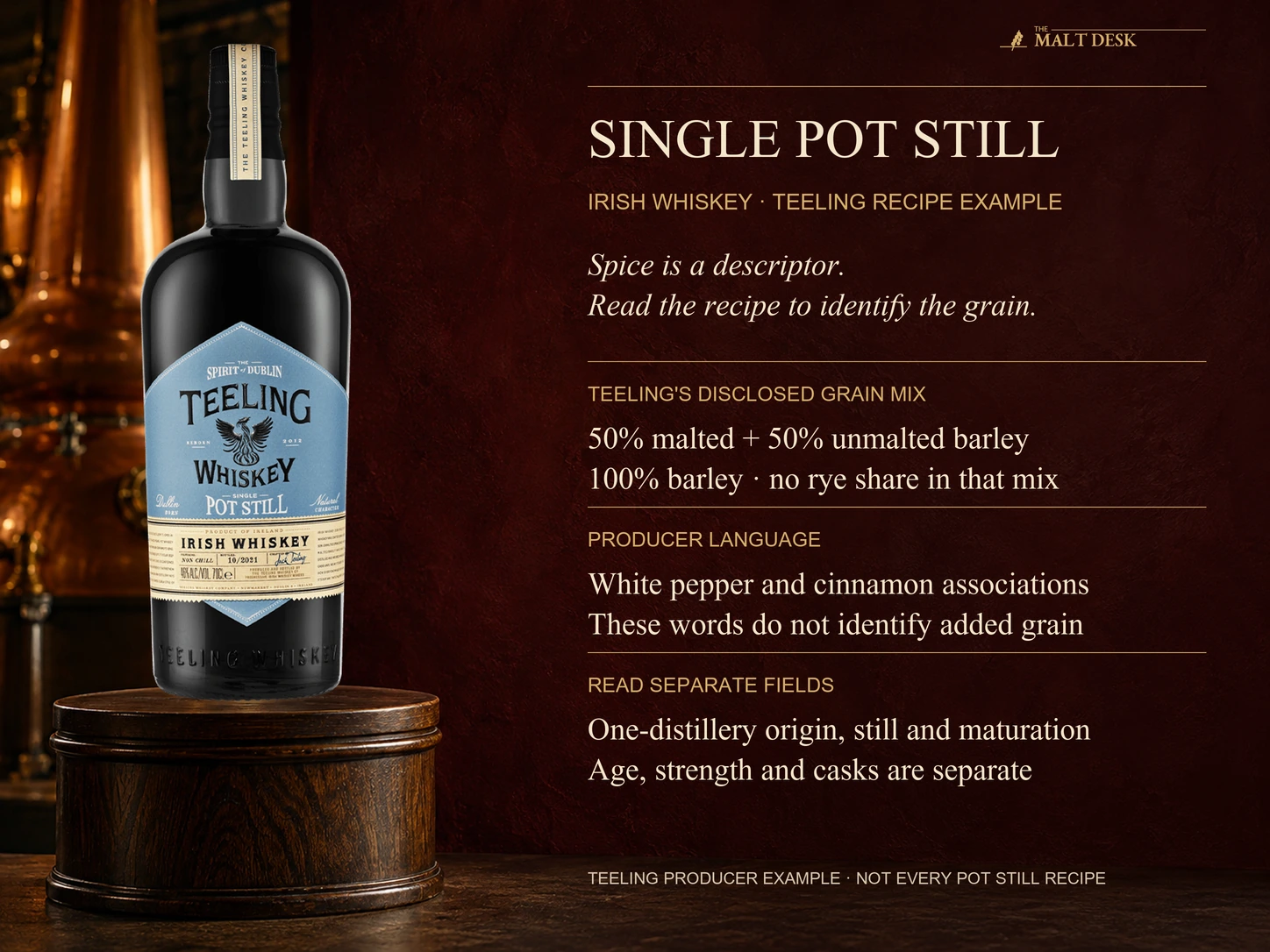
Pot-still spice is a sensory phrase, not a declaration that rye is in the mash. Teeling Single Pot Still gives a concrete counterexample: the producer discloses 50% malted and 50% unmalted barley while describing white pepper and cinnamon associations. A recipe totaling 100% barley leaves no cereal share for rye, even though spice appears in the published profile.
That distinction helps make the category rules useful. The published technical file’s allowance for up to 5% other cereals is permission within that framework, not a requirement that every single pot still whiskey contains them. The actual producer recipe answers the ingredient question more directly than a tasting adjective.
Single pot still Irish whiskey is made at one distillery from a mash that combines malted barley with unmalted barley, then batch-distilled in pot stills. Under the published Irish Whiskey Technical File, the mash must contain at least 30% malted barley and at least 30% unmalted barley; up to 5% may come from other cereals such as oats or rye.
The word single means that all the whiskey was distilled at one distillery. It does not mean one grain, one cask or one batch. Unmalted barley is the defining ingredient: it can contribute a creamy or silky texture and the peppery, clove-like character commonly described as pot-still spice.
Triple distillation is traditional and common, but it is not legally required. Green Spot and Redbreast 12 are clear single pot still examples. Jameson Original is not: it blends pot still whiskey with grain whiskey and is therefore a blended Irish whiskey.
Key Takeaways
Single identifies one distillery, not one grain or one cask.
The published technical file requires at least 30% malted barley and 30% unmalted barley; other cereals are limited to 5%.
Pot still whiskey is batch-distilled in pot stills; column-distilled grain whiskey is a different category.
Triple distillation is common but not mandatory. Double distillation is also permitted.
Irish whiskey must mature for at least three years in wooden casks no larger than 700 liters on the island of Ireland.
Unmalted barley helps explain the style’s creamy texture and distinctive spice, but casks and spirit cuts still create a wide range of flavors.
Green Spot and Redbreast 12 are single pot still examples; Jameson Original is a blend.
The Irish government announced a specification consultation in 2026; proposed amendments and approved requirements are different.
What Is Single Pot Still Irish Whiskey?
Single pot still Irish whiskey is one of the protected varieties inside the Irish Whiskey geographical indication. It begins with a mixed barley mash, uses batch distillation in pot stills and comes entirely from one distillery.
That combination separates it from two neighboring categories. Single malt Irish whiskey uses 100% malted barley at one distillery. Grain Irish whiskey is normally produced in continuous column stills and can create a lighter spirit. When two or more Irish whiskey types are combined, the result is blended Irish whiskey.
The published Irish Whiskey Technical File treats pot still, malt and grain as distinct production varieties. The label can use those terms only when the relevant method is followed.
What Does “Single” Mean?
Single means every drop in the bottle was distilled at the same distillery and belongs to one protected whiskey variety. Multiple batches, ages and casks can still be combined.
A single pot still bottle may therefore contain whiskey from many bourbon barrels, sherry butts or other permitted wooden casks. Green Spot combines pot still whiskeys of different ages and cask histories, yet remains single pot still because the spirit was distilled at Midleton Distillery and stays within the same pot still variety.
The word does not guarantee a single barrel, fixed age, natural color, non-chill filtration or cask strength. Those are separate claims that must be checked independently.
What Does the Published Technical File Specify?
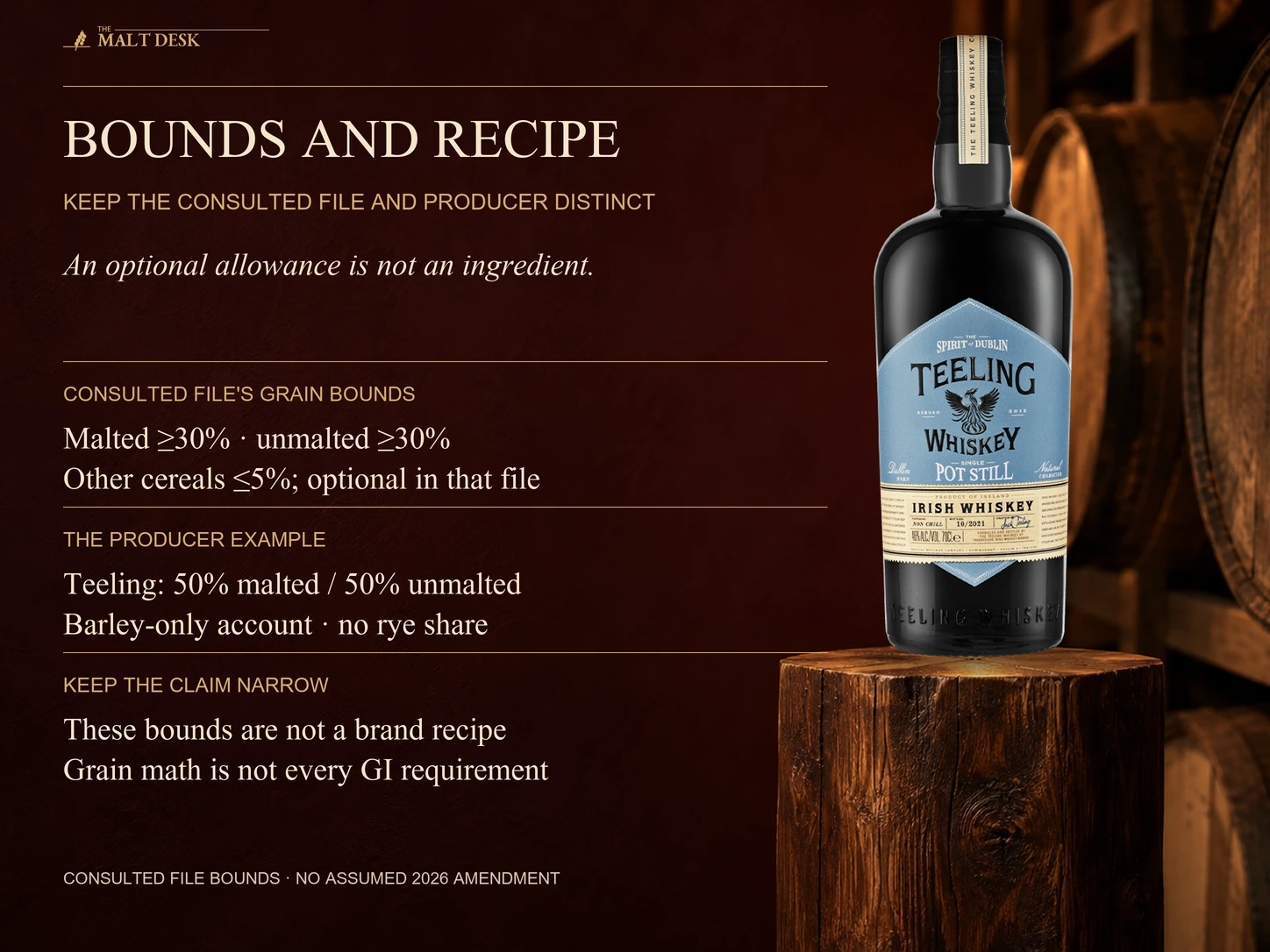
The linked file is the Department’s October 2014 specification, still provided by Drinks Ireland when checked October 4, 2026. The June 23, 2026 consultation concerned proposed amendments and closed September 4. This guide does not claim that a proposal became an approved replacement. The grain bounds below summarize that linked published file. A hypothetical 50% malted/50% unmalted barley recipe satisfies those grain bounds, but is not a disclosed brand recipe or a demonstration of every GI requirement.
The published technical file describes the following production requirements.
| Rule | Published-file requirement | What it means in the glass or on the label |
|---|---|---|
| Malted barley | Minimum 30% of the mash | Supplies enzymes for conversion and contributes malt, cereal and fruit character |
| Unmalted barley | Minimum 30% of the mash | Essential to the category; associated with creamy texture and pot-still spice |
| Other cereals | Up to 5% | Oats or rye may be used in a limited supporting role under the published file |
| Distillation | Batch-distilled in pot stills | Distillation time, reflux, cuts and recycled feints can shape weight and flavor |
| Distillation count | Double or triple allowed | Triple distillation is traditional, not a universal legal requirement |
| Origin | Distilled and matured on the island of Ireland | The GI includes both the Republic of Ireland and Northern Ireland |
| Maturation | At least 3 years in wooden casks up to 700 L | Bourbon, sherry, port, Madeira and other permitted cask histories can change style |
| Bottling strength | At least 40% ABV | Individual releases may be bottled substantially higher |
These are category rules, not a recipe for identical whiskey. A distillery can vary the balance of malted and unmalted barley, fermentation, still shape, spirit cuts, cask type, age and bottling strength while remaining within the category.
An Optional Grain Allowance Is Not a Hidden Ingredient
Teeling’s disclosed 50/50 barley recipe meets both published barley minimums without using the optional other-cereal share. It is a real producer account, whereas the illustrative compliant recipes elsewhere in this guide are only arithmetic examples. The disclosure does not supply every fermentation or still setting, but it does settle whether that stated recipe needs rye to explain its spice vocabulary.
Conversely, an expression that does not publish its precise percentages should not be assigned Teeling’s 50/50 ratio just because it belongs to the same category. The technical file supplies boundaries for a family of recipes. A boundary is not the recipe of Green Spot, Redbreast or every other single pot still release.
| Statement | What it establishes | What it does not establish |
|---|---|---|
| Published-file other cereals up to 5% | An optional upper bound in that file | That each producer uses 5% |
| Teeling 50% malted / 50% unmalted barley | A disclosed barley-only recipe | Every pot still recipe has that ratio |
| Producer describes white pepper or cinnamon | A sensory association in its note | Rye was used or pepper was added |
Spice Vocabulary Needs Its Production Context
Teeling also discloses triple distillation and maturation in virgin American oak, bourbon and sherry casks. Those are further dimensions of its production account. A producer’s pepper-like note cannot assign a contribution to one grain or one cask in isolation, and the grain proportions cannot reconstruct the final sensory intensity.
For a reader comparing pot still whiskey with rye whiskey, shared pepper vocabulary can identify an interesting sensory question without erasing the different recipes and categories. For a reader checking ingredients, the exact recipe disclosure remains the relevant evidence. These are two legitimate inquiries, but one cannot serve as proof for the other.
The specification review is a separate status question. This example uses the bounds in the linked published file, not an assumed adoption of a proposed amendment. Teeling’s disclosed 50/50 recipe and attributed notes do not establish the legal status of any future change; that still requires an authoritative replacement specification.
Why Use Both Malted and Unmalted Barley?
Malted barley unlocks fermentable sugar
Malting begins by allowing barley to germinate, then stopping the process with heat. This develops enzymes that convert starches into fermentable sugars during mashing. Malted barley also contributes cereal, biscuit, fruit and floral character.
Unmalted barley changes texture and spice
Unmalted barley is not merely filler. The technical file calls it essential and connects it to a distinctive spicy flavor and creamy mouthfeel. Official Redbreast and Spot Whiskey production material makes the same link: silky texture and pot-still spice are recurring house signatures.
The common history says Irish distillers increased unmalted barley to reduce exposure to a tax on malt. That history helps explain the practice, but the modern style survives because it also creates a recognizable sensory identity.
Read the Recipe and the Expression Together
Two whiskeys can meet the same grain rules and taste very different. Fermentation, still operation and cask selection can outweigh a simple mash percentage. Green Spot’s producer emphasizes green apple and barley, while Redbreast’s emphasizes fruit, spice, sherry and toasted wood.
How Is Single Pot Still Irish Whiskey Made?
1. Grain is milled and mashed
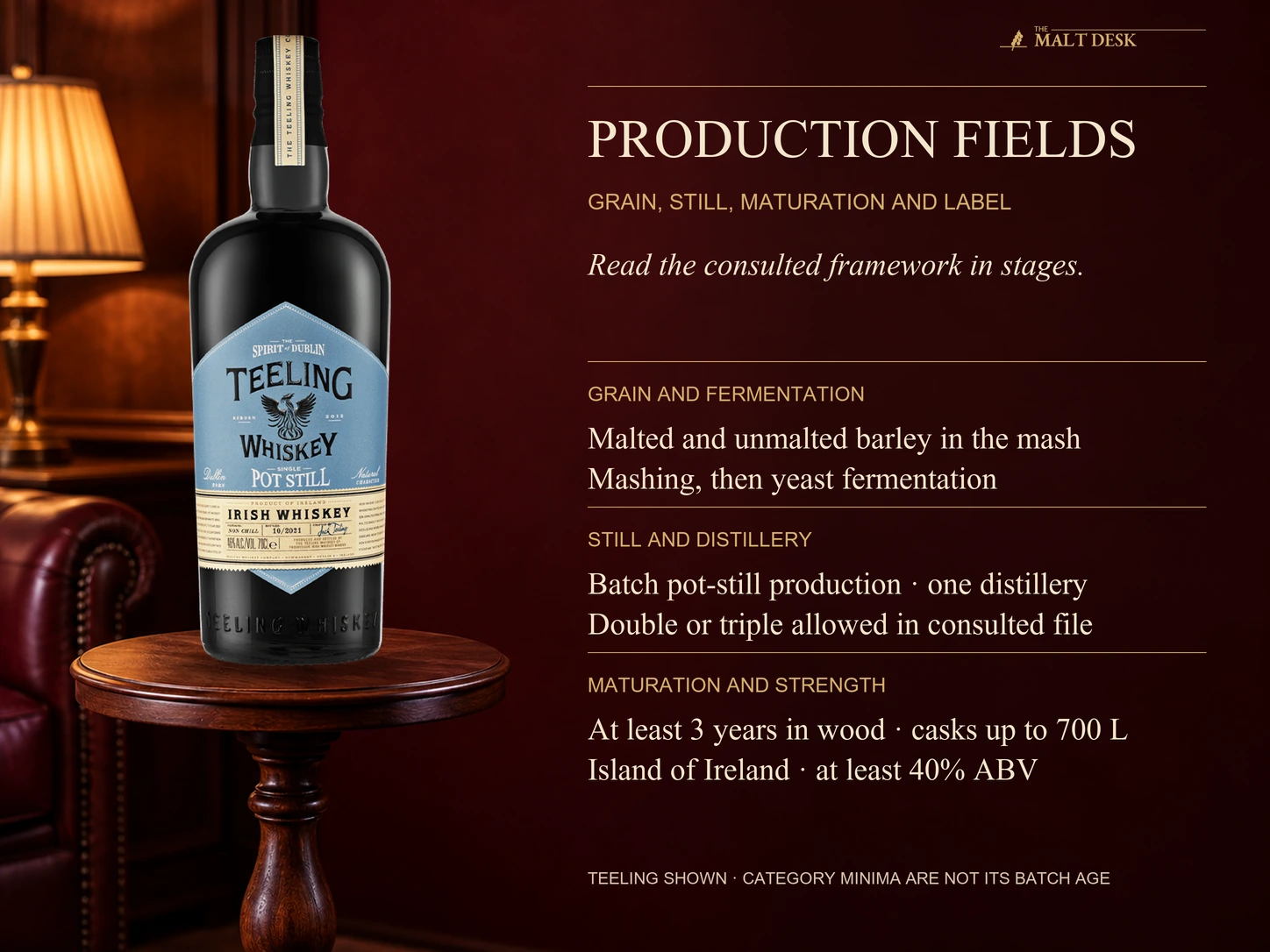
Malted and unmalted barley are milled into grist and mixed with water. Enzymes convert starch into sugars, and the sugary liquid is separated for fermentation. The technical file notes that wort separation can influence later flavor development.
2. Yeast ferments the wort
Yeast converts sugar into alcohol and creates flavor compounds that can suggest apple, pear, banana, flowers, pastry or nuts. Fermentation is not just an alcohol-making step; it establishes much of the fruit character that distillation later selects.
3. Pot stills distill in batches
The fermented wash enters copper pot stills. Time, reflux, the size and shape of the still, the cut between heads, heart and tails, and the treatment of feints all affect the new make spirit.
Many famous examples are triple-distilled. Triple distillation can produce a higher-strength, cleaner spirit, but the published file also allows double distillation. Irish whiskey is always triple-distilled is therefore a useful stereotype only until it is treated as a law.
4. The spirit matures in wood
The spirit must mature for at least three years on the island of Ireland in wooden casks no larger than 700 liters. Ex-bourbon barrels can bring vanilla, honey and coconut. Sherry-seasoned casks can add dried fruit, nuts and spice. Port, Madeira, wine and virgin-oak programs can move the style in other directions.
What Does Single Pot Still Irish Whiskey Taste Like?
The published technical file associates the category with spice and creamy mouthfeel, but does not require every drinker to perceive one intensity. Use an expression’s attributed producer notes alongside its disclosed grain, still, cask and strength information.
Fruit
Green apple, pear, citrus and tropical fruit often appear in younger or bourbon-cask-led examples. Longer maturation and sherry casks can shift the profile toward baked apple, raisin, fig, dark cherry and orange peel.
Creamy or oily texture
Unmalted barley is commonly associated with a silky, creamy or oily mouthfeel. Bottling strength still matters: a 40% whiskey can feel polished and rounded, while a cask-strength release may produce a different perception of texture and alcohol intensity.
Pot-still spice
Black pepper, white pepper, clove, cinnamon, ginger or a prickly herbal note can form the category’s most recognizable contrast. This is not the same as rye whiskey spice, even when the vocabulary overlaps.
Cask character
Vanilla, honey, toasted oak, nuts, dried fruit and tannin come largely from maturation. The cask program explains why a fruit-forward Green Spot and a richer Redbreast 12 still belong to the same production family.
How Is It Different From Single Malt and Blended Irish Whiskey?
| Label | Grain and still | Distillery rule | Typical role |
|---|---|---|---|
| Single Pot Still Irish Whiskey | Malted plus unmalted barley; batch pot stills | One distillery | Creamy texture, fruit and distinctive spice |
| Single Malt Irish Whiskey | 100% malted barley; batch pot stills | One distillery | Malt, fruit and fermentation character without the defining unmalted-barley requirement |
| Grain Irish Whiskey | Cereal mash; usually continuous column stills | Single only when one distillery qualifies | Lighter spirit used alone or as a blending component |
| Blended Irish Whiskey | Two or more Irish whiskey types | May combine types and sources allowed by the GI | Balances lighter grain whiskey with malt or pot still character |
Jameson Original is a contrasting blended Irish expression, combining pot still and grain whiskey. The mix of production varieties establishes the category.
Examples of the Category and a Contrasting Blend
Jameson Original: blended Irish whiskey
Jameson Original combines pot still whiskey with grain whiskey. A pot still component does not make the finished blend a single pot still expression. The classification concerns the complete contents of the bottle.
Green Spot: no label age statement
Green Spot is a Midleton single pot still expression. Its producer describes components aged seven to ten years and bourbon, refill bourbon and sherry casks. Its published notes emphasize orchard fruit, green apple, barley and spice.
Redbreast 12: an age-stated expression
Redbreast 12 is also a Midleton single pot still whiskey. It has a 12-year statement, bourbon- and sherry-cask maturation and a standard strength of 40% ABV. Its producer describes fruit, spice, sherry and toasted wood.
The Green Spot and Redbreast 12 comparison explains these differences. Neither product defines the flavor of every single pot still whiskey.
How Should You Read the Label?
Look for the complete phrase Single Pot Still Irish Whiskey, not only pot still in marketing copy.
Treat single as a distillery statement, not a single-cask statement.
If an age appears, it refers to the youngest whiskey in the bottle.
Check ABV separately; 40% is the category minimum, not the category’s only strength.
Check cask details separately. Bourbon and sherry casks are common, not legally mandatory for every bottle.
Do not assume triple distillation unless the producer confirms it.
Do not assume natural color or non-chill filtration without an explicit statement.
The 2026 Specification Review
The Department announced proposed specification amendments on June 23, 2026, with a September 4 consultation deadline. Consultation dates establish the proposal’s status at announcement, not approval of a replacement. Keep an approved specification distinct from an industry proposal when checking a current producer label.
Putting the Label Information Together
Single pot still identifies a production category and one-distillery origin. Age, bottling strength, cask history, filtration and color statements provide separate information. Read those claims individually instead of treating the category name as a guarantee of smoothness or quality.
Read the Grain Recipe Behind Pot-Still Spice
Use the disclosed recipe to answer a grain question and the attributed notes to explore aroma. Teeling’s cited all-barley recipe makes that distinction concrete for a reader investigating pepper or cinnamon descriptions. When comparing single pot still expressions, record the malted and unmalted barley account, any other disclosed grains, casks and strength before choosing the feature to explore next.
Frequently Asked Questions
Is single pot still the same as single malt?
No. Single malt Irish whiskey uses 100% malted barley. Single pot still Irish whiskey combines malted and unmalted barley and may include a small amount of other cereals under the published file.
What does single mean in single pot still?
It means all the whiskey was distilled at one distillery and belongs to the same protected whiskey variety. It does not mean one cask, one batch or one age.
Must single pot still Irish whiskey be triple-distilled?
No. Triple distillation is traditional and common, but the published technical file also permits double distillation.
Why is unmalted barley used?
Historically, taxation is often cited as an incentive. In sensory terms, unmalted barley is now valued for the creamy texture and distinctive spice it can bring to the spirit.
Is Jameson a single pot still Irish whiskey?
Jameson Original is not. It is a blended Irish whiskey that combines pot still whiskey with fine grain whiskey.
Are Green Spot and Redbreast made at the same distillery?
Yes. Both are single pot still Irish whiskeys produced at Midleton Distillery, but different age and cask selections create distinct profiles.
What is a good first single pot still Irish whiskey?
Green Spot and Redbreast 12 illustrate the category at the same standard 40% ABV. Their age disclosures and producer-described flavor emphases differ; neither is a universal first choice.
Can the 2026 consultation change the definition?
A consultation can lead to amendments, but its announcement is not itself an approved change. The published technical file and proposed revisions should be distinguished.
Sources
Department of Agriculture, Food and the Marine, October 2014 Irish Whiskey Technical File as linked by Drinks Ireland; June 23, 2026 consultation announcement with September 4 deadline. Source status checked October 4, 2026. Grain-limit examples summarize the linked file, not unverified adoption of proposed amendments. Existing Jameson, Spot Whiskey and Redbreast references distinguish blends from pot still expressions.
Recipe analysis note: the Teeling 50/50 mash is an attributed producer disclosure. Optional grain bounds follow the linked published technical file; no proposed replacement is assumed adopted. Spice descriptors do not identify an added ingredient.