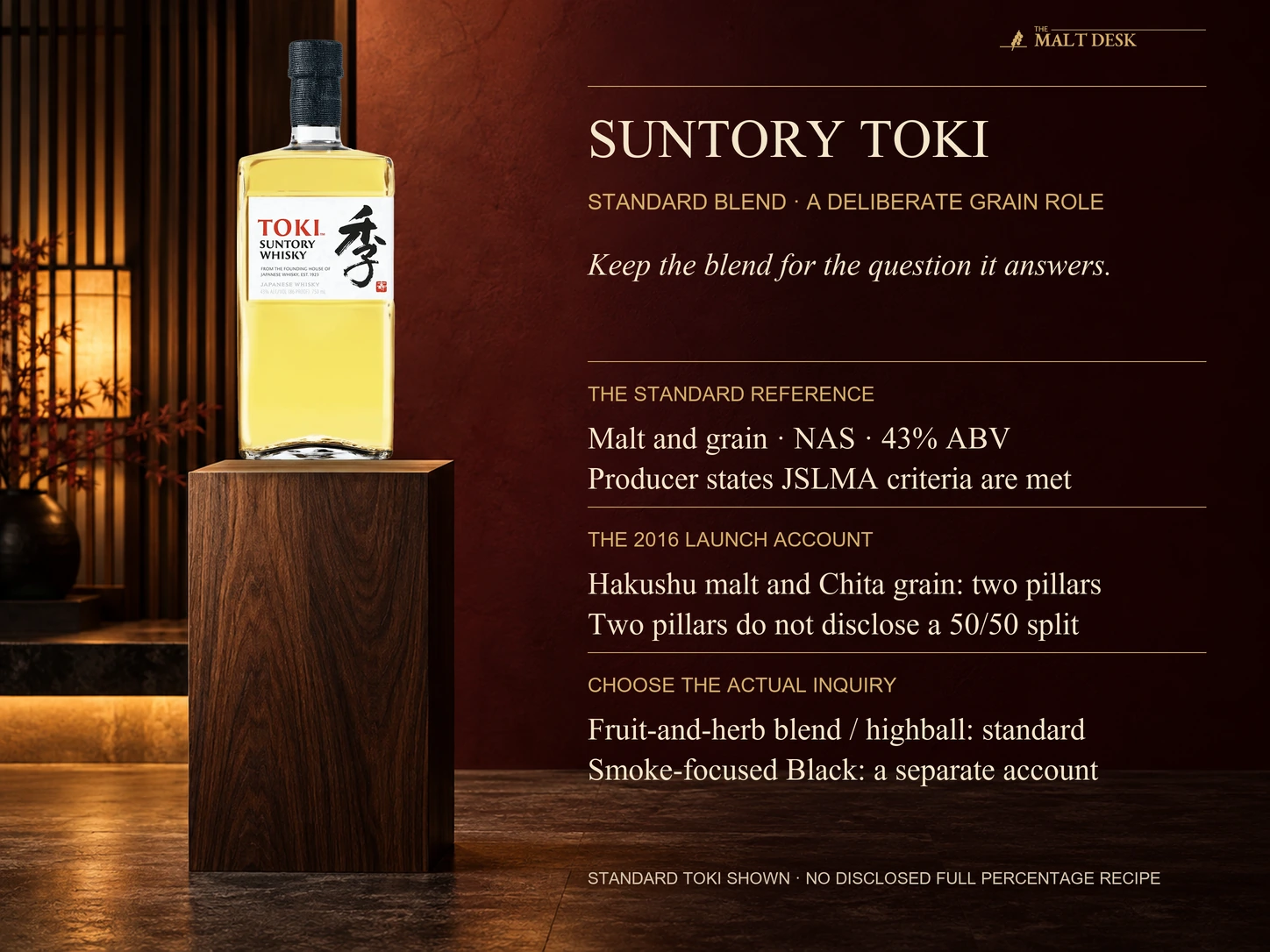
I would not approach Toki as a malt whisky diluted with an unimportant grain component. Suntory’s 2016 launch account deliberately made Hakushu malt and Chita heavy-type grain the blend’s two principal pillars. The grain was presented as a central design choice. Seeking an all-malt replacement would therefore change the intended construction, rather than simply remove something the producer regarded as filler.
This gives a reader a useful reason to keep standard Toki in view: curiosity about a blend built around both malt and grain. A different aim, such as exploring the more smoke-focused Black expression, needs its own account. More malt, more age and more smoke are separate questions; the ordinary Toki name cannot answer them all.
Suntory Toki is a blended Japanese whisky made with malt and grain whiskies associated with Yamazaki, Hakushu and Chita. The standard reference bottling is 43% ABV, or 86 U.S. proof, and carries no age statement.
The House of Suntory gives Toki a prominent highball role, while also presenting it in other cocktails. Its blend, published flavor notes and highball role provide useful points of comparison.
Blend information
The current brand materials identify Chita heavy grain, lightly peated Hakushu and Yamazaki Spanish-oak-cask components. Suntory describes different roles for those components, but does not publish a complete percentage recipe or the age of each component.
Three named distilleries do not imply equal thirds. Nor does a cask descriptor establish that the entire blend has the same maturation history. The absence of an age statement means an exact minimum component age is not disclosed on the standard label.
Japanese-whisky status
The current official product page states that Toki meets the Japan Spirits & Liqueurs Makers Association’s Japanese-whisky labeling criteria. This is a product-specific producer statement, rather than an inference from the Japanese brand name.
The association’s standard covers production provenance, maturation and bottling. Those claims need separate product information.
Published flavor notes
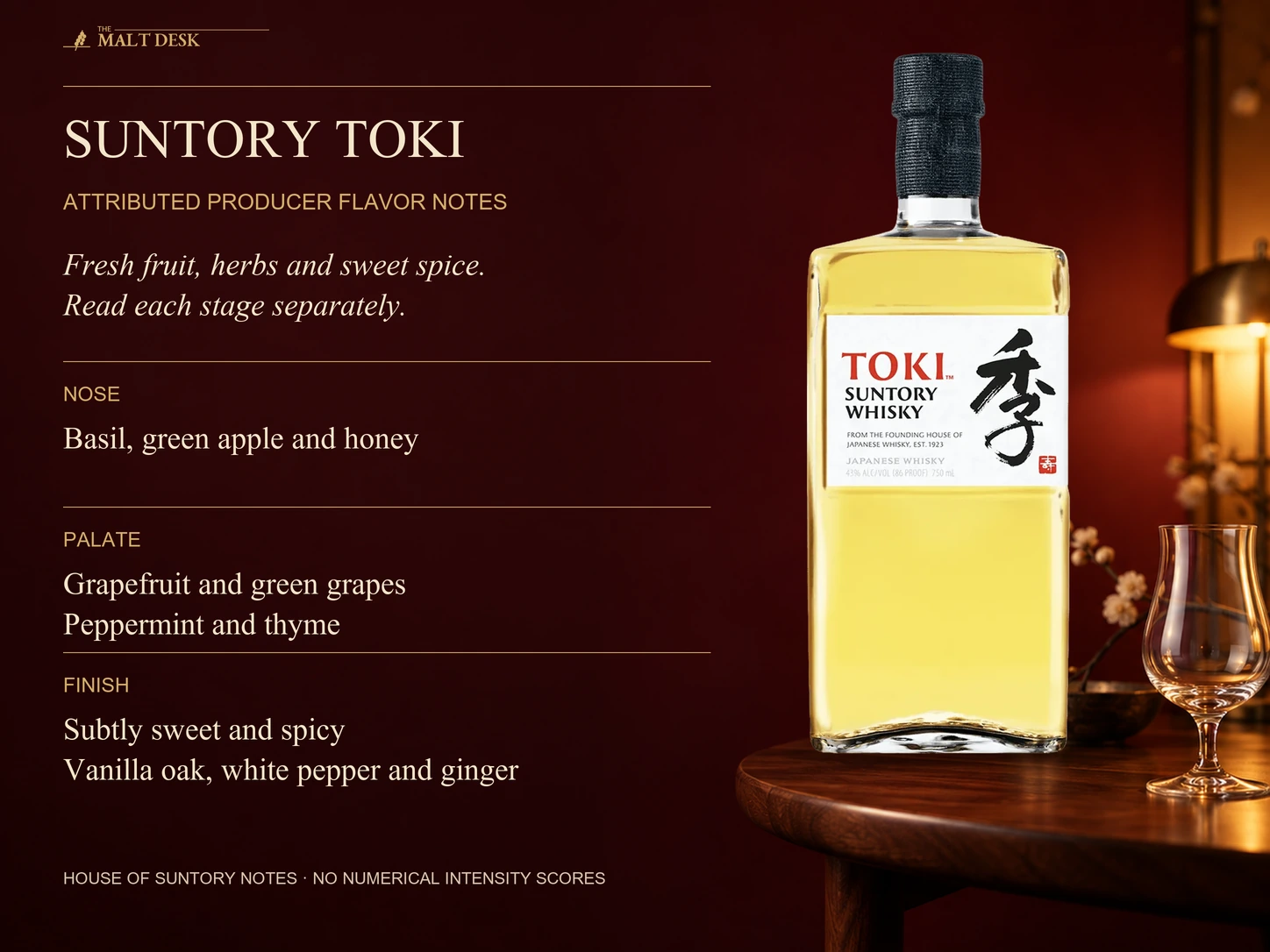
Suntory lists basil, green apple and honey as aroma references. Its palate description includes grapefruit, green grapes, peppermint and thyme; the finish notes include vanilla oak, white pepper and ginger. These are the producer’s sensory descriptors.
The fresh-fruit and herbal vocabulary helps distinguish the published style from descriptions centered on dried fruit or heavy caramel.
Why the exact expression matters
The Toki name now appears on more than one expression in Suntory’s range. This guide concerns the standard Toki Blended Japanese Whisky. Toki Black has its own product description and should not be assumed to have identical specifications.
Check the full label, bottle volume and ABV when comparing an online listing with an older article. A different market bottle or special presentation can change the comparison even when the brand name looks familiar.
Two Pillars Do Not Mean Fifty-Fifty
The dated North American launch account identifies Hakushu American-white-oak malt and Chita heavy-type grain as the two main pillars. It also names two Yamazaki selections: one associated with American white oak, another with Spanish oak. Three distillery names therefore describe at least four named selections in that account. Counting distilleries as equal component portions would discard information rather than reveal the recipe.
Likewise, two pillars is a statement about the blend’s design, not a disclosed 50/50 volume split. The announcement explains the intended roles of its selected whiskies without supplying their complete proportions. This is a historical launch record; today’s shorter component account should remain attached to today’s expression rather than being expanded into an unverified current four-part formula.
| Actual inquiry | What the producer account contributes | What cannot be obtained by counting |
|---|---|---|
| Why retain grain in the Toki discussion? | Chita grain was deliberately made a main pillar in the launch design | A sensory verdict that more malt must be better |
| How many selections does the launch account name? | Hakushu, Chita and two Yamazaki wood-associated selections | Equal thirds from the three distillery names |
| What does Toki Black add? | Its own named additions and smoke-focused profile | A guaranteed larger malt percentage or exact blend reconstruction |
Choose a Different Design Only When That Is the Question
Consider a reader who likes the idea of a fresh, herbal highball and assumes the next improvement must be removing grain. That change is not required by the stated purpose. Toki’s producer describes its fruit, herb and sweet-spice direction within a malt-and-grain expression, while explicitly assigning grain a meaningful role. The complete blend is the relevant reference for that curiosity; an all-malt bottle would be a new comparison, not the same design purified.
Toki Black creates a different branch. Its current page names Hakushu Peated Whisky and Hakushu Grain Whisky in its addition account and emphasizes a gently smoky finish. I would retain those exact producer terms, rather than replace the grain name with Chita or infer the percentages. The Black description also keeps white pepper and ginger, so its smoke interest need not be mistaken for a promise to remove spice. Its clear-gold color is another reason to read the description rather than interpret the suffix as a liquid-color measurement.
For a highball decision, the benefit still has to be relevant in the intended preparation. Keep the soda quantity, garnish and temperature consistent before attributing a changed result to another bottle. Paying for a different composition only makes sense when that is the question the reader wants to investigate; the producer’s deliberate grain role prevents a category hierarchy from choosing it in advance.
Highball preparation as a set of variables
Suntory’s highball guidance emphasizes chilled ingredients, ice and careful handling of carbonation. This is a practical preparation framework.
Record the whisky-to-soda ratio and keep it consistent when comparing bottles. The temperature of the glass, amount of ice and carbonation of the mixer affect the finished drink. Citrus garnish also contributes aroma, so changing garnish changes the comparison.
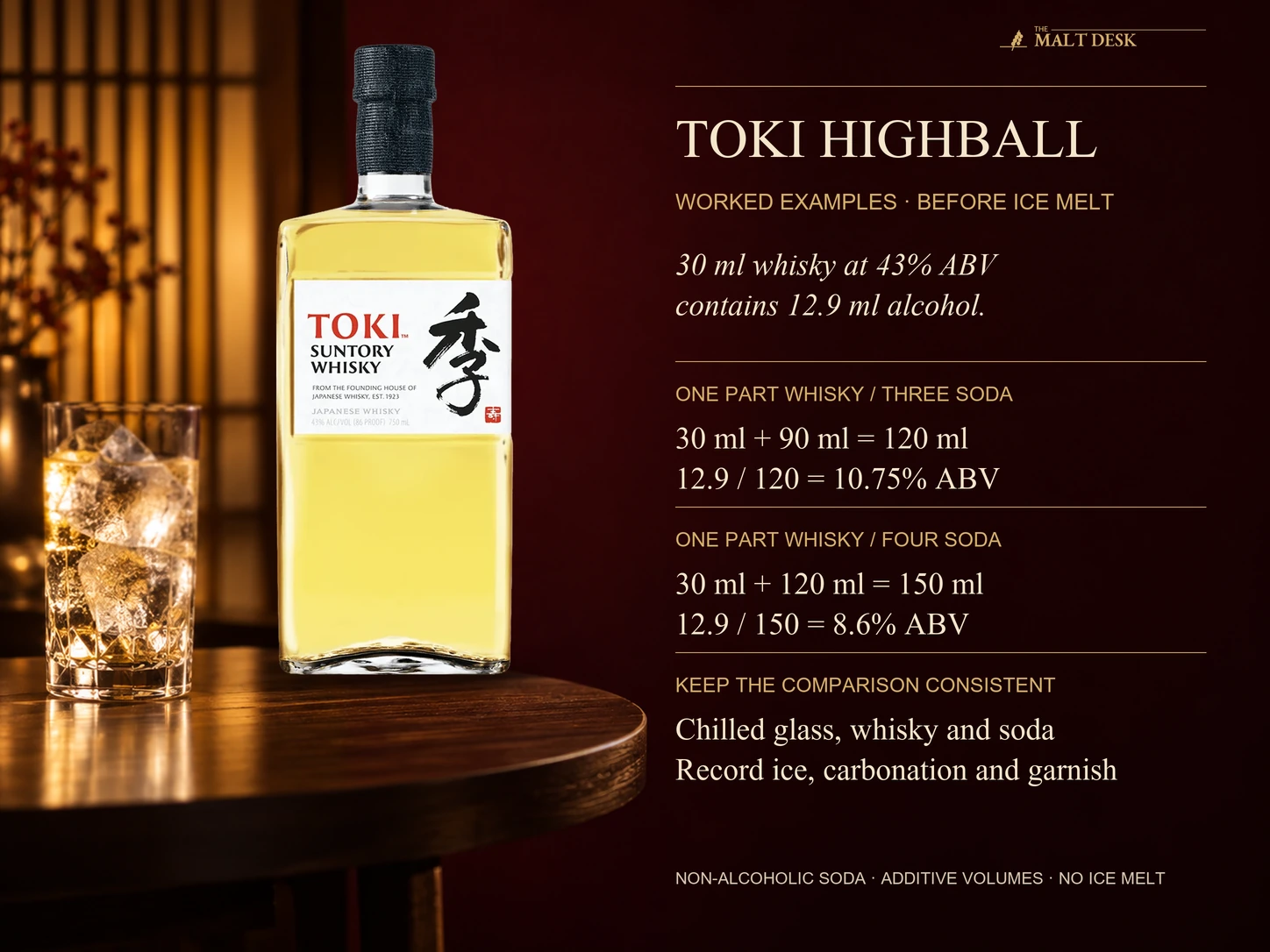
Suntory’s current highball recipe lists three parts soda and allows three to four parts in its instructions. At a worked 30 ml whisky measure and 43% reference, the alcohol volume is 12.9 ml. Adding 90 ml soda (1:3) gives about 10.75% ABV; adding 120 ml (1:4) gives about 8.6%. These estimates assume non-alcoholic soda and additive volumes, before ice melt or garnish. The 43% reference is also stated in Suntory’s June 8, 2016 North American launch announcement; check the actual local bottle.
The highball guide explains preparation in more detail. A highball comparison should describe the complete recipe rather than crediting every difference to the spirit alone.
Neat and diluted comparisons
Toki can also be examined neat as a reference. If water is added, note the quantity and keep an unchanged sample for comparison. Ice changes both temperature and dilution as it melts, so it tests more than water addition alone.
Neither a no-age-statement label nor a cocktail-oriented brand position proves that a whisky has a short finish or is unsuitable neat. Those are sensory judgments that need actual observations and clear attribution.
Price and Label Comparisons
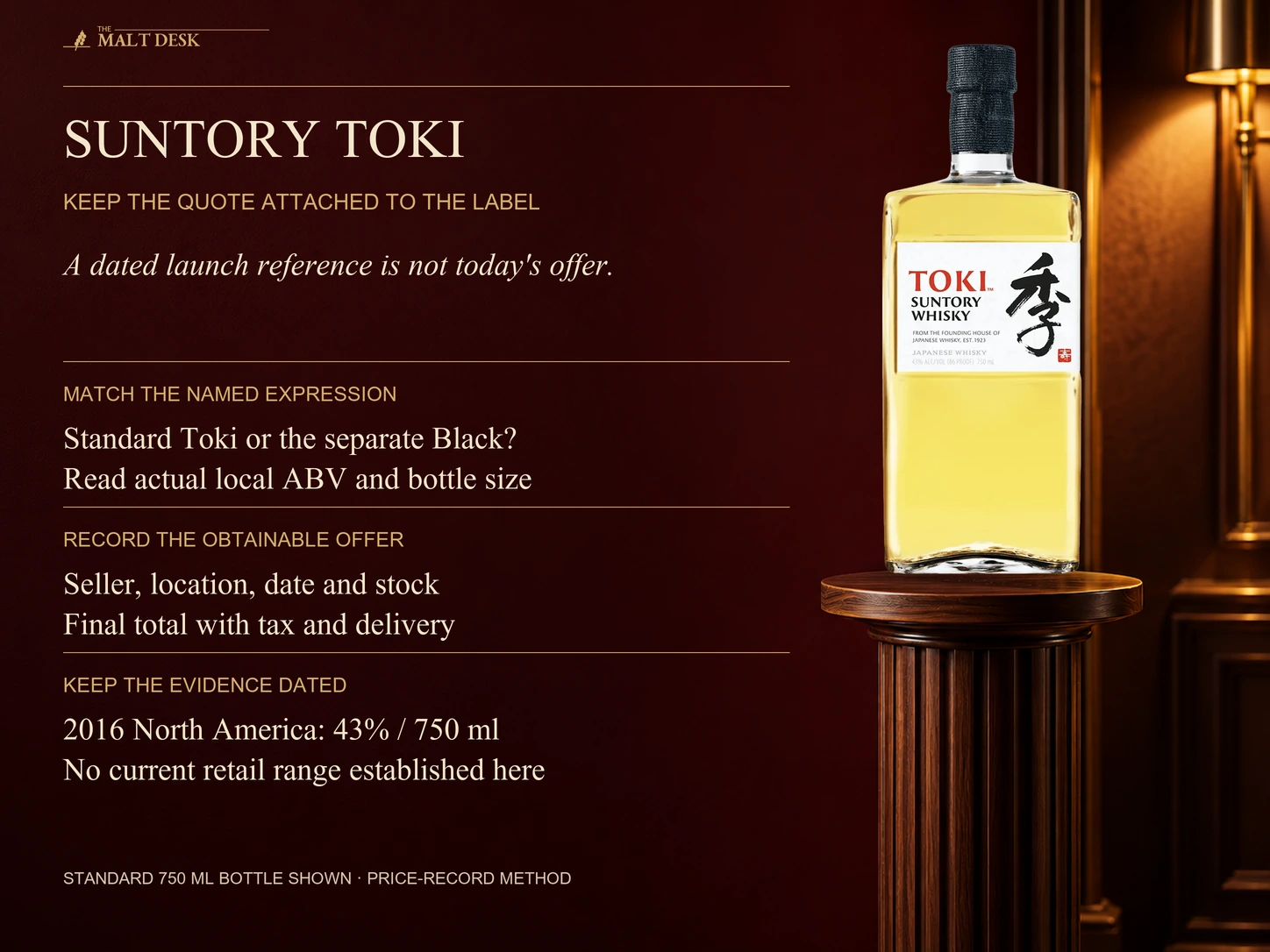
A Toki quote needs the exact market label and volume. The producer’s 2016 North American 43%/750 ml launch reference is dated evidence, not a promise for every current listing. Record the seller, location, stock and final total for the actual bottle; no verified retail range is established here.
Comparison with Hibiki Japanese Harmony
Hibiki Japanese Harmony shares Suntory’s malt-and-grain blending tradition but is a separate expression. Similar distillery sources and matching reference ABVs do not make the recipes identical. The Hibiki Harmony vs Suntory Toki comparison places those label and production differences side by side.
Compare published flavor descriptions, packaging and price as separate attributes. A higher price does not reveal a hidden age statement or establish a multiple of flavor intensity. The preferred serving method is also an individual choice, rather than a rule imposed by the bottle’s market position.
In Brief
Suntory Toki is a blended Japanese whisky bottled at 43% ABV. Published descriptions emphasize light citrus, green apple, herbs and pepper, while a highball’s balance depends on dilution and mixer proportions.
Choose Toki for Its Deliberate Blend Structure
Keep Toki on the shortlist when its documented Hakushu-malt and Chita-grain construction is the blend you want to explore. For a highball, record the mixer and ratio alongside the bottle. If an all-malt composition is the actual requirement, choose that category explicitly; the useful next step follows the production structure or serving role you want.
Common questions
Is Toki a single malt?
No. It is a blended Japanese whisky containing malt and grain whisky.
What does 86 proof mean?
Under the U.S. proof convention, it corresponds to 43% ABV.
Is an exact age published?
The standard expression carries no age statement. Its component ages and percentages are not disclosed as a complete recipe.
Does a highball change the whisky?
It adds water, carbonation and cooling, with additional dilution from melting ice. Those preparation variables are part of the drink.
Sources
House of Suntory’s current Toki product, blending and highball pages, checked October 3, 2026. The producer’s June 8, 2016 North American launch announcement supplies a historical 43%/750 ml reference, not a guarantee for every current market bottle. Flavor words are attributed; no current retail price or complete component recipe is established.
Blend-design analysis checked October 8, 2026: Suntory’s June 2016 North American launch record and its current Toki Black page. These cited regional component accounts describe production roles. Keep their exact expression names, component wording and regional strength references attached to those records.