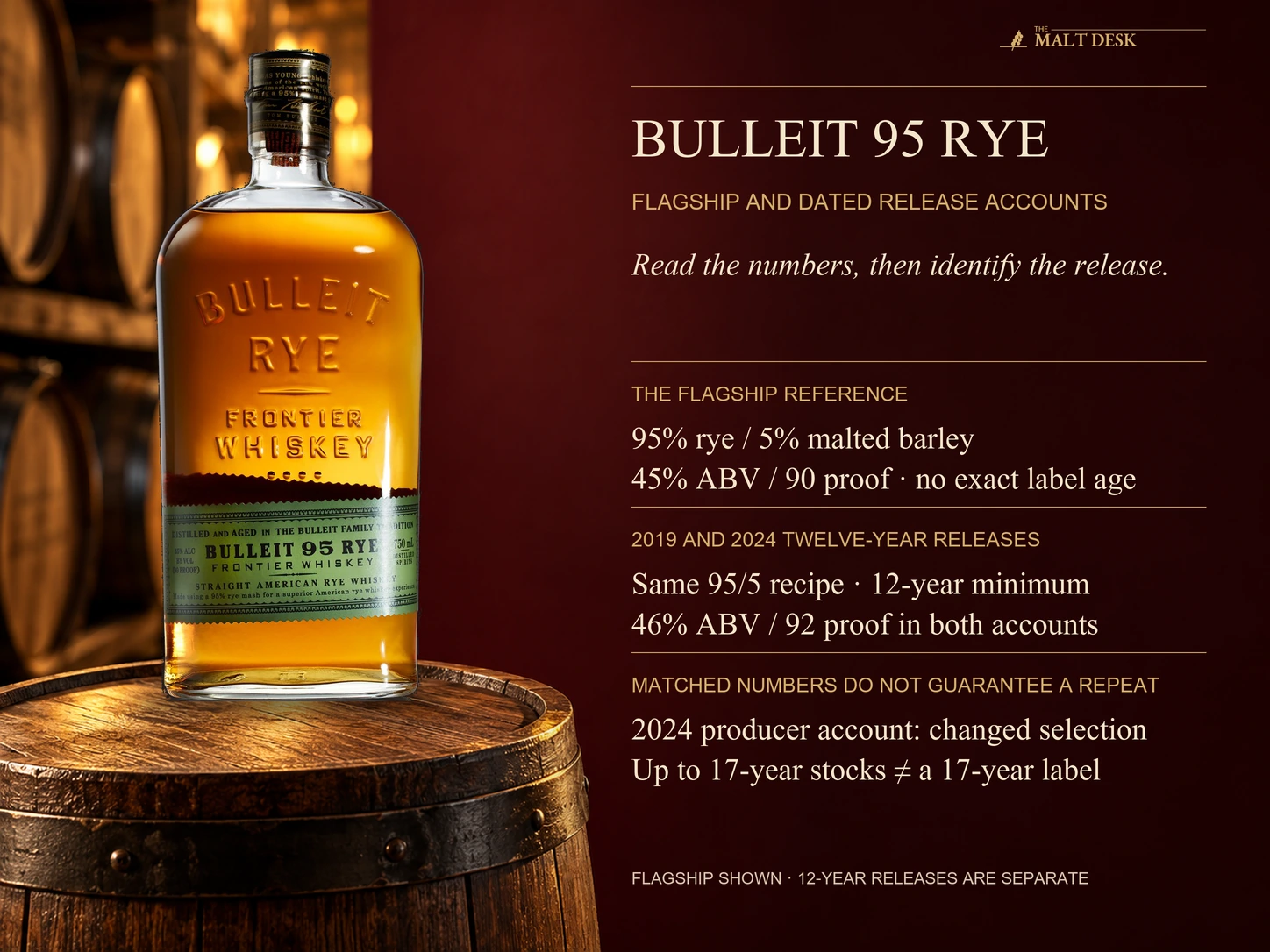
Bulleit’s rye range offers a sharper lesson than simply saying age changes flavor. Its 2019 and 2024 twelve-year releases share a disclosed 95% rye / 5% malted-barley recipe, a twelve-year minimum and 92 proof. Yet the producer’s 2024 announcement explicitly describes differences from the first release. Matching those three numbers does not establish that the returning whiskey repeats the earlier bottle.
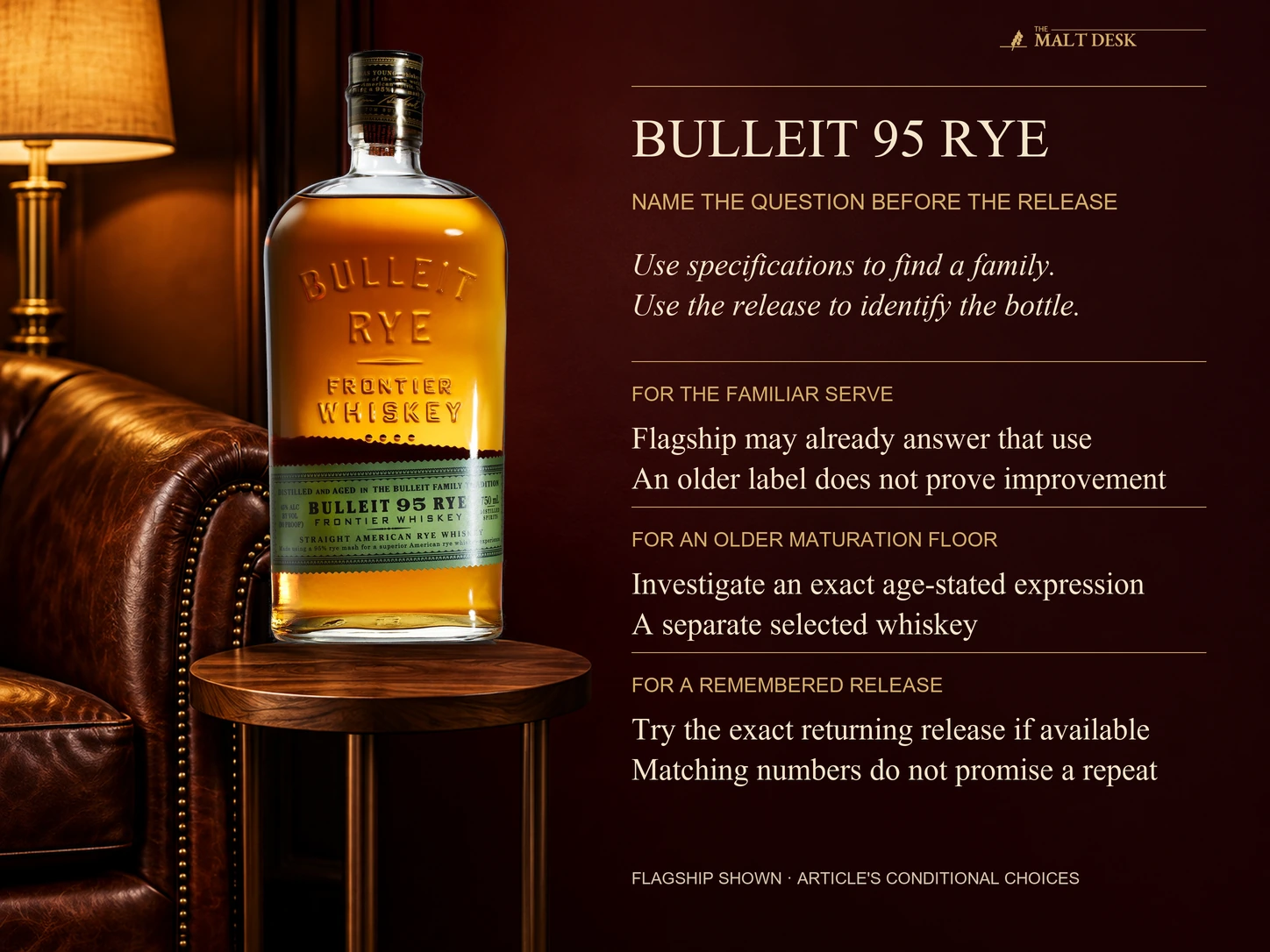
For someone who knows the flagship 95 Rye, this creates two separate decisions. An older minimum can be a feature worth investigating. Recreating a remembered edition is a more demanding request, and an old review cannot complete it merely because the new label has the same age and proof.
Bulleit 95 Rye is a straight American rye whiskey bottled at 45% ABV, or 90 U.S. proof. The number 95 refers to the rye share of its grain recipe: 95% rye and 5% malted barley. It is not an age statement or a proof figure.
Three numbers that mean different things
95: the percentage of rye in the mash bill. 45%: the alcohol by volume in the bottled whiskey. 90 proof: the U.S. expression of that same alcohol strength. Confusing these numbers can make a product comparison misleading.
The standard expression should also be distinguished from Bulleit Rye 10 Year Old. The latter is a separate age-stated product, even though Bulleit says it uses the flagship 95/5 grain recipe. Its age and bottling specifications should not be transferred to the standard bottle.
What straight rye means
The American rye category requires at least 51% rye in the mash. Bulleit’s 95% recipe is therefore well above the category minimum. The remaining grain is malted barley; there is no corn component in this disclosed recipe.
Straight rye adds a minimum two-year maturation requirement in new charred oak and restrictions on added coloring, flavoring and blending materials. The word straight has a production meaning, rather than simply indicating that a whiskey should be served without ice.
The standard bottle has no exact age statement. Under U.S. labeling rules, whisky younger than four years generally requires an age statement. The absence of one supports a minimum-age inference for a compliant label, not a claim that every component is exactly four years old.
Producer flavor notes
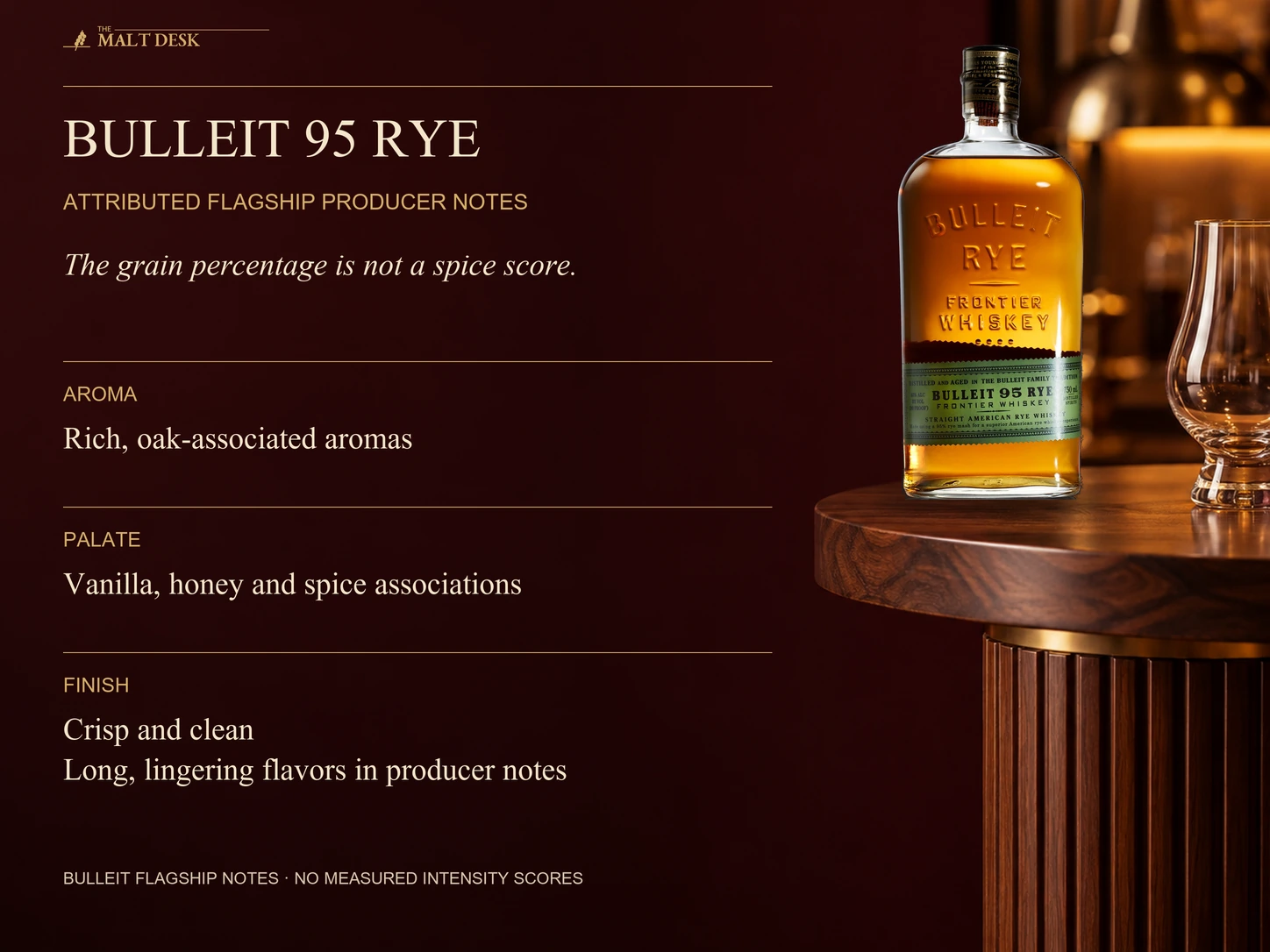
Bulleit’s current flagship page emphasizes oak aromas, followed by vanilla, honey and spice. It describes the finish as clean and lingering. These are producer descriptions of the expression, rather than tasting observations made by The Malt Desk.
A mash bill describes the grains before fermentation and distillation, while casks, maturation and blending decisions also affect the finished product. A 95% rye recipe does not guarantee one particular dill, mint or pepper intensity.
For category context, the types of whiskey guide explains how rye differs from bourbon and other styles. Flavor vocabulary is most useful when attributed to the product description or a named reviewer rather than presented as an objective ingredient list.
Brand and production information
Bulleit’s official page identifies the straight American rye expression and its strength. It does not provide a current batch-by-batch distillery and sourcing record. A brand-company address on a label should not be treated as a complete account of where every production step occurred.
For historical sourcing discussions, keep the publication date and specific bottling in view. A report about an older bottle does not by itself prove the production path of every current batch. An exact source claim needs a producer disclosure or a clearly attributed report relevant to that release.
A Real Same-Specification Counterexample Inside the Range
| Identified expression | Disclosed mash bill | Minimum-age disclosure | Published bottle strength |
|---|---|---|---|
| Flagship 95 Rye | 95% rye / 5% malted barley | No exact label age | 45% / 90 proof |
| Producer 10 Year Aged Rye account | 95% rye / 5% malted barley | Ten years | 45.6% / 91.2 proof |
| 2019 twelve-year release | 95% rye / 5% malted barley | Twelve years | 46% / 92 proof |
| 2024 returning twelve-year release | 95% rye / 5% malted barley | Twelve years | 46% / 92 proof |
The final two rows match in every displayed production number. The 2019 issuer announcement describes selected barrels and a twelve-year minimum. The April 2024 announcement adds that the returning selection includes barrels aged as much as seventeen years and describes the resulting profile as differing in details from 2019. Those are producer disclosures, rather than a blind tasting result reported here.
The comparison nevertheless disproves a useful shortcut: recipe percentage, youngest age and proof are not a complete identity for a finished rye. The numbers leave barrel selection and the mix of component ages open. A specification match can justify researching a related release, but it cannot certify a repeat of an earlier sensory experience. That is a real example from this brand, rather than an invented general warning.
What an Older Bottle Can Actually Add to the Flagship Choice
If the question is whether to pursue a longer guaranteed maturation within the disclosed 95/5 family, the ten- and twelve-year accounts provide clear answers. They retain the stated grain recipe while adding an older floor. Their strengths remain close to the flagship’s 45%, so the purchase should not be explained as moving to a markedly higher-proof rye. The additional guarantee is time, alongside a different selected expression.
If the question is whether the 2024 bottle will repeat a favorite 2019 release, I would lower the commitment before treating it as a replacement. Seek a modest serving of that exact release if one is available, or buy it as a new expression with an older minimum. Do not pay a nostalgia premium on the assumption that a matching twelve and 92 establish the old profile. The producer’s own return announcement gives a reason to keep that assumption open.
A third reader may be satisfied with the flagship in a measured Manhattan and want only the same recipe again. No disclosed number proves that the age-stated alternatives improve that preparation. In that case, the original retains a positive role: it is the expression already answering the reader’s specific use, while the premium versions answer a different maturation curiosity.
Finally, the seventeen-year upper component in the 2024 account does not turn it into a seventeen-year rye. Nor does a five-year gap between the 2019 and 2024 launches mean the returning whisky is five years older. Release calendar, component range and guaranteed minimum answer different questions. Keep the release date with any notes so a later same-name bottle is not silently assigned the 2024 selection.
Cocktail context
Bulleit publishes a Rye Manhattan recipe, making that a documented serving use. Cocktail performance still depends on the vermouth, bitters, proportions, temperature and dilution. It should not be reduced to a guaranteed claim that one whiskey survives every mixer better than another.
When comparing a rye and bourbon Manhattan, hold the recipe constant and note the starting ABVs. If one base is substantially stronger, the comparison changes alcohol concentration as well as whiskey style. The same principle applies to an Old Fashioned: sweetener and bitters are part of the result.
Neat service is another way to establish a reference. If adding water, record the amount; if adding ice, account for both cooling and melting.
Comparing Exact Rye Offers
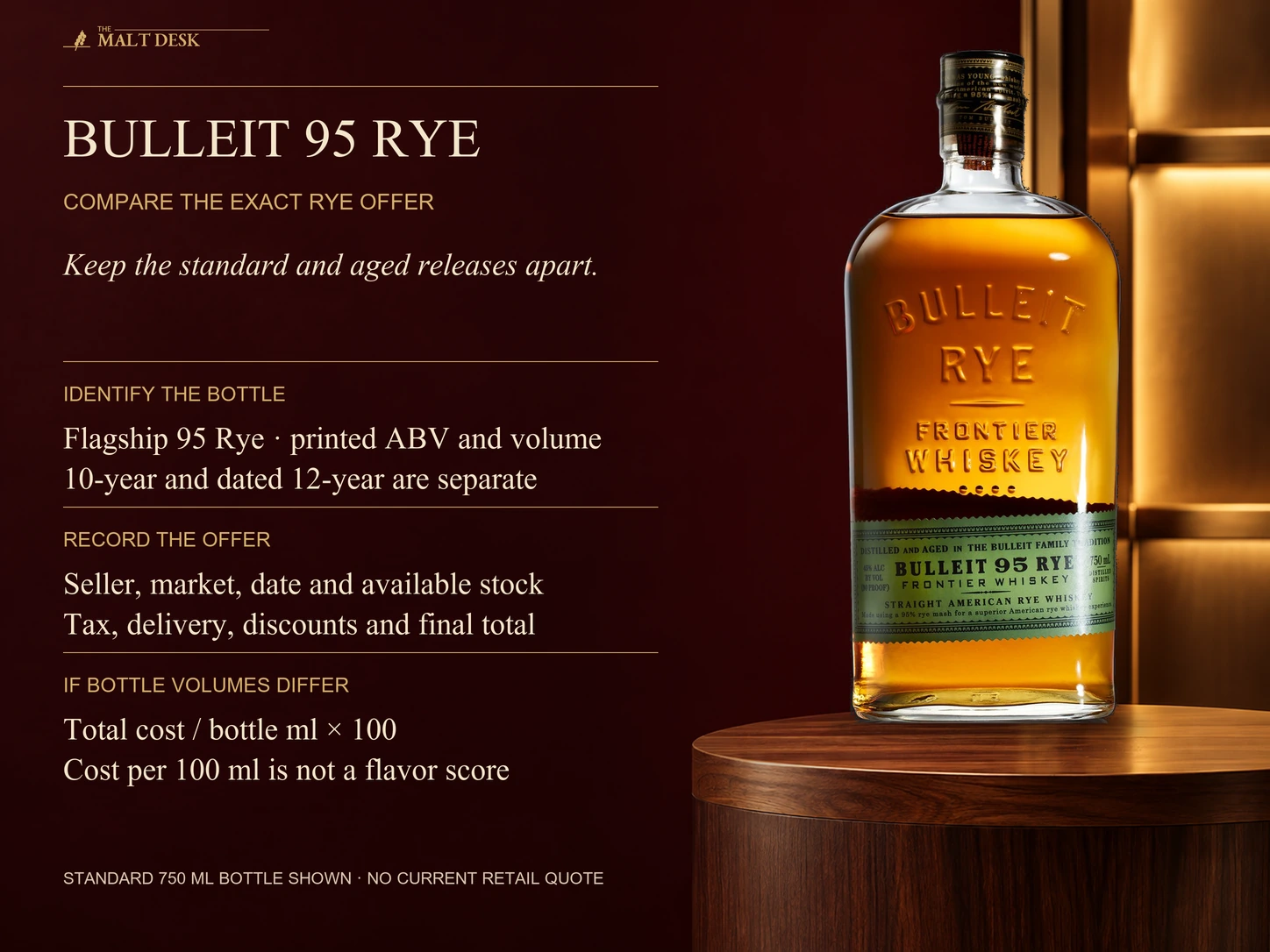
The earlier retailer notes do not retain complete offer records, so they cannot support a dependable historical range or current quote. Start a new comparison with the standard 95 Rye expression and its printed strength and volume, keeping Rye 10 Year Old separate.
For each dated local offer, record the seller, location, stock status and total after tax, delivery and discounts. When bottle sizes differ, total cost divided by bottle ml and multiplied by 100 gives cost per 100 ml.
Compare the standard 95 Rye with the same expression and volume. A larger bottle, ten-year expression or temporary promotion can otherwise distort the comparison.
Related product comparisons
Wild Turkey 101 and Woodford Reserve are bourbon references, not substitute definitions of rye. Their different grain category and bottling strengths should be recorded before comparing published notes.
The three-bourbon comparison shows why even one category contains varied recipes. The same care applies when comparing Bulleit with another rye: examine the full label instead of assuming that the shared grain name makes the products equivalent.
In Brief
Bulleit 95 Rye refers to its 95% rye mash bill; the bottling is 90 proof.
Identify the Bulleit Rye Release as Well as Its Numbers
Use recipe, age and proof to recognize the product family, then match the release year when researching the twelve-year bottling. A review or offer tied to the 2019 release belongs with that release; the 2024 account supplies its own context. Choose standard Bulleit Rye or a dated special release according to the expression you actually want to explore.
Common questions
Does 95 mean 95 proof?
No. It describes the rye percentage in the mash. The standard Bulleit Rye is 90 proof, or 45% ABV.
Is it a ten-year-old whiskey?
The standard expression is not labeled ten years old. Bulleit Rye 10 Year Old is a separate product.
Does straight mean it cannot be mixed?
No. Straight is a regulated whiskey designation. It does not restrict the serving method.
Is rye automatically stronger than bourbon?
No. Compare ABV on the actual labels. Grain category and alcohol concentration answer different questions.
Sources
Bulleit: flagship Rye and Rye 10 Year Old product information and Rye Manhattan materials. U.S. TTB whisky guidance and 27 CFR 5.74. The guide does not establish a current retailer price or a verified historical price range.
Range analysis checked October 8, 2026: Diageo’s 2019 release announcement and Bulleit’s April 2024 return announcement establish the dated twelve-year comparison; the producer attributes profile differences to the returning selection. Current flagship and ten-year records remain separate.