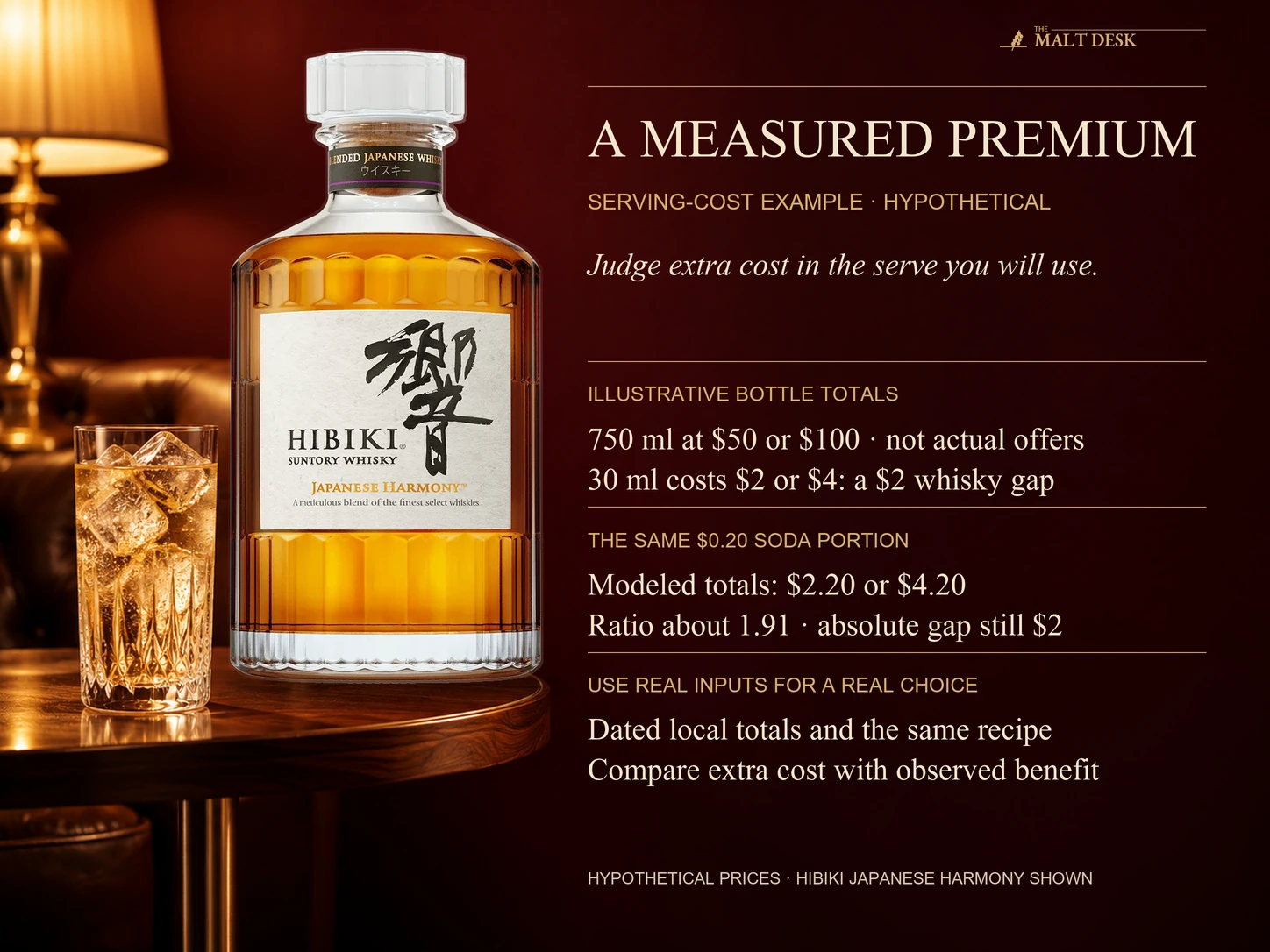
Keep the bottle’s cost per measured whiskey pour in the highball comparison alongside the mixer and serving recipe. For a highball decision, I would translate the actual local bottle totals into the whisky contribution for that recipe. That gives the price premium a concrete amount to judge against any observed benefit in the intended serve.
The arithmetic can reveal two different comparisons. A larger mixer amount reduces cost per milliliter of the finished drink, while the cost difference for the unchanged whisky measure remains the same. Confusing those measures can make an expensive bottle look economical simply because the drink was lengthened.
Hibiki Japanese Harmony and Suntory Toki are blended Japanese whiskies from the House of Suntory. Both combine malt and grain whisky, carry no age statement and have a reference bottling strength of 43% ABV. Their shared producer and distillery sources do not make them the same recipe.
A useful comparison separates product facts, attributed flavor descriptions and packaging. Shared distillery sources do not disclose equal component shares, and neither no-age-statement blend supplies its component ages.
What the two expressions share
Suntory connects both blends with Yamazaki, Hakushu and Chita. The producer presents both as meeting the Japan Spirits & Liqueurs Makers Association’s Japanese-whisky labeling standards. The Japanese whisky guide explains what those standards cover.
Neither standard expression states the age of its youngest component. No age statement does not mean no maturation, and a higher price does not establish an older minimum age. At the same 43% ABV, equal volumes of the two contain the same amount of alcohol.
How Suntory describes Toki
The current Toki materials describe a blend using Hakushu lightly peated whisky, Chita heavy grain whisky and Yamazaki Spanish-oak-cask whisky. These are producer-identified components, not a published percentage recipe.
Toki’s product notes emphasize basil, green apple and honey on the nose; grapefruit, green grape and herbs on the palate; and vanilla oak, pepper and ginger in the finish. This places fresh fruit and herbal vocabulary prominently in the brand’s description.
The Toki guide covers the individual expression. Toki Black is a separate product, so its specifications and additional smoky emphasis should not be transferred to the standard Toki bottle.
How Suntory describes Hibiki Japanese Harmony
The Japanese Harmony product page uses rose, lychee, rosemary and wood aromas, followed by honey-like sweetness, candied orange peel and white chocolate. These are Suntory’s sensory descriptions.
The Hibiki range contains other expressions with age statements. Their ages do not establish the age of Japanese Harmony. Similarly, a general account of the Hibiki range should not be treated as the exact component recipe for this particular bottling.
The Japanese Harmony guide provides product-specific context. When reading comparisons, check that “Hibiki” means Japanese Harmony rather than an age-stated release or a special edition.
Comparing the Producer Flavor Profiles
The published notes suggest different emphases: fresh green fruit and herbs for Toki, floral fruit and confectionery associations for Japanese Harmony. That is an interpretation of the producer descriptions.
Words such as integrated, smooth, light or complex are sensory judgments. They can be useful when attributed to a source, but they do not follow automatically from ABV, price or the number of distilleries. A common origin can support many different blends.
Serving method changes the comparison
Suntory prominently presents Toki in a Japanese highball and also publishes other cocktail uses. That is a documented product role. It does not establish that Hibiki cannot be mixed or that every Toki highball will be preferred.
For a controlled highball comparison, use matching whisky measures, soda volumes, ice and temperatures. Keep garnish constant too: citrus peel contributes its own aroma. Change the whisky while holding the recipe stable, then record the result as a preference within that preparation.
A neat comparison asks a different question. Water and ice alter the conditions, with ice combining cooling and dilution as it melts. The highball guide explains the practical variables.
Put the Premium Into One Measured Serve
For an explicitly hypothetical example, use equivalent 750 ml bottle totals of $50 and $100. A 30 ml measure uses one twenty-fifth of either bottle, so the whisky contributions are $2 and $4. The difference is $2 for that measure. A drinker’s decision can then ask whether the preferred expression in the actual highball earns that additional amount.
If the same 90 ml soda portion costs $0.20 in each, the modeled ingredient totals become $2.20 and $4.20, before any other ingredients or service costs. The bottle price ratio was two, but the drink-cost ratio is about 1.91. Adding the same mixer cost changes the ratio; it does not change the $2 absolute gap.
More Soda Changes the Denominator, Not the Whisky Outlay
At 30 ml whisky plus 90 ml soda, those ingredient totals spread over a nominal 120 ml before ice melt. If the recipe instead adds 120 ml soda from the same unit-cost source, the modeled totals become about $2.27 and $4.27 over 150 ml. The cost per milliliter falls, but the unchanged whisky portions still differ by $2. This is a different recipe, not a reduction in the premium paid for the spirit.
The longer recipe also changes the modeled starting concentration from 10.75% to 8.6% when both whiskies are 43%. Any sensory preference therefore belongs to its particular preparation. The cost calculation cannot establish that Harmony’s described floral or confectionery direction survives unchanged, or that mixing makes it irrelevant.
For a real comparison, replace the invented prices with dated final local totals and use the printed bottle volumes. Keep soda, garnish, ice and measured whisky quantity equal if the question concerns the extra spirit cost. An actual preference under that recipe supplies the benefit side of the decision; a bottle-price ratio alone cannot supply it.
Compare Age, Strength and Local Cost
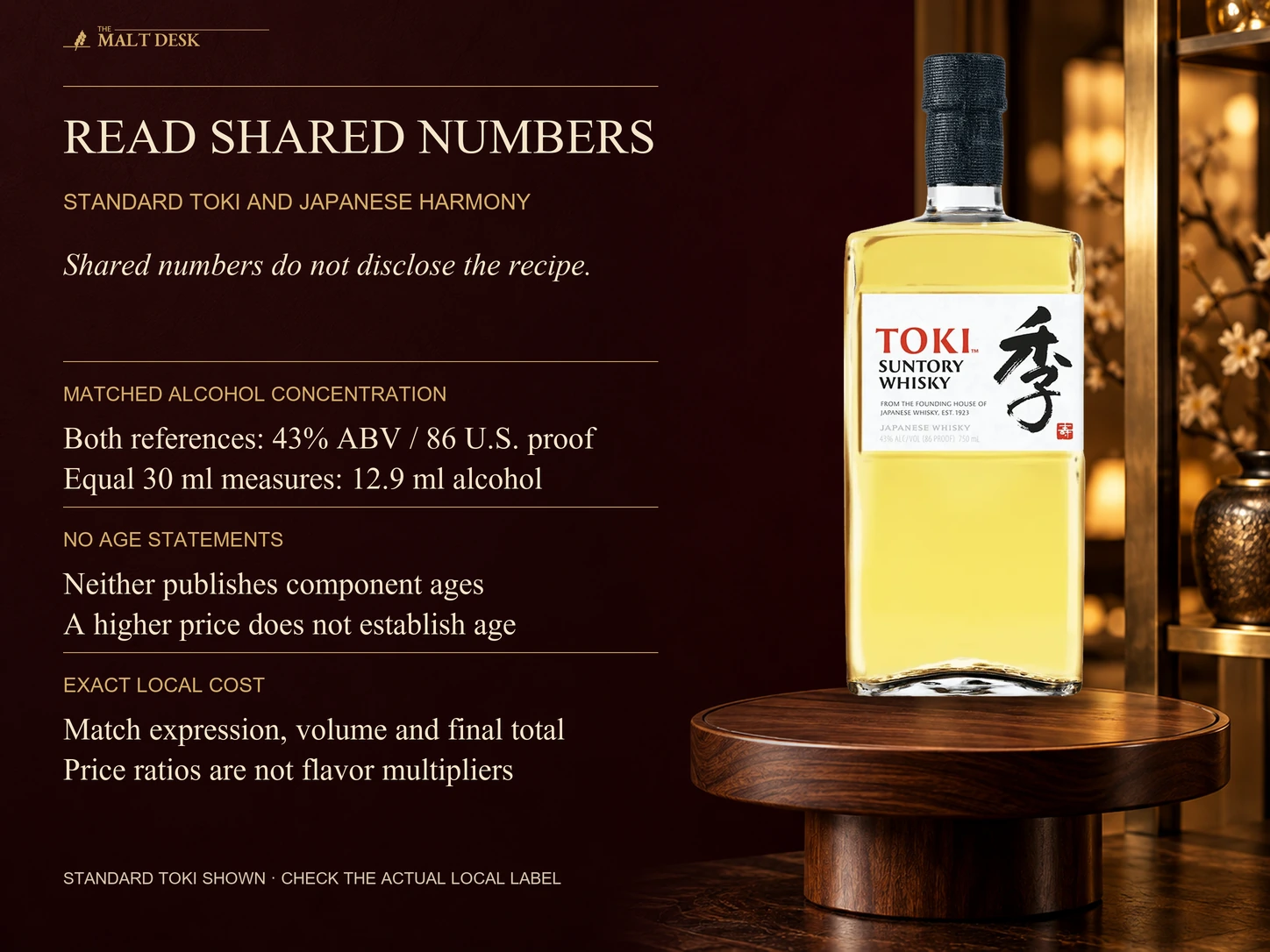
The earlier retailer amounts lack complete original records of location, stock, tax and offer conditions, so they are not used as current prices or a historical market range. Compare the exact expression, actual local bottle and dated final total.
At the shared 43% reference, equal 30 ml measures contain 12.9 ml pure alcohol. A local price ratio is a cost calculation, not a multiplier for flavor quality.
A current comparison needs the same expression, bottle volume and final local cost. A limited gift presentation or different bottle size can change the price without representing the same product comparison. A permanent “worth it below” threshold would hide those differences.
Presentation and gifting
Packaging can be a legitimate part of a gift decision, but it should be discussed separately from the liquid. A recipient’s interest in design, the specific expression and preferred serving method matters more than a universal claim that an expensive bottle is a better gift.
For an informational comparison, distinguish the package being considered from the standard bottle and record any included accessories. That keeps presentation value separate from product specifications and avoids implying that price guarantees a tasting experience.
In Brief
Both are Suntory malt-and-grain blends with no age statements and 43% references. Their producer vocabulary differs; component ages, local cost and personal serving preference are separate questions.
Judge the Hibiki Premium in the Intended Serve
Compare the actual bottle totals by the whiskey amount used in one recorded highball. Keep mixer, ratio and garnish consistent, then decide whether Harmony’s contribution in that serve justifies its extra cost to you. If presentation or ownership is the purpose, assess the full bottle directly; the relevant comparison follows the occasion you plan to use it for.
Common questions
Is Toki simply a cheaper Hibiki?
No. Shared distillery sources do not make two blends identical. Component selection and proportions can differ.
Which one is older?
Neither standard expression publishes an age statement. A minimum-age comparison cannot be inferred from their relative prices.
Are both 43% ABV?
The reference bottlings are 43% ABV, or 86 U.S. proof. Check the exact expression and local label.
Does a higher price make Hibiki better for every use?
No. Price, presentation, published flavor style and serving preference are separate considerations.
Sources
Current Suntory Toki and Hibiki Japanese Harmony product descriptions and Japanese-whisky labeling statements, checked October 4, 2026; Toki North American launch announcement, June 8, 2016, for its 43% historical reference. Producer vocabulary is attributed. No current retail range or component-age comparison is established.
Serving-cost analysis note: bottle and soda prices are hypothetical, not current offers. Ingredient totals exclude service and unspecified extras. Concentrations assume the shared 43% reference and additive volumes before ice melt.