Wild Turkey 101 Bourbon: Proof and Production
The next step from Wild Turkey 101 does not have to mean more alcohol. The producer also identifies a separate 101 8-Year-Old Bourbon: the proof remains 101 while the printed age floor becomes eight years. Rare Breed takes another route, with a barrel-proof presentation and a disclosed mixture of differently aged stocks. Those two routes answer different requests.
I would start by asking what is missing from standard 101 for this particular reader. If it is a named minimum age, the age-stated 101 is the directly relevant comparison. If it is an undiluted-at-bottling expression, Rare Breed is more relevant. The oldest stock mentioned in Rare Breed’s description does not turn the latter into the older minimum-age option.
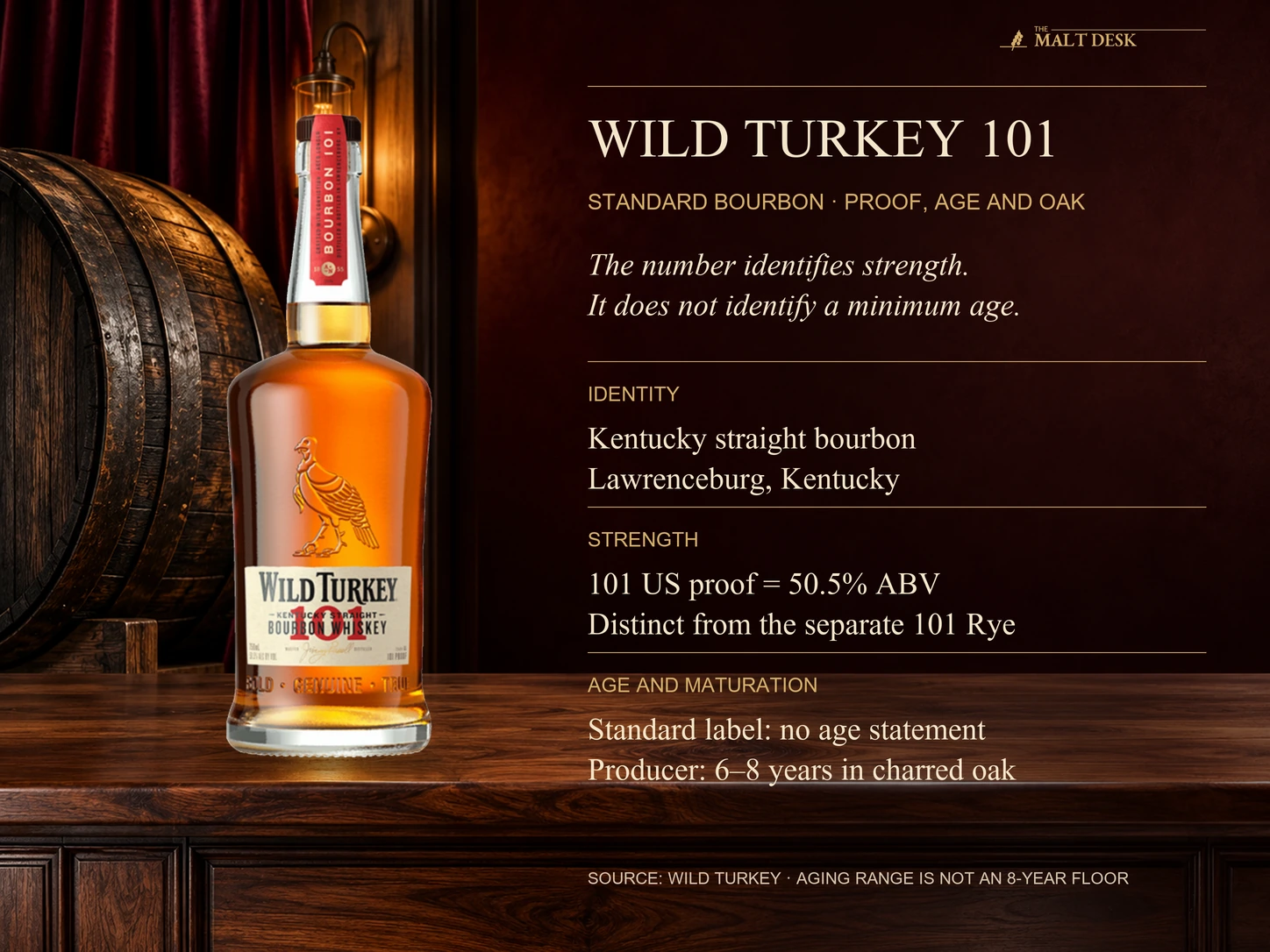
Wild Turkey 101 is Kentucky straight bourbon bottled at 101 US proof, equivalent to 50.5% ABV. The number identifies strength, not age. It is also important to distinguish the bourbon from Wild Turkey 101 Rye, which shares the proof number but belongs to a different whiskey category.
Product Facts
| Expression | Wild Turkey 101 Bourbon |
|---|---|
| Category | Kentucky straight bourbon whiskey |
| Distillery location | Lawrenceburg, Kentucky |
| ABV / US proof | 50.5% / 101 |
| Standard bottle age label | No age statement |
| Producer maturation description | American white oak with a deep alligator char |
What 101 Proof Changes
At an equal volume, Wild Turkey 101 contains more alcohol than a 40% or 45% bottling. Thirty milliliters contains 15.15 ml of pure alcohol, compared with 12 ml at 40% or 13.5 ml at 45%. Compared with the 40% pour, the 50.5% pour contains 3.15 ml more alcohol, or 26.25% more at equal volume (3.15 divided by 12). The ABV difference itself is 10.5 percentage points.
Mixer flavor, dilution, temperature and personal perception affect the result. “More proof” and “more quality” are separate claims.
Age Statement Versus Producer Description
The Wild Turkey U.S. and international product pages describe an aging range of six to eight years. That is a producer description of the standard expression, while the standard no-age-statement label does not display an eight-year minimum. Product information and market presentations should be checked together.
A separately labeled Wild Turkey 101 8 Year Old is a different expression. Do not apply an eight-year label, photograph or price to the standard bottle simply because both display 101 proof. The youngest-age claim on a specific bottle matters more than an assumed brand-wide age.
Charred Oak and Grain Recipe
The producer describes American white oak barrels with a deep alligator char. Charring refers to the burned inner surface of the barrel. It is a different process from drying malt with peat smoke and should not be used as a synonym for peated whisky.
Wild Turkey’s product page also refers to rye in the bourbon recipe without giving a full percentage breakdown. A bourbon can contain rye while remaining bourbon; rye whiskey is a different category. A published exact mash bill should not be invented from the brand’s broad description.
Producer Flavor Profile
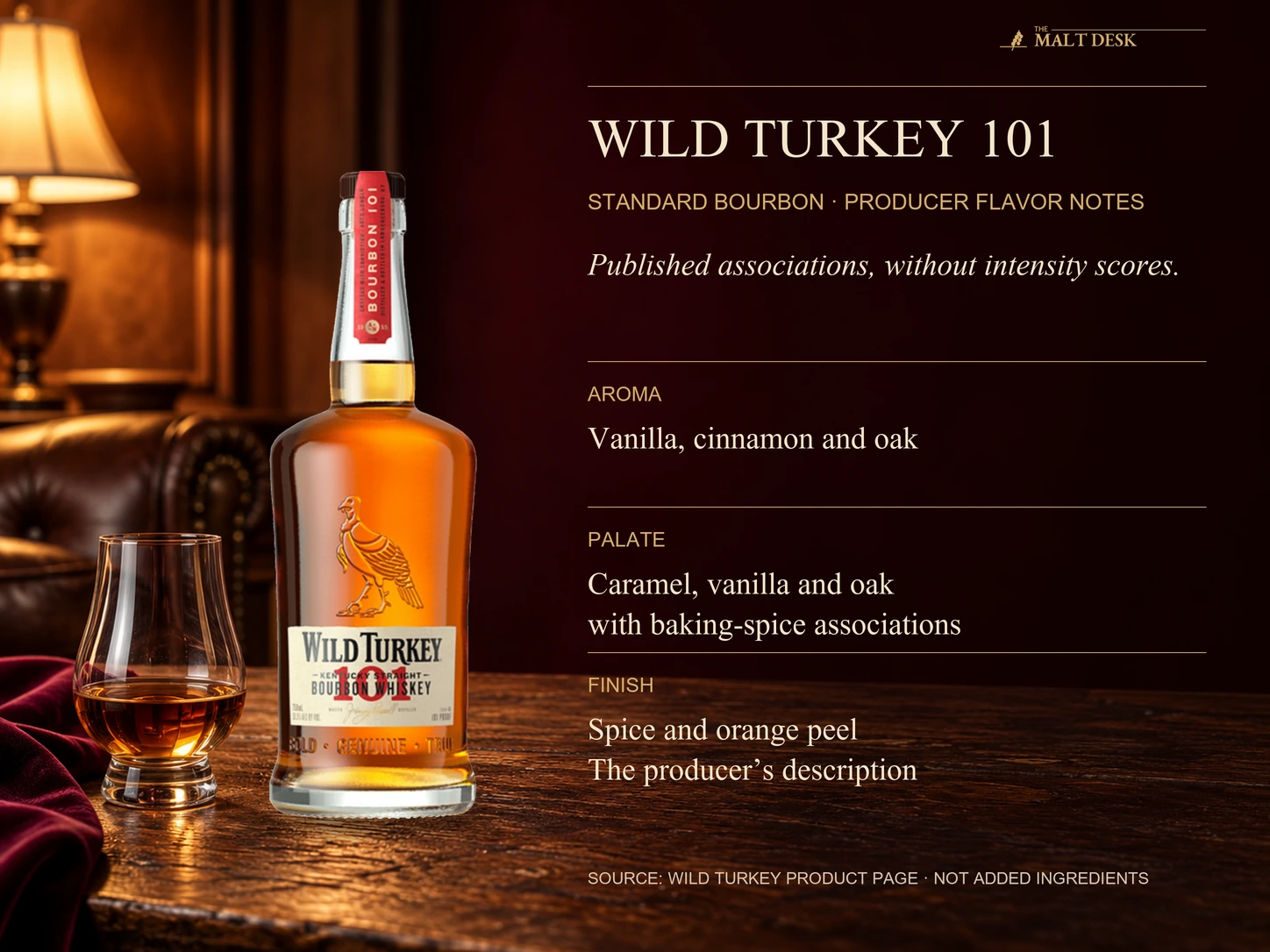
Wild Turkey’s official notes describe vanilla, cinnamon and oak in the aroma; caramel, vanilla, oak and baking-spice associations on the palate; and spice with orange peel in the finish.
Nor does a flavor description establish the concentration of a particular chemical or a numerical intensity score. Perceived warmth and dryness can differ with serving conditions.
Water and Ice: A Quantitative View
Adding 10 ml water to 30 ml of 50.5% whiskey gives a total of about 40 ml at 37.9% ABV, assuming additive volumes. Adding 5 ml instead gives about 43.3%. These calculations explain why a measured water addition is more reproducible than saying “a splash.”
Ice adds a second variable: cooling. Its meltwater contribution changes over time, so the concentration cannot be calculated from the initial whiskey volume alone. Record the ice amount and elapsed time if the aim is a comparison.
A fixed five-minute rest or one cube does not guarantee sweeter flavors or remove alcohol. Those are serving conditions to describe, not universal outcomes.
An Eight-Year Floor and a Twelve-Year Component Are Different Promises
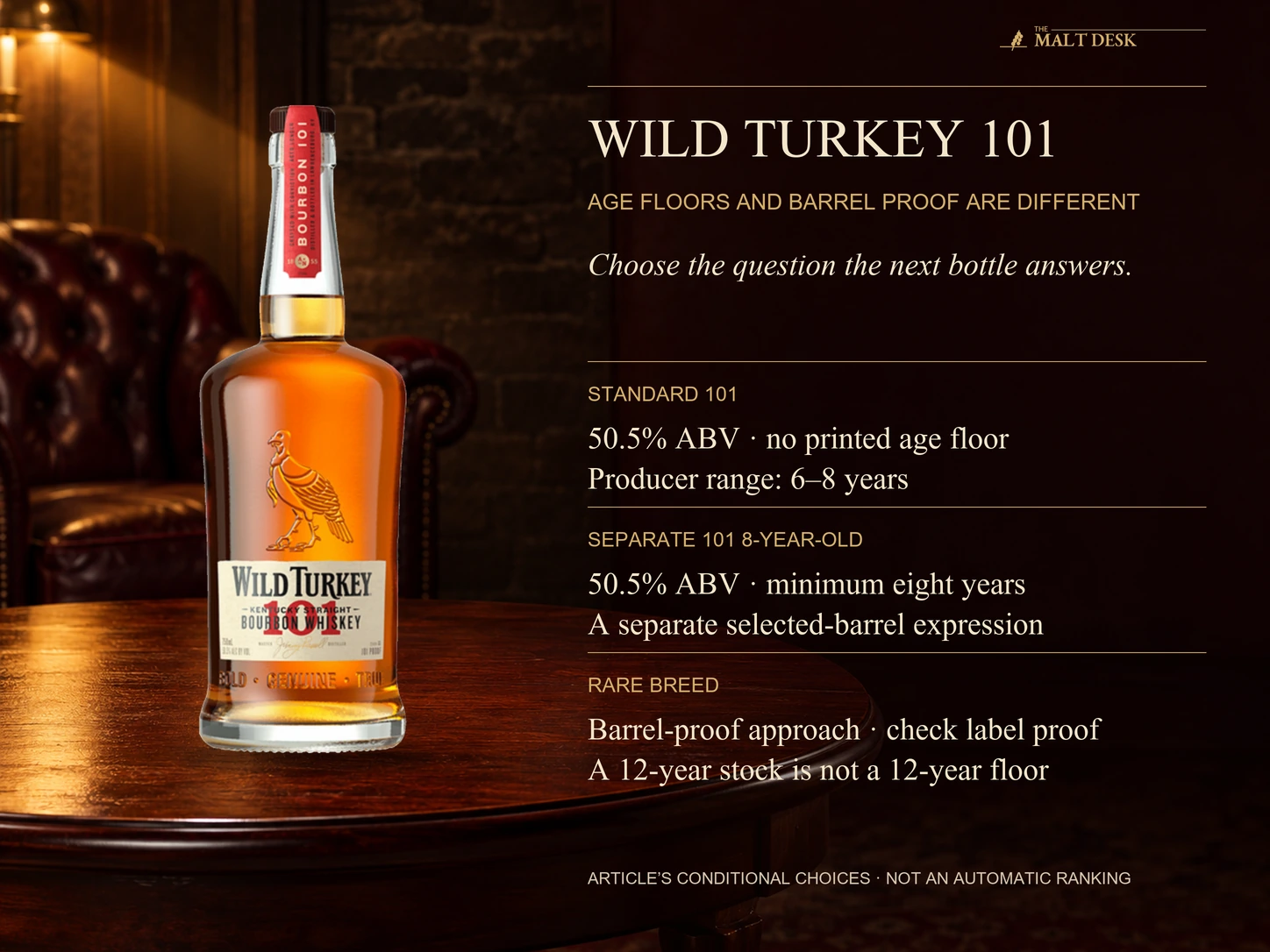
The standard product account describes six-to-eight-year maturation, while its usual label carries no age statement. The separate 101 8-Year-Old page specifies at least eight years. Rare Breed’s U.S. account describes six-, eight- and twelve-year stocks and lists 116.8 proof. These disclosures can be arranged without treating every larger number as the next rung of one age ladder.
| Exact expression | Strength in the cited account | Age information that the account supplies |
|---|---|---|
| Standard Wild Turkey 101 Bourbon | 101 proof / 50.5% | No label age; producer describes six to eight years |
| Wild Turkey 101 8-Year-Old Bourbon | 101 proof / 50.5% | Minimum eight years |
| Wild Turkey Rare Breed, cited U.S. account | 116.8 proof / 58.4% | Six-, eight- and twelve-year stocks; not a twelve-year floor |
The age-stated 101 lets a reader seek an eight-year minimum while retaining the familiar bottling proof. That is a more precise response to an age requirement than selecting Rare Breed because twelve appears in its component description. It does not make the two 101 products an experiment in age alone: the producer also describes a smaller selection of barrels for the eight-year expression.
Rare Breed instead answers a bottling-treatment question. The producer says no water is added before bottling. Its twelve-year stocks can contribute to the blend without making every component twelve years old, and their share is not supplied by listing three ages. Averaging six, eight and twelve would be equally unjustified without component proportions.
The strength needs its own market check. The U.S. Rare Breed account used here lists 116.8 proof, while another official product page lists 112.8. Neither web entry should overrule the actual bottle’s proof.
Cocktail Context
An Old Fashioned introduces sugar, bitters and dilution. A Whiskey Sour adds citrus and sweetener. Those ingredients change the balance independently of the whiskey’s proof. The producer promotes 101 for cocktails, but that is not a controlled comparison against all other bourbons.
For a highball made with 30 ml Wild Turkey 101 and 120 ml non-alcoholic mixer, approximate strength is 10.1% before ice melt. A 1:3 recipe using 90 ml mixer is approximately 12.6%. The larger mixer measure lowers concentration while retaining the 15.15 ml of alcohol in the whiskey pour.
The highball guide explains the role of soda, ginger ale and cola. Keep the recipe consistent when comparing the effect of different bottles.
Compare With Other Bourbon Expressions
Maker’s Mark is a 45% wheated bourbon. It differs in both grain recipe and strength. That makes “softer because of wheat” an incomplete explanation: multiple production and serving variables can affect the impression.
The Buffalo Trace, Maker’s Mark and Wild Turkey comparison separates disclosed recipe details from ABV. It is more useful to identify those differences than to assign a winner for every drinker.
Reading Price Information
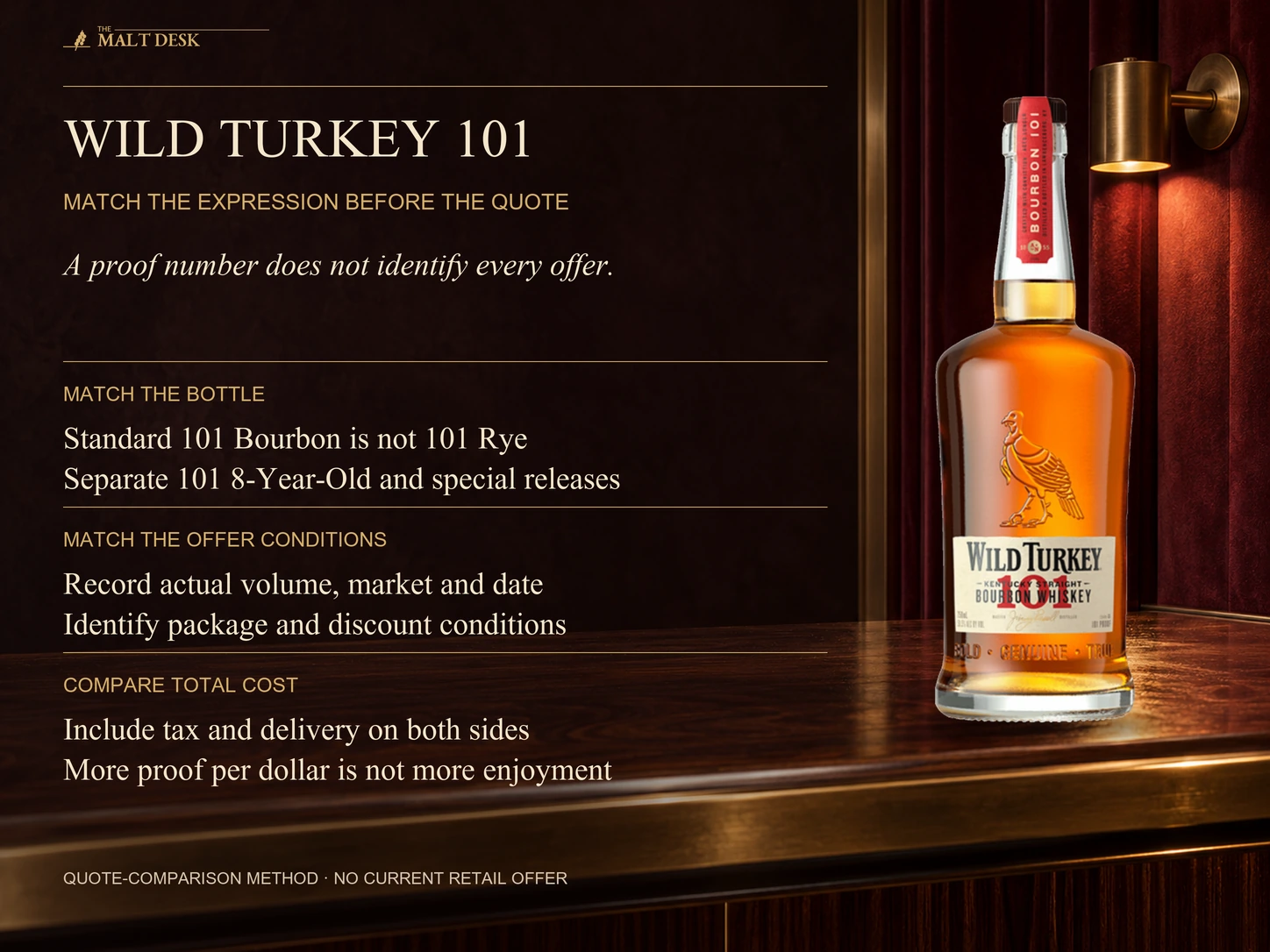
A price needs a date, market, bottle volume and offer conditions. A historical low listing is not a permanent national benchmark, and a standard 101 price is not automatically applicable to an age-stated or single-barrel release.
The whiskey budget guide explains unit-price comparisons. More proof per dollar is arithmetic, but it does not establish more enjoyment or a reason to consume a larger quantity.
Choose the Wild Turkey Upgrade by Its Disclosure
Investigate 101 8-Year-Old when the desired change is an explicit eight-year age floor at the familiar 101 proof. Investigate Rare Breed when the interest is its barrel-proof presentation and disclosed age mix. For either route, compare the exact local expression with standard 101 so the added cost answers the age or strength question you actually have.
Common Questions
Is 101 an age?
No. It is US proof: 101 divided by two equals 50.5% ABV.
Is standard 101 the same as 101 Rye?
No. Check the category printed on the bottle. Bourbon and rye expressions can share a proof number.
Is it bottled in bond?
A 101-proof number is not a bottled-in-bond claim. Bottled-in-bond is a separate designation, not a general term for any whiskey around 100 proof.
Does the producer’s six-to-eight-year description make it eight years old?
No. An aging range is not an eight-year minimum-age statement. Use the exact expression and its label when describing age.
Does adding water reduce the amount of alcohol?
It reduces concentration. The alcohol quantity already poured remains unless some of the drink is removed.
Sources
Wild Turkey, Wild Turkey 101 Bourbon product and production information; U.S. Alcohol and Tobacco Tax and Trade Bureau standards of identity for bourbon whisky and age statements. The current U.S. product page was checked October 3, 2026. The producer’s six-to-eight-year description remains separate from a label age and from the named 101 8 Year Old release.
Additional range sources: Wild Turkey’s standard 101, 101 8-Year-Old and Rare Breed product accounts, checked October 5, 2026. U.S. Rare Breed strength is distinguished from another official page’s figure. Product descriptions do not establish local stock, transaction availability or identical barrel selection.