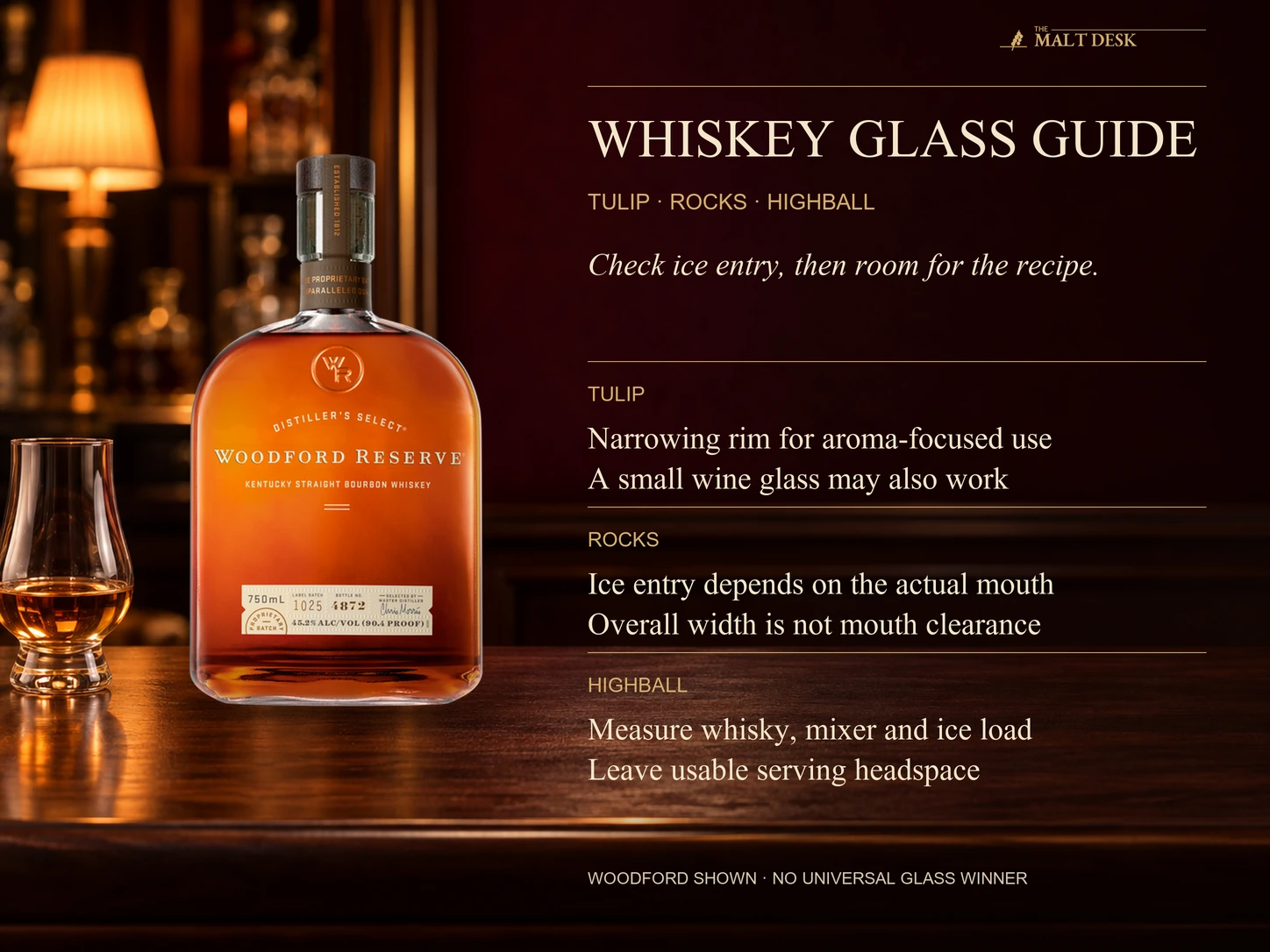
How the Three Glass Shapes Differ
A glass can have enough advertised capacity for a drink and still fail the actual serve. The ice may not pass through its mouth, or the intended liquid may leave too little usable room once ice is present. I would make those two checks separately: entry through the opening, then space for the measured recipe. A single capacity number cannot answer both.
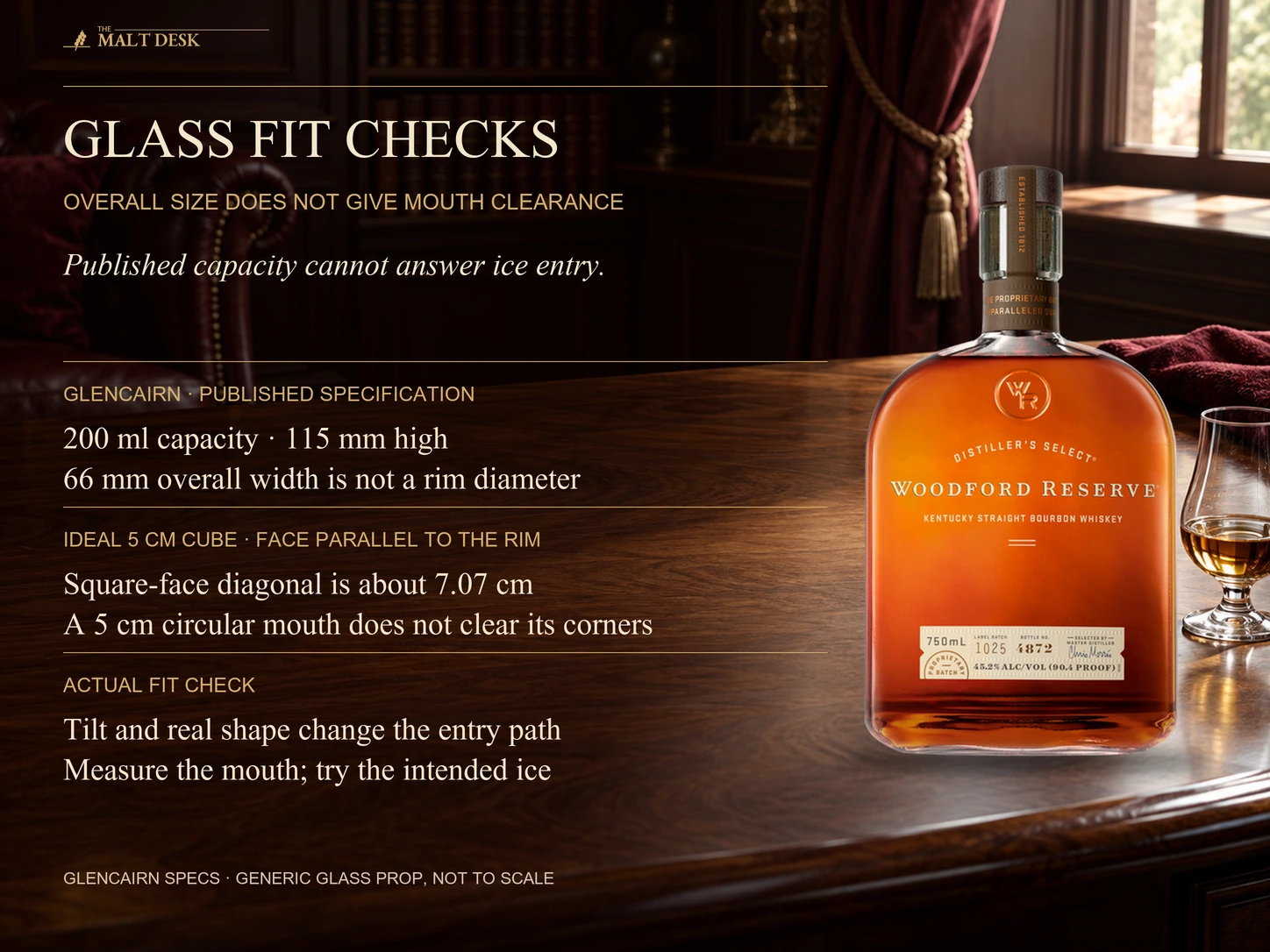
That separation can prevent a disappointing purchase. The Glencairn’s published figures are 200 ml capacity and 115 by 66 mm overall dimensions. Obtain the mouth-opening width separately when checking ice fit. The same problem applies to a tumbler advertised mainly by volume: its widest point may be below the opening.
A tulip-shaped glass has a bowl that narrows toward the rim and is commonly used for aroma-focused assessment. A rocks glass has a wider opening that accommodates larger ice. A highball glass provides space for ice and mixer in a tall format.
The relevant difference is the intended serve, available headspace and handling. Shape can influence how aromas reach the nose, but no one design makes every whisky objectively better. A small wine glass with a narrowing rim can also serve as a practical nosing vessel.
Key Takeaways
- A tulip-shaped glass is commonly used for aroma-focused assessment.
- A Glencairn is one familiar tulip-shaped design, not a rule that every whiskey drinker must follow.
- Rocks glasses trade aroma concentration for room to add large ice and build short cocktails.
- Highball glasses are tall because long, cold drinks need space for ice and mixer.
- A copita performs a similar tasting role to a tulip glass but adds a stem.
- Expensive crystal is optional; shape, cleanliness, stability and repeat use matter more.
- A small wine glass with a narrowing rim can be a useful substitute.
Does the Whiskey Glass Really Matter?
The glass cannot add flavor compounds to a whiskey, but it can change what reaches your nose and how you experience the pour.
The Scotch Whisky Association’s tasting toolkit separates glassware by occasion. It describes the Glencairn’s bulb and tulip shape as useful for collecting aroma during traditional tastings, the tumbler as a practical choice for rocks serves and classic cocktails, the copita as an aroma-concentrating tasting glass, and the highball as the glass for long mixed drinks.
That is the useful level of the claim. A tulip rim can make nosing easier; a wide tumbler can make ice and stirring easier; a tall glass can make a highball easier. It does not follow that one shape makes every whiskey objectively better.
The current Glencairn product specification lists 200 ml capacity and overall dimensions of 115 mm high by 66 mm wide. Capacity is not a recommended pour, and the overall width is not a published rim diameter. For ice fit, compare the actual opening with the cube dimensions.
Glencairn vs Rocks vs Highball: At a Glance
| Glass type | Best use | Aroma focus | Ice capacity | Main strength |
|---|---|---|---|---|
| Tulip / Glencairn-style | Neat tasting, water trials, comparison | Narrowing rim; commonly used for nosing | Limited space; check the rim and bowl dimensions | Narrowing rim helps collect and direct aroma |
| Rocks glass / tumbler | On the rocks, Old Fashioned, short cocktails | Wide opening | Usually accommodates larger cubes; check dimensions | Wide mouth accepts large ice and bar tools |
| Highball glass | Soda, ginger ale, cola and long drinks | Tall open rim; varies by design | Space for ice and mixer; cube size must fit | Tall form provides space for cold mixer and ice |
The table summarizes common uses. Aroma concentration depends on the exact vessel and conditions rather than a universal high-to-low score.
1. Tulip-Shaped Whiskey Glass for Neat Tasting
A tulip-shaped whiskey glass has a rounded lower bowl and a rim that narrows toward the top. The lower section gives a small pour enough surface and headspace to release aroma. The narrower opening keeps that aroma near the nose instead of letting it disperse immediately.
The Glencairn is the best-known example. Its heavy foot makes it easier to set down and hold than a delicate stemmed tasting glass, while its clear bowl keeps color and clarity visible.
Best for
- Opening a new bottle for the first time
- Neat pours and controlled water trials
- Comparing two or more whiskeys under the same conditions
- Small pours that will be nosed slowly
- Scotch, bourbon, Irish whiskey, Tennessee whiskey and Japanese whisky
Start with roughly 0.75 to 1 ounce. A small pour preserves headspace and keeps your nose away from the liquid. Do not force your nose deep into the rim and inhale hard; approach from a short distance and take several gentle passes.
Advantages
- Concentrates aroma more effectively than an open tumbler
- Supports swirling without needing a large pour
- Creates a repeatable format for bottle comparisons
- Fits a small amount of whiskey comfortably
- Usually stable and easy to store
Trade-offs
- Does not accept a large cube
- Too small for an Old Fashioned or highball
- Can also concentrate ethanol when the whiskey is high proof
- Less comfortable than a wide tumbler for a casual cold pour
If high proof produces too much nasal prickle, move the glass farther away, keep your mouth slightly open while nosing and add water gradually. The goal is aroma access, not proving that you can tolerate the strongest presentation.
Is a Copita Better Than a Glencairn?
A copita has a similar aroma-first bowl and narrowing rim, but it adds a stem. The shape descends from the traditional Spanish glass used to sample sherry and has long been used by distillers, blenders and serious tasters.
The stem makes it easy to handle several samples without wrapping a warm hand around the bowl. It can also feel more precise when swirling. The trade-off is fragility and a higher center of gravity.
Choose a Glencairn-style glass for stability and relaxed home use. Choose a copita if you prefer a stem, compare flights frequently or want less direct hand contact with the bowl. Most home drinkers do not need both.
2. Rocks Glass for Ice and Short Cocktails
A rocks glass is a low, wide tumbler. Its defining advantage is room: a large cube or sphere fits through the mouth, and a bar spoon can move freely when building an Old Fashioned.
The Scotch Whisky Association places the tumbler with rocks serves and classic cocktails. Riedel’s official rocks-glass description makes the same practical case, positioning the shape for spirits over ice and balanced cocktails.
Best for
- Whiskey over one large cube
- Old Fashioneds and other stirred short cocktails
- Whiskey Sours served over ice
- Relaxed sipping when temperature matters more than detailed nosing
- Drinkers who like a substantial glass in the hand
Advantages
- Excellent room for large-format ice
- Easy to stir and garnish
- Stable, familiar and widely available
- Useful beyond whiskey
Trade-offs
- A wide opening differs from the narrowing rim used for aroma-focused tasting
- Large capacity can encourage an unnecessarily large pour
- Heavy decorative bases can become tiring or awkward to wash
You can drink whiskey neat from a rocks glass. Nothing becomes invalid. It simply gives you less aroma concentration than a smaller tulip shape, so it is not the most repeatable tool for careful comparison.
The Woodford Reserve guide provides related product context; the glass dimensions should still be matched to the intended serve.
3. Highball Glass for Soda and Long Drinks
A highball glass is tall and relatively narrow. It provides vertical room for ice, whiskey and a carbonated mixer without turning the drink into a wide bowl of rapidly warming liquid.
A highball glass must accommodate the intended liquid and ice, with space above the drink. Tall form alone does not establish a carbonation-retention time; temperature, agitation and recipe also matter.
Best for
- Whiskey and soda
- Ginger highballs
- Whiskey and cola
- Long, cold drinks served with food
- Highballs starting around one part whiskey to three or four parts mixer
Advantages
- Holds enough ice and mixer for a properly cold long drink
- Tall shape supports the visual and tactile experience of carbonation
- Easier to stir gently without spilling than an undersized tasting glass
- Works for many non-whiskey mixed drinks
Trade-offs
- Poor format for studying neat aroma
- Too much capacity can tempt over-dilution
- Narrow shapes require ice that actually fits
- Thin tall glasses can be less stable than tumblers
When choosing a glass for a highball, the best highball glass is not necessarily the largest one. It should fit your normal whiskey measure, cold mixer and full ice load without forcing the ratio upward. For bottle choices and mixers, see the best whiskeys for highballs.
What About a Brandy Snifter?
A snifter also uses a broad bowl and narrowed mouth, so it can work for neat whiskey. The main issue is scale. Many brandy snifters are large relative to a 0.75-ounce whiskey pour, and wrapping a hand around the bowl deliberately warms the liquid.
A snifter’s bowl and rim form a different geometry from a tulip glass. To compare perception, keep liquid volume, temperature, elapsed time and handling consistent.
Use a small snifter if you already own and enjoy one. If you are buying a single dedicated whiskey glass, a compact tulip shape is usually easier to control.
Can You Use a Shot Glass for Whiskey?
A shot glass is designed for a quick, small serve. Its straight open walls create little headspace for controlled nosing, and the format encourages drinking before the aroma has time to develop.
It is appropriate when a shot is genuinely the intended serve. It is a weak choice for evaluating an expensive bottle or comparing subtle differences.
Can You Use a Wine Glass Instead?
Yes. A small white-wine glass with a bowl and a slightly narrowing rim can perform the same basic job as a dedicated nosing glass.
Use the smallest suitable wine glass, pour lightly and leave headspace. A very large red-wine bowl is less convenient because the small whiskey pour sits far below the rim.
This is the most practical test before buying specialist glassware: use a small wine glass for several sessions. If the aroma-first format becomes part of your routine, add a durable tulip-shaped whiskey glass later.
Matching Dimensions to the Serve
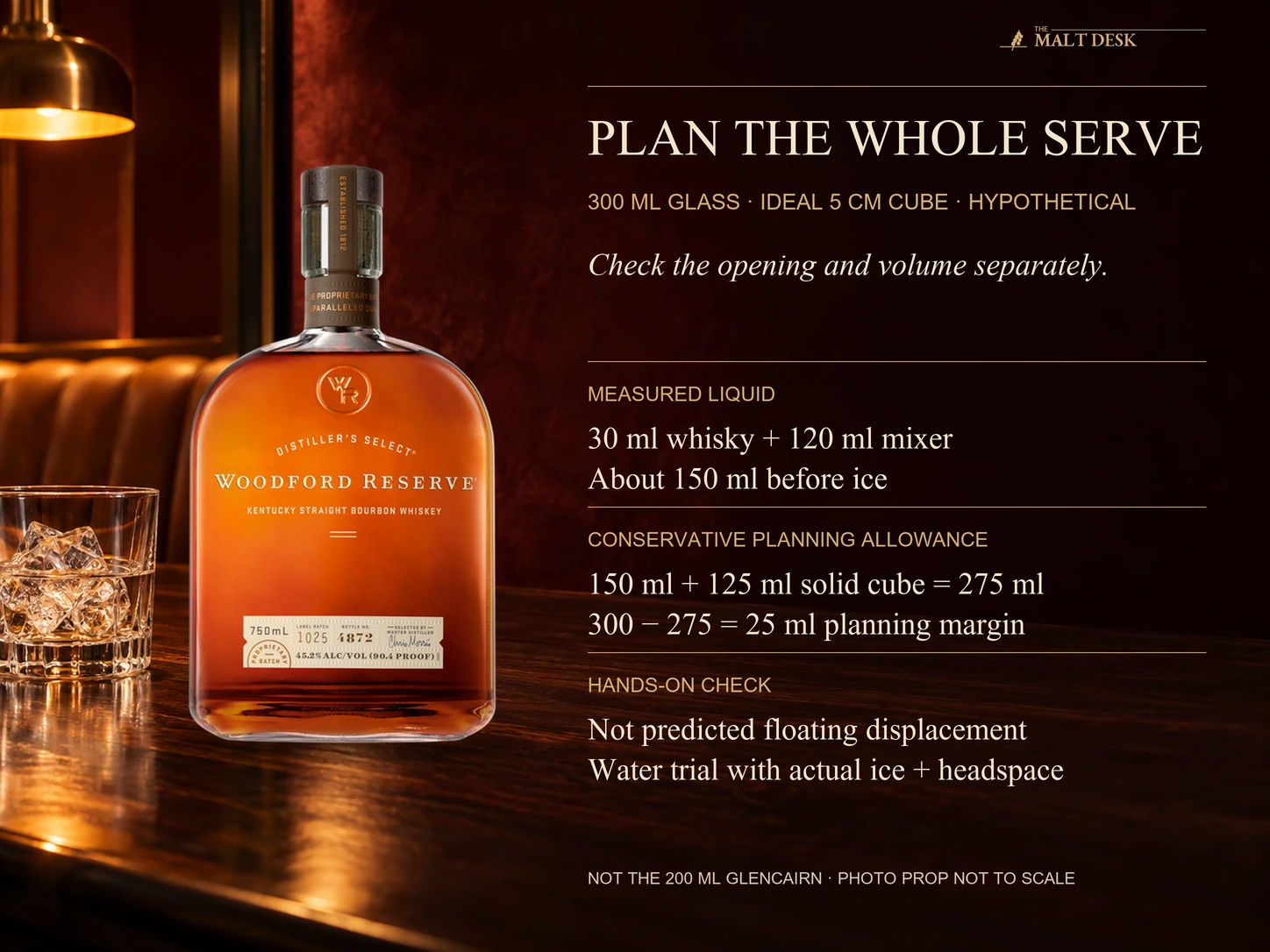
For an illustrative 300 ml glass, 30 ml whisky plus 120 ml non-alcoholic mixer occupies about 150 ml before ice. The nominal remaining 150 ml must accommodate ice displacement and serving headspace. This is a hypothetical capacity example, not the 200 ml Glencairn model or a guaranteed ice load.
For a small neat sample, useful dimensions leave headspace above the liquid. For an ice serve, the opening must accommodate the ice without forcing it through the rim. For a highball, capacity needs to account for ice displacement as well as the liquid volume.
Matching glasses help keep conditions similar in a comparison. A stem reduces direct hand contact with the bowl, while a broad foot can improve stability. These are practical design differences rather than a brand ranking.
A Five-Centimeter Cube Has Two Different Fit Tests
Consider an ideal cube with five-centimeter edges. Its solid volume is 5 × 5 × 5 = 125 cubic centimeters, equivalent to 125 ml. If a planned short drink contains 150 ml of measured liquid, adding the whole solid cube volume gives a conservative planning total of 275 ml. Against a hypothetical 300 ml capacity, that leaves only 25 ml of that allowance for clearance and handling.
This is a planning sum, not a prediction of the liquid’s exact height. A floating cube displaces liquid according to buoyancy, part of it may project above the surface, and real cubes have rounded edges and melt. Glass capacity may also be measured close to the brim. The arithmetic identifies a serve worth checking; it does not prove that every 300 ml tumbler will hold it comfortably.
The opening requires another calculation. A square face five centimeters wide has a corner-to-corner diagonal of 5√2, about 7.07 centimeters. With that face held parallel to a circular opening, a nominal five-centimeter opening cannot accept it merely because the edge is five centimeters long. The circle must accommodate the corners in that orientation.
Tilting the cube can change the entry path, so 7.07 centimeters is not a universal minimum for every possible insertion. An angled rim, a tapered bowl and the actual cube shape also change the result. Measure the opening separately from the widest outside dimension, then check the fit with the actual ice intended for the drink.
Keep the Recipe Fixed During the Glass Test
Use water to represent the intended liquid amount, then add the real ice format and check insertion, settling and a comfortable lifting margin. If the glass only works after cutting the mixer from 90 ml to 60 ml, it has not accommodated the same highball: the recipe and starting alcohol concentration have changed. Moving the unchanged recipe to another suitable glass gives a clearer answer about the vessel.
For tasting glasses, apply the same practical logic to a different task. Leave room above the intended small pour for gentle nosing rather than filling toward the advertised capacity. A rocks or highball glass solves a space problem; a narrowing tasting glass solves an aroma-access problem.
How to Choose Quality Without Overpaying
Shape before brand
For neat whiskey, look for a bowl with usable headspace and a rim narrower than the widest part. For ice, check the actual mouth opening. For highballs, make sure your preferred ice fits and that normal mixer volume does not require filling to the edge.
Clear, neutral glass
Colorless glass makes it easier to inspect color and clarity. Colored crystal can be attractive, but it is less useful for comparison tasting.
Stability and comfort
Thin glass is not automatically better. A daily glass should feel balanced when lifted, stable when set down and comfortable at the rim.
Cleaning
Soap residue, cabinet odors and scented towels can interfere with whiskey aroma. Follow the manufacturer’s dishwasher guidance, rinse thoroughly and let the glass dry without adding a new smell.
Replaceability
A glass you are afraid to use is poor daily equipment. Choose a line that can be replaced individually or in small sets, especially when building a tasting flight.
Are Expensive Whiskey Glasses Worth It?
They can be worth it for tactile reasons: thinner rims, better balance, visual clarity, finishing and presentation. Those improvements affect pleasure and ownership.
For a first purchase, prioritize:
- The right shape for your normal serve
- Cleanliness and neutral odor
- Stability and comfort
- Easy replacement
- Material, decoration and brand prestige
A clean, suitable vessel makes comparative observations easier to interpret than appearance or price alone.
Choosing by Function
Tulip, rocks and highball glasses serve different functions. Bowl shape, rim opening, headspace, stability and cleaning requirements are more useful comparison points than a claim that one glass is universally best. A suitable glass already in use can meet the same functional need.
Fit the Glass to the Complete Serve
For a neat pour, prioritize a comfortable rim and a bowl suited to nosing. For an iced drink, check that the chosen ice passes through the opening and that the measured liquid fits with usable headroom. Rehearse the intended serve with water before choosing a new glass; mouth width, working capacity and handling answer more than advertised capacity alone.
Frequently Asked Questions
Is a Glencairn glass only for Scotch?
No. The shape is useful for nosing many spirits. It works with bourbon, Irish whiskey, Tennessee whiskey, Japanese whisky and other neat pours.
Does a Glencairn glass make whiskey taste better?
It does not change the liquid. Its bowl and narrowing rim can make aroma easier to collect and compare, which may make the tasting experience feel clearer.
Can you drink whiskey neat from a rocks glass?
Yes. A rocks glass is suitable for neat whiskey and has a wide opening. A tulip glass narrows toward the rim and is commonly used for aroma-focused tasting. These are design and use differences.
Can you put ice in a Glencairn glass?
Small ice may fit, but the glass is not designed around large cubes. Use a rocks glass when ice is central to the serve.
What size highball glass should you buy?
Choose enough capacity for your normal whiskey measure, a full ice load and roughly three to four parts mixer without filling to the rim. Avoid buying extra capacity that encourages automatic over-dilution.
Is crystal better than regular glass for whiskey?
Crystal can offer clarity, balance and a thinner rim, but regular glass can perform the same basic tasting role. Shape, cleanliness and comfort matter more than the material name.
How many whiskey glasses do you need?
One or two tulip glasses are enough for solo use. Four matching glasses are useful for comparison flights or guests. Add rocks or highball glasses only when those serving styles are part of your routine.
Can a wine glass replace a whiskey glass?
Yes. A small wine glass with a narrowing rim is a practical substitute for neat whiskey and nosing. Leave plenty of headspace and avoid an oversized bowl.
Sources
Scotch Whisky Association, Scotch Whisky Tasting Toolkit; Glencairn Glass in Premium Gift Carton product specifications, checked October 4, 2026. Manufacturer dimensions are model-specific. The capacity example is arithmetic with approximate additive liquid volumes.
Glass-fit analysis note: the five-centimeter cube and 300 ml vessel are hypothetical geometry examples. Solid volume supplies a conservative planning allowance in this approximate capacity example. Glencairn specifications describe overall size, not mouth clearance.