Quick Answer
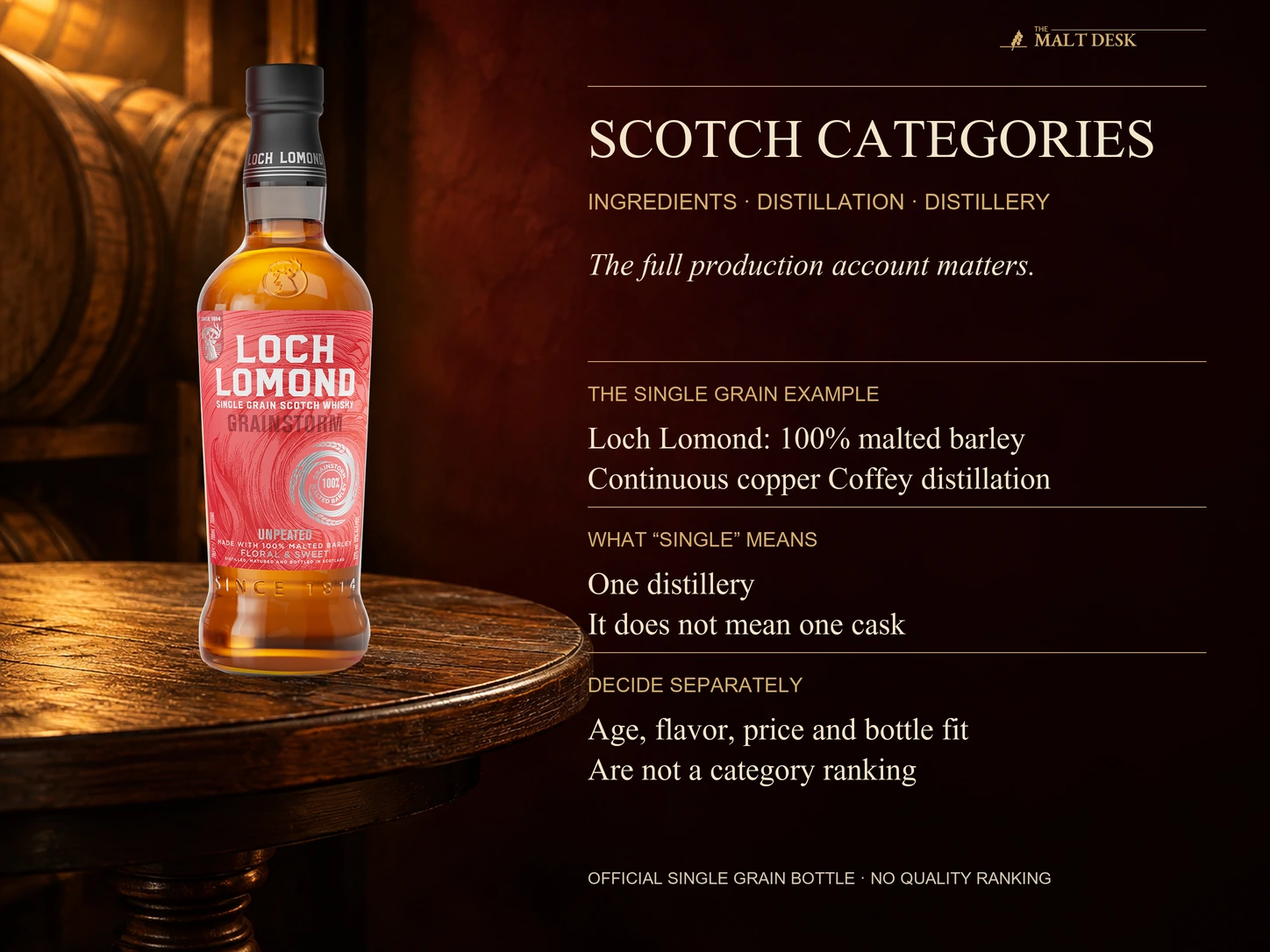
The most useful challenge to the single-malt-versus-blend shortcut is a bottle that sits outside both sides of it: Loch Lomond Single Grain, which the producer says is made from 100% malted barley. A reader who equates grain with a non-barley ingredient could misread that label immediately. Here, the distillation method supplies the missing information.
The producer describes continuous distillation in a copper Coffey still. Single Malt Scotch requires batch distillation in pot stills as well as the malted-barley and single-distillery conditions. Using only malted barley satisfies an ingredient condition; it does not, by itself, satisfy the complete category. This counterexample makes the five Scotch categories more useful than a two-column prestige ladder.
Single malt and blended Scotch are different production structures.
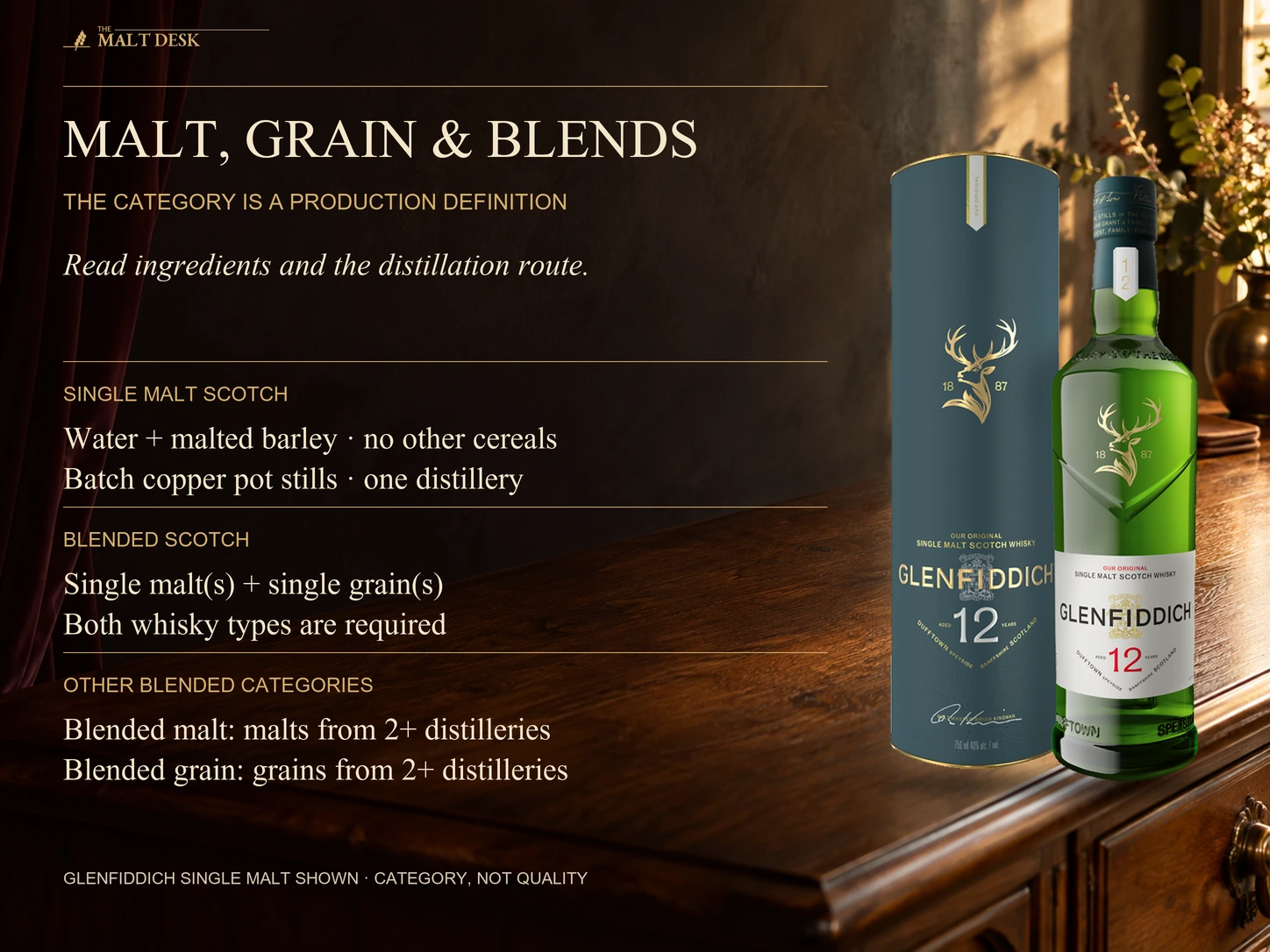
Single Malt Scotch Whisky is made at one distillery from water and malted barley, using batch distillation in copper pot stills. The word single means one distillery. It does not mean one cask, one batch or one year of distillation.
Blended Scotch Whisky combines one or more Single Malt Scotch Whiskies with one or more Single Grain Scotch Whiskies. A blender can use those components to build balance, texture, consistency, smoke, fruit and a particular house style across repeated releases.
The category identifies production structure. Age, strength, cask history and flavor descriptions supply additional information about the particular expression.
Key Takeaways
- Single means one distillery—not one cask.
- Single Malt Scotch uses malted barley and batch distillation in copper pot stills.
- Blended Scotch legally contains at least one single malt and at least one single grain Scotch.
- Blended Malt Scotch is a separate category made from single malts from more than one distillery; it contains no grain whisky.
- Both single malt and blended Scotch may combine multiple casks and batches.
- Any age statement refers to the youngest Scotch whisky in the bottle.
- Single malt often invites a distillery-first comparison; blended Scotch invites a composition-and-balance comparison.
- Use expression-specific casks, strength and producer notes to compare the style.
- Beginners should choose by flavor and purpose before choosing by category prestige.
What Is the Main Difference Between Single Malt and Blended Scotch?
The central difference is composition and distillery origin.
A single malt starts with spirit produced at one distillery. That distillery can combine many qualifying casks to make a consistent core release, but every drop of the malt spirit must trace back to that one site.
A blended Scotch starts with at least two category roles: single malt and single grain. Those components can contribute different weights, flavors, textures and price structures. The blender decides how the parts should interact as one product.
This distinction sits inside the wider Scotch category. As our types of whiskey guide explains, Scotch also includes Single Grain, Blended Malt and Blended Grain Scotch Whisky. Single malt is not a synonym for all Scotch, and blended does not describe one guaranteed flavor.
What Is Single Malt Scotch Whisky?
The Scotch Whisky Association category guide defines Single Malt Scotch Whisky as whisky mashed, fermented and distilled at one distillery from water and malted barley without other cereals, using batch distillation in copper pot stills. It must also be bottled in Scotland.
That definition creates a strong connection to place and production method. Distilleries can still make dramatically different whiskies through fermentation, still design, cut points, peat, cask selection, maturation and bottling strength.
Does single malt come from one cask?
No. Single identifies one distillery.
A standard single malt can combine spirit from many casks and several distillation runs. Producers do this to assemble volume and maintain a recognizable house profile. A bottle drawn from one cask is normally identified separately as single cask or single barrel.
The distinction matters because one familiar 12-year single malt may contain several cask types and many individual barrels while remaining fully single malt. The whisky is unified by distillery, raw material and production method—not by one wooden container.
What creates single-malt character?
Look beyond the category name to the variables that make the bottle individual:
- Fermentation time and yeast management
- Pot-still shape, charge and reflux
- Spirit cut points
- Peated or unpeated malt
- Bourbon, sherry, wine or other permitted cask history
- Warehouse conditions and maturation time
- Cask strength or reduced bottling proof
- Batch size and cask selection
Glenfiddich 12, The Glenlivet 12 and Macallan 12 Double Cask are single-malt product examples with different producer disclosures. Their distillery, cask program and published notes need individual checks; the shared category does not prescribe one flavor.
The Glenfiddich 12 vs Glenlivet 12 vs Macallan 12 comparison examines the three specific expressions.
Lagavulin 16 is an Islay single malt whose producer describes peat, iodine and seaweed. These are product-specific notes.
What Is Blended Scotch Whisky?
The Scotch Whisky Regulations 2009 define Blended Scotch Whisky as a blend of one or more Single Malt Scotch Whiskies with one or more Single Grain Scotch Whiskies.
Single malt can contribute fruit, malt, peat, cask influence and a recognizable distillery signature. Single grain may use whole grains beyond malted barley and can contribute lighter cereal, vanilla, sweetness or texture depending on its grain recipe, distillation, cask and age.
Those are general descriptive tendencies, not legal flavor guarantees. Mature grain whisky can be rich and complex. Young malt can be light. The blend depends on the actual stock selected, not a simple formula in which malt always means flavor and grain always means filler.
What does a blender actually design?
Blending can serve several purposes:
- Reproduce a recognizable profile across batches and years
- Connect fruit, sweetness, smoke, spice, cereal and oak into one sequence
- Control texture and alcohol delivery
- Make a whisky comfortable neat, over ice or in a highball
- Build products for different audiences and price tiers
- Preserve a house identity while component inventory changes
The Scotch Whisky Association says a blended Scotch may combine up to 60 different Scotch whiskies. More components do not automatically make a better blend, but the number illustrates why blending is a construction skill rather than a shortcut.
Chivas Regal 12 and Johnnie Walker Blue Label are blended-Scotch examples with their own age disclosures, components and packaging. Their category does not establish a fixed price relationship or a universal serving preference.
Both are blended Scotch. The category includes expressions with different specifications and market positioning.
Is Blended Malt the Same as Blended Scotch?
No. This is the label distinction most likely to confuse a new buyer.
- Blended Scotch Whisky: one or more single malts plus one or more single grains
- Blended Malt Scotch Whisky: two or more single malts from different distilleries
- Blended Grain Scotch Whisky: two or more single grains from different distilleries
A blended malt contains no grain whisky. It uses malt whisky from more than one distillery, so it cannot be called single malt even though every component is malt.
The older terms vatted malt and pure malt should not be used as current official category names. The Scotch regulations prohibit Pure Malt because it can blur the difference between single malt and blended malt.
Single Malt vs Blended Scotch: At a Glance
| Feature | Single Malt Scotch | Blended Scotch |
|---|---|---|
| Legal formula | Water and malted barley only | 1+ single malt plus 1+ single grain |
| Production base | Mashed, fermented and distilled at one distillery | Qualifying Scotch components are combined into one blend |
| Distillation | Batch-distilled in copper pot stills | Malt and grain components follow their own category rules |
| Multiple casks allowed? | Yes | Yes |
| What single means | One distillery | Not applicable |
| Age statement | Youngest Scotch whisky in the bottle | Youngest Scotch whisky in the bottle |
| Information to compare | Distillery, cask, peat and proof | Composition, balance, house style and proof |
| Recipe disclosure | Check the exact release’s casks and strength | Check the exact release’s components and strength |
| Common misconception | It must come from one cask | It is a lower grade of Scotch |
The category rows describe production definitions. Other comparisons are general context and should not be treated as universal flavor claims.
Does Single Malt Taste Better Than Blended Scotch?
There is no objective category winner.
Single malt can make differences easier to discuss. One distillery’s fruit, spirit texture, peat and cask program remain the frame, so comparing releases can teach you how age, finishing and proof change that base spirit.
Blended Scotch can produce a broader architecture. A blender may place fruit over a light grain foundation, connect sweetness to smoke, soften a sharp edge or extend a finish with mature components. When the parts feel seamless, the blend succeeds precisely because no single component dominates.
Read the Single-Malt Expression
Check these expression-level details rather than assigning a mandatory aroma to single malt:
- Named distillery and exact release
- Age statement, if present
- Actual printed strength
- Disclosed cask categories and finish stages
- Peated/unpeated production information when stated
- Attributed producer vocabulary
Read the Blended-Scotch Expression
Check the blend’s own disclosures rather than assuming grain whisky must produce one texture:
- Malt-and-grain category statement
- Youngest-age statement, if present
- Actual printed strength
- Named components, without assuming a full recipe
- Disclosed cask categories and maturation information
- Attributed producer vocabulary and exact release
Sensory expectations vary by expression. A 40% unpeated single malt can be lighter than a smoky 43% blend. A mature grain component can add depth.
Does Category Predict Smoothness?
The word may describe perceived alcohol warmth, texture or the way flavors combine. ABV, cask influence, smoke, temperature and dilution can all affect the impression. A product-specific description is more informative than assigning the quality to every single malt or every blend.
How Do Age Statements Work in Each Category?
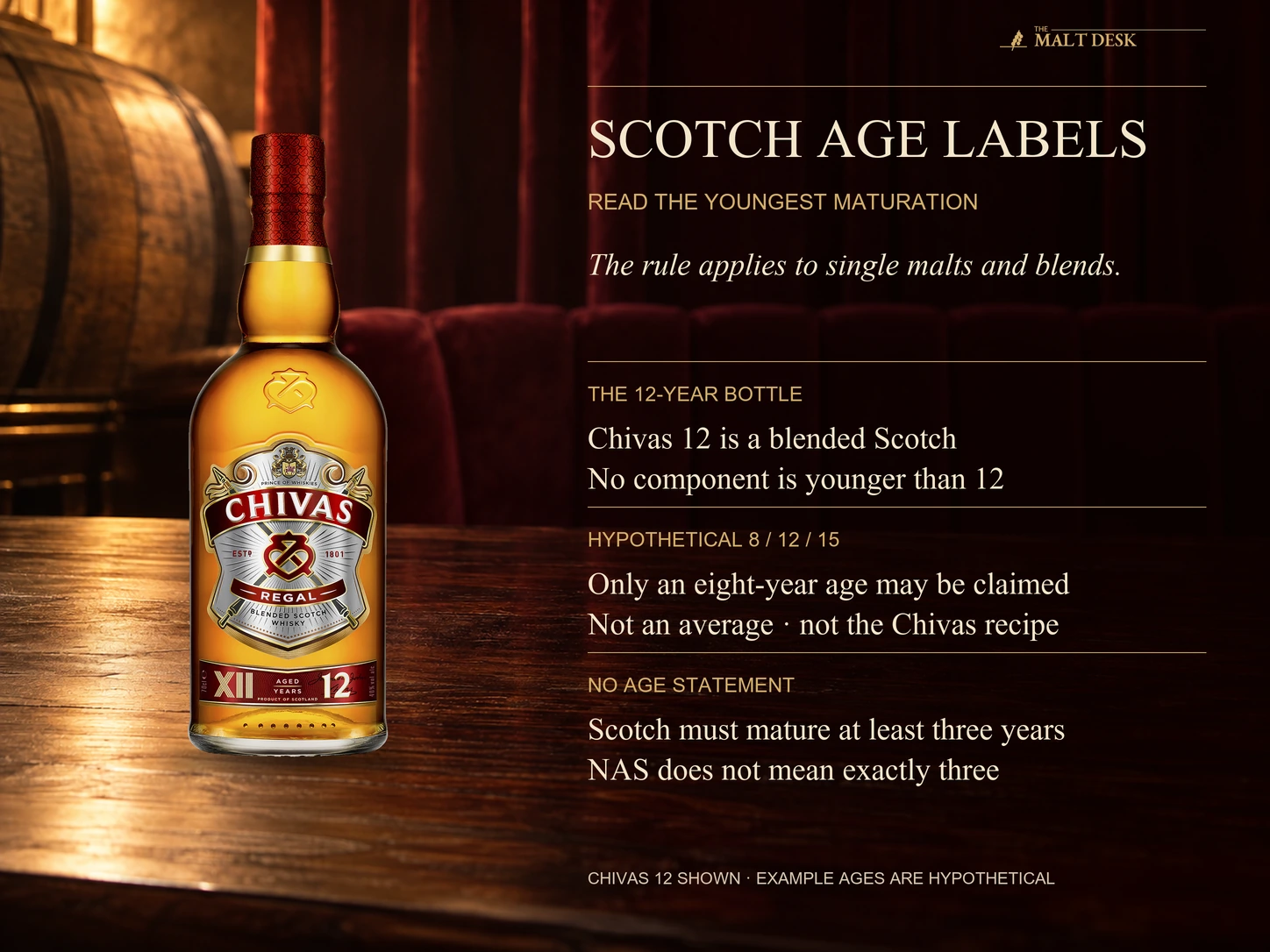
The rule is the same: an age statement must refer to the youngest Scotch whisky in the product.
The SWA guidance for bottlers and producers gives a clear example. If a product contains 8-, 12- and 15-year-old Scotch whiskies, the only age that may be claimed is eight years.
That rule protects both categories:
- A 12-year single malt assembled from several casks contains no Scotch younger than 12.
- A 12-year blended Scotch contains no malt or grain Scotch younger than 12.
- Older components may be present, but the label cannot advertise their age as though it described the whole bottle.
NAS, or no age statement, does not mean the whisky is exactly three years old. Every Scotch must mature for at least three years, but an NAS bottle simply does not declare a specific age. Its components may be older than the legal minimum.
Is Single Malt More Expensive?
A category name does not establish the local asking price. Match the exact expression, bottle volume, strength and dated final cost, including stock, tax, delivery and offer conditions. Age and packaging are separate product facts, not a universal price formula.
The exact offer and intended use are more informative than a general category price expectation.
- Entry-level single malts can cost less than luxury blends.
- A blend may include old or scarce components and expensive presentation.
- A higher price does not guarantee higher proof, heavier flavor or a longer finish.
- Familiar brand recognition can add value for gifts while adding little flavor-per-dollar value.
- A strongly individual single malt is poor value if you dislike its peat or cask style.
Compare within the actual budget. At roughly the same price, ask whether you want one distillery’s profile or a blender’s integrated house style. At very different prices, category becomes less important than the opportunity cost of the specific bottle.
Category Labels and Familiarity
Neither category is a required starting point. Single malt, blended malt and blended Scotch identify production and composition, while a reader’s familiarity with smoke, fruit or wood is a separate question. Information about the exact expression is needed to describe its profile.
Serving Style Is Separate from Category
Both single malts and blends appear in mixed drinks. Mixer ingredients, dilution and temperature change the resulting drink, so the category alone cannot establish which expression performs best. A recipe’s choice of whisky is a serving decision rather than part of the legal definition.
One Ingredient Fact Can Lead to Two Scotch Categories
Loch Lomond’s regular Single Grain account gives a concrete combination: one distillery, malted barley only, continuous distillation. The Single Grain classification is therefore compatible with a fully malted-barley recipe. Single Grain Scotch may use other cereals, but it does not have to use them. The word grain should not be treated as an ingredient list showing wheat or corn.
| Information disclosed | What it answers | What still needs to be checked |
|---|---|---|
| 100% malted barley | The cereal ingredient | Batch pot distillation or another method |
| One distillery | The meaning of single | The malt or grain category requirements |
| Continuous Coffey distillation in this example | Why the all-malted-barley product is Single Grain | The separately disclosed strength, maturation and sensory account |
By contrast, a qualifying Scotch produced at one distillery from malted barley only and distilled in batches in pot stills belongs to the Single Malt category. The change in this thought comparison is the distillation route, not a requirement to replace barley with another cereal. Both descriptions still depend on the wider Scotch production rules; they are not stand-alone permissions to label any spirit Scotch.
Do Not Transfer a Distillery-Wide Recipe to Every Product
Loch Lomond’s wider distillery account also describes commercial grain production using 90% wheat and 10% malted barley. That is a different disclosed stream from its 100%-malted-barley Single Grain product. Assigning the broader grain recipe to this named bottle would erase the very distinction the producer makes. A distillery can operate more than one production route; the exact expression matters.
Nor does 100% malted barley make the finished bottle interchangeable with one of the distillery’s single malts. Continuous and batch processes, maturation and selection can differ. The counterexample resolves classification.
A Practical Label-Reading Order
First identify the full category name. Then record the expression, any age statement, ABV and disclosed cask history. Finally, distinguish producer descriptions from the writer’s sensory judgments. This order keeps verifiable specifications separate from preference and commercial presentation.
What the Category Can Establish
Single malt identifies malt whisky from one distillery. Blended Scotch combines malt and grain Scotch; blended malt and blended grain are distinct categories. These definitions describe the contents and production framework.
Use the Full Category and the Distillation Method
Read the complete Scotch category, then the grain and distillation information. The cited all-malted-barley single grain illustrates why grain wording alone can leave a category question unresolved. Choose a single malt, blended malt or malt-and-grain blend according to the production structure you want to explore, then compare the named expression’s casks and published profile.
Frequently Asked Questions
Is single malt made from one barrel?
No. Single means the whisky was produced at one distillery. A standard single malt can combine many qualifying casks and production batches.
Is blended Scotch made only from several single malts?
No. Blended Scotch contains at least one single malt and at least one single grain Scotch. A blend of single malts from different distilleries is Blended Malt Scotch Whisky.
Is blended Scotch lower quality than single malt?
No. The categories describe composition, not grade. Blends range from inexpensive mixing whisky to luxury bottles made with old, scarce or highly selected components.
Is single malt always stronger or smokier?
No. Peat is optional, and many single malts are light, fruity and bottled at 40% ABV. A blend can contain smoky malt and may be more intense than a gentle single malt.
What does a 12-year age statement mean on blended Scotch?
Every Scotch whisky component in the bottle is at least 12 years old. The number refers to the youngest whisky, not the average or oldest component.
Does NAS blended Scotch contain only three-year-old whisky?
Not necessarily. All Scotch must mature for at least three years, but NAS only means no specific age is declared. The blend may contain older components.
Should a beginner start with blended Scotch?
There is no required starting category. Use the actual expression’s strength and producer descriptions, then compare under consistent serving conditions. Familiarity and preference are individual.
Is blended Scotch better for highballs?
Both categories can appear in highballs. The selected expression, ratio, mixer, temperature and ice determine the preparation; category alone cannot establish lower cost or better performance.
Is Johnnie Walker a single malt or blended Scotch?
Most familiar Johnnie Walker labels, including Black and Blue, are blended Scotch whiskies made from malt and grain components. Green Label is a blended malt, which is a different category.
Is Chivas Regal a single malt?
No. Familiar Chivas Regal expressions such as Chivas 12 are blended Scotch whiskies. The blend includes malt and grain Scotch components.
Sources
Scotch Whisky Association producer/bottler guidance and category/age-statement explanations, checked October 4, 2026. The 8/12/15-year component example is hypothetical: its youngest age is eight, not an average or a disclosed brand recipe. Named product references are separate from the legal category definitions.
Category analysis note: Loch Lomond’s named Single Grain production is distinguished from its separate commercial grain account. Scotch category requirements follow the Scotch Whisky Association; ingredient percentages alone are not treated as a complete classification.