Jameson Original: Irish Blend and Production Guide
Jameson’s U.S. Ginger and Lime page leaves a reader with three different strength cues. The ingredient list uses a 1:2 whiskey-to-mixer ratio, the instructions use 1:3, and the nutritional section states approximately 14–15% ABV. At the standard 40% whiskey reference, those statements do not all describe the same preparation.
This is a useful place to do more than repeat an official recipe. I would reconstruct the drink from its measured ingredients, identify which statement the calculation supports, and choose one reproducible reference. A recognizable whiskey name cannot resolve an internally inconsistent recipe page.
The bottle guide below establishes what Original is. The recipe analysis establishes what is in the glass. Both are needed before calling one version of this familiar highball stronger or weaker.
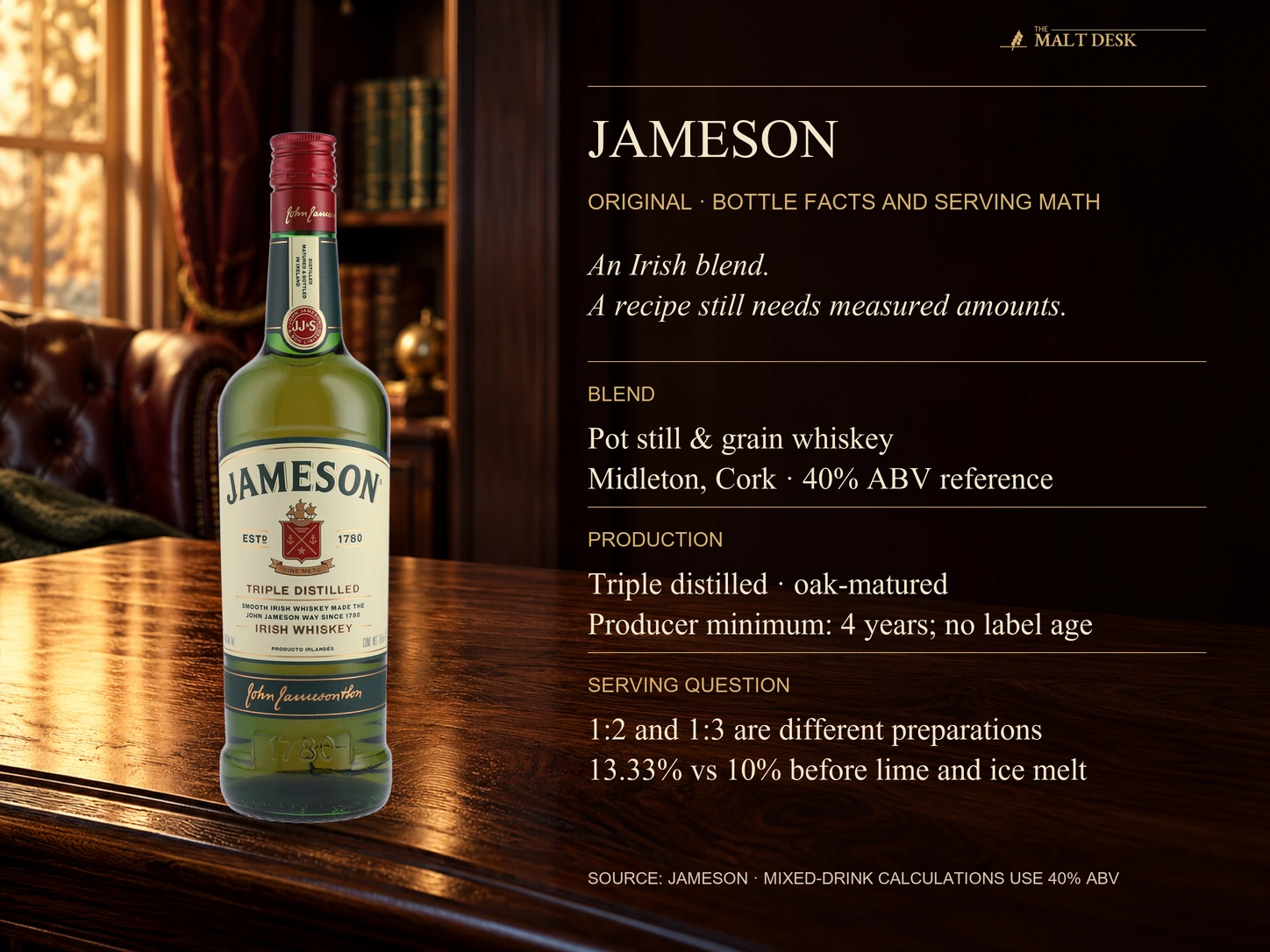
Jameson Original is a blended Irish whiskey produced at Midleton in County Cork. It combines pot still and grain whiskey, is triple distilled and is commonly bottled at 40% ABV. The standard expression has no age statement on the label; Jameson’s product information describes at least four years of oak maturation.
Product Facts
| Expression | Jameson Original |
|---|---|
| Producer | Irish Distillers |
| Distillery | Midleton, County Cork, Ireland |
| Category | Blended Irish whiskey |
| Components | Pot still and grain whiskey |
| ABV / US proof | 40% / 80 |
| Distillation | Triple distilled |
| Label age statement | None |
Pot Still and Grain Whiskey
Pot still whiskey and grain whiskey are separate components in this blend. Irish pot still whiskey uses malted and unmalted barley, whereas the grain-whiskey component provides a different production style. Jameson Original should therefore not be called a single malt or a single pot still whiskey.
The final blend’s component proportions are not disclosed here. Describing grain whiskey as automatically thin or pot still whiskey as automatically superior would turn a production distinction into an unsupported hierarchy. Maturation and the final combination also influence the profile.
Triple Distillation
Triple distillation describes repeated distillation in the production process. It should not be confused with three years of aging, three cask types or three ingredients. Distillation and maturation are different stages.
The brand associates triple distillation with its intended smooth style. Still design, distillation choices, maturation and bottling strength also matter.
Age Information
The official product description states a minimum of four years in oak casks. That is a producer maturation statement rather than a printed age number in the standard expression name. It does not disclose the exact age of every component or their proportions.
A no-age-statement whiskey should not be assigned an average age based on color or price. Likewise, years spent in a sealed bottle do not add years of cask maturation. Keep production age and subsequent storage separate.
Producer Flavor Notes
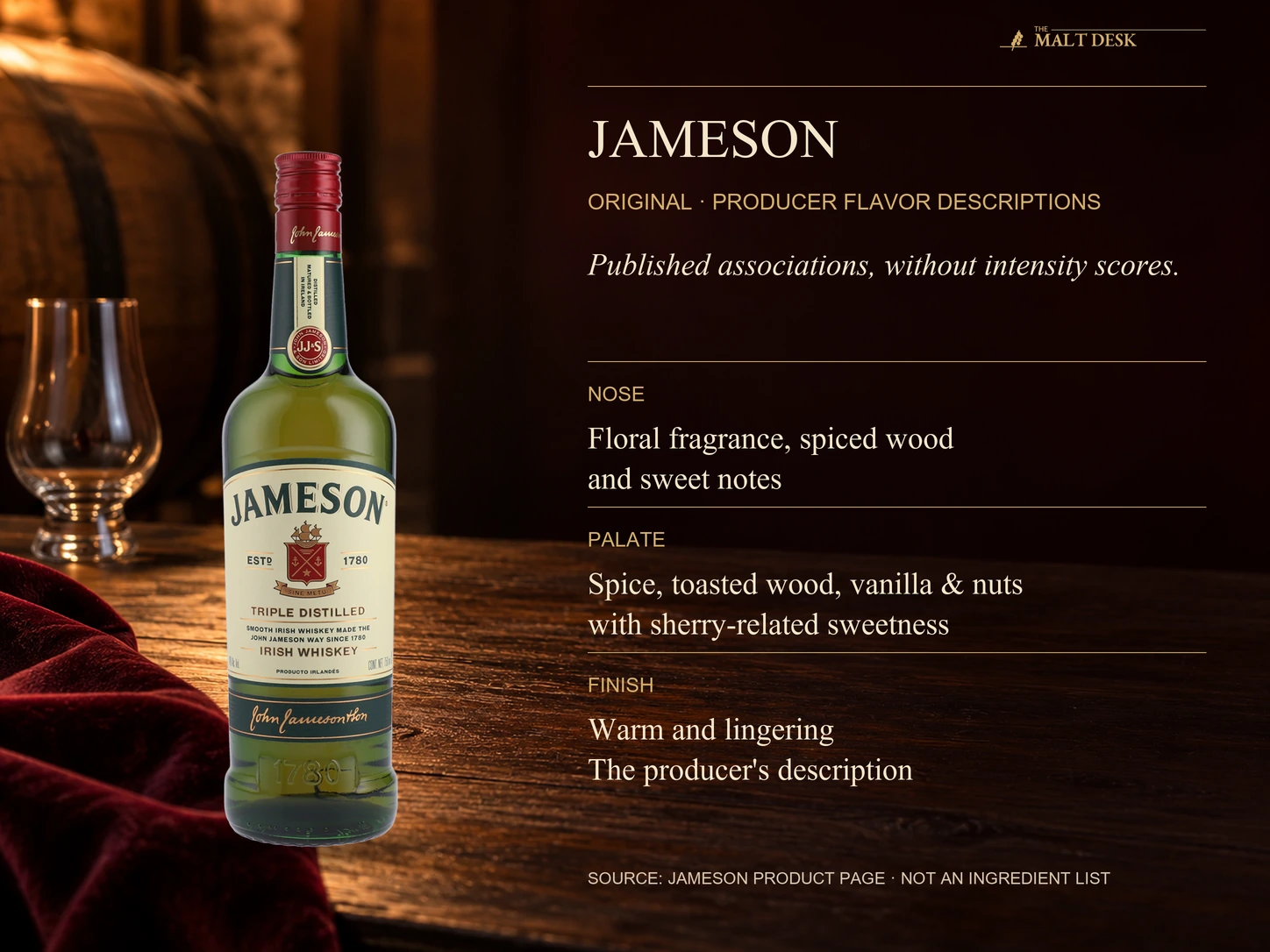
Jameson’s current product notes describe a floral, spiced-wood aroma, followed by spice, toasted wood, vanilla, nut associations and sherry-related sweetness. The producer describes a warm, lingering finish. These are published sensory associations rather than measured ratings.
Flavor words do not identify added ingredients. A nut or sherry descriptor is not a complete composition statement. Exact cask percentages and any processing claims require their own product-specific evidence.
Terms such as light, smooth or complex describe different impressions. A light aroma does not establish a short finish, and 40% ABV does not quantify texture. Avoid using one adjective to infer every other aspect of the whiskey.
Jameson, Ginger and Lime
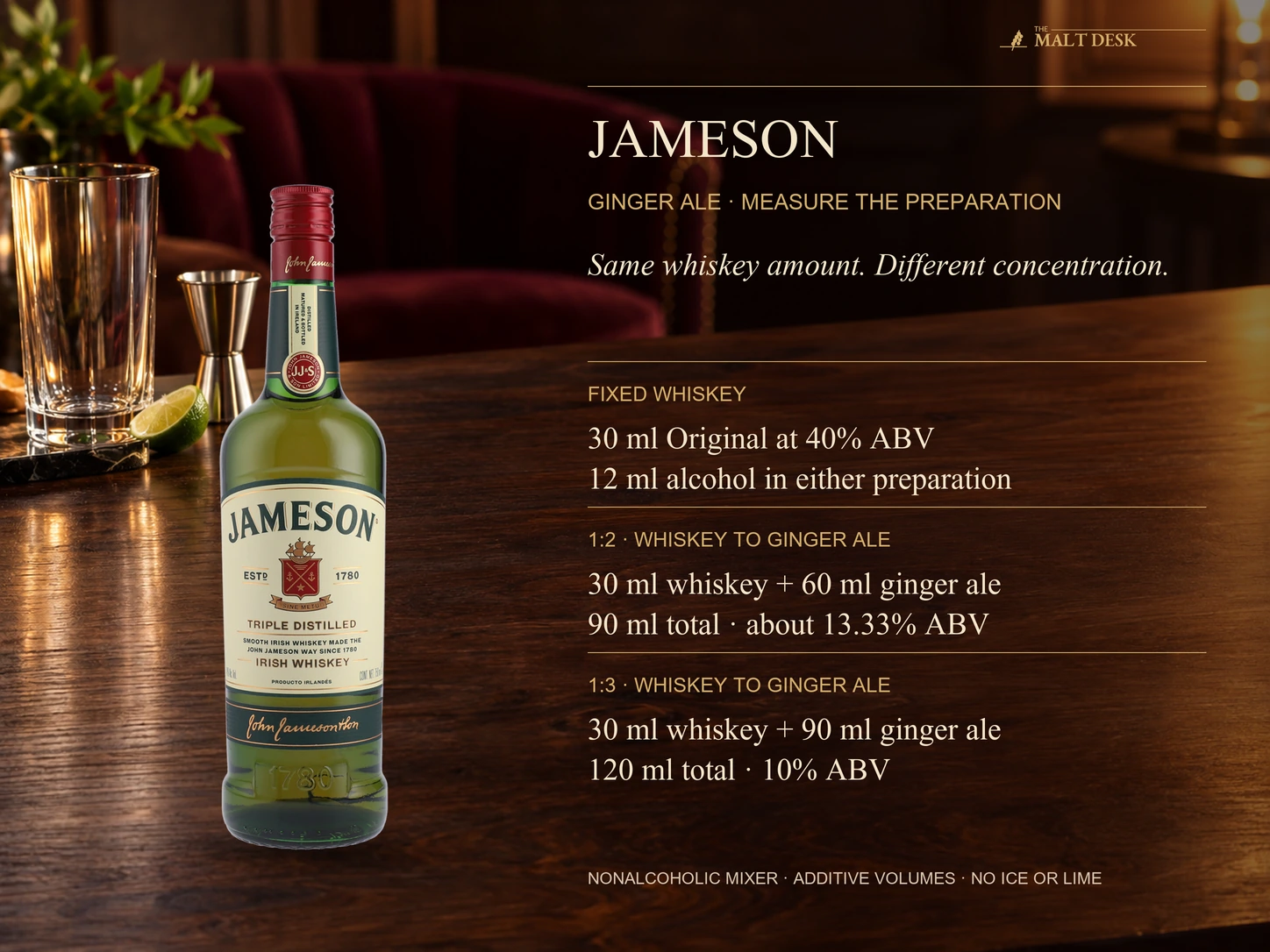
Jameson’s U.S. Ginger and Lime page, checked October 3, 2026, contains two different ratios: its ingredient list gives 60 ml whiskey and 120 ml ginger ale (1:2), while its instructions say one shot of whiskey and three of ginger ale (1:3). Both include lime. Specify the actual amounts instead of treating this page as one unambiguous ratio. Ginger ale contributes sweetness and ginger flavor; squeezed lime adds acidity.
To compare the ratios at an equal whiskey measure, start with 30 ml at the producer-listed 40% reference: it contains 12 ml pure alcohol. Adding 60 ml non-alcoholic ginger ale (1:2) gives about 13.33% ABV; adding 90 ml (1:3) gives 10%. These estimates assume additive volumes and exclude lime juice and ice melt. More mixer changes concentration without removing the alcohol already poured.
The highball guide explains how soda, ginger ale and cola produce different results. Use the same ratio and mixer when comparing bottles if the aim is to isolate the whiskey component.
The Published ABV Estimate Does Not Match the 1:3 Instructions
With a nonalcoholic mixer, nominal mixed-drink ABV is the whiskey’s ABV multiplied by its share of the combined liquid. At 40%, one part whiskey plus three parts mixer gives 40 divided by four, or 10%, before lime juice and ice melt. One part plus two parts gives about 13.33%. The ratio, not the word shot, determines that concentration.
| Statement on the consulted U.S. page | Ratio implied | Calculated nominal ABV at 40% |
|---|---|---|
| 60 ml whiskey and 120 ml ginger ale | 1:2 | 13.33% before lime and melt |
| One shot whiskey and three shots ginger ale | 1:3 | 10% before lime and melt |
| Nutrition basis: 1.5 fl oz whiskey and 4.5 fl oz ginger ale | 1:3 | 10% before lime and melt |
The page’s approximate 14–15% statement therefore cannot be carried over to the listed 1:3 preparation under those assumptions. Adding nonalcoholic lime juice or meltwater would reduce concentration further, not raise a 10% reference to that range. I would use the measured-ingredient calculation for the actual serving rather than let the larger printed estimate override it.
For a repeatable starting recipe, I would adopt the 1:3 instructions with a modest measured whiskey quantity: 30 ml Original and 90 ml ginger ale, plus a recorded lime choice and ice. This is my selected comparison reference, not a claim that the conflicting U.S. ingredient list has disappeared. Jameson’s Irish recipe page independently lists the same 30-and-90 quantities, which supports using that documented preparation without inventing a new brand ratio.
To investigate a more whiskey-forward version, keep the 30 ml whiskey measure and reduce the ginger ale to 60 ml in a separate preparation. The original alcohol quantity stays 12 ml in either case. What changes is mixer quantity, final volume and concentration. Writing those amounts is more informative than calling both drinks one shot of Jameson and treating their different impressions as a bottle inconsistency.
I would keep the purpose of the numbers narrow. They make a preparation traceable and expose a mismatch in the published recipe. A preferred ginger ale or a different lime amount deserves its own ingredient record, because those choices can change the highball without changing Original at all.
Other Serving Conditions
Neat service leaves the bottling concentration unchanged. Water lowers it; ice also cools the liquid and adds a changing amount of meltwater.
A 30 ml measure of 40% whiskey with 10 ml water is approximately 30% ABV.
Distinguish Original From Other Expressions
Jameson Black Barrel and other Jameson releases have their own production descriptions. The specifications of one should not be transferred to another simply because the green bottle or brand name is familiar. Use the full expression name when comparing labels.
Jack Daniel’s Old No. 7 is a Tennessee whiskey, not an Irish blend. Similar use in mixed drinks does not make the two production categories equivalent.
The beginner guide explains category and label terms. It does not require a first bottle or a progression to higher-strength whiskey.
Price Comparisons
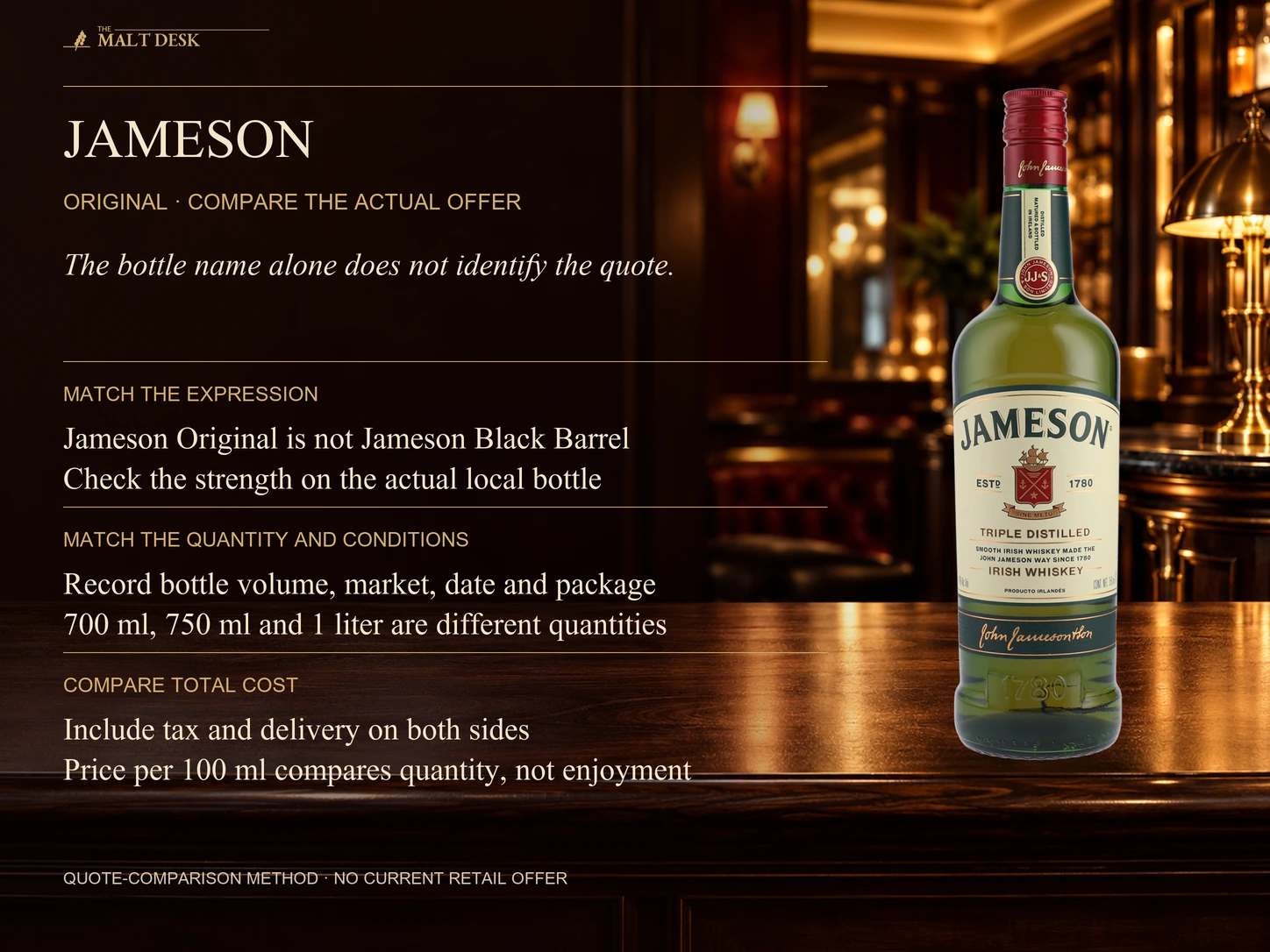
Compare the exact expression, bottle volume, date and total cost. A historical retailer price cannot establish a current nationwide minimum. A 700 ml, 750 ml and 1-liter bottle also contain different quantities even when their photographs look similar.
The budget guide shows how to normalize volume. Price per 100 ml is a quantity comparison.
Make the Jameson Highball Recipe Reproducible
For a traceable Jameson Ginger and Lime reference, record 30 ml of 40% Original and 90 ml nonalcoholic ginger ale, then record the lime and ice separately. The initial liquid calculation is approximately 10% ABV. Keep the 1:2 variation as its own recipe, and adjust mixer balance or garnish before changing the whiskey when those ingredients are the feature you want to improve.
Common Questions
Is Jameson Original single malt?
No. It combines pot still and grain whiskey.
Does triple distilled mean three casks?
No. It describes distillation, not maturation vessels.
What age is stated?
The standard label has no age statement. The producer describes at least four years of oak maturation.
Is ginger ale required?
No. It appears in an official recipe, but serving style and mixer preference are individual choices.
Does 80 proof mean 80% alcohol?
No. In the US proof system, 80 proof is 40% ABV.
Sources
Jameson, Jameson Irish Whiskey product and production information; Irish Whiskey Technical File requirements for category and maturation. The U.S. product and Ginger and Lime pages were checked October 3, 2026. Jameson’s regional nutritional page supplies the 40% reference; verify the local bottle’s strength and volume. Producer notes are attributed, and no average component age is assigned.
Jameson’s U.S. and Irish Ginger and Lime pages were rechecked October 5, 2026. The U.S. ratios and nutritional ABV estimate are compared with arithmetic using the 40% reference, nonalcoholic mixer, additive volumes, and no lime juice or ice melt. The selected 30 ml plus 90 ml preparation is an editorial comparison reference.