Maker’s Mark: A Wheated Bourbon at 90 Proof
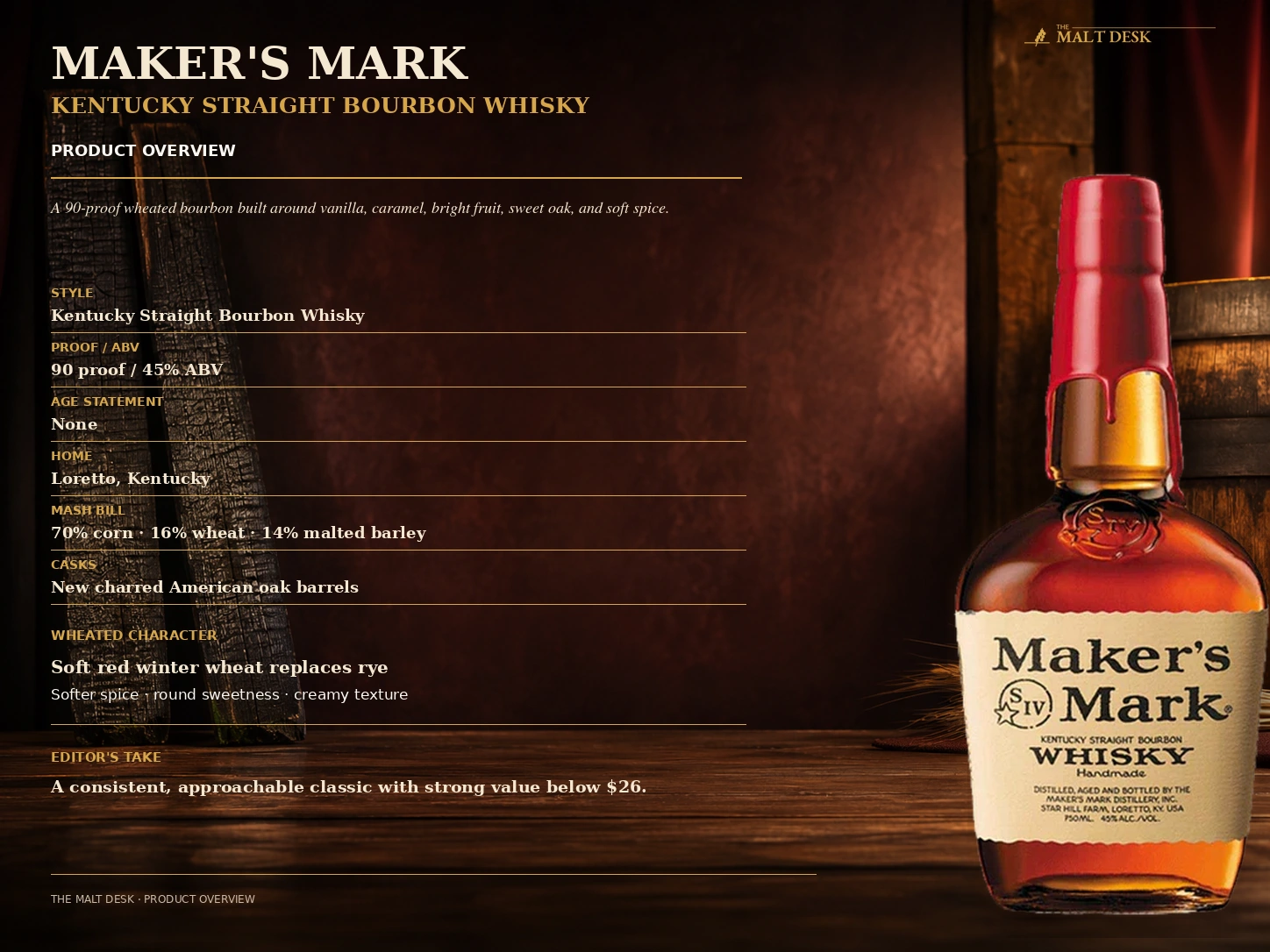
The standard Maker’s Mark expression is Kentucky straight bourbon whisky bottled at 90 US proof, or 45% ABV. It is produced in Loretto, Kentucky, and uses soft red winter wheat in its grain recipe. The red wax seal identifies the brand visually, while the expression name and proof identify the product.
Product Facts
| Expression | Maker’s Mark Kentucky Straight Bourbon Whisky |
|---|---|
| Location | Loretto, Kentucky |
| ABV / US proof | 45% / 90 |
| Recipe distinction | Soft red winter wheat rather than rye as the secondary grain |
| Age statement | None on the standard expression |
| Maturation | New charred oak barrels |
What Wheated Bourbon Means
Wheated bourbon uses wheat in a corn-led bourbon recipe. It is not the same category as wheat whiskey, and “wheated” does not mean that wheat is the majority grain. Corn remains central to the bourbon category.
The grain choice helps distinguish Maker’s Mark from bourbons that use rye as the secondary grain. It does not, by itself, establish a universal sweetness or smoothness ranking. Fermentation, distillation, barrel conditions, maturation and strength also shape the result.
An exact mash-bill percentage should be given only with reliable production documentation. This guide identifies the disclosed grain distinction without treating frequently repeated percentages as an expression-specific specification.
Producer Flavor Descriptions
Maker’s Mark’s official notes describe oak, vanilla, fruit and wheat in the aroma. The producer’s broader description includes cherry and caramel, with soft spice and a creamy finish. These are brand descriptions of the intended profile.
Vanilla, cherry and caramel are sensory associations, not an ingredient list. Their presence in a description does not quantify sugar or establish a measured level of sweetness. Likewise, “creamy” describes an impression of texture rather than an added dairy ingredient.
The producer’s preference for a softer style is distinct from a claim that every person will find the whisky easy to drink. Ninety proof is a concentration measurement, not a guarantee about perceived alcohol warmth.
Age and Oak
The standard expression carries no age statement. It should not be described as a fixed five-, six- or seven-year whisky based on general production reporting. A typical barrel-age discussion and the guaranteed youngest age on a label are different kinds of information.
New charred oak is a defining part of bourbon production. It should not be confused with reusing a cask that previously held bourbon, a practice common in other whisky categories. The first describes the bourbon’s maturation vessel; the second describes that vessel’s later use.
Original, 46 and Cask Strength
Maker’s Mark 46, Cask Strength, 101 and other named releases are separate expressions. The standard bottle’s 90 proof should not be applied to the whole range. The name “46” should not be assumed to be an age statement or substituted for the original expression.
A comparison needs the full expression name and actual label strength. A different wood treatment or bottling strength changes more than the price, so an abbreviated brand-only listing can lead to a misleading comparison.
Understanding 45% ABV
A 30 ml measure at 45% contains 13.5 ml of pure alcohol. The same volume at 40% contains 12 ml. Thus the 45% pour contains 12.5% more alcohol at equal volume, even though the ABV difference is five percentage points.
Adding 10 ml water to 30 ml Maker’s Mark gives approximately 33.75% ABV in a total of 40 ml, assuming additive volumes. Water reduces concentration; it does not remove the original alcohol. Ice adds cooling and an amount of meltwater that changes with time.
Serving Context
The official product page presents neat, rocks and Whisky Sour serving options. These are producer suggestions, not a ranking established by a comparative test. Citrus, sugar, bitters and ice each change the resulting drink.
For an observation that can be compared later, record the glass, amount of whisky, water or mixer, and temperature. A statement that one bottle “survives dilution better” is incomplete without those conditions and a defined sensory comparison.
Comparing Bourbon Recipes
Buffalo Trace is also commonly bottled at 45% ABV. Equal strength provides one shared variable, but it does not establish an identical grain recipe, cask selection or flavor profile.
The three-bourbon comparison adds Wild Turkey 101 at 50.5%. It separates proof differences from grain choices instead of assigning a universal winner for softness or value.
Budget and Label Checks
The whiskey budget guide explains why volume, market and date matter in a price comparison. A past promotional price is not a current national benchmark, and a red-wax bottle may be a different expression or size.
The beginner guide introduces grain, age and proof terminology. Wheated bourbon is a production style to understand, not a compulsory first step before another category.
Common Questions
Is Maker’s Mark wheat whiskey?
No. The standard expression is bourbon that uses wheat in its grain recipe.
Is 90 proof the same as 90% ABV?
No. It is 45% ABV in the US proof system.
Does the standard bottle have an age statement?
No. Do not assign it a fixed age from an estimate or a description of typical barrel selection.
Does the whisky spelling mean it is Scotch?
No. Maker’s Mark uses “whisky” in its brand labeling, but it is Kentucky bourbon. Spelling alone cannot establish origin or category.
Do cherry and vanilla notes mean flavoring was added?
No. They are sensory descriptions in the producer’s profile, not added-ingredient claims.