A numerical flavor map can appear more exact than the language it was built from. If one note says fruit and another says lemon and lime, a computer or chart author must decide whether those are different descriptors or the same broad family. That decision can move bottles closer together even though no liquid and no observation changed.
I would check that translation before using a map to find a substitute bottle. Similarity may partly describe the author’s dictionary, the length of the notes and their choice of axes. A useful map makes those decisions visible instead of letting an unexplained distance stand in for a sensory measurement.
A whiskey flavor map organizes sensory descriptions so that similarities and differences are easier to discuss. It is a communication tool. Two products can share words such as apple, vanilla or smoke while differing in texture, intensity and finish.
This guide explains two common formats: a flavor wheel that groups related vocabulary, and a map that places descriptions along selected axes. Neither assigns an objective position to a bottle unless the author also explains the evidence and method behind that position.
Flavor Wheel Versus Flavor Map
| Tool | Main purpose | Important limitation |
|---|---|---|
| Flavor wheel | Groups broad families and more specific descriptors | Nearby words do not mean two bottles are equivalent |
| Two-axis map | Summarizes selected differences such as aroma intensity and smoke character | Two dimensions cannot capture a complete sensory profile |
| Tasting note | Describes aroma, palate, texture and finish separately | Depends on the source, conditions and individual perception |
| Product specification | Records category, ABV, age and production details | Use alongside attributed aroma, texture and finish descriptions |
How to Read the Axes
Start with the legend. A horizontal line marked delicate to rich may combine aroma intensity, body and cask influence, or it may refer only to one of them. A vertical line marked fruity to smoky simplifies another set of impressions. The axes need clear definitions before positions can be interpreted.
Fruit and smoke are not opposites in the liquid. A whiskey can have both, just as it can be floral and full-bodied. A two-axis diagram compresses these combinations; it should not imply that increasing one property necessarily removes another.
The center of a map is not a quality award or a promise of versatility. It may simply indicate moderate values on the chosen scales. A point farther to the right does not mean older, more expensive or better.
Six Useful Families of Descriptors
Fruit
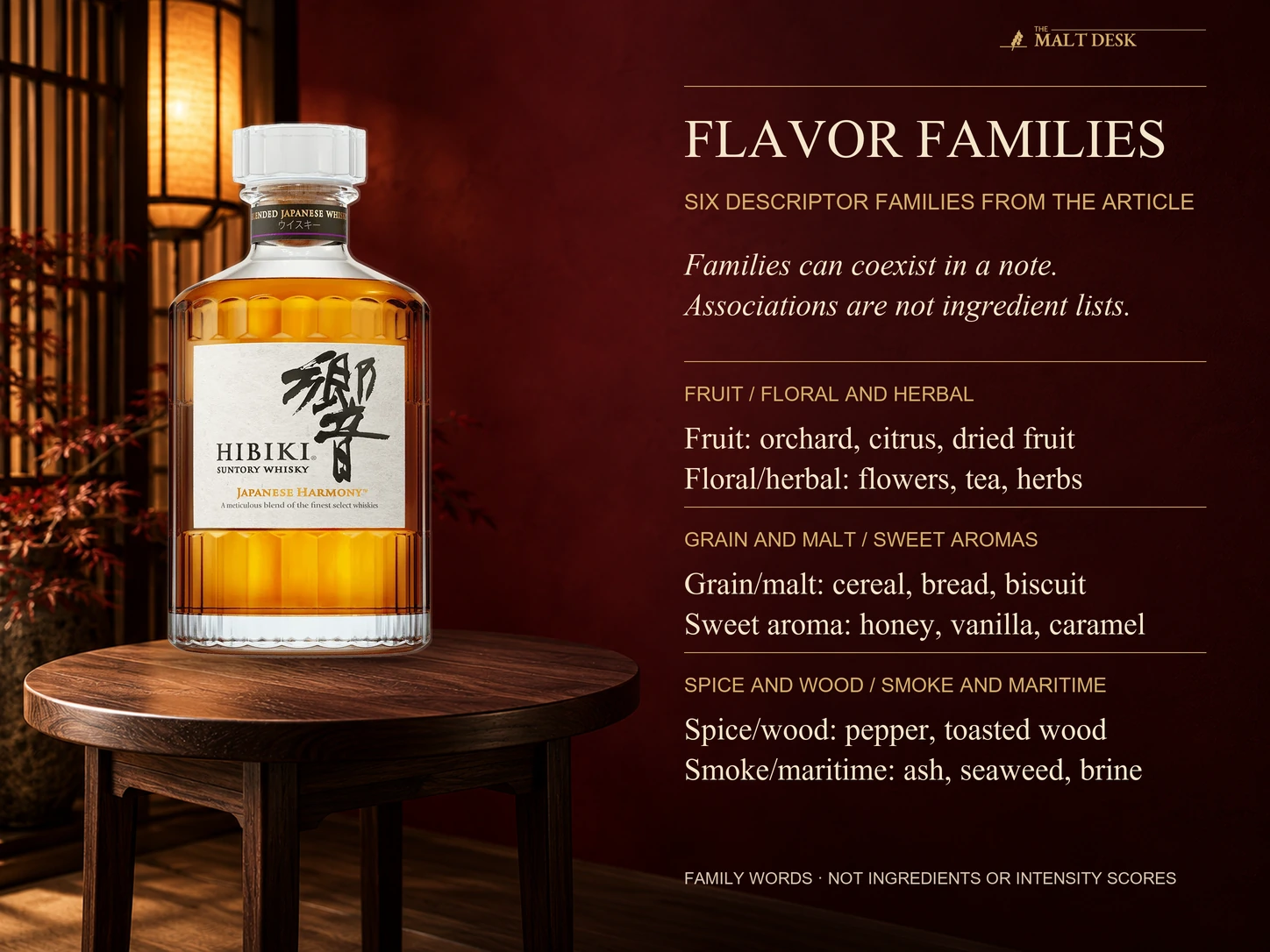
Fruit vocabulary can distinguish fresh orchard impressions from citrus, tropical or dried-fruit associations. Apple-like and raisin-like are more specific than fruity, but neither indicates that an apple or raisin was added. A note can contain more than one fruit family.
Floral and herbal
Flower, grass, tea and herb comparisons describe a different aroma direction from fruit or toasted wood. Floral describes a type of aroma, rather than low alcohol strength or a light texture. Those other properties need their own words.
Grain and malt
Cereal, bread and biscuit associations connect descriptive language with grain-based production. The grain named in a recipe and the grain-like aroma reported by a taster are different kinds of information. A mash bill cannot be reconstructed simply by recognizing a bread-like note.
Sweet-associated aromas
Honey, vanilla and caramel are familiar reference points. A rigorous description separates what a whiskey smells like from the sensation of sweetness on the palate.
Spice and wood
Pepper-like spice, toasted wood and drying astringency are not interchangeable. The first two describe flavor associations; the last describes a tactile sensation. Combining them under one heading can be convenient, but a detailed note should preserve the distinction.
Smoke and maritime associations
Smoke descriptors may evoke a hearth, ash or medicinal aromas. Maritime language may evoke seaweed or brine. These words do not prove that seawater entered a cask, and smoky is not always the same claim as peat being used in production.
Examples from Published Product Descriptions
The examples below illustrate vocabulary used by producers.
| Expression | Examples in the producer’s profile | Descriptive connection |
|---|---|---|
| Glenfiddich 12 | Pear and fruit | Orchard-fruit vocabulary |
| Hibiki Japanese Harmony | Rose, lychee, honey and candied orange | Floral, fruit and sweet associations together |
| Buffalo Trace | Vanilla, mint and molasses | Sweet and herbal vocabulary |
| Redbreast 12 | Fruit, spice, sherry and toasted wood | Several families in one expression |
| Johnnie Walker Black Label | Fruit, vanilla, spice and smoke | Fruit and smoke can coexist |
| Laphroaig 10 | Peat smoke, seaweed and medicinal associations | Several distinct descriptions within a smoky profile |
For expression-specific context, see the Hibiki Japanese Harmony guide and Redbreast 12 guide. The descriptions should remain attached to the full product name; they should not be applied automatically to every release from the same brand.
Why Different Systems Use Different Groups
A lexicon provides shared vocabulary, while a commercial range may use broad groups to organize its own bottles. WSET’s Level 3 spirits materials distinguish appearance, aroma, palate, texture and finish. The Scotch Malt Whisky Society describes revising its own twelve flavor groups into eight. Neither system makes a two-axis map the official classification for all whiskey.
Choose a tool according to the question it answers. For explaining a word, a vocabulary group is useful. For discussing why two published notes overlap, a comparison table may be clearer. For checking an age statement or production category, use the product specification instead.
What Production Can and Cannot Explain
Grains, fermentation, distillation and maturation all contribute to a whiskey’s character. Their effects interact. A simple rule assigning all fruit to fermentation or all spice to one grain is too narrow to explain a finished product.
Cask history can provide context for toasted, vanilla-like or dried-fruit descriptions, but the same descriptor can have more than one contributing source. The peated whisky guide explains that distinction.
The Same Two Notes Can Produce Very Different Overlap
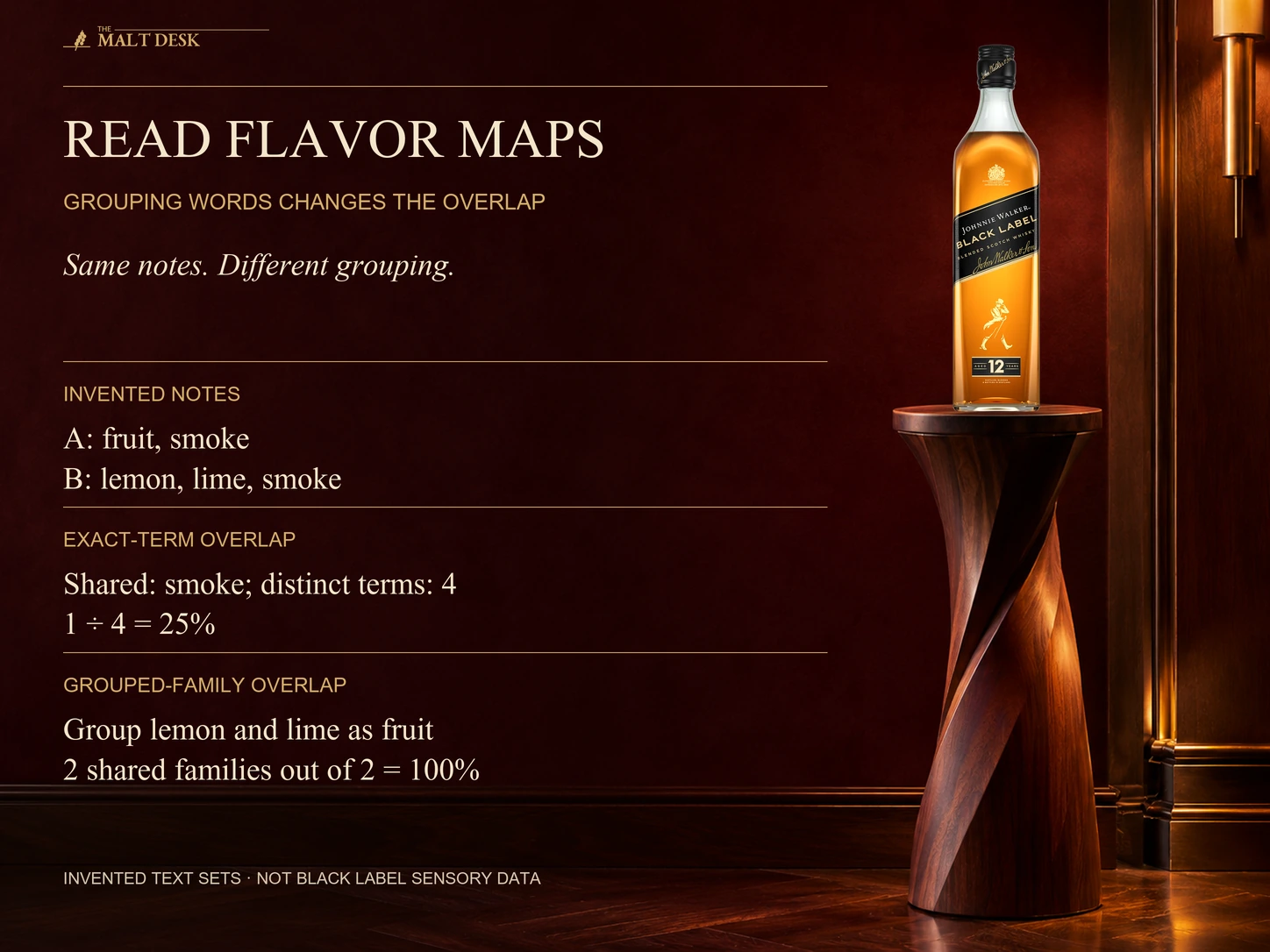
Take two invented descriptions: A contains fruit and smoke; B contains lemon, lime and smoke. Counting exact words gives one shared term, smoke, out of four distinct terms overall: 25% under a shared-terms-divided-by-all-distinct-terms calculation. The unit here is overlap between the two text sets.
Now group lemon and lime into the fruit family. Both descriptions become fruit and smoke, producing two shared families out of two: 100%. Grouping the words accounts for the entire increase. The broad-family calculation records shared families, while the exact-word calculation retains different levels of descriptive detail.
| Representation of the invented notes | A | B | Overlap under the stated calculation |
|---|---|---|---|
| Exact terms | fruit; smoke | lemon; lime; smoke | 1 of 4 = 25% |
| Grouped families | fruit; smoke | fruit; smoke | 2 of 2 = 100% |
Record Omitted Descriptors as Unreported
A longer note may mention it because the author chose more detail. Coding every unmentioned word as zero would turn editorial brevity into apparent sensory difference. Before assigning coordinates, distinguish an explicit assessed absence from something the source simply did not discuss.
Keep the descriptor at the level of detail its source provides. Where a source uses a defined intensity scale, retain that scale and its conditions; for descriptive notes, record the original words and their chosen aroma families.
A better record preserves the original words beside the chosen family and marks unreported properties as unreported. The WSET spirits lexicon provides vocabulary for several sensory dimensions, but it does not supply numerical coordinates for these producer notes. A grouping can help a reader find fruit or smoke; the more detailed wording still determines what remains interesting to compare.
Building a Clear Comparison Record
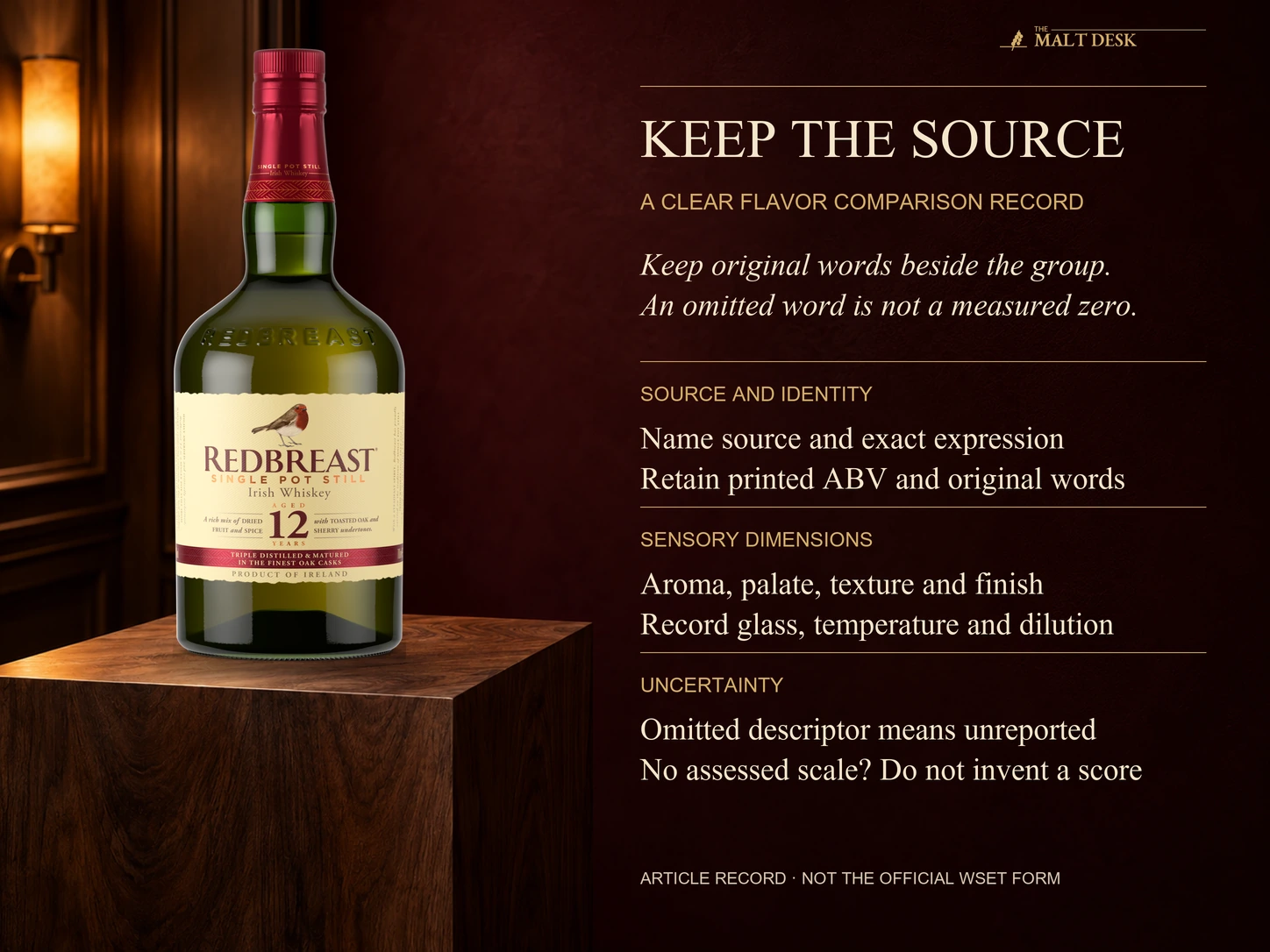
Record the source first: a manufacturer’s note, a named reviewer’s assessment or your own observation. Then separate aroma, flavor, texture and finish.
Use the complete expression name and printed ABV. If personal observations are involved, note glassware, temperature and dilution, since differences in conditions can affect the comparison. An uncertain descriptor can remain uncertain; precision is not improved by inventing a specific fruit or assigning an unsupported number.
Common Interpretation Errors
Region also does not determine one fixed profile. A regional label describes origin; the production and expression details still matter.
Finally, a map should not imply that the natural goal is progressively stronger alcohol or heavier smoke. It describes differences. There is no required path through those differences and no endpoint that represents a more advanced preference.
Use a Flavor Map With a Visible Translation Key
Use the map to organize broad aroma families, then return to each expression’s attributed source notes. Check how specific terms such as lemon and lime were grouped under broader fruit labels before treating distances as meaningful. For your own comparison, keep original descriptors beside the grouped version so the map remains a readable index to the evidence.
Frequently Asked Questions
Is there one official whiskey flavor map?
No single map covers every category with a universally binding set of positions. Different systems serve different descriptive and educational purposes.
Can a whiskey belong to several flavor families?
Yes. Floral, fruity, woody and smoky descriptors can appear in the same note. A broad category is a summary, not an exclusive ingredient list.
Can a map establish which bottle is best?
Use the map to shortlist styles, then compare the named expressions against your preferred aromas, texture and serving method.
Sources
WSET Level 3 Systematic Approach to Tasting Spirits and accompanying lexicon, Issue 3 (2025); Scotch Malt Whisky Society’s New Flavour Profiles information; official product descriptions from Glenfiddich, House of Suntory, Buffalo Trace, Redbreast, Johnnie Walker and Laphroaig.
Map analysis note: notes A and B and their overlap percentages are invented text examples. The calculation illustrates the effect of grouping descriptors.