Chivas Regal 12: Blended Scotch Explained
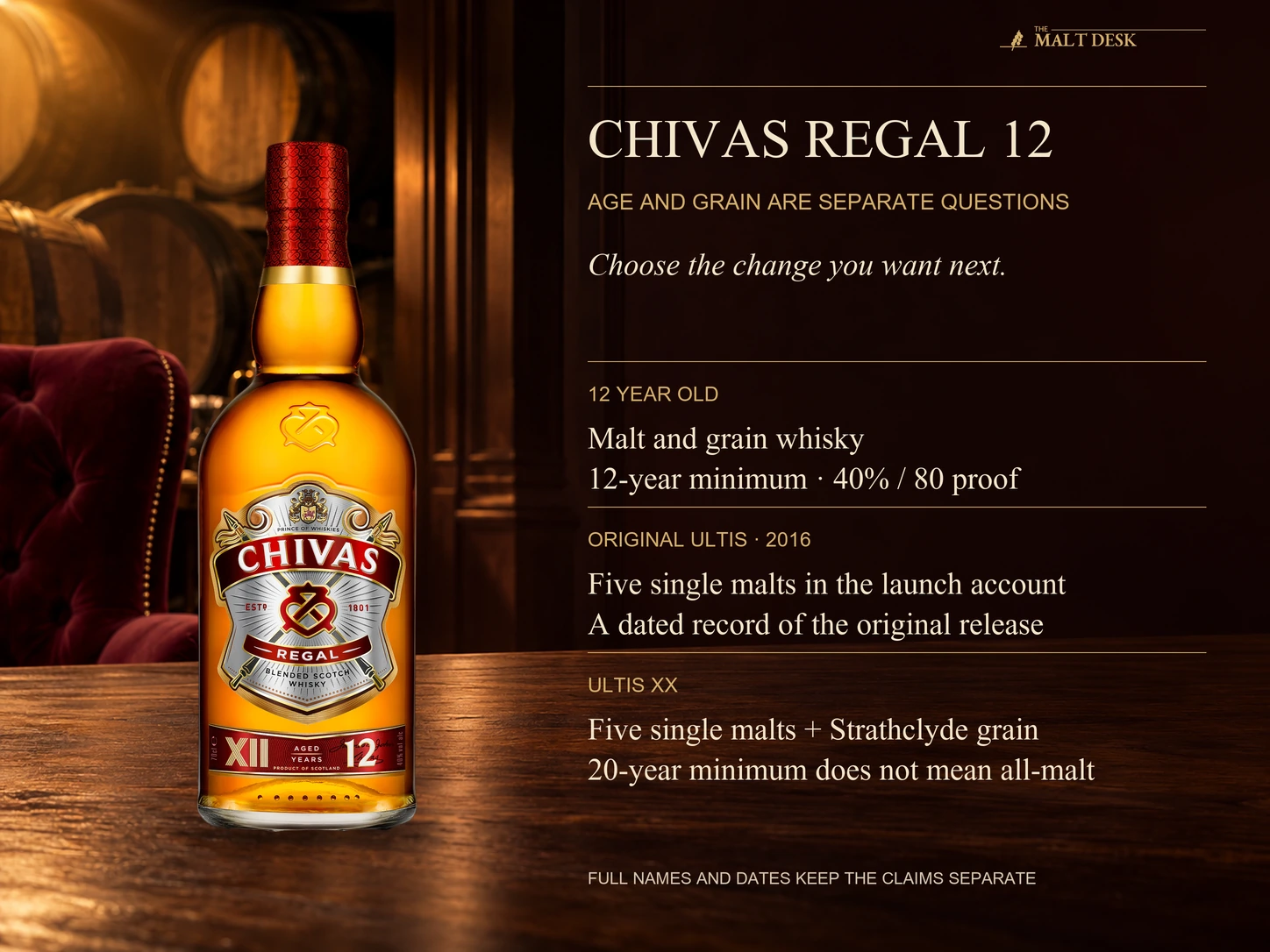
Chivas 12 gives a clear twelve-year minimum within a malt-and-grain blend. What it does not establish is a route through the rest of the brand’s range. In particular, the original Ultis and the later Ultis XX need separate composition records: the producer’s 2016 launch described five single malts, while its current Ultis XX account includes Strathclyde grain whisky as well.
I would use that distinction when a reader is considering what comes after the 12. Moving to a larger age number and removing grain are different decisions. The specific current product, rather than a remembered range description, determines whether either one has actually happened.
Chivas Regal 12 is a blended Scotch whisky bottled at 40% ABV. It combines malt and grain whiskies, with a 12-year minimum age. The expression offers a clear example of how an age statement works in a multi-component Scotch blend.
Product Specifications
| Producer | Chivas Brothers |
|---|---|
| Category | Blended Scotch whisky |
| Origin | Scotland |
| Age statement | 12 years |
| ABV / US proof | 40% / 80 |
| Named components | Strathisla malt and Strathclyde grain, among others |
What Is in a Blended Scotch?
Blended Scotch combines malt Scotch and grain Scotch. It differs from a blended malt, which combines malt whiskies without grain whisky, and from a single malt, which comes from one distillery. These are production categories.
Chivas identifies Strathisla as central to its house style and Strathclyde as a grain-whisky component. Naming those distilleries does not disclose the complete recipe or component proportions. It would be misleading to turn two named contributors into a claim that the blend contains only two whiskies.
Grain whisky should not be described simply as a substance that removes harshness. Its contribution depends on the distillate, maturation and proportion used. The blending process combines components to create an intended profile, but the product name does not reveal every decision.
The Meaning of 12 Years
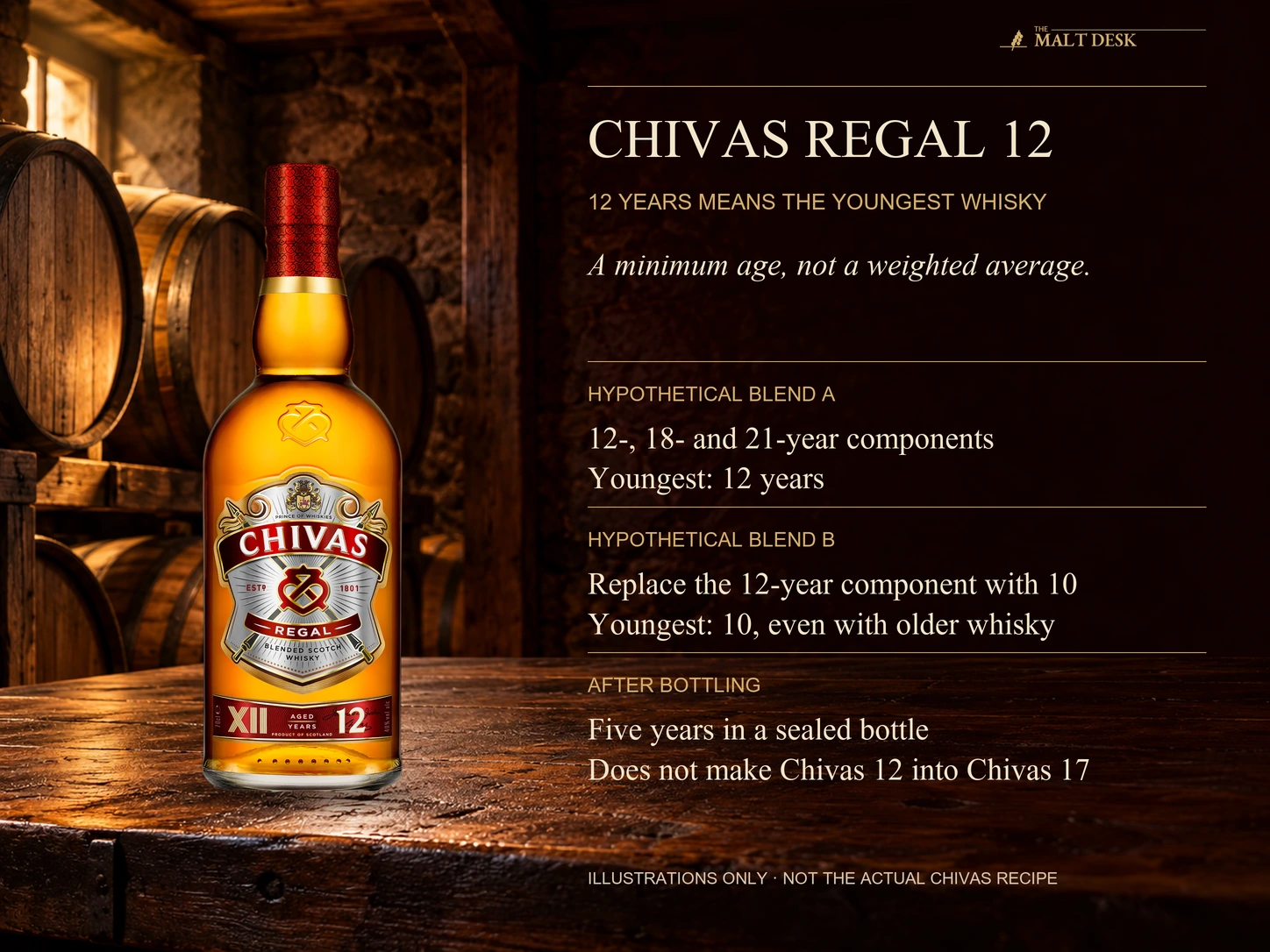
The age statement applies to the youngest whisky in the blend. Every whisky component must have matured for at least 12 years; the number is not an average. Older components may be present without changing the youngest-age statement.
For a hypothetical blend of 12-, 18- and 21-year whiskies, the youngest age is 12. Replacing the 12-year component with a 10-year one makes the youngest age 10; averaging the ages or adding more of an older whisky does not make that a 12-year blend. These are illustrations of the labeling rule, not the Chivas recipe or disclosed component ages.
The whisky does not continue cask maturation once bottled. Storing a sealed Chivas 12 for another five years does not make it Chivas 17. Bottle condition and storage are separate questions from the age declared at bottling.
Producer Flavor Descriptions
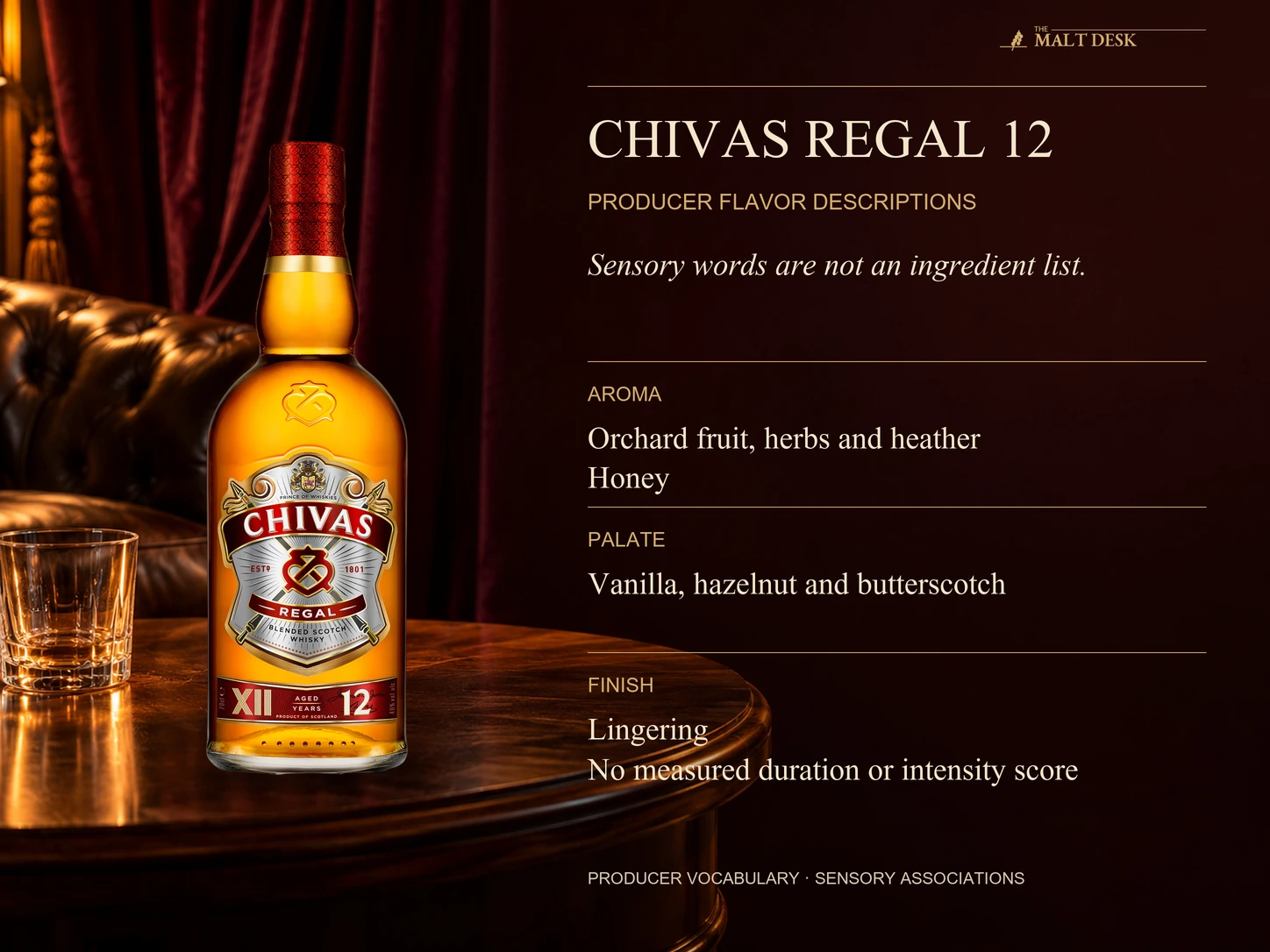
Chivas’s official notes describe orchard fruit, herbs, heather and honey in the aroma. The palate description includes vanilla, hazelnut and butterscotch, and the producer describes a lingering finish. These are sensory descriptions supplied by the brand.
Flavor vocabulary describes associations. It should not be used to infer composition or allergen status beyond actual product information.
At 40% ABV, perceived smoothness still depends on texture, astringency and alcohol warmth, as well as serving conditions.
Cask and Processing Details
The complete cask recipe and component percentages are not specified here. A vanilla note alone cannot establish an ex-bourbon percentage, and a fruit note cannot establish a sherry-cask proportion. Cask history needs its own evidence.
Likewise, appearance does not confirm natural color or non-chill filtration. Treat those claims as undisclosed unless a reliable expression-specific statement confirms them. A familiar brand or an age statement is not a substitute for that information.
A Chivas Range Name Can Outlast the Composition Being Discussed
Chivas’s 2016 Ultis launch presented an all-malt combination from five named distilleries. That dated account is useful evidence for the expression it announced. It should not be treated as the recipe of every later product retaining the Ultis name. The XX suffix is part of the product identity, not decorative text that can be dropped from a comparison.
Pernod Ricard’s current Ultis XX product account describes five single malts plus Strathclyde grain whisky and a twenty-year minimum. That makes the age floor higher than Chivas 12’s while keeping malt-and-grain composition in the disclosed account. The larger age and the all-malt question therefore point to different fields, rather than one automatic premium progression.
For a reader who values Chivas 12’s explicit minimum age and the producer’s orchard-fruit, honey and creamy profile, the twelve-year malt-and-grain identity is already a coherent choice. For someone requiring an all-malt blend, a higher Chivas age or an abbreviated Ultis listing is not enough. Verify the exact expression’s component statement before letting the product join that shortlist.
This also changes how I would read an older official article. A brand explanation can be authoritative about an earlier expression while being incomplete for a later one. Preserve the full name and date attached to its claim, then prefer the current exact-product account for a present purchase. There is no need to label every difference a contradiction or silently transfer one recipe to another.
The practical result is a cleaner comparison: twelve-year minimum versus twenty-year minimum can be one question; malt-and-grain versus all-malt can be another. A single range ladder cannot answer both. Price and presentation can be assessed after the bottle has satisfied the intended condition, rather than being used to guess its composition.
Strength and Dilution
Forty percent ABV is 80 US proof. A 30 ml measure contains 12 ml of pure alcohol. With 10 ml water added, the approximate concentration becomes 30% in 40 ml total liquid, assuming additive volumes.
A highball using the same 30 ml measure and 90 ml non-alcoholic mixer is about 10% ABV before ice melt. The concentration changes, but the alcohol quantity already poured remains. Sweetness and carbonation are not reliable indicators of strength.
The highball guide explains how soda and sweetened mixers create different recipes. Claims that one mixer always reveals a specific fruit note are less useful than recording the ingredients and ratio.
Compare Labels Before Preferences
Two blends can share a 12-year age statement while using different components. A blended malt can share a similar strength without using grain whisky. A single malt can combine many casks while remaining a single malt. Keeping these distinctions clear avoids treating unlike categories as a simple prestige ladder.
The beginner guide introduces those terms through several expressions. It does not require a progression from blends to single malts or from lower to higher proof.
Price and Presentation
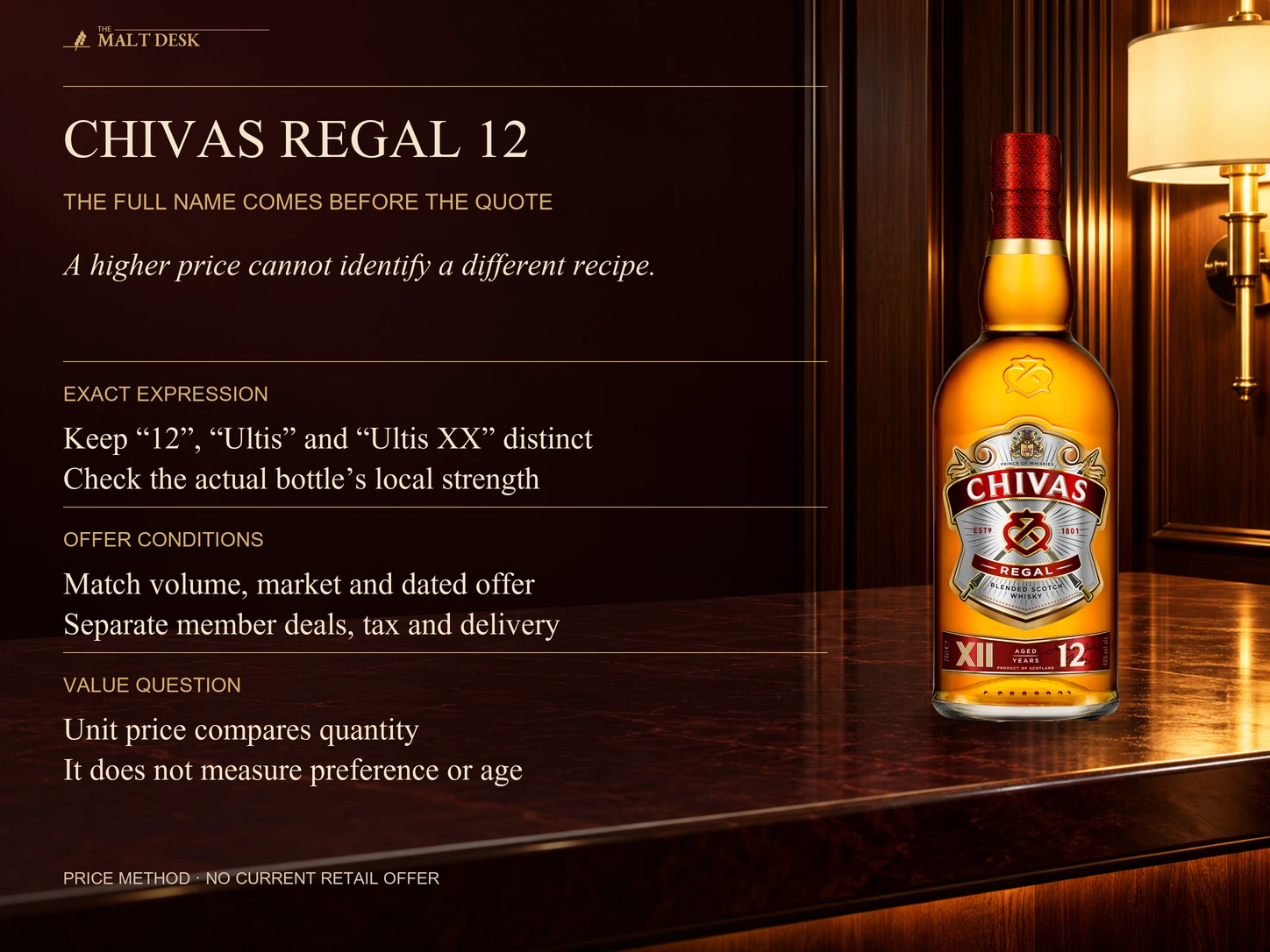
A meaningful price record identifies volume, market, date and offer conditions. An old retailer snapshot cannot establish a current nationwide price or a permanent threshold for value. Dividing cost by volume helps compare quantity.
The budget guide explains unit-price calculations. A higher price does not mean a different age or formulation unless the expression itself changes.
For gifts, familiarity does not guarantee suitability. The gift guide focuses on recipient preferences and exact product identification instead of assuming a recognizable label is universally welcome.
Match the Chivas Range to the Composition You Want
Keep Chivas 12 on the shortlist for a twelve-year malt-and-grain blend. When moving through the range, identify the exact Ultis release and consult its own composition account: original Ultis and Ultis XX have separate records. This is especially useful when all-malt composition is a requirement; settle that field before considering age, presentation and total cost.
Common Questions
Is Chivas Regal 12 single malt?
No. It is blended Scotch containing malt and grain whiskies.
Does 12 mean an average age?
No. It is the minimum age of the youngest whisky in the blend.
Does the product disclose every component?
No complete percentage recipe is provided here. Named distilleries are useful information but not the full composition.
Does 40% guarantee a smooth experience?
It establishes concentration. Perceived texture and warmth vary with the person and serving conditions.
Are the flavor notes added ingredients?
No. Terms such as honey, vanilla and hazelnut are the producer’s sensory associations, not a list of flavor additions.
Sources
Chivas Regal 12 U.S. product information and Scotch Whisky Association Guidance for Bottlers and Producers (2025), section 10.1, checked October 3, 2026. Producer flavor descriptions are attributed. The hypothetical age examples do not disclose the blend’s actual recipe.
Additional range sources: Chivas Regal’s October 6, 2016 Ultis launch statement and Pernod Ricard’s current Ultis XX product account, checked October 5, 2026. These support the separate composition records.