A Beginner’s Guide to Whiskey Labels and Styles
The most useful thing this seven-bottle list can do for a newcomer is expose a few misleading shortcuts. Forty percent does not identify a whiskey category; twelve years does not identify a single malt; a familiar brand does not identify every expression it sells. You can establish those distinctions from the labels before buying or tasting anything.
I would use the list as a set of counterexamples, then make the first choice with the mistaken rule removed. That gives the beginner something transferable to the next unfamiliar shelf: a way to recognize what a number or category actually identifies, rather than a ranking to memorize.
Whiskey is a family of grain spirits, not one uniform flavor. Country, grain recipe, distillation, cask maturation and bottling strength all help explain the differences. Learning those terms is more useful than treating one brand as the mandatory first bottle.
The seven bottles below illustrate five categories: blended Irish whiskey, bourbon, Tennessee whiskey, blended Scotch and single malt Scotch. Several bottles share a category.
Read These Four Details First
Expression name
Use the full name, not only the brand. Jameson Original and Jameson Black Barrel are different expressions; standard Maker’s Mark differs from its cask-strength releases. A brand name by itself may not identify the grain recipe, maturation or bottling strength.
ABV and proof
ABV is alcohol by volume. US proof is twice ABV, so 40% is 80 proof and 45% is 90 proof. These numbers record alcohol concentration. At an equal-sized pour, the higher percentage contains more alcohol.
Category
Terms such as bourbon, single malt Scotch and blended Irish whiskey describe production or origin. They are not positions on a quality ladder. A blended whisky can be complex, and a single malt may combine many casks.
Age statement
For Scotch, an age statement refers to the youngest whisky in the bottle. Twelve years is not an average and does not mean 12 years in glass. No age statement means the label does not provide that age; it is not permission to guess one from price or color.
Seven Bottles Across Five Categories
| Expression | Category | Common ABV | Concept illustrated |
|---|---|---|---|
| Jameson Original | Blended Irish whiskey | 40% | Pot still and grain whiskey combined |
| Maker’s Mark | Bourbon | 45% | Wheat in a bourbon recipe |
| Buffalo Trace | Bourbon | 45% | Another expression at the same strength |
| Jack Daniel’s Old No. 7 | Tennessee whiskey | 40% | Charcoal mellowing before maturation |
| Chivas Regal 12 | Blended Scotch | 40% | Malt and grain Scotch, age-stated |
| Glenfiddich 12 | Single malt Scotch | 40% | One distillery, 12-year minimum age |
| The Glenlivet 12 | Single malt Scotch | 40% | A different distillery at the same stated age |
Market presentations can vary. The percentage and volume on the specific bottle take precedence over a general product table.
Irish Whiskey and Bourbon
Jameson Original combines pot still and grain whiskey. This is one Irish style, not a definition of all Irish whiskey. The pot still category and the blended category should not be treated as interchangeable.
Maker’s Mark uses wheat alongside corn and malted barley. Its producer describes vanilla and fruit. The wheat is part of the grain recipe; vanilla is a sensory descriptor rather than a flavoring ingredient.
Buffalo Trace is another bourbon commonly bottled at 45%. Its producer descriptions include vanilla, mint and molasses. The same strength does not mean the same recipe, nor does it establish that one is sweeter or oakier than the other.
Tennessee Whiskey
Jack Daniel’s Old No. 7 includes maple-charcoal mellowing before cask maturation. This is a process detail. It should not be translated into a claim that a newcomer will necessarily experience less alcohol heat.
A familiar mixed drink can make a brand recognizable without revealing how the whiskey component tastes on its own. Cola, ginger ale and soda change the drink in different ways, and a recipe preference is separate from a whisky-category preference.
Blended Scotch and Single Malt
Chivas Regal 12 blends malt and grain Scotch. The producer’s notes include honey, orchard fruit, vanilla and nuts. Those words describe intended sensory associations.
Glenfiddich 12 and The Glenlivet 12 are single malts from different Speyside distilleries. Glenfiddich emphasizes pear in its product descriptions; The Glenlivet describes tropical and orchard fruit with vanilla and toffee.
The shared 12-year age statement is a minimum-age fact. It does not imply identical wood, cask history, fermentation or still design. “Single malt” also does not mean one cask: the distillery may combine whisky from many casks to make the expression.
Three Shortcuts These Labels Can Already Disprove
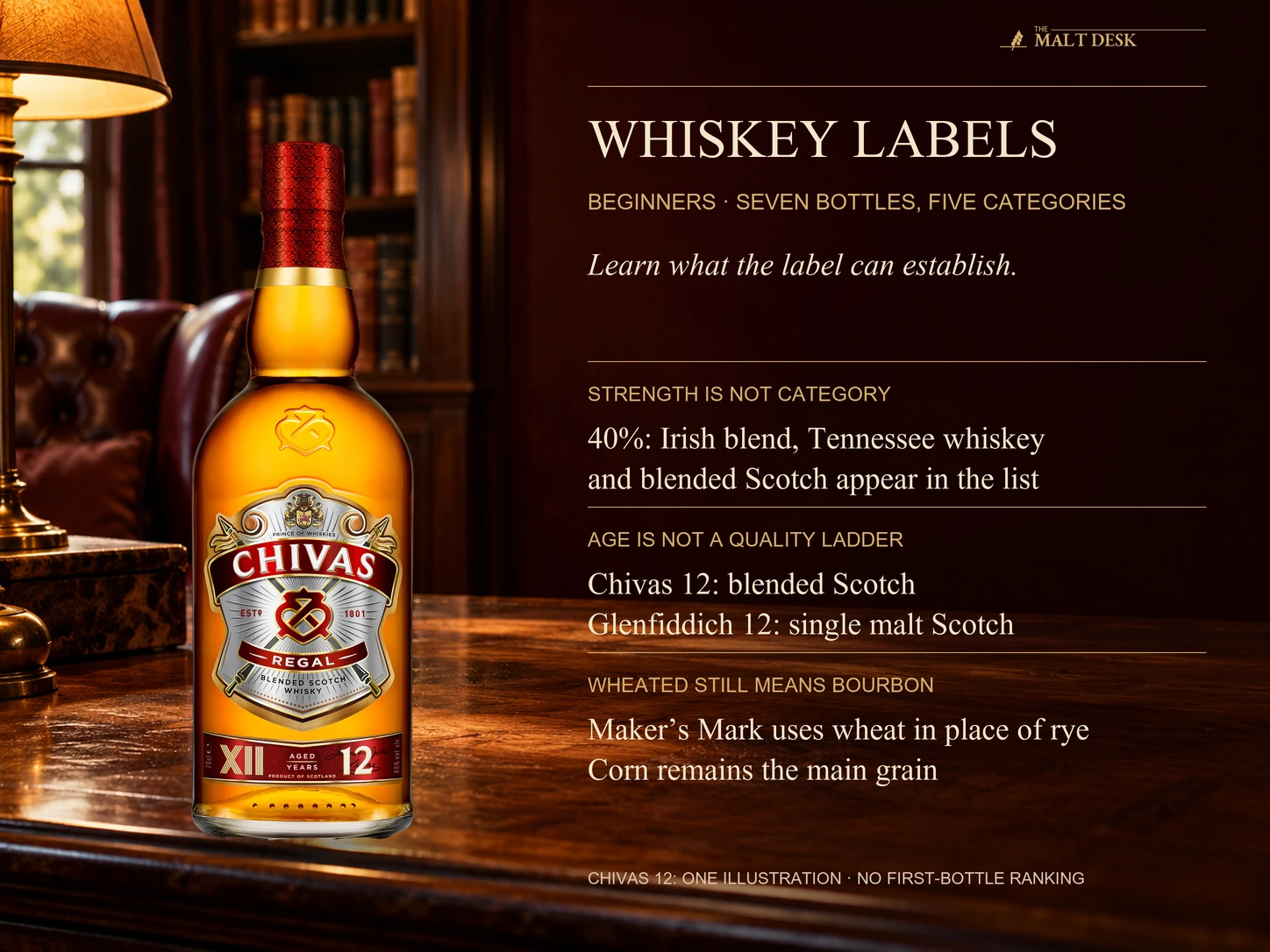
Consider the idea that a shared strength means a shared kind of whiskey. Jameson Original, Old No. 7 and Chivas 12 are all listed here at 40%, yet their disclosed categories and production accounts differ. The percentage tells you concentration. It cannot select Irish blend, Tennessee whiskey or blended Scotch on its own. This is a direct counterexample.
Now consider the assumption that twelve-year whisky must be single malt. Chivas 12 and Glenfiddich 12 both state twelve years, but Chivas combines malt and grain Scotch while Glenfiddich identifies one malt distillery. The age field and category field answer separate questions. Either category can carry a minimum-age statement, so the number cannot serve as a quality tier or substitute for reading the category.
Finally, a bourbon need not use wheat as its main grain merely because it is described as wheated. Maker’s Mark’s wheat replaces the customary rye component in its disclosed recipe; it remains bourbon. Read the category first, then the recipe detail. Otherwise a beginner can wrongly build a corn-versus-wheat category distinction from two terms that describe different levels of the same product.
I would turn those counterexamples into three separate lines of a first-bottle note: what the expression is, what strength it has, and what age or production detail is actually disclosed. Leave a fourth line for what interests you about it.
This also sets a sensible limit on the first bottle’s lesson. A preference for Maker’s Mark over Buffalo Trace would be a preference between two complete 45% bourbons. A useful beginner result is knowing which expression to revisit and what to investigate next; learning does not require pretending that one pair established a rule for an entire category.
How to Read Flavor Descriptions
Separate aroma from taste and texture. Aroma is what is perceived through smell; palate descriptions often combine taste with aromas perceived while sipping. Texture words such as oily, dry or creamy describe mouthfeel. Finish describes sensations that remain afterward.
Begin with broad groups such as fruit, cereal, oak, spice or smoke. A precise note like pear or candied orange is optional vocabulary, not a test with one correct answer. Temperature, glassware, dilution and personal perception can change which associations are noticeable.
It can refer to low perceived heat, little astringency or a familiar flavor.
Serving Terms Without a Required Ritual
Neat means served without a mixer or ice. Adding still water changes concentration; ice also changes temperature and contributes meltwater over time. A highball adds a longer measure of mixer, typically carbonated. These are serving styles, not levels of expertise.
If making observations, use a small measured amount and note the serving conditions. A few drops of water and a large pour of soda are very different dilutions. Keep the glass and temperature similar when the aim is to compare two expressions.
There is no required first-week drinking schedule. Reading labels and learning production terms does not require consuming alcohol, and a person does not need to progress to higher proof or stronger smoke to understand whiskey.
A Simple Dilution Example
Thirty milliliters of 40% whiskey contains 12 ml of pure alcohol. Adding 10 ml water gives approximately 30% ABV in a total of 40 ml, assuming additive volumes. The concentration falls, but the original 12 ml of alcohol remains.
The same amount of water added to 45% whiskey produces a different final strength: 30 × 0.45 ÷ 40 is about 33.75% ABV. Record each starting strength when calculating a water addition for a chosen final concentration.
What to Record When Comparing Information
Record the exact expression, category, ABV, age statement and disclosed casks. Add the source of the flavor description, and mark undisclosed specifications as unknown.
This approach makes later comparisons more specific. Instead of asking only whether bourbon or Scotch is “better,” you can compare grain recipes, cask histories, age statements or serving conditions one at a time.
Turn the First Bottle Into a Specific Learning Choice
Choose a first expression by one clear interest: a familiar Irish blend, a wheated bourbon recipe, a non-peated fruit-described malt, or another named style in the table. Record its category, strength and age disclosure separately. That small record gives the first preference a useful next step: repeat the expression you enjoyed or change one feature you want to explore.
Common Questions
Is one category best for every beginner?
No. The categories explain how whiskey is made. They do not establish everyone’s preferred flavor or serving style.
Does darker whisky mean older whisky?
No. Cask type and history affect color, and some whisky categories permit coloring. Appearance cannot establish age.
Must whiskey be served neat to understand it?
No. Neat is one reference condition. Water, ice and mixers create different conditions that can be described and compared without treating one as a test of expertise.
Is a long list of tasting notes a sign of higher quality?
No. The number of descriptors reflects the writer’s vocabulary and method.
Additional label-reading references: Scotch Whisky Association category guidance and expression-specific Maker’s Mark and Chivas product information, checked October 5, 2026. Counterexamples compare disclosed label fields.
Sources
Producer product information for the seven named expressions, U.S. distilled-spirits labeling principles for proof and bourbon terminology, and Scotch Whisky Association guidance on Scotch categories and age statements. Category facts, producer descriptions and individual preferences are treated as separate kinds of information.