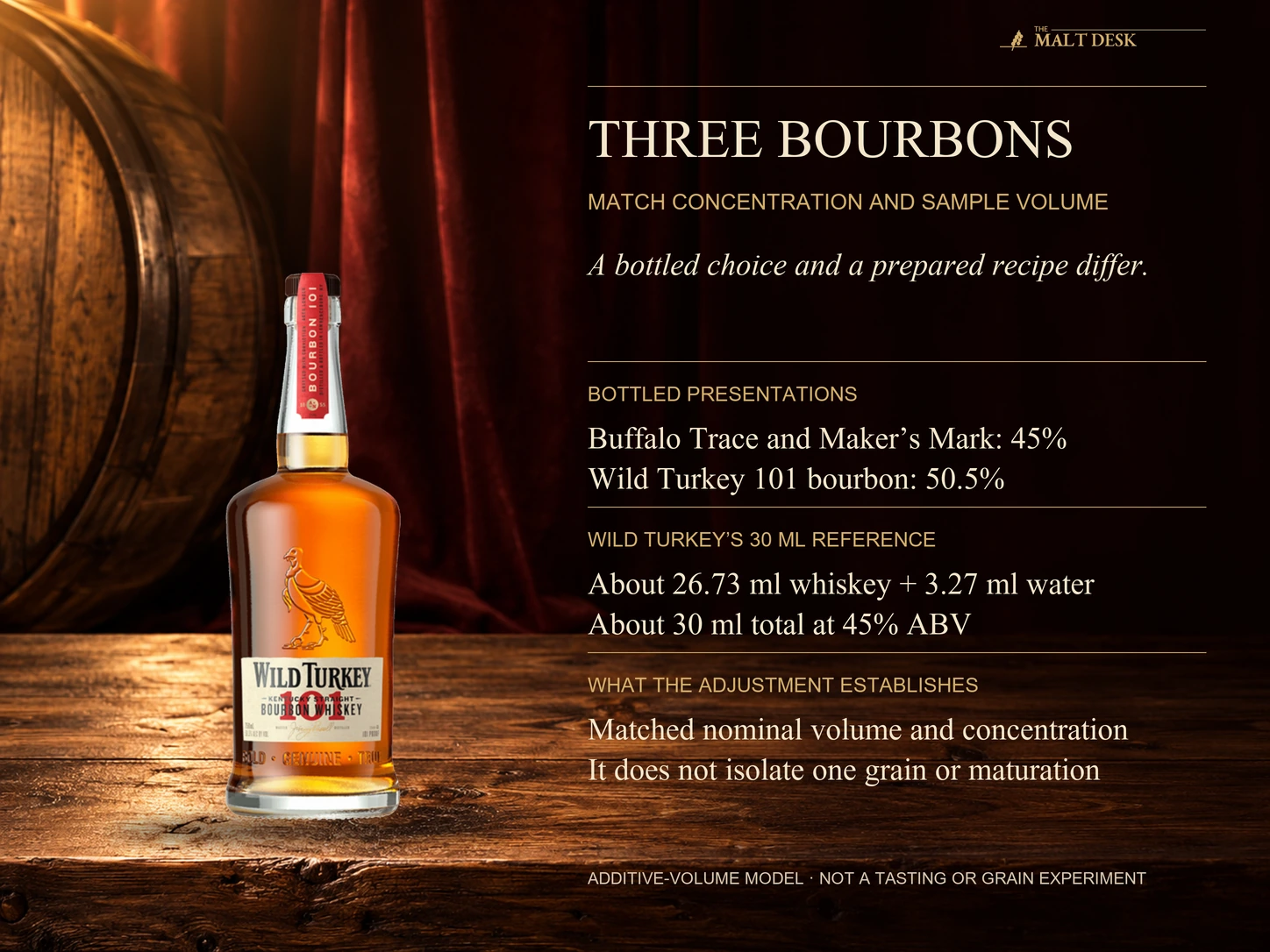
This comparison has a useful built-in pair: standard Buffalo Trace and Maker’s Mark are both 45%, while Wild Turkey 101 is 50.5%. To compare the three at the same initial concentration and sample volume, the 101 portion must become slightly smaller before measured water is added. Adding water to a full equal-sized 101 pour fixes only the concentration; it makes the sample larger.
I would preserve two separate results if comparing them: the actual bottled presentations and a clearly recorded, volume-matched 45% preparation. That second preparation can answer a more specific recipe question without pretending it isolates wheat, rye or maturation.
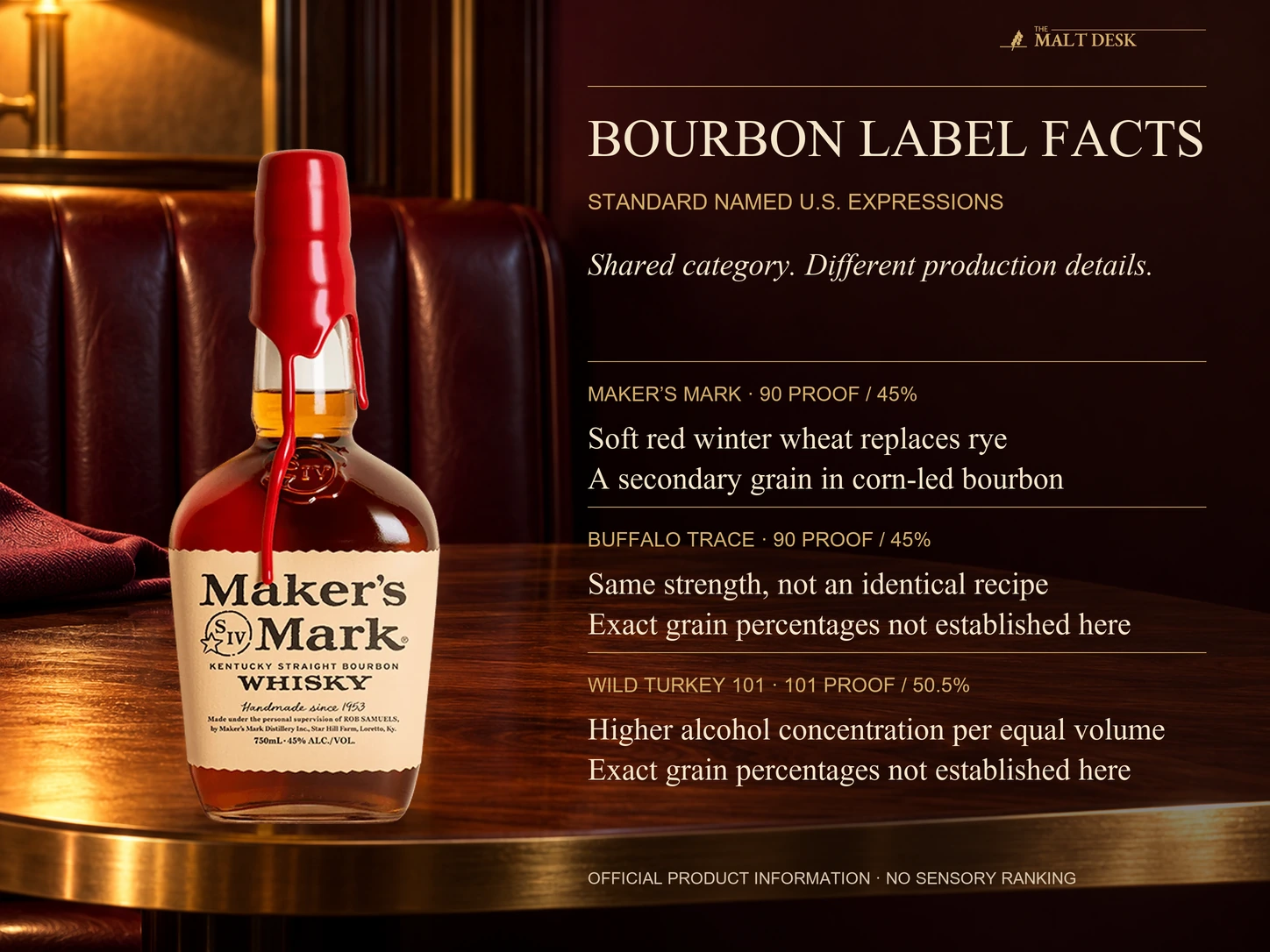
Buffalo Trace, Maker’s Mark and Wild Turkey 101 are Kentucky straight bourbons with different disclosed production details and bottling strengths. Standard Buffalo Trace and Maker’s Mark are both 90 proof, while Wild Turkey 101 is 101 proof. Maker’s Mark also provides a clear grain distinction through its use of wheat rather than rye as a secondary grain.
These facts support a comparison of recipe and presentation. They do not establish that one is universally the smoothest, has the longest finish or offers the best value. The flavor summaries below use the producers’ descriptions.
Standard Expressions Compared
| Detail | Buffalo Trace | Maker’s Mark | Wild Turkey 101 |
|---|---|---|---|
| Category | Kentucky straight bourbon | Kentucky straight bourbon | Kentucky straight bourbon |
| Standard US proof | 90 | 90 | 101 |
| ABV | 45% | 45% | 50.5% |
| Recipe detail | Exact grain percentages not disclosed here | Wheat replaces rye as a secondary grain | Exact grain percentages not established here |
| Maturation framework | New charred oak | New charred oak | New charred oak; producer emphasizes a heavy char |
What the Shared Bourbon Category Tells You
Bourbon uses a corn-majority grain recipe and new charred oak maturation. The straight designation adds maturation requirements. Those common features establish a production family while leaving considerable room for different recipes, fermentation, distillation, cask management and batching.
A brand’s standard expression may also appear beside single-barrel selections, cask-strength releases or age-stated market editions. The comparison here concerns the named standard US expressions. Full label information is needed before extending it to another release.
Maker’s Mark: the Wheated Recipe
Maker’s Mark’s producer identifies soft red winter wheat in place of rye as a secondary grain. Its official description uses sweet oak, vanilla, fruit and spice vocabulary. Those descriptions accompany the recipe.
Wheated bourbon remains corn-majority bourbon. It is different from wheat whiskey as a category. The Maker’s Mark product guide explains the standard expression in more detail.
Buffalo Trace: 90-Proof Presentation
Buffalo Trace’s published profile includes vanilla, mint, molasses and brown-sugar associations. It shares the standard 45% ABV of Maker’s Mark, so a difference between their published profiles cannot be explained by bottling strength alone.
Exact mash-bill percentages should not be inferred from a flavor note or an unofficial recipe name. The Buffalo Trace guide separates available product facts from sensory descriptions.
Wild Turkey 101: a Higher Bottling Strength
Wild Turkey 101’s label identifies 50.5% ABV. Its producer describes vanilla, caramel, spice and orange alongside oak-related character. The higher alcohol concentration is directly measurable; greater perceived heat or body is a sensory observation that can vary.
The Wild Turkey 101 guide covers the named expression. An age statement on a market-specific bottle should be recorded as such rather than applied automatically to every bottle carrying the 101 name.
Putting the Proof Difference into Numbers
The difference between 90 and 101 proof is 11 proof points, equivalent to 5.5 percentage points of ABV. A 30 ml measure at 45% ABV contains 13.5 ml of alcohol; the same volume at 50.5% contains 15.15 ml. The difference is 1.65 ml of alcohol for that equal-volume example.
These numbers describe concentration and quantity, not quality. Adding water reduces the concentration in the glass but leaves the amount of alcohol from the original measure unchanged. Record serving volume and dilution when comparing a highball with a neat measure.
Why Smoothness and Finish Need Attribution
Smoothness can refer to perceived alcohol warmth, texture or flavor integration. Finish can refer to how long an aroma persists, what remains after swallowing, or both. A simple ranking often hides those different meanings.
Compare the producers’ flavor descriptions alongside the grain recipes and bottled strengths. Similar notes can appear in bourbons with different production details.
Make a Thirty-Milliliter Reference, Not a Larger Diluted Sample
A 30 ml portion at 45% contains 13.5 ml pure alcohol. To obtain that alcohol quantity from 50.5% Wild Turkey 101, divide 13.5 by 0.505: approximately 26.73 ml whiskey. Add approximately 3.27 ml water to reach 30 ml total. Assuming additive volumes, the preparation now matches the other two samples in both nominal concentration and liquid volume.
| Thirty-milliliter reference | Whiskey | Water | Approximate starting ABV |
|---|---|---|---|
| Standard Buffalo Trace | 30 ml | 0 ml | 45% |
| Standard Maker’s Mark | 30 ml | 0 ml | 45% |
| Wild Turkey 101 adjusted reference | 26.73 ml | 3.27 ml | 45% |
The distinction matters in a cocktail. If each reference is combined with the same 90 ml non-alcoholic mixer, each nominally begins at 120 ml, with 13.5 ml alcohol and the same mixer quantity. An unchanged 30 ml pour of 101 instead contributes 15.15 ml alcohol. These are two different substitution plans: preserve the original bottle presentation, or preserve the recipe’s initial volume and alcohol concentration.
Small additions are difficult to reproduce with an unmarked spoon or an approximate splash. Use a suitable measuring device if the adjusted comparison is worth performing, and record realistic precision rather than claiming hundredth-milliliter accuracy from ordinary barware. The calculated amounts describe the target; the actual measurement determines how closely it was reached.
A matched preparation still leaves three complete bourbon production histories. Maker’s Mark’s wheat detail is informative, but the other two have not been reconstructed as identical spirits with only wheat replaced. Any preference after adjustment belongs to these prepared expressions. It cannot establish that one grain alone produces a particular texture or that all 101-proof bourbon would behave like Wild Turkey.
Comparing Recipes and Mixed Drinks
A cocktail recipe adds ingredients, temperature changes and dilution to the whiskey. The result depends on the recipe as a whole. Higher initial proof is one relevant variable, but it cannot alone establish the best Old Fashioned or Whiskey Sour.
For consistent comparisons, record the whiskey measure, mixer or syrup quantities, ice and preparation method. Different recipes can make the same base whiskey seem sweeter, sharper or less prominent.
Price Records Need Comparable Conditions
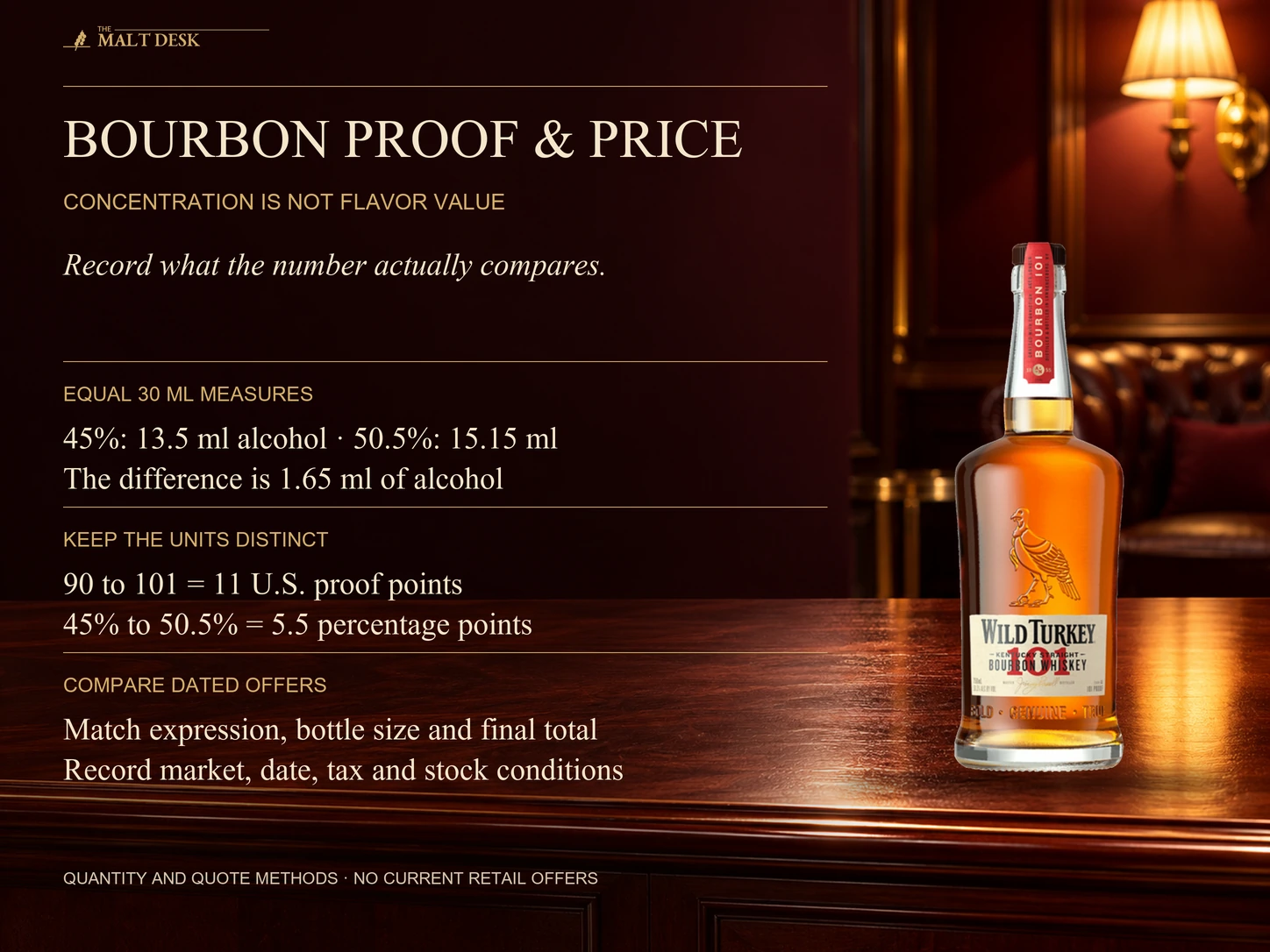
Local availability and price should be documented with a date, location, bottle size, tax treatment and stock status. A historic retailer range is not a current national average. A hard-to-find listing also does not establish that the liquid has a different specification.
A price-per-volume calculation can compare the cost of equal quantities. A price-per-proof figure is simply a concentration-based calculation. These numerical comparisons should remain separate from buying awards.
In Brief
Maker’s Mark, Buffalo Trace and Wild Turkey 101 have different recipes or bottling strengths. Their labels provide useful comparison points, while the preferred flavor and serve depend on the drinker.
Decide Whether the Comparison Is Bottled or Matched
For the experience each bottle supplies as sold, keep Buffalo Trace, Maker’s Mark and Wild Turkey 101 at their labeled strengths. For the equal-volume 45% exercise, use the calculated smaller 101 portion plus measured water. Record which comparison you chose: the first addresses the complete bottled products, while the second holds starting volume and concentration together.
Frequently Asked Questions
Do Maker’s Mark and Buffalo Trace have the same strength?
Their standard US expressions are both 90 proof, or 45% ABV. That does not make their recipes or flavor profiles identical.
Is Maker’s Mark wheat whiskey?
No. It is bourbon using wheat as a secondary grain.
Does Wild Turkey 101 have eleven percent more alcohol?
It has 11 more proof points, or 5.5 percentage points more ABV, than a 90-proof whiskey. Those are different units; the relative concentration increase is approximately 12.2%.
Which is the sweetest or smoothest?
Compare attributed descriptions and distinguish aroma associations from sweetness, texture and alcohol warmth.
Sources
Official standard-product information from Buffalo Trace Distillery, Maker’s Mark and Wild Turkey. Proof and equal-volume alcohol comparisons are arithmetic calculations; flavor descriptions are attributed to the producers.
Additional comparison inputs: producer standard-expression strengths, checked October 5, 2026. The volume-matched 45% reference is an arithmetic construction, assuming additive volumes. Actual measurement precision and later ice melt remain separate.