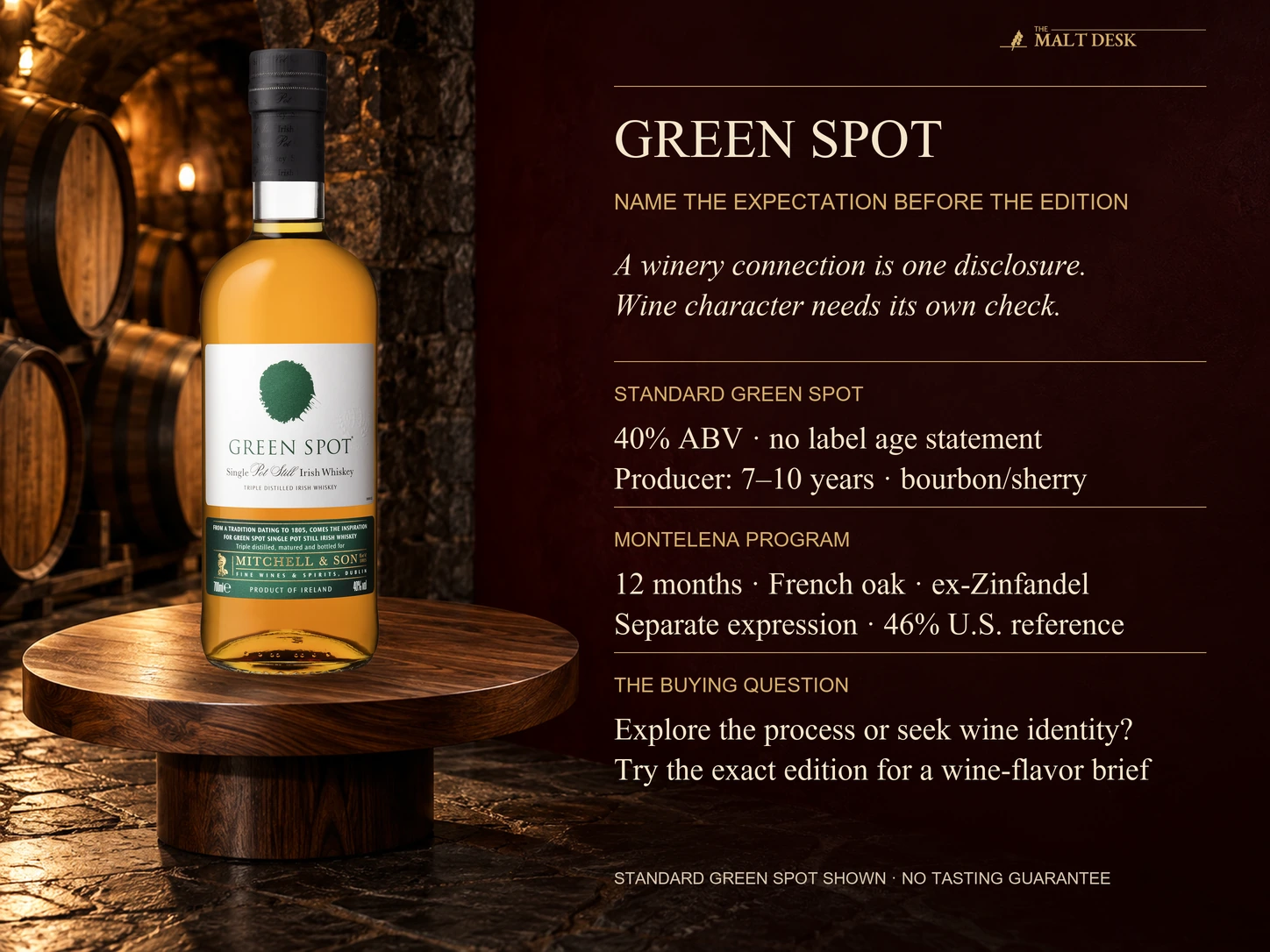
A favorite winery can give a whiskey a compelling story without giving it the flavor of a favorite wine. That is the distinction I would make before choosing Green Spot Chateau Montelena. Exploring what its Zinfandel casks do to Irish pot still whiskey is one aim; wanting a recognizable Zinfandel experience in a whiskey glass is another. The winery name establishes the connection, but not that second result.
Two published, firsthand reviews make the problem concrete. One welcomed the edition’s added fruit and balance; another admired its pot still texture while finding the expected grape character absent. I would read that disagreement as evidence about the expectations attached to the purchase, rather than average their verdicts into a promise to wine drinkers. Standard Green Spot is also more than an unfinished starting point: its own maturation already includes sherry casks.
Green Spot is a single pot still Irish whiskey produced at Midleton Distillery in County Cork. The standard expression is bottled at 40% ABV and combines malted and unmalted barley. Although the label carries no age statement, Spot Whiskey’s production information describes maturation for seven to ten years in bourbon and sherry casks.
Its identity is closely tied to Mitchell & Son, the Dublin merchant associated with the Spot range. Understanding that history, the production category and the producer’s flavor descriptions is more useful than treating Green Spot as simply an Irish single malt or a younger version of another brand.
Green Spot Specifications
| Item | Standard Green Spot |
|---|---|
| Category | Single pot still Irish whiskey |
| Distillery | Midleton, County Cork, Ireland |
| Age disclosure | No label age statement; producer describes 7–10 years |
| Strength | 40% ABV / 80 US proof |
| Grains | Malted and unmalted barley |
| Distillation | Triple distillation in copper pot stills |
| Maturation | Bourbon and sherry casks, including refill bourbon casks |
| Expression scope | Standard Green Spot; wine-cask editions are separate products |
The Mitchell & Son Connection
The Spot story comes from whiskey bonding: merchants obtained spirit from distilleries and managed maturation in their own casks. Mitchell & Son’s wine trade gave the business access to casks previously used for wine and fortified wine. Colored marks on casks became associated with the range’s names.
That heritage is different from saying Mitchell & Son operates the modern distillery. Green Spot’s distillation takes place at Midleton. Keeping the merchant, brand and distillery roles separate avoids a common source of confusion in accounts of Irish whiskey.
Why Green Spot Is Single Pot Still, Not Single Malt
Single identifies one distillery, while pot still identifies the category. Green Spot uses both malted and unmalted barley. Single malt whiskey uses malted barley alone, so the terms are not interchangeable even when both products come from one distillery and use copper pot stills.
A bottle can contain whiskey from multiple casks and batches and still be single pot still. The word single is not a promise that the contents came from one barrel. For the wider terminology, see the guide to whiskey types.
Spot Whiskey’s production account describes triple distillation after fermentation. It is a production detail to record alongside the grains, maturation and bottling strength.
What the Age and Cask Information Establishes
Green Spot has no front-label age statement, often abbreviated NAS. Its producer nevertheless supplies a seven-to-ten-year maturation range. Describing it as a ten-year-old whiskey would give the oldest end of that range the meaning of a minimum age, which is not what the label says.
The official production page identifies ex-bourbon casks and ex-sherry butts. The product page also distinguishes bourbon and refill bourbon casks. These descriptions establish previous cask use without revealing a precise percentage for each component.
Cask history can help explain flavor vocabulary. Refill casks have already participated in a previous maturation cycle; the degree of extraction depends on more than the refill label alone. Cask size, condition and time also matter.
The Producer’s Flavor Profile
Aroma
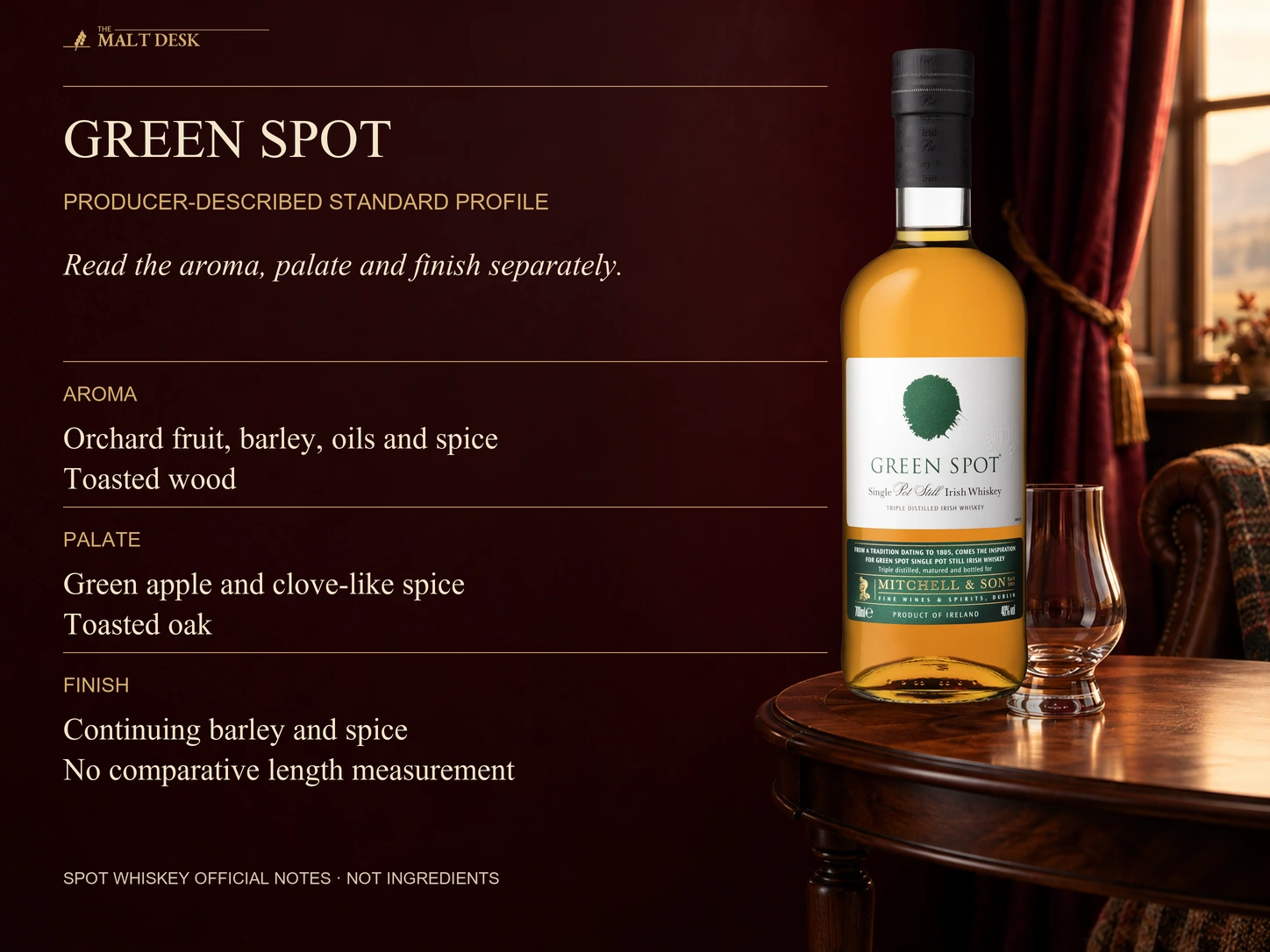
The official Green Spot description brings together orchard fruit, barley, aromatic oils, spice and toasted wood. Fruit names are comparisons used to describe aroma.
Palate
Green apple, clove-like spice and toasted oak are central to the producer’s palate description. The production material also associates the malted-and-unmalted-barley style with a silky texture. Those are attributed sensory descriptions rather than measurements of how every bottle will feel to every person.
Finish
The producer describes continuing barley and spice. A finish-length ranking against another whiskey would require its own stated evaluation method. Green Spot’s product specifications do not establish that its finish is objectively too short or that a higher bottling strength would necessarily improve it.
Montelena Adds a Specific Red-Wine Finish, Not Wine Casks for the First Time
Standard Green Spot’s bourbon-and-sherry account already contains a wine-cask connection, since sherry is a wine. The Mitchell & Son bonding history described above makes that connection part of the range’s background as well. Montelena’s distinguishing feature is therefore not simply that wine has entered the story. It is the named Napa Zinfandel cask stage added after initial bourbon and sherry maturation.
Spot Whiskey specifies twelve months in French oak casks that previously held Chateau Montelena Zinfandel. The U.S. expression is 46%, compared with standard Green Spot’s 40% reference. French wood, Californian wine and Irish whiskey belong to different parts of that account. They explain what was made; none specifies how recognizably Zinfandel-like a particular reader will find it.
Two Reviewers Found Different Reasons to Value the Same Edition
In his January 28, 2018 Drinkhacker review, Robert Lublin recognized the original Green Spot character and described a well-integrated cherry contribution, with berries, honey and developing spice. He judged the wine-cask additions successful because they added to the whiskey without disrupting its balance. That is a positive report about an altered Green Spot, rather than a demonstration that it reproduces a glass of Zinfandel.
Jim Bonomo’s February 28, 2018 review for The Whiskey Wash praised the thick, rich pot still mouthfeel but did not find the grape character or Zinfandel-associated spice he was seeking. He could value the whiskey’s texture while judging the wine integration disappointing. These are the reviewers’ own observations from 2018.
The important disagreement is about what counts as a successful collaboration. Added fruit that preserves the whiskey’s balance can satisfy one criterion. An unmistakable connection to the named wine can satisfy another. A wine enthusiast might mean either when saying that the bottle sounds interesting. A favorable whiskey review cannot answer an unspoken requirement for recognizable grape identity.
Make the Wine Connection Earn Its Place in the Purchase
For a reader who already enjoys Green Spot and wants a named red-wine finishing branch, I would keep Montelena in consideration. The disclosed process answers that curiosity directly, and Lublin’s report supplies a relevant reason to investigate it. The aim is a different pot still expression with a documented winery connection, so success does not depend on mistaking the whiskey for wine.
For a reader whose main reason is loving Chateau Montelena Zinfandel, I would first seek a modest serving of this exact edition and ask a narrower question: is the connection perceptible in a way I actually want? Bonomo’s account makes that uncertainty concrete. If the answer is no, liking the mouthfeel would be a separate reason to consider the whiskey; it would not retroactively fulfill the original wine-flavor brief.
Standard Green Spot remains a coherent choice when the interest is its orchard-fruit, barley and pot still identity. It does not need the winery suffix to become a complete whiskey. Nor would I replace an unwanted Montelena with Château Léoville Barton merely because both carry wine names: the latter has its own Bordeaux-cask account and a twelve-to-twenty-four-month stage. That would be another inquiry, not a demonstrated cure for the first disappointment.
Understanding 40% ABV
At 40% ABV, alcohol makes up 40% of the liquid volume; this corresponds to 80 proof under the US convention.
Dilution changes alcohol concentration, while temperature affects aroma release and the sensory setting. Neither provides a universal formula for making a whiskey better. Exact claims about a required resting time or a fixed number of water drops should be treated as a serving preference rather than a property of Green Spot.
Green Spot and Related Irish Whiskeys
Redbreast 12
Redbreast 12 shares Midleton production, single pot still classification and a standard 40% ABV presentation. Its 12-year age statement is a clear difference. Its producer gives sherry, fruit, spice and toasted wood a prominent place in the published profile. These details describe two expressions without establishing which one every reader should prefer.
Jameson Original
Jameson Original is a blended Irish whiskey containing pot still and grain whiskey. Green Spot is a single pot still expression. This is a category difference.
Other Spot expressions
Yellow Spot and Green Spot wine-cask editions have their own specifications. Yellow Spot’s published maturation includes a Malaga-cask component and a 12-year minimum; those details do not apply to standard Green Spot. Match the complete expression name before transferring an age, strength or cask description from one page to another.
Price Information and Its Limits
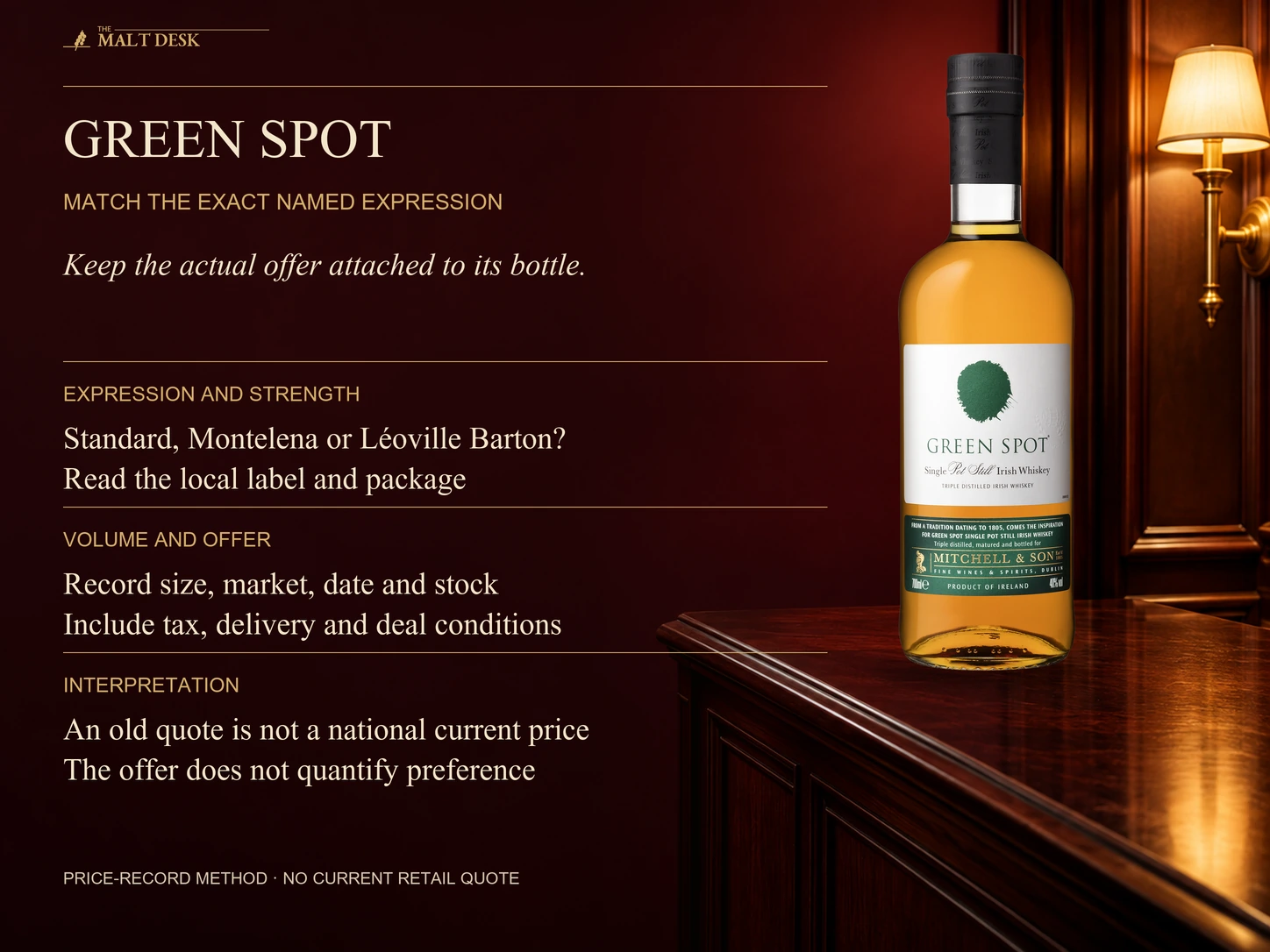
Match standard Green Spot before recording a quote. Its producer’s seven-to-ten-year description is not a ten-year label age, and wine-cask editions are separate expressions. The worksheet records the printed strength, bottle volume and dated local offer; no verified retailer range is established here.
Include seller, location, stock and the final total after tax, delivery and discounts. Divide that total by bottle ml and multiply by 100 for cost per 100 ml. This compares quantity, not the value of the producer’s age description or a flavor preference.
In Brief
Green Spot is a single pot still Irish whiskey with no age statement on the standard expression. Producer notes describe orchard fruit and spice; these descriptors are guides.
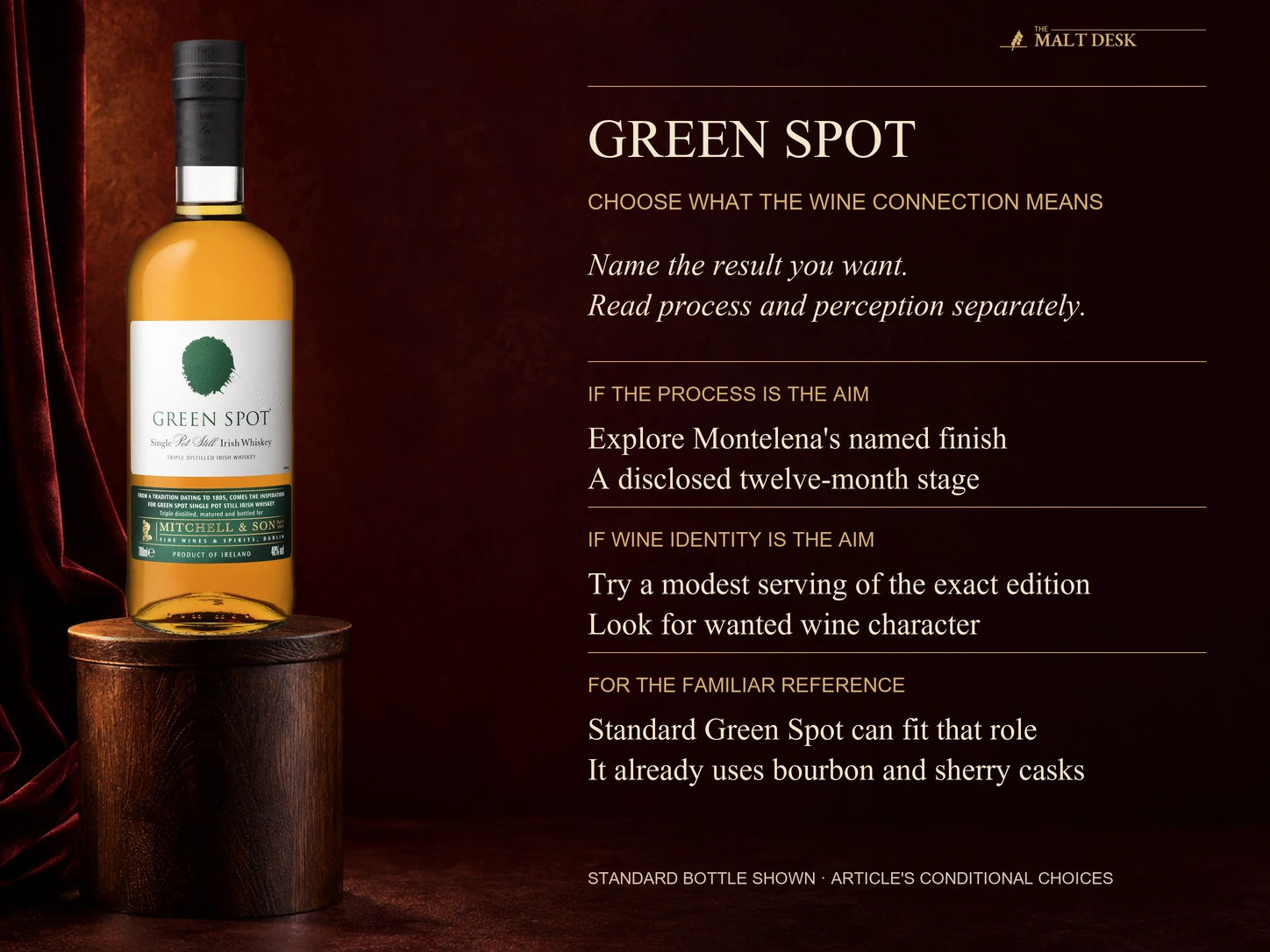
Choose the Green Spot Cask Connection You Want
Use standard Green Spot for the core pot-still expression. Investigate Chateau Montelena when the Zinfandel-cask connection is itself the attraction, and judge it as a whiskey shaped by that documented cask program. If the aim is enjoying a particular wine, keep that as a separate preference when deciding whether the cask-linked whiskey answers the same occasion.
Frequently Asked Questions
How old is Green Spot?
The standard bottle carries no age statement. Its producer describes whiskey matured for seven to ten years.
Where is it made?
At Midleton Distillery in County Cork, Ireland. Mitchell & Son’s role in the brand history should not be confused with the location of modern distillation.
Is it single malt?
No. Green Spot is single pot still Irish whiskey made with malted and unmalted barley.
Is it naturally colored or non-chill-filtered?
The official product and production pages used for this guide do not establish those claims. Neither should be inferred from the whiskey’s appearance or its category.
Sources
Spot Whiskey: official Green Spot product page and production overview; the product page was rechecked October 4, 2026 for the NAS wording, seven-to-ten-year account and cask history. Comparative details: official Redbreast 12 and Jameson Original information. Flavor words are attributed to the producer; no verified retail price range is supplied.
Further research checked October 7, 2026: Spot Whiskey’s production, history and Montelena accounts; Robert Lublin’s Drinkhacker review dated January 28, 2018; Jim Bonomo’s The Whiskey Wash review dated February 28, 2018. The two reviews are attributed historical observations. The distinction between a finishing-process interest and an expected wine identity, and the resulting purchase choices, are The Malt Desk’s editorial analysis.