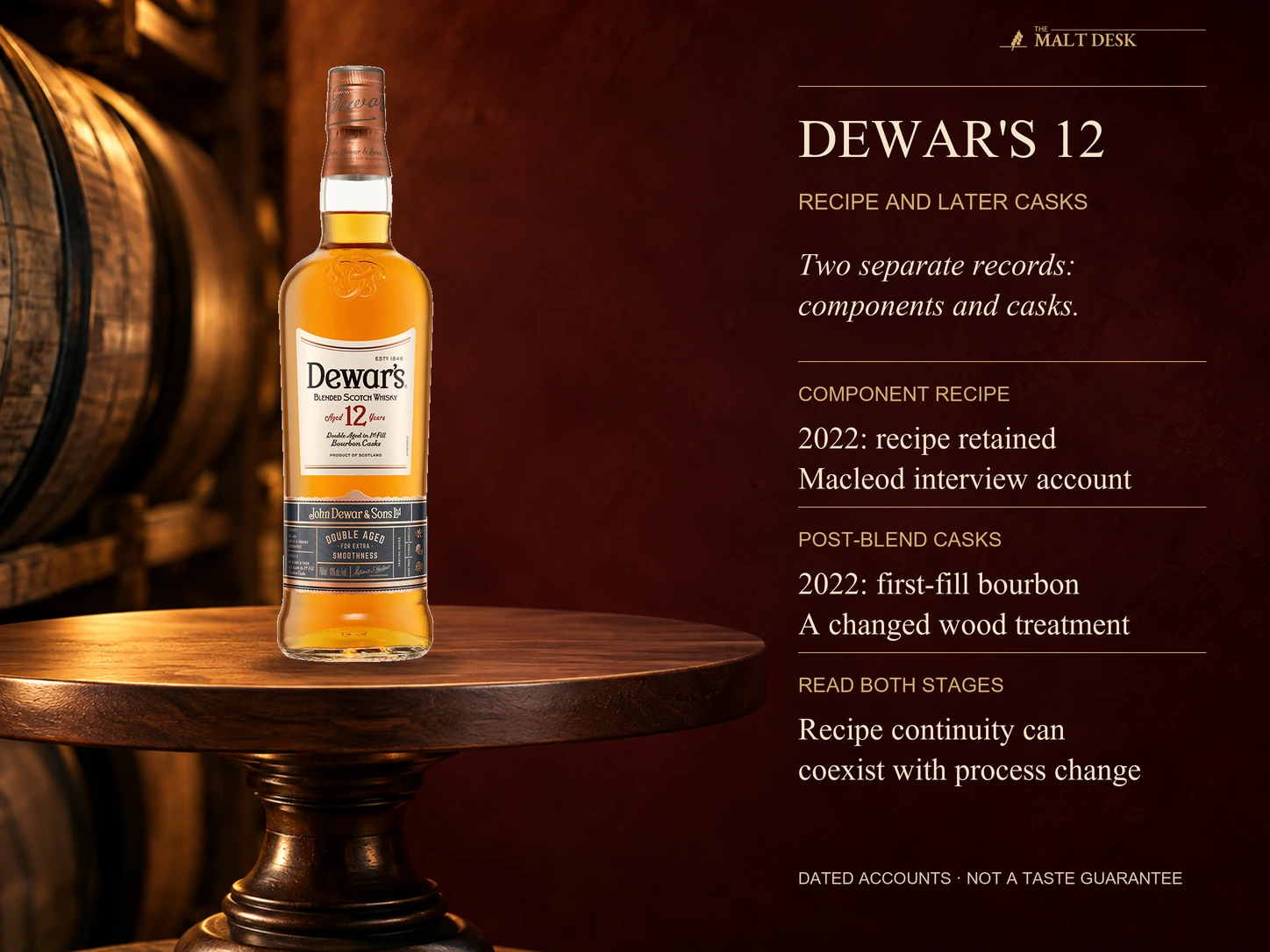
An unchanged blend recipe and a changed whisky can both be accurate descriptions of Dewar’s 12. In a September 2022 Whisky Advocate interview, master blender Stephanie Macleod said the underlying liquid recipe stayed the same while the casks used after blending changed. The important distinction is between selecting the components and treating the blend after they have been combined.
That gives the first-fill bourbon claim a more precise role than simply promising extra smoothness. A reader interested in a different oak influence does not have to assume a new grain formula, a higher age or a larger ABV. The 2022 account describes an intervention later in the process. Published old-versus-new observations can then help decide whether that direction is worth investigating.
Dewar’s 12 is a twelve-year-old blended Scotch whisky bottled at 40% ABV. Its current production description combines malt and grain whiskies, a two-stage aging process and a finish in first-fill bourbon casks.
The label is useful for understanding three separate questions: what is blended, how long the youngest whisky matured, and how the casks are used. Keeping those questions separate makes the production description easier to interpret.
What is in the blend?
Dewar’s current product page identifies up to thirty malt and grain whiskies, including aged reserves from its own distilleries. The precise proportions are not given. The upper limit does not mean equal shares, exactly thirty components or thirty different distilleries.
Blended Scotch combines malt and grain Scotch whiskies. The twelve-year age statement applies to the youngest component, rather than only to the malt portion or to an average of the blend. Read single malt and blended Scotch for a fuller explanation.
Two-stage aging and bourbon-cask finishing
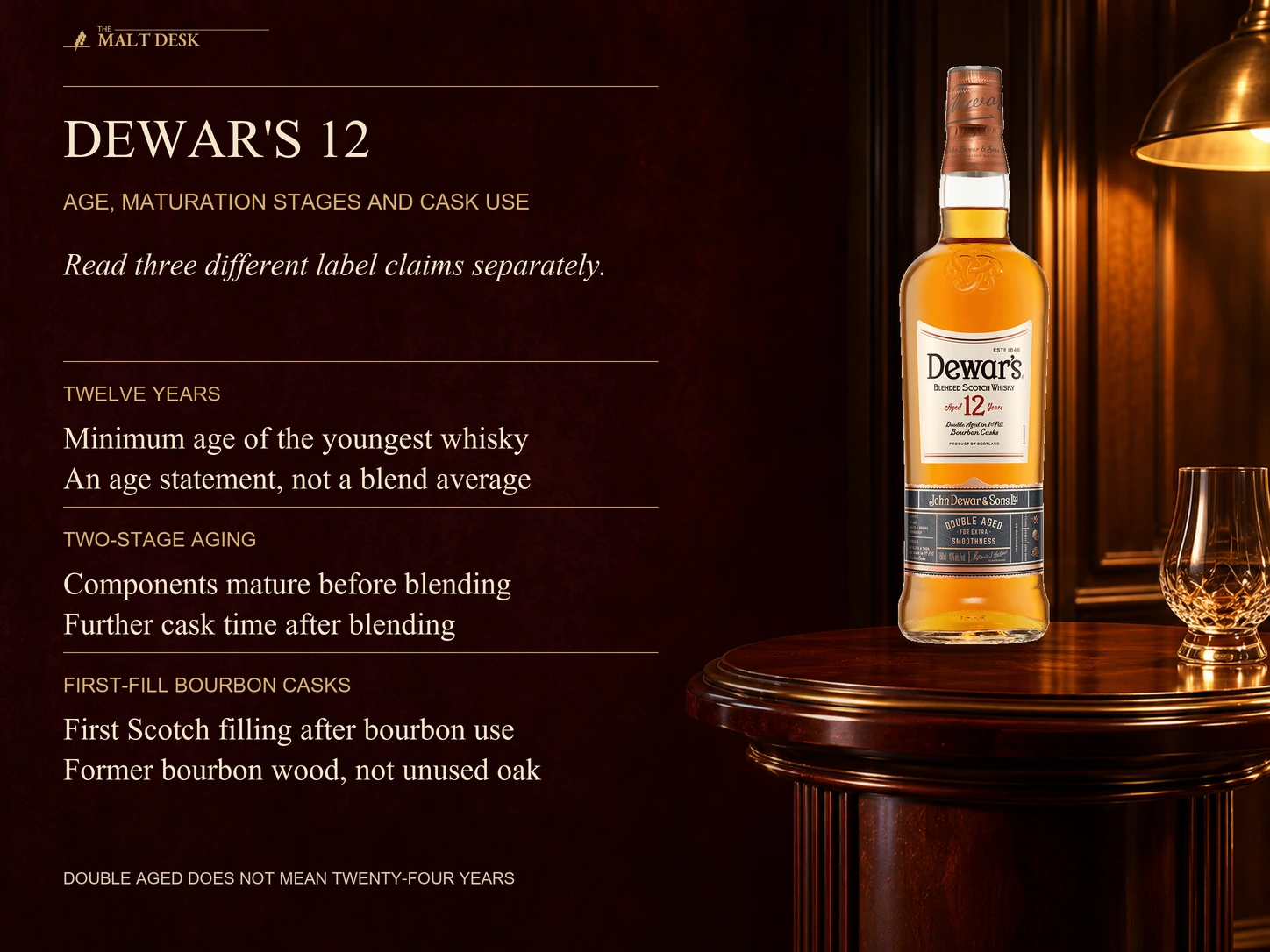
The producer’s two-stage account distinguishes maturation of the components from further cask time after blending. Its current description identifies first-fill bourbon treatment. The dated 2022 interview below explains how that post-blend wood environment changed while the underlying liquid recipe was retained.
“Double aged” does not turn twelve years into twenty-four. Nor does “first-fill bourbon” mean a new, never-used barrel: it describes the first Scotch filling after the cask’s previous bourbon use. The public product page does not specify the length of every stage or a percentage for each component.
This makes the label more informative than a generic claim of extra smoothness. Readers can distinguish the documented process from the producer’s intended sensory effect, without assuming that a maturation method guarantees the same perception for everyone.
Published flavor profile
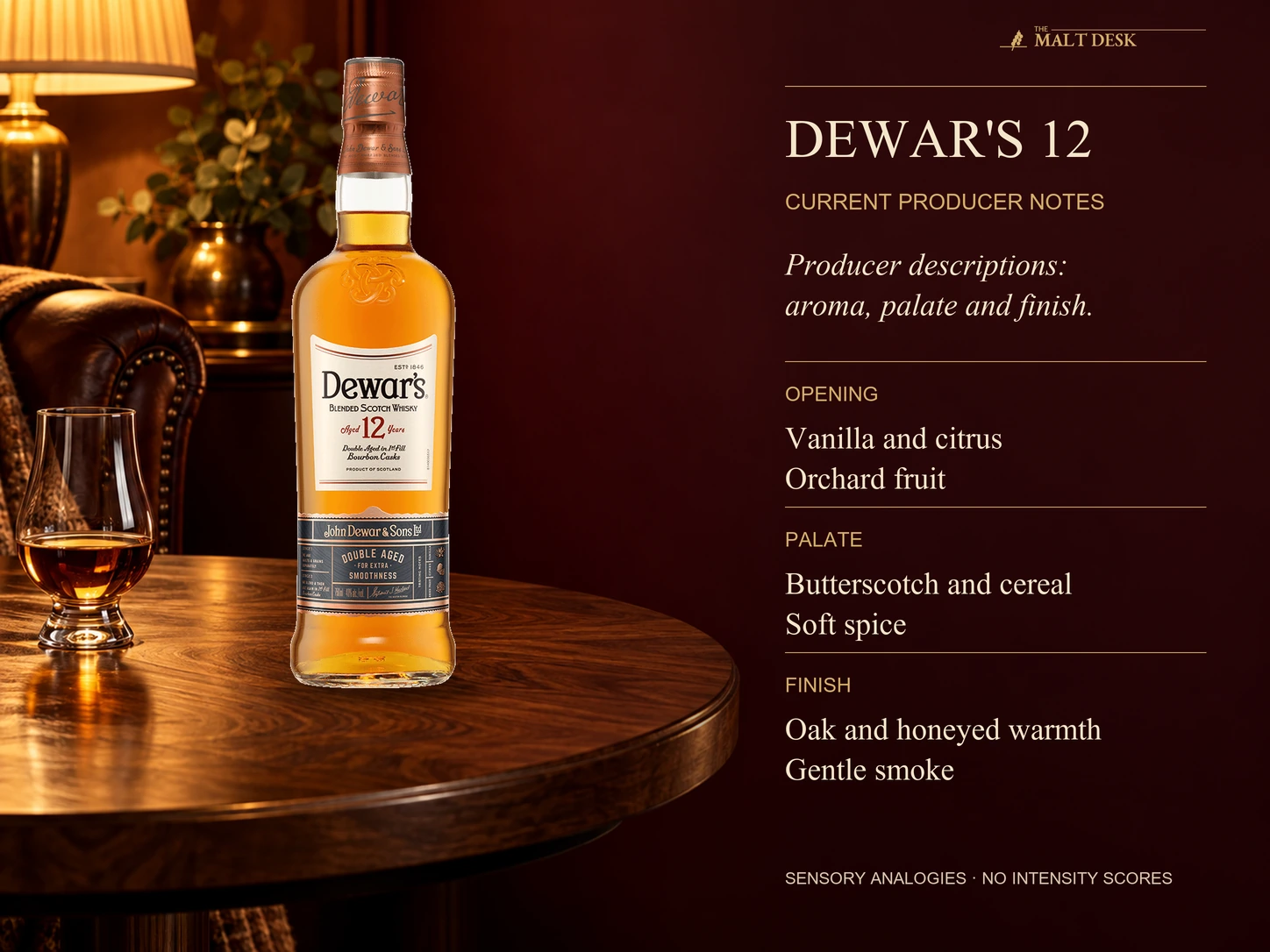
Dewar’s describes vanilla, citrus and orchard fruit at the opening; butterscotch, cereal and soft spice on the palate; and oak, honeyed warmth and gentle smoke in the finish. These are the producer’s flavor references.
The terms belong to different aroma families. Orchard fruit suggests a different comparison from dried fruit; cereal is distinct from oak; gentle smoke does not mean an absence of smoky character. Keeping those terms separate makes the description easier to compare with other blends.
Forty percent ABV is a label measurement. Descriptions such as smooth or layered are sensory language, so the strength alone cannot establish how oily the whisky feels or how long its finish lasts.
Serving context
Dewar’s publishes highball, Whisky Collins and Boulevardier suggestions for its range. This supports discussing the whisky in mixed preparations as well as neat, without declaring one method a universal winner.
For a highball comparison, keep the whisky measure, soda volume, temperature and ice consistent. Changing the mixer or ratio changes the drink even before the whisky is considered. A recorded ratio is more useful than saying only “a splash of soda.”
For neat and water-added comparisons, leave one reference sample unchanged and adjust the other gradually. Ice combines cooling with dilution as it melts. The serving guide and highball guide explain those preparation choices.
How to compare prices
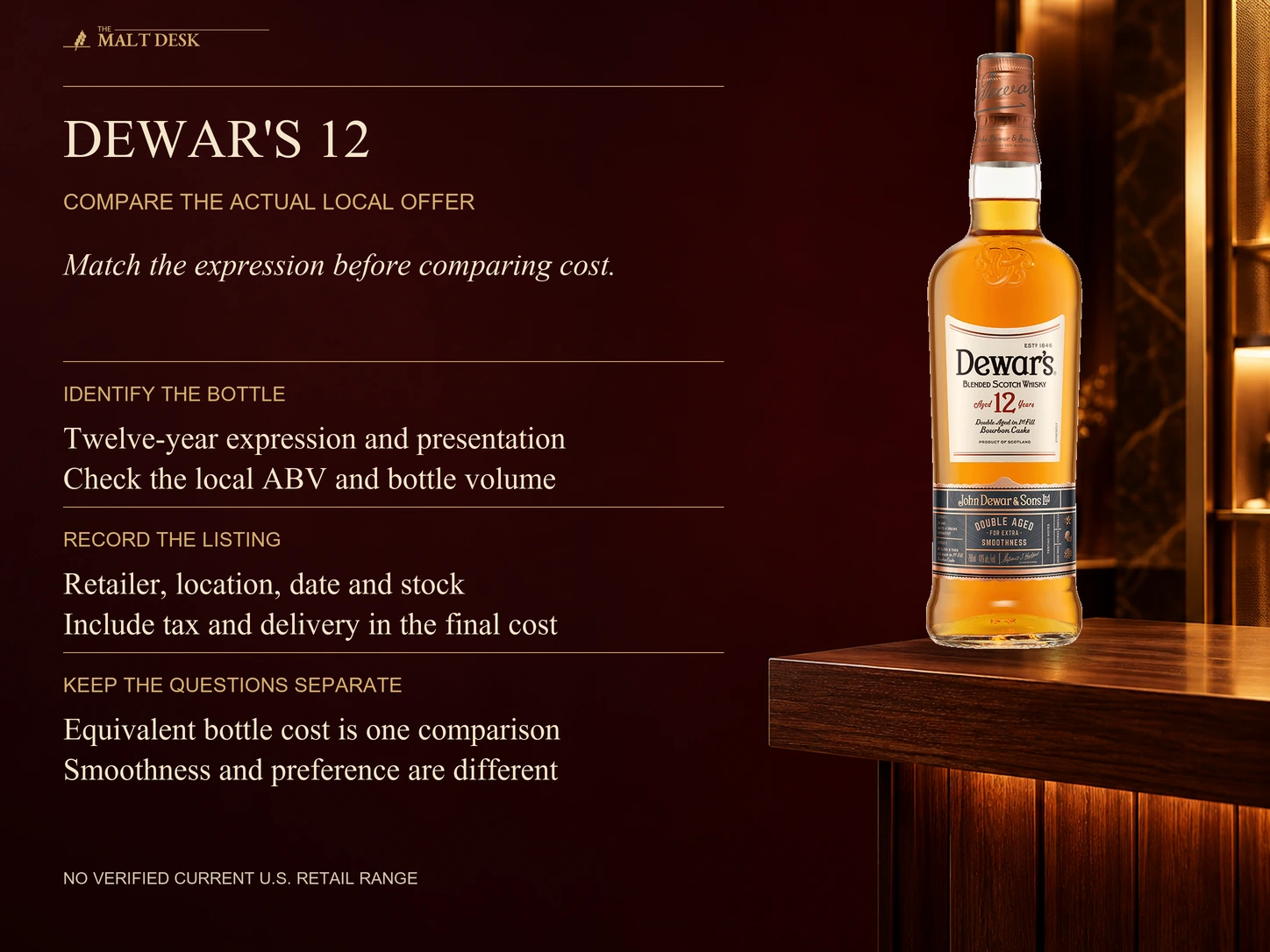
This guide does not establish a verified current U.S. price for Dewar’s 12. Compare the same age-stated expression and bottle volume using dated local listings, and record whether taxes and other charges are included.
A price spread between locations cannot establish a single nationwide value threshold. Separate the cost of an equivalent bottle from claims about smoothness, finish, or preference.
The whiskey budget guide provides broader context. Treat a budget label as a local price constraint rather than part of the whisky’s specification.
An Unchanged Component Recipe Can Meet a Different Marrying Cask
Macleod’s September 21, 2022 interview distinguishes the existing malt-and-grain liquid recipe from its subsequent marrying treatment. Previously, the blended whisky went into large, well-used butts with little remaining wood influence. The revised treatment put the blend into first-fill bourbon casks for about three months. This is a dated explanation of the change, not a disclosed duration for every present-day batch.
Dewar’s September 26 launch announcement separately identifies the new bottle and the newly used first-fill American-oak bourbon treatment. Those sources therefore describe both a presentation change and a liquid-treatment change. Macleod’s statement that the underlying recipe remained the same is consistent with them: keeping the selected components does not require keeping the post-blend wood environment unchanged.
The useful process map has two records. One concerns what mature malt and grain whiskies were assembled; the other concerns what happened to that assembly before bottling. An unchanged first record cannot establish an unchanged second record. Conversely, the change in marrying casks is not evidence that the grain component was removed or that the twelve-year minimum became twenty-four. The current page’s up-to-thirty account remains its own disclosure, rather than an exact historical component count.
The Change Can Be Interesting Without Improving Every Feature
In his December 5, 2023 Whiskey Apostle comparison, reviewer Gary reported blind side-by-side checks of the older and newer presentations. He preferred the newer one, finding a richer fruit direction and more depth, while describing their finishes as quite similar. That is his reported result for those bottles. It supports investigating a changed profile without promising a longer finish or a universal improvement.
I would use that observation to sharpen the purchase question. For someone seeking a vanilla-and-fruit change while retaining the blended-Scotch category and twelve-year floor, the new treatment is relevant and Gary’s account supplies independent sensory evidence to examine. For someone whose main wish is a markedly longer finish, his favorable verdict does not answer that request merely because he preferred the newer bottle overall.
For a reader content with the older expression, an unchanged underlying recipe is not sufficient reason to expect the familiar finished profile in the new presentation. An actual comparison of correctly identified bottles can address that concern. The revised bourbon-cask marrying treatment is also a concrete way to explore wood influence within an established blend; changing to an unrelated higher-proof or single-malt bottle would ask a broader question.
The interview and review locate a reason for difference, but do not isolate its sensory cause. Individual cask selections, serving conditions and the identity of the compared bottles still matter. A shop’s current photograph cannot identify the liquid in every old listing. Keep the dated production change attached to the identified presentation, and the reviewer’s observations attached to the bottles he actually compared.
How it compares with other twelve-year blends
Johnnie Walker Black Label and Chivas Regal 12 share the blended Scotch category and a twelve-year minimum age. Their blend recipes and producer descriptions differ, so the matching age statements do not make them identical products.
For a comparison, record category, age, ABV and the producer’s main aroma families in separate columns. Then record your serving method. This avoids using an unsupported ranking such as “best neat” or “shortest finish” as if it were a specification.
The broader types of whiskey guide explains how Scotch blends differ from bourbon, Irish whiskey and other categories.
In Brief
Dewar’s 12 is a blended Scotch with a twelve-year minimum age, producer-described two-stage aging and a first-fill former bourbon-cask finish.
Follow Dewar's Change After Blending
For Dewar’s 12, keep the cited component-recipe continuity and the changed post-blending cask treatment in the same production timeline. A reader interested in the updated expression should identify the relevant presentation and its finishing account. This makes the comparison about the stage that changed while preserving the context of the familiar twelve-year blend.
Common questions
Is Dewar’s 12 a single malt?
No. It is a blend of malt and grain Scotch whiskies.
Does double aging double the age statement?
No. Twelve years remains the minimum age shown for the youngest whisky. The process description refers to maturation stages.
Does first-fill mean unused oak?
Not in the phrase first-fill bourbon cask. The cask has already held bourbon; first-fill refers to its subsequent use for Scotch.
Is it completely without smoke?
The current producer description includes gentle smoke in the finish. That is more precise than calling it either entirely unpeated in flavor or a peat-focused expression.
Sources
Dewar’s current 12 Year Old product information and serving suggestions, checked October 3, 2026; Scotch Whisky Association category and age-statement guidance. The producer says up to thirty malt and grain whiskies, not exactly thirty distilleries. No current retail range or duration for every maturation stage is established.
Process research checked October 7, 2026: Jonny McCormick’s September 21, 2022 Whisky Advocate interview with Stephanie Macleod; Dewar’s September 26, 2022 launch announcement and current twelve-year account; Gary’s December 5, 2023 Whiskey Apostle old-versus-new comparison. The roughly three-month treatment is retained as a historical interview disclosure. The reviewer’s blind observations are attributed. The component-versus-post-blend distinction is The Malt Desk’s editorial analysis.