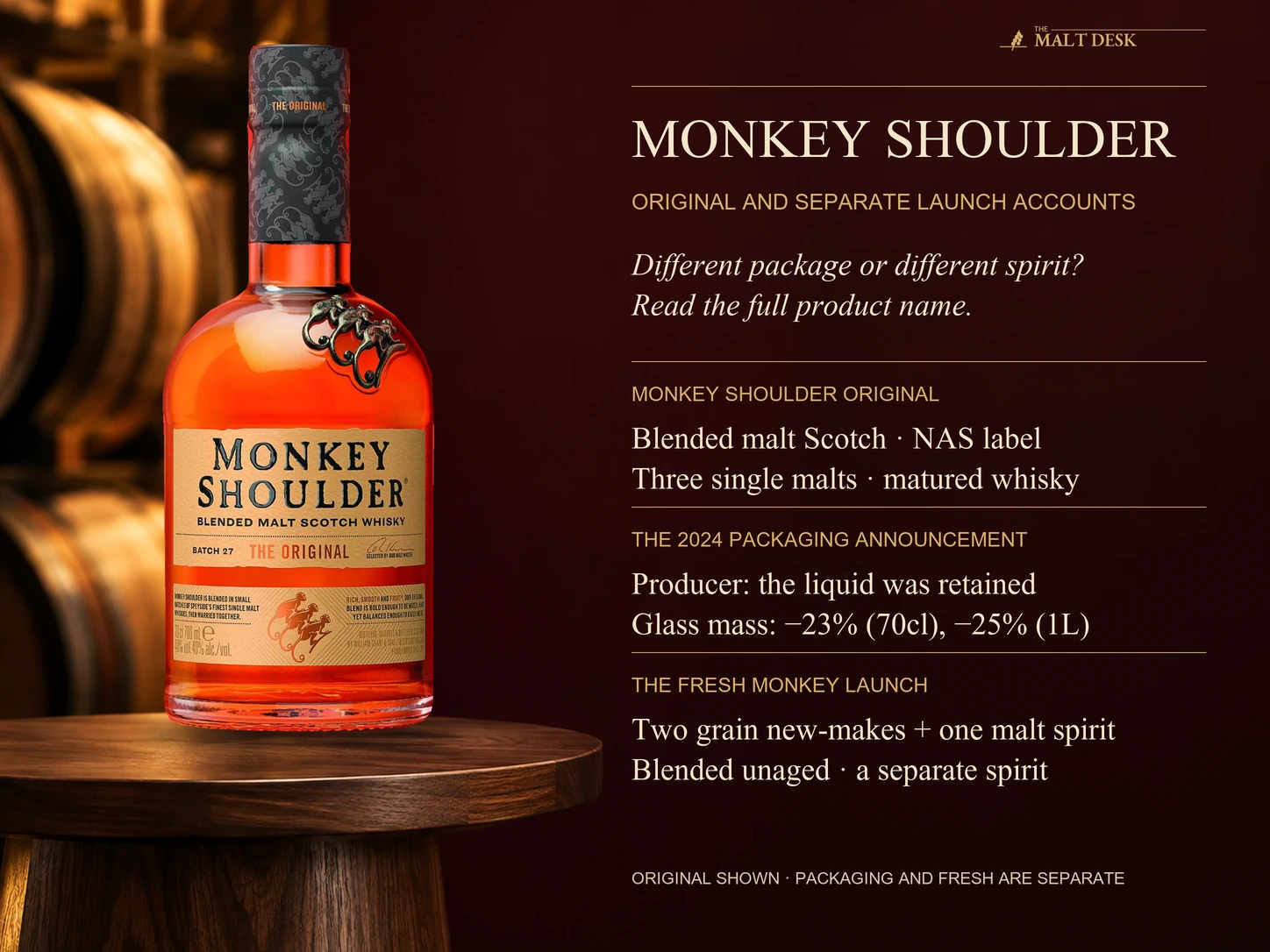
A fresh Monkey Shoulder bottle and a bottle of Fresh Monkey can describe two very different things. The producer’s June 2024 packaging announcement kept the Original whisky unchanged. William Grant & Sons’ separate Fresh Monkey launch, however, introduced unaged malt-and-grain spirits. The resemblance in wording can hide a change in both composition and maturation status.
That distinction matters before deciding whether a description belongs in this guide. Original’s three single malts, Fresh Monkey’s three new-make spirits and a new three-monkey label are not interchangeable evidence. I would identify the full product name before borrowing a category or mixing recommendation from any of them.
Monkey Shoulder Original is a blended malt Scotch whisky: a combination of single malts from more than one distillery. Its official brand description emphasizes vanilla, orange and spice, and presents the whisky as made for mixing.
The category is the most important starting point. Monkey Shoulder is neither a single malt nor the same category as a malt-and-grain blended Scotch. Understanding that distinction makes comparisons with other familiar bottles more useful.
What blended malt means
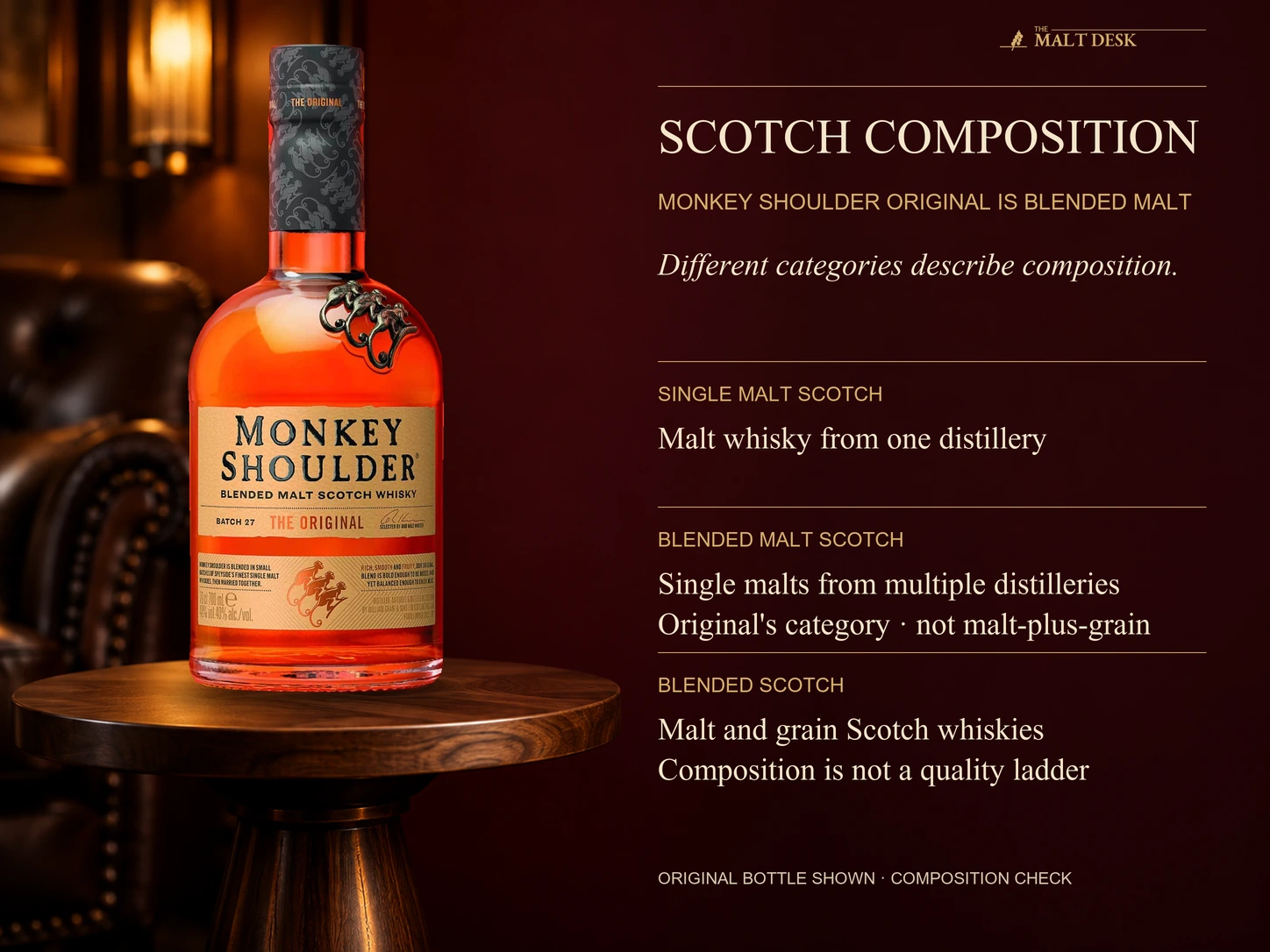
Single malt Scotch is made at one distillery from malted barley. Blended malt combines single malt Scotch whiskies from different distilleries. Blended Scotch combines malt and grain Scotch whiskies. These are compositional definitions.
| Category | Distillery origin | Composition |
|---|---|---|
| Single malt Scotch | One distillery | Malt whisky |
| Blended malt Scotch | More than one distillery | Malt whiskies |
| Blended Scotch | A blend | Malt and grain Scotch whiskies |
Our Scotch category guide explains the distinctions in more detail. The wider types of whiskey guide places them alongside other whiskey traditions.
Age statement and component information
The standard Original does not carry an age statement. A batch number is not an age. The current product page describes three single malts, first-fill former bourbon casks, and blending followed by marrying. It does not name every component distillery or give their proportions. Its reference to up to six months in the blending account is not the whisky’s total maturation age.
Older descriptions of a particular three-distillery recipe may be historical context, but they should not replace current product information. Without a published current recipe, assigning percentages or presenting a fixed distillery list would add precision that the available information does not support.
Published flavor direction
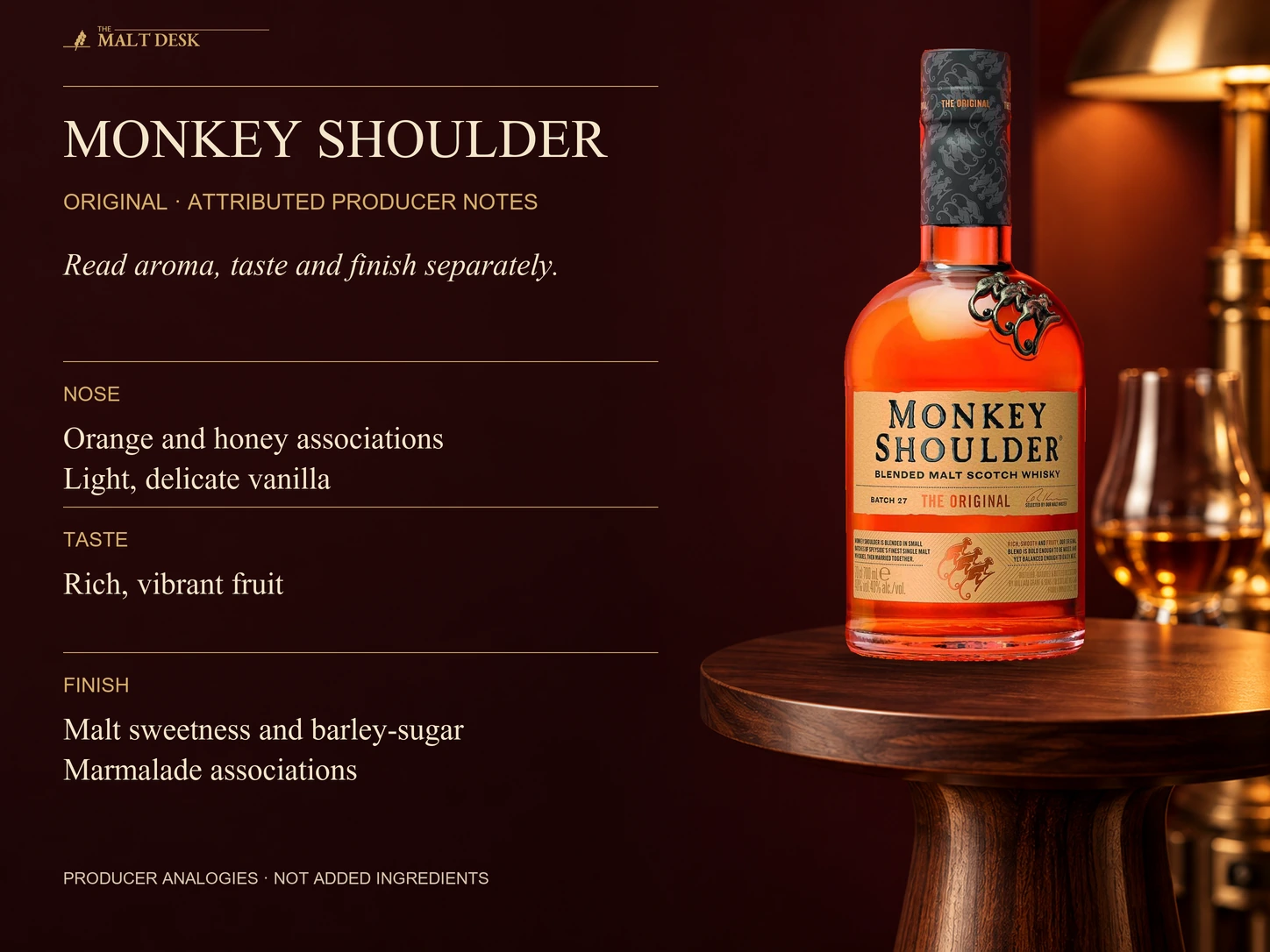
The current Monkey Shoulder product page describes orange, honey and delicate vanilla in the aroma, fruit on the palate, and malt sweetness, barley-sugar and marmalade associations in the finish. These are producer sensory descriptions.
Citrus, vanilla and spice are separate aroma families. Compare which aroma family the producer emphasizes. The absence of an age statement also does not prove that a finish will be short.
Market strength and bottle size
William Grant & Sons’ regional product-information table lists Monkey Shoulder at 40% ABV, equivalent to 80 U.S. proof. This table does not certify every U.S. bottle. Read the actual local label for strength and volume before comparing offers; a market-specific figure from an older review is not a universal specification.
An ABV difference is measurable; a claim that one market version is smoother or fuller requires a sensory comparison. Similarly, a larger bottle can have a lower unit price without being a different whisky recipe. Keep those questions separate when reading retailer listings or older reviews.
Why cocktail positioning matters
The brand explicitly positions the Original for mixing. That is a documented intended use, rather than evidence that it wins every cocktail comparison. A highball, a sour and a spirit-forward cocktail combine the whisky with very different ingredients.
A repeatable comparison begins with the recipe. Record the whisky measure, mixer volume, sweetener or citrus quantity, ice and preparation method. Change one element at a time. Otherwise, a preference for a sweeter or colder preparation can be mistaken for a preference between whiskeys.
In a highball, carbonation and temperature are particularly noticeable variables. The highball guide covers preparation, while the glassware guide explains practical glass choices.
Neat service is also possible; a cocktail-oriented brand position does not prohibit it. If exploring water or ice, keep an unchanged reference sample and note the addition. The serving guide explains the terminology.
Price and Label Comparisons
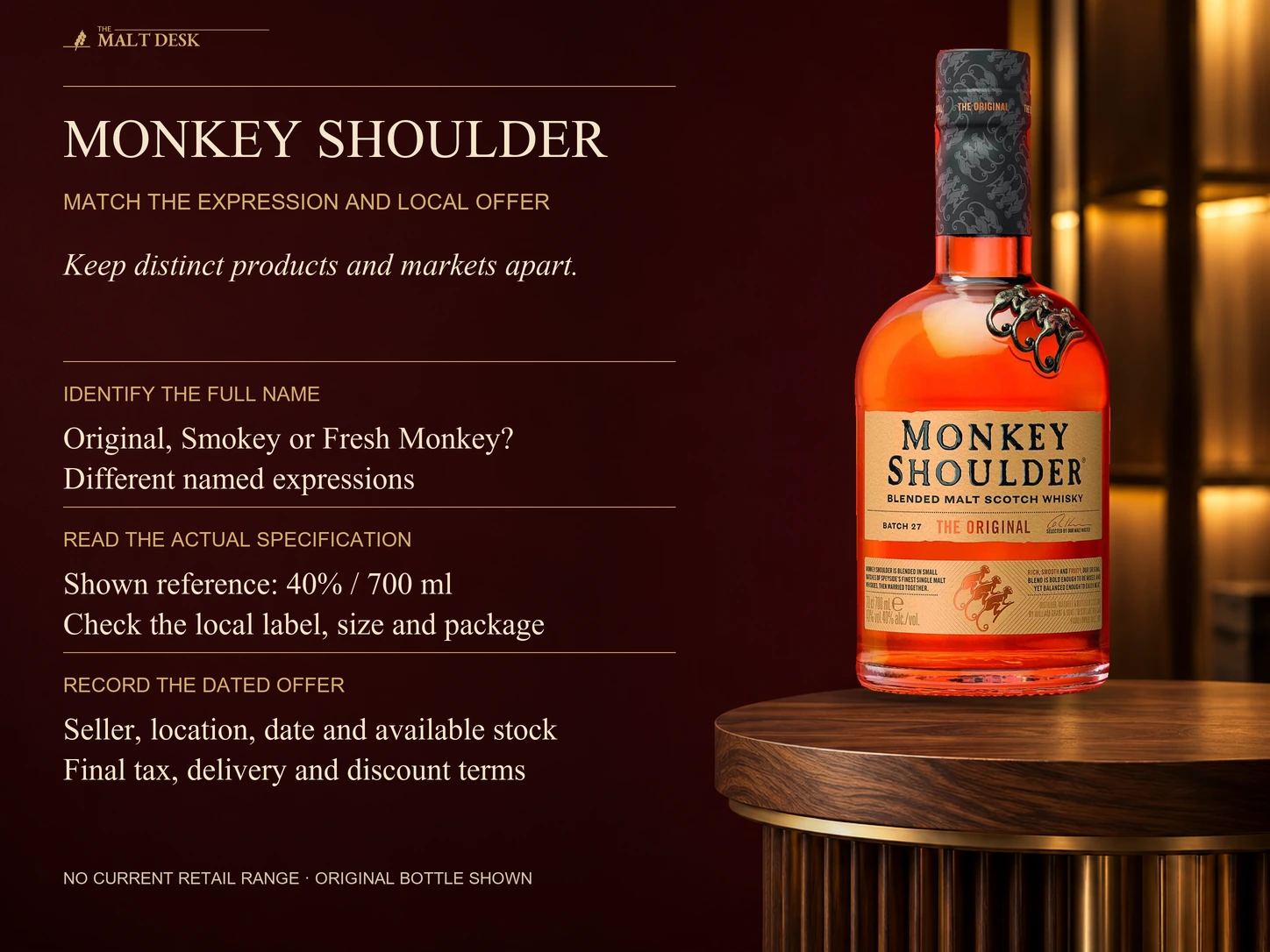
Match standard Monkey Shoulder before comparing quotes with Smokey Monkey or another named release. Record the actual strength, volume, seller, location and dated final total. The blended-malt category does not make different releases interchangeable; no verified retail range is established here.
The budget guide offers broader context. Match expression, volume and local final cost before comparing it with another bottle.
A New Package and a New Spirit Need Different Comparisons
The June 3, 2024 brand announcement describes a redesigned label, a longer neck and lower glass weight for Original and Smokey Monkey. It explicitly retains the liquid. Its quoted glass reductions are format-specific: 23% for 70cl bottles and 25% for 1L. These percentages concern glass mass, not a reduction in whisky volume or strength, and do not establish the specification of a different bottle size.
Fresh Monkey’s separate producer launch account describes two grain new-make spirits and one Speyside malt new-make spirit blended without aging. Original’s all-malt identity therefore cannot be transferred to Fresh Monkey merely because both accounts involve three components. Three is a count; it does not identify the components.
| Reference | What changed or differs | Relevant conclusion |
|---|---|---|
| Original in the announced 2024 package | Label and glass design; producer says liquid unchanged | Packaging alone is not evidence of a new whisky recipe |
| Monkey Shoulder Original | Blended malt Scotch made from single malts | No label age statement does not mean unaged spirit |
| Fresh Monkey launch account | Two grain spirits plus one malt spirit, blended unaged | A different spirit composition and maturation status |
Scotch whisky must mature in qualifying oak casks for at least three years. Original can consequently be NAS Scotch while still being matured whisky. Fresh Monkey’s disclosed unaged status is a different fact. NAS means an age is not stated; unaged means the maturation described for Scotch has not occurred. Treating both as bottles with ‘no age’ loses the distinction that matters most here.
The Fresh Monkey launch was directed toward cocktails including daiquiris and mojitos. That is a separate intended-use account from Original’s whisky recipes. It does not prove that substituting one for the other leaves a drink unchanged. The useful comparison begins with which spirit the recipe actually names, rather than the brand logo alone.
Comparing familiar Scotch categories
Chivas Regal 12 and Johnnie Walker Black Label are malt-and-grain blended Scotches with twelve-year age statements. Monkey Shoulder’s all-malt composition and lack of an age statement are factual differences, but neither settles which one a reader will prefer.
For someone learning the category, compare label information first, then published aroma families and finally a consistent serving method. The beginner guide provides a broader introduction without requiring a single universal starting bottle.
In Brief
Monkey Shoulder Original is a blended malt Scotch. Its current producer description identifies three single malts, former bourbon casks, and a fruit-led profile with orange, vanilla and malt associations. Category, local label and serving method answer separate questions.
Resolve the Monkey Shoulder Product Name First
Use the Original Monkey Shoulder account for the blended malt, including the packaging update that retained the whisky. Treat Fresh Monkey as the separately launched unaged malt-and-grain spirit product. Match the full name and category before comparing a shelf offer with this guide, particularly when the word fresh appears in a retailer’s description.
Common questions
Is Monkey Shoulder a single malt?
No. It is a blended malt made from single malt Scotch whiskies from multiple distilleries.
Does it contain grain whisky?
The blended malt category contains malt whiskies, unlike blended Scotch, which combines malt and grain whisky.
Does Batch 27 mean twenty-seven years old?
No. A batch reference is not an age statement. The standard Original does not publish an age on that basis.
Are its current component distilleries guaranteed by older articles?
No. Historical recipe descriptions should not be treated as a current guarantee without an explicit producer statement.
Sources
Monkey Shoulder’s current product page and William Grant & Sons’ brand and regional product-information pages, checked October 3, 2026. Scotch Whisky Association category guidance supplies the compositional distinctions.
Expression analysis checked October 7, 2026: the producer’s 2024 packaging announcement and its separate Fresh Monkey launch describe different events. Glass-weight changes are not liquid-volume changes.