Bushmills Black Bush: Malt and Maturation
Black Bush’s consumer page gives a qualitative high-malt description, while the Proximo portfolio document currently served under a 2026 cover supplies a more detailed trade account: 80% single malt and 80% sherry-cask aging. Those are two different fields. Matching numbers do not establish that all of the malt is the same portion that received sherry-cask maturation.
This adds useful information without reconstructing a complete blend. I would retain the trade document’s source and distinguish composition from cask allocation. Its eight-year wording also needs care because the same page uses both ‘aged for eight years’ and ‘up to eight years’; that is not a consistent minimum-age disclosure for the standard label.
Bushmills Black Bush is a blended Irish whiskey combining malt and grain whiskey. Its producer emphasizes a high malt proportion and maturation involving former Oloroso sherry and bourbon casks. Those are the most useful reference points for understanding the expression.
What “High Malt” Means
A blend can contain malt whiskey without being a single malt. Black Bush includes grain whiskey as well, so the category remains blended Irish whiskey. The producer’s high-malt description does not disclose an exact percentage on the product page consulted here.
The component count and proportion describe a recipe. The Irish pot still guide explains another production category that should be kept distinct from malt whiskey.
Oloroso and Bourbon Casks
Bushmills identifies both former Oloroso sherry and bourbon casks. This is a maturation description, not evidence that sherry or bourbon was added directly to the bottled blend. Cask size, previous use, and maturation time also matter, and the cask names alone do not disclose all of those details.
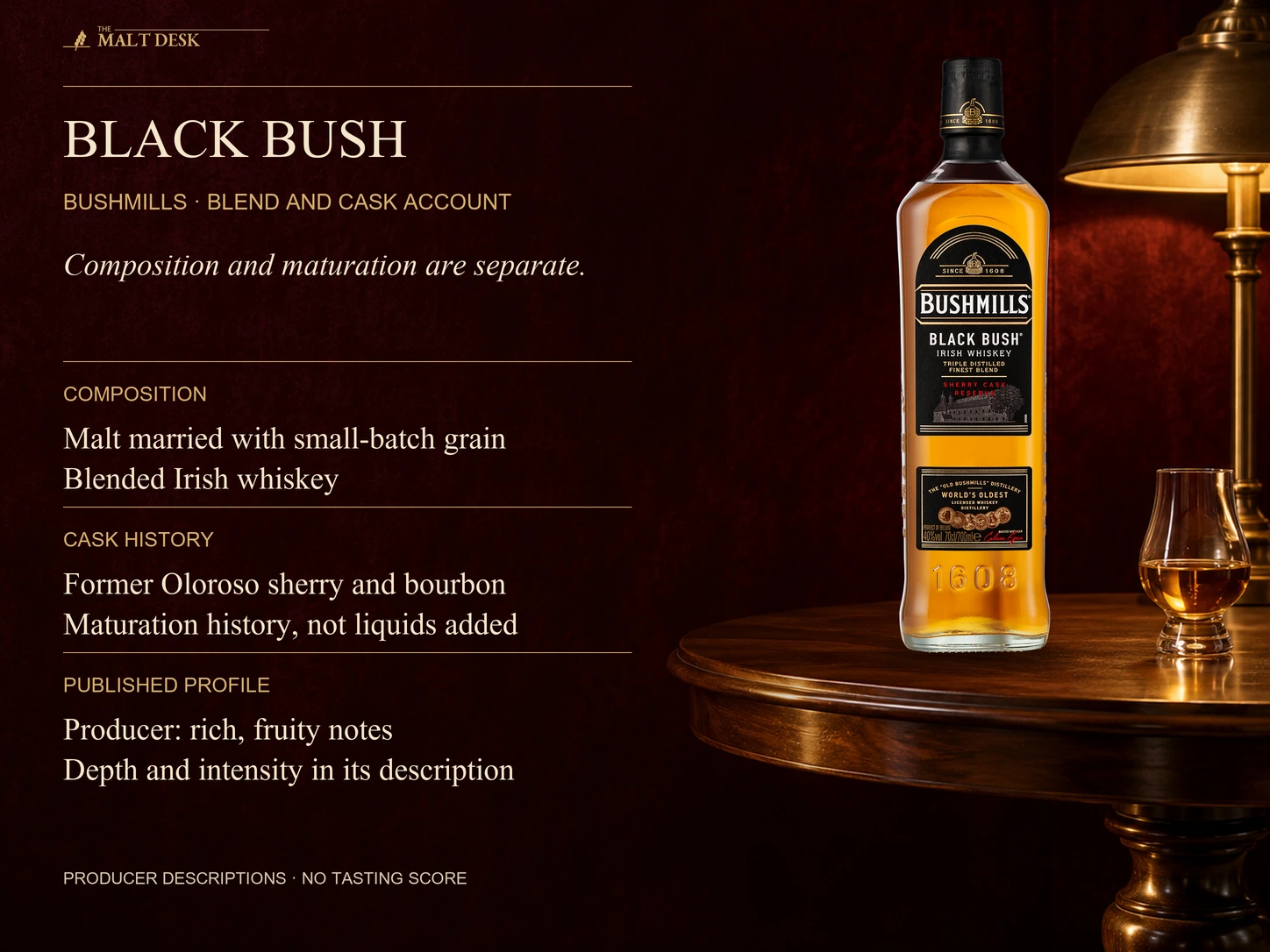
The producer describes fruit and depth in Black Bush’s profile.
Label Details to Check
The reference bottle in this guide is the standard Black Bush at 40% ABV, or 80 U.S. proof. Confirm the strength and volume on the particular market bottling. Black Bush should not be confused with Bushmills Original, Red Bush, or an age-stated Bushmills single malt.
No fixed maturation age is assigned here. A high malt proportion is not an age statement, and neither price nor color reliably identifies the age of a blend.
Two Eighties Do Not Supply the Joint Recipe
The current Bushmills consumer product page does not state a percentage, but Proximo’s Black Bush trade page explicitly gives 80% single malt and an 80% sherry/20% bourbon maturation account. It is therefore possible to attribute those figures to that document without claiming that the consumer page printed them or that every historical market bottle has an identical disclosed recipe.
The document does not give a cross-tabulation of malt versus grain within sherry versus bourbon maturation. It also does not clearly define a common volume basis for every percentage. Multiplying the two 80% figures would require compatible measurement bases and an independence assumption. Keep blend composition and cask-aging share in separate fields until the joint recipe is documented.
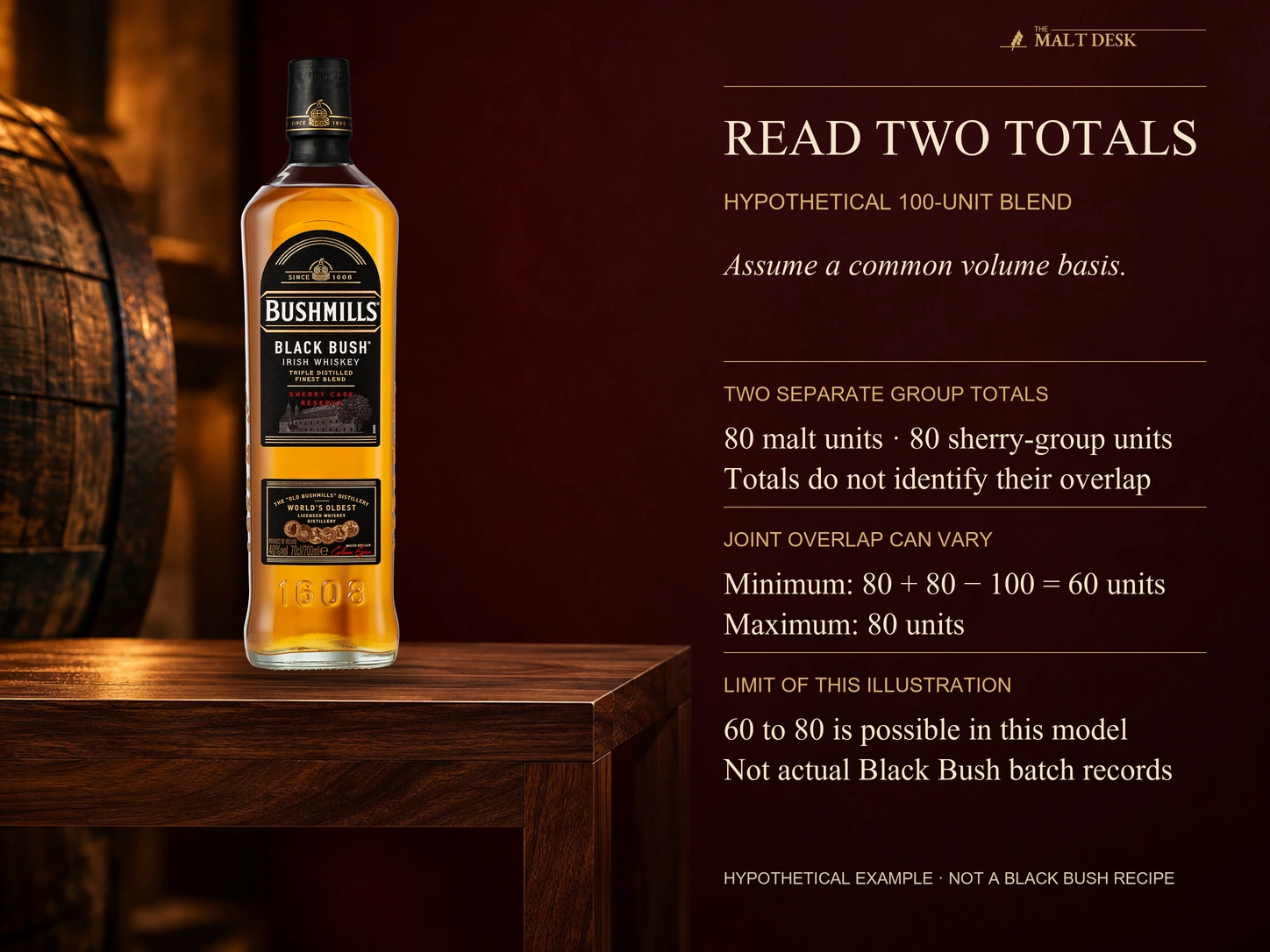
A hypothetical 100-unit blend shows the distinction if both percentages were measured on that same volume basis. With 80 units malt and 80 units in the sherry group, the overlap could be 60 to 80 units. The following two possible allocations satisfy both totals. They are teaching examples, not Black Bush batch records.
| Hypothetical allocation | Malt/sherry | Malt/bourbon | Grain/sherry | Grain/bourbon |
|---|---|---|---|---|
| All grain in sherry group | 60 | 20 | 20 | 0 |
| All malt in sherry group | 80 | 0 | 0 | 20 |
The lower overlap is 80 plus 80 minus 100, or 60, because only 100 units exist in this model. The upper overlap cannot exceed either 80-unit group. These hypothetical bounds illustrate the joint-recipe question under compatible measurement bases. Apply them to a real blend only with the producer’s definitions for both percentages.
The trade page’s age language has a separate problem. Its headline account says eight years, while a later explanation says up to eight. A ceiling and a minimum do different work. I would report the inconsistency and keep the standard label’s NAS identity, rather than elevate one phrase into a guaranteed eight-year floor for all components.
How It Differs from Jameson
Jameson Original describes a pot still and grain blend. Black Bush’s producer emphasizes malt with grain, while Jameson Black Barrel adds a different cask-treatment story within the Jameson range. These production differences offer more concrete information than calling one expression smoother or more polished.
The Jameson Original guide and Black Barrel guide cover the individual expressions.
Black Bush Label and Quote Checks
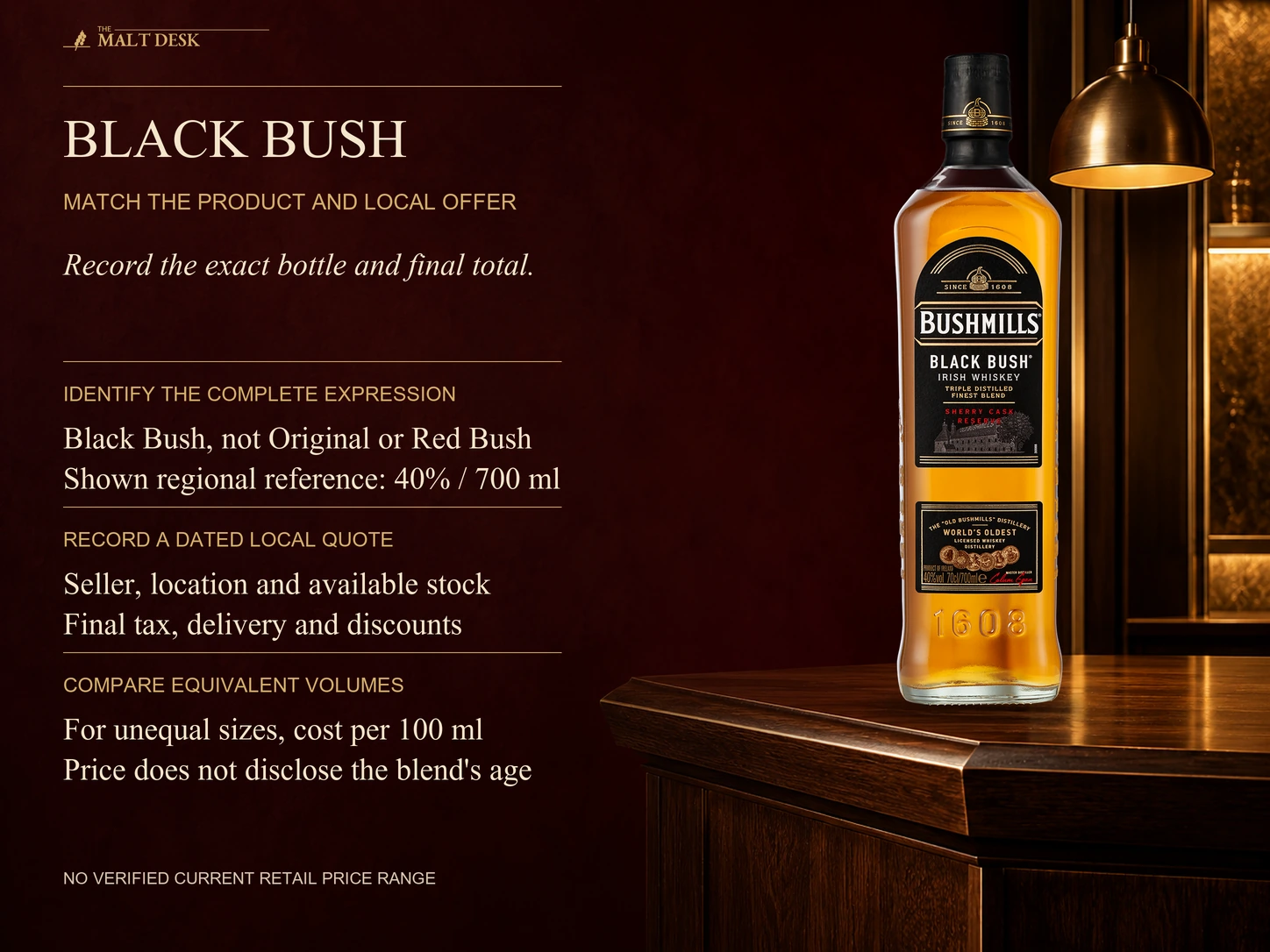
Identify Black Bush by its full expression name, printed strength and bottle volume before collecting dated local quotes. The consumer product page describes a high-malt blend at a 40% reference; the separate Proximo trade account supplies the attributed percentages discussed above. Its conflicting age language leaves a universal minimum unresolved. Oloroso and bourbon refer to cask history.
The earlier retailer notes lack complete original offer records and cannot establish a historical range. Compare a fresh seller, location, stock status and final total after tax, delivery and discounts. For unequal bottle sizes, use final cost per 100 ml rather than the sticker price alone.
The budget comparison guide provides broader category context. Keep local offer records separate from an expression’s production specifications.
Serving Terms
The producer lists neat, ice, and classic cocktails among possible serves. That describes suggested uses rather than test results from The Malt Desk. Ice changes temperature and adds water as it melts; mixers add their own flavors and ingredients.
No fixed resting time, cube size, or recipe guarantees that fruit or nuts become more noticeable. The serving guide explains the variables without assigning a best serving method to every reader.
In Brief
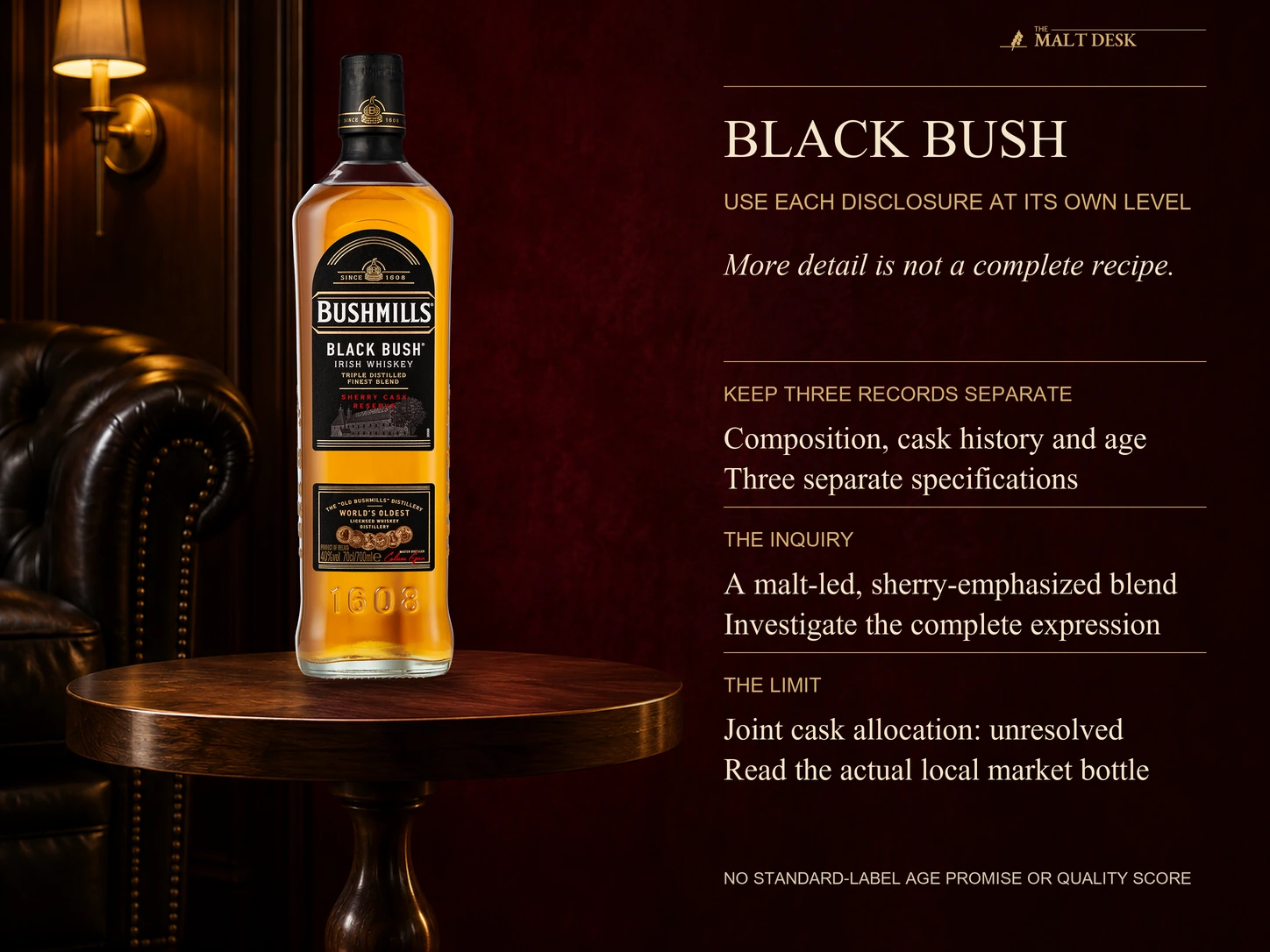
Black Bush blends malt and grain whiskey with Oloroso and bourbon cask histories. Its consumer product page gives a qualitative high-malt account; a separate Proximo trade document supplies percentages but inconsistent eight-year wording. These sources are distinguished above.
Read Black Bush's Two Disclosures Separately
Use the cited trade account’s 80% malt figure for the blend-composition question and its 80% sherry-aging figure for the maturation question. Keep those fields separate when comparing Black Bush with another Irish blend. For a reader seeking a high-malt, sherry-associated production account, those disclosures give a concrete shortlist reason alongside the exact bottle’s strength and cost.
Frequently Asked Questions
Is Black Bush a single malt?
No. It combines malt and grain whiskey and is labeled as a blend.
Is the malt percentage confirmed here?
The current consumer page does not state one. Proximo’s portfolio document separately gives 80% single malt; the analysis above attributes that figure to the trade account rather than to every market label.
Do Oloroso casks make it an age-stated whiskey?
No. Cask history and age are different specifications.
Does this guide establish a retail range?
No. A comparable range needs verified offers for the same expression, market, volume and final-cost conditions. The worksheet gives a way to record those fields without assigning a purchase threshold.
Sources
Bushmills Black Bush consumer product description, rechecked October 4, 2026 for the blend, cask history and 40% ABV reference; Jameson Original and Black Barrel producer descriptions for category context. The Proximo trade percentages and conflicting age language have their separately dated analysis above. No verified retailer price range is established here.
Disclosure analysis checked October 7, 2026: percentages are attributed to Proximo’s trade portfolio and are not asserted on every label. The 100-unit examples assume matching volume bases only for illustration; the document does not supply a joint component/cask recipe. Conflicting eight-year language is retained as unresolved.