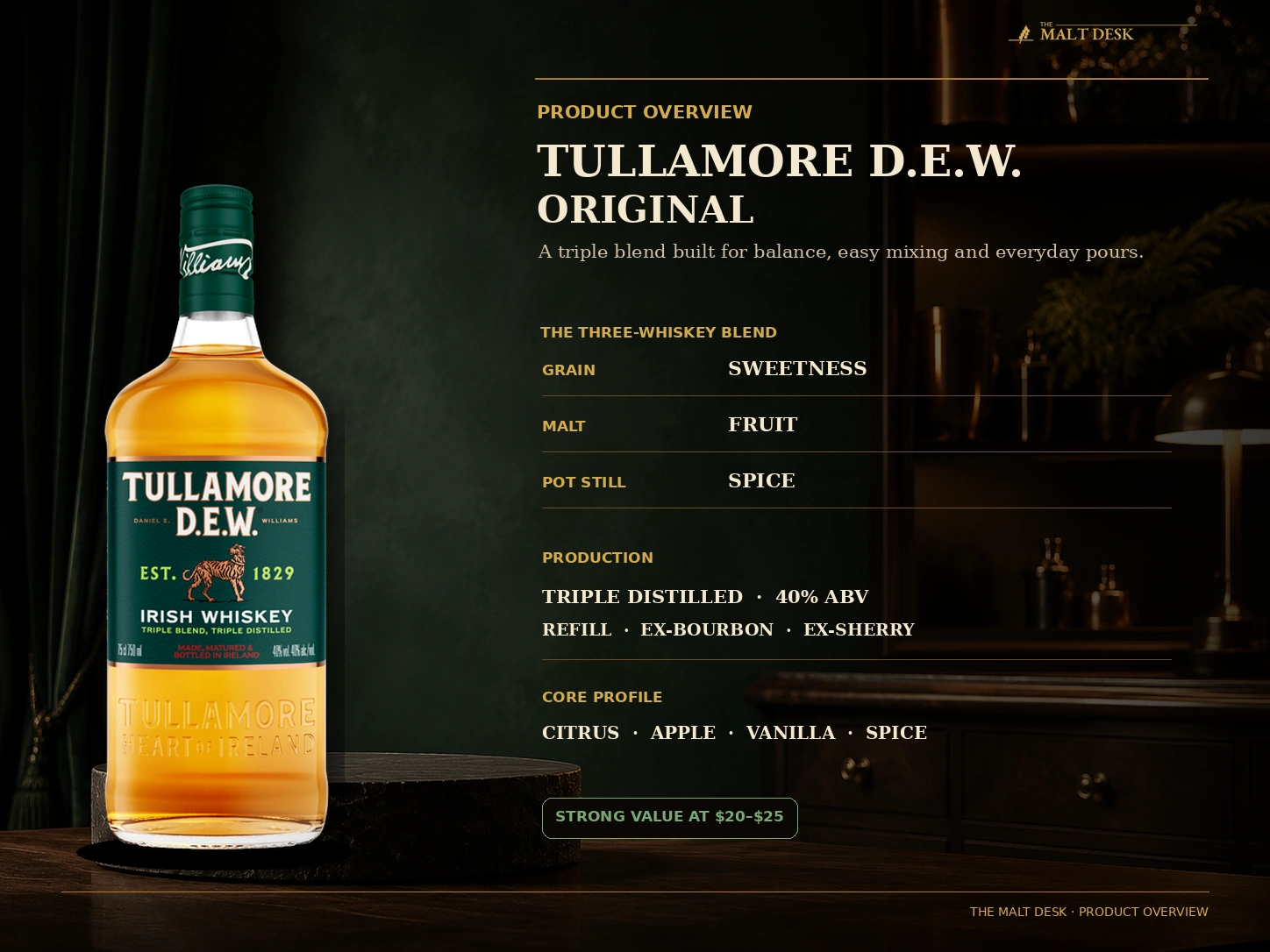
Tullamore D.E.W. Original Explained
Tullamore D.E.W. Original is a blended Irish whiskey whose identity centers on three component whiskey types: grain, malt, and pot still. Its producer also describes triple distillation and maturation across three cask categories. These three uses of “triple” refer to separate production choices, so understanding the distinction is more informative than treating the word as a quality score.
Triple Blend, Triple Distillation, and Triple Cask
A triple blend combines three whiskey types. Triple distillation describes the distillation process. Triple cask maturation concerns the wood used during aging. None of these phrases means that the components are present in equal proportions or that every part spends an identical period in each cask.
Tullamore identifies traditional refill barrels, former bourbon barrels, and former sherry butts in its Original maturation program. Its product description says the whiskey ages for several years without supplying a fixed age statement. The cask categories identify maturation history; they do not specify an exact flavor intensity.
How the Producer Describes the Components
Tullamore associates grain whiskey with sweetness, malt whiskey with fruit, and pot still whiskey with spice. This is the producer’s explanation of the components’ roles. It provides useful flavor vocabulary without claiming that each component contributes only one type of flavor.
The finished product remains a blend. The presence of pot still whiskey does not make the whole bottle a single pot still whiskey. The single pot still Irish whiskey guide explains that category distinction.
Product Information at a Glance
| Detail | Information |
|---|---|
| Expression | Tullamore D.E.W. Original |
| Category | Blended Irish whiskey |
| Components | Grain, malt, and pot still whiskey |
| Reference bottling | 40% ABV / 80 U.S. proof; check the local label |
| Cask categories | Refill, ex-bourbon, and ex-sherry |
| Age information | No fixed age given on the consulted Original product page |
Match the complete expression name when checking a bottle. Other Tullamore releases and flavored products should not inherit the Original’s specifications. Volume also matters: a 700 ml reference and a 750 ml reference are different quantities even when their labels look similar.
Understanding the Published Flavor Vocabulary
The official description emphasizes the relationship between fruit and spice, with sweetness associated with the grain component. These are producer descriptors. They do not support a numerical sweetness score, a measured finish length, or a claim that the whiskey is better in a highball than another brand.
Flavor words describe perception rather than added ingredients. A vanilla or fruit association does not establish that vanilla or fruit was added. Similarly, “smooth” is not a measurement of alcohol concentration. The flavor vocabulary guide explains how to interpret common descriptions.
Comparing Jameson and Black Bush
The main production comparison is component type. Jameson describes pot still and grain whiskey, while Bushmills Black Bush emphasizes a high malt share with grain whiskey. Tullamore identifies all three types. That distinction explains different approaches to blending without establishing a universal winner.
The individual Jameson and Black Bush guides provide further context. Compare disclosed production details separately from subjective terms such as richer, cleaner, or more balanced.
U.S. Price Context
The site’s historical notes record an August 29, 2026 snapshot for 750 ml: $19.99 at Total Wine, $24.99 at Target, and $26.98 at Walmart. These figures have not been rechecked as current offers. They are historical references, not live offers or a national average.
Location, tax, delivery, promotions, and inventory can change the final amount. A useful comparison records those conditions alongside the bottle size. The difference between a $20 and a $27 listing does not, by itself, establish a corresponding difference in the whiskey’s quality.
For a broader category comparison, see the whiskey budget guide. Treat its dated examples as context and check equivalent local bottles when comparing amounts.
Serving Terminology
The producer publishes a citrus highball suggestion combining Original with lemon-lime soda and lime. That is a brand recipe, rather than a cocktail tested by The Malt Desk. Club soda, tonic, and sweetened lemon-lime soda contain different ingredients and should not be treated as identical mixers.
Neat means no added water or ice. Ice changes temperature and adds water as it melts. Mixing or dilution changes concentration, but does not remove the alcohol initially poured. The serving guide explains the terms without promising a specific sensory result.
Frequently Asked Questions
Does triple blend mean three equal parts?
No. It identifies three component whiskey types. The consulted product description does not disclose equal proportions.
Is triple cask the same as a three-stage finish?
No. The producer identifies three cask categories in the maturation program. That wording alone does not establish a sequential three-stage finishing process.
Is Original an age-stated whiskey?
The consulted product page describes several years of maturation without providing a fixed age. Do not infer a bottle age from a cask count or price.
Are the listed prices current?
They are dated August 29, 2026 and have not been refreshed.
Sources
Tullamore D.E.W., Original Irish Whiskey product description and citrus highball suggestion; Jameson Original and Bushmills Black Bush product descriptions for the component comparison. Historical retailer figures are identified above by date.