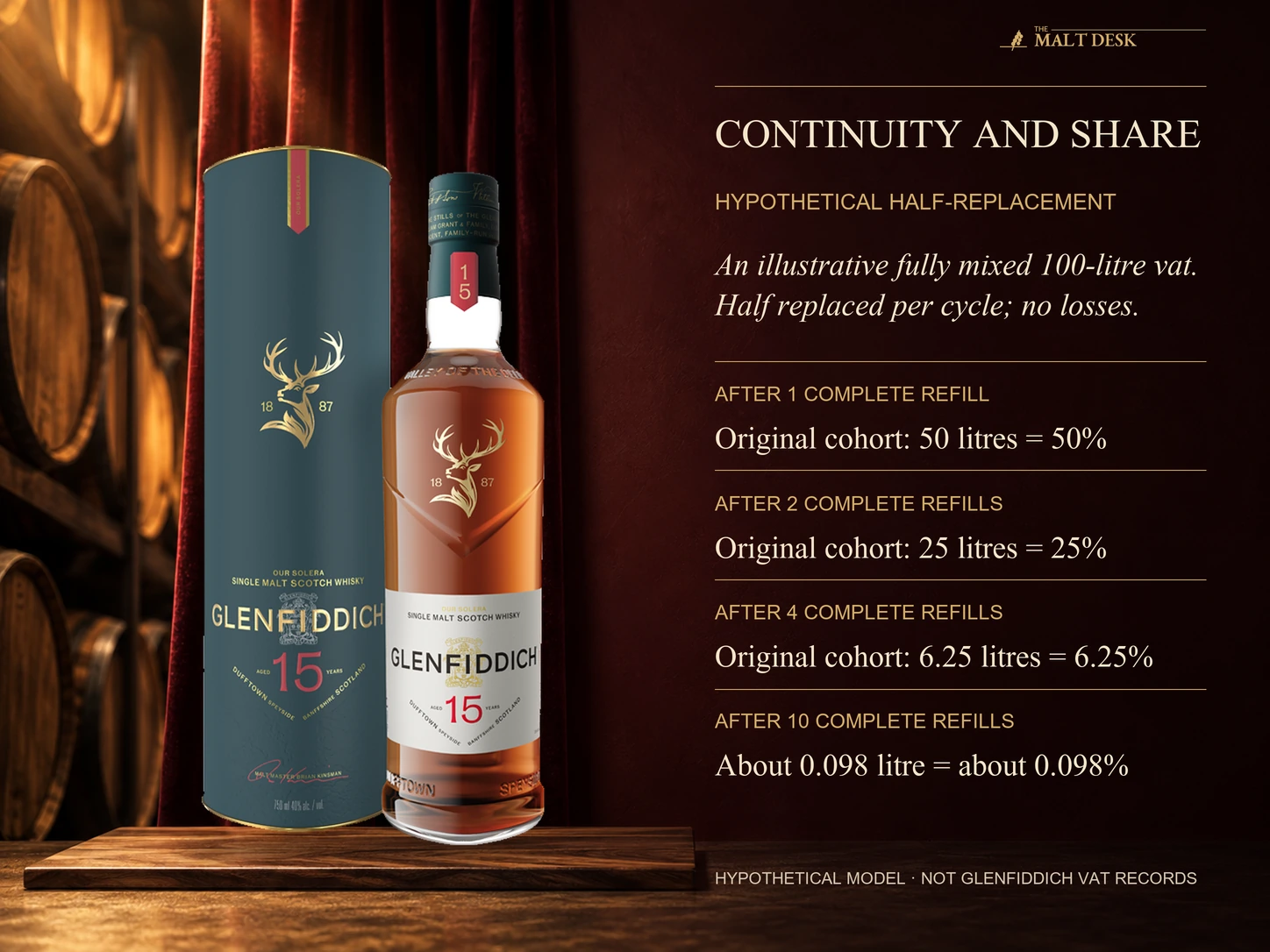
A Solera Vat can preserve continuity without preserving a large proportion of its earliest filling. Glenfiddich’s producer tasting-notes sheet describes the vat as retained rather than emptied, with at least half kept full. That is an interesting process story. It is not enough information to calculate how much of an earlier filling reaches a later bottle, or to replace the fifteen-year minimum with a hidden older age.
A simple repeated-refill model shows why the distinction matters: retaining half at each cycle can leave some of an original cohort after many cycles while reducing its share dramatically. For a buyer, the positive reason to explore this expression is the disclosed maturation-and-marrying program. An assumption that the bottle is mostly much earlier stock asks for evidence the vat story alone does not supply.
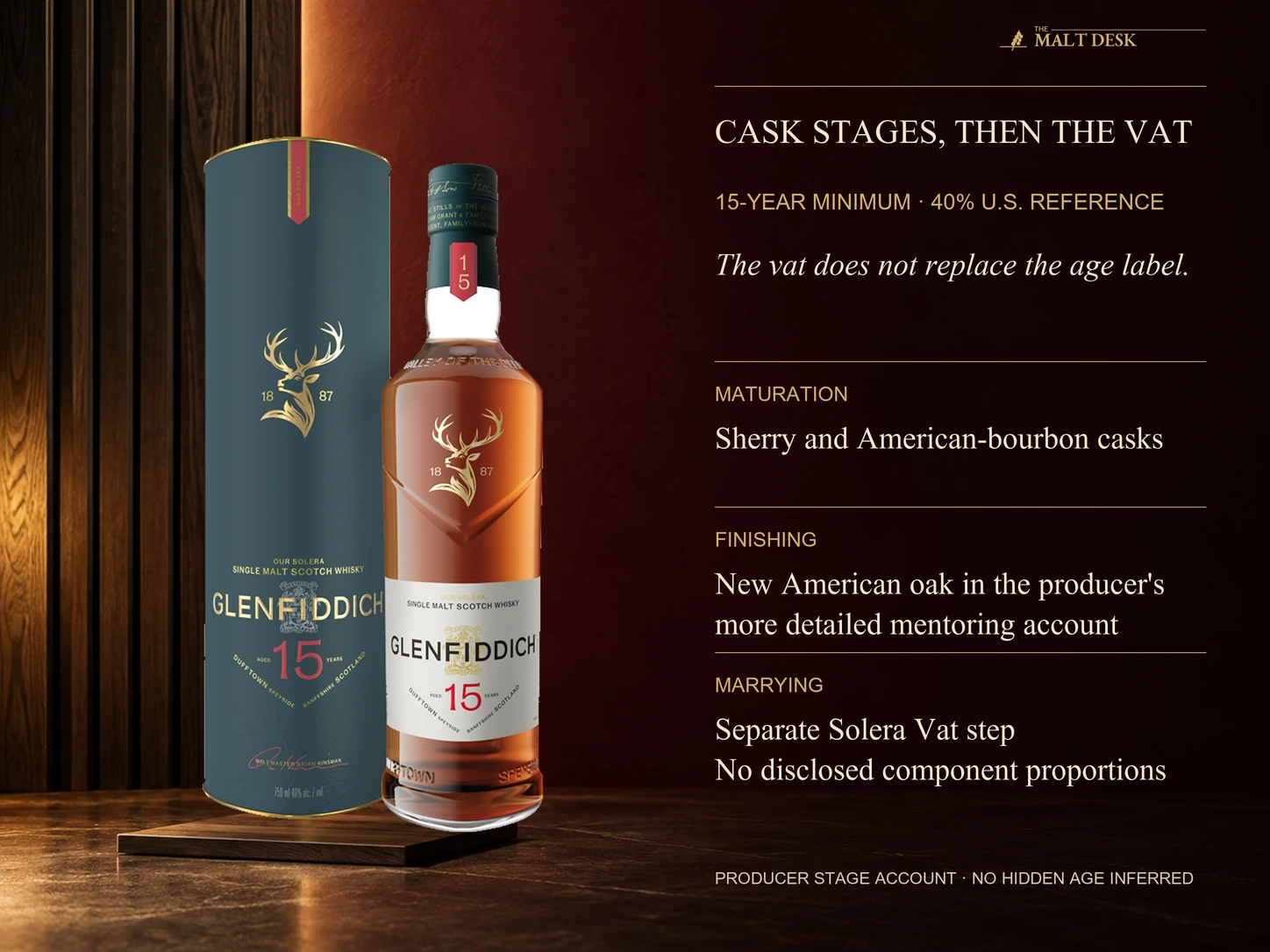
Glenfiddich 15 Year Old Solera is a Speyside single malt whose U.S. producer overview names bourbon, new oak and sherry casks before the Solera Vat. The producer’s more detailed mentoring account places new American oak at a finishing stage after sherry- and bourbon-cask maturation, followed by the separate Solera Vat step.
The useful distinction is between maturation and marrying: three cask types shape the whisky before a separate vat brings the components together. Here is how that process differs from a two-cask finish, what the 15-year label tells you, and how to compare the bottle with other Speyside malts.
Quick Answer
Glenfiddich 15 Solera carries a 15-year minimum-age statement and a 40% ABV U.S. reference. The disclosed bourbon, new-oak and sherry-cask components undergo a separate Solera Vat marrying stage. Producer notes use honey, fruit and spice vocabulary.
Product Overview
| Category | Speyside single malt Scotch whisky |
|---|---|
| Age statement | 15 years |
| Strength | 40% ABV in the U.S. |
| Typical bottle size | 750 ml in the U.S. |
| Producer cask overview | Bourbon, new oak and sherry casks |
| Marrying stage | Glenfiddich Solera Vat |
| Published style | Honeyed, fruity, gently spiced and rounded |
The 15-year statement applies to the youngest whisky in the bottle. Bourbon, new oak and sherry identify three cask inputs, but the names alone do not disclose their shares or let each perceived aroma be assigned to one component. The Solera Vat is a separate marrying stage rather than a fourth cask-age claim.
How the Solera Vat Works
After maturation, the selected whiskies enter a large oak marrying vat. The producer describes this as a harmonizing step after the cask stages. The vat name does not make the whisky infinitely old or replace the 15-year age statement. The age claim still refers to the youngest whisky in the finished product.
The system is best understood as a consistency and integration step. It brings selected whiskies together after their cask stages; the detailed mentoring account identifies new American oak as a finish before the vat. Readers comparing cask families can use the sherry-cask vs bourbon-cask guide for the broader differences.
Published Flavor Profile
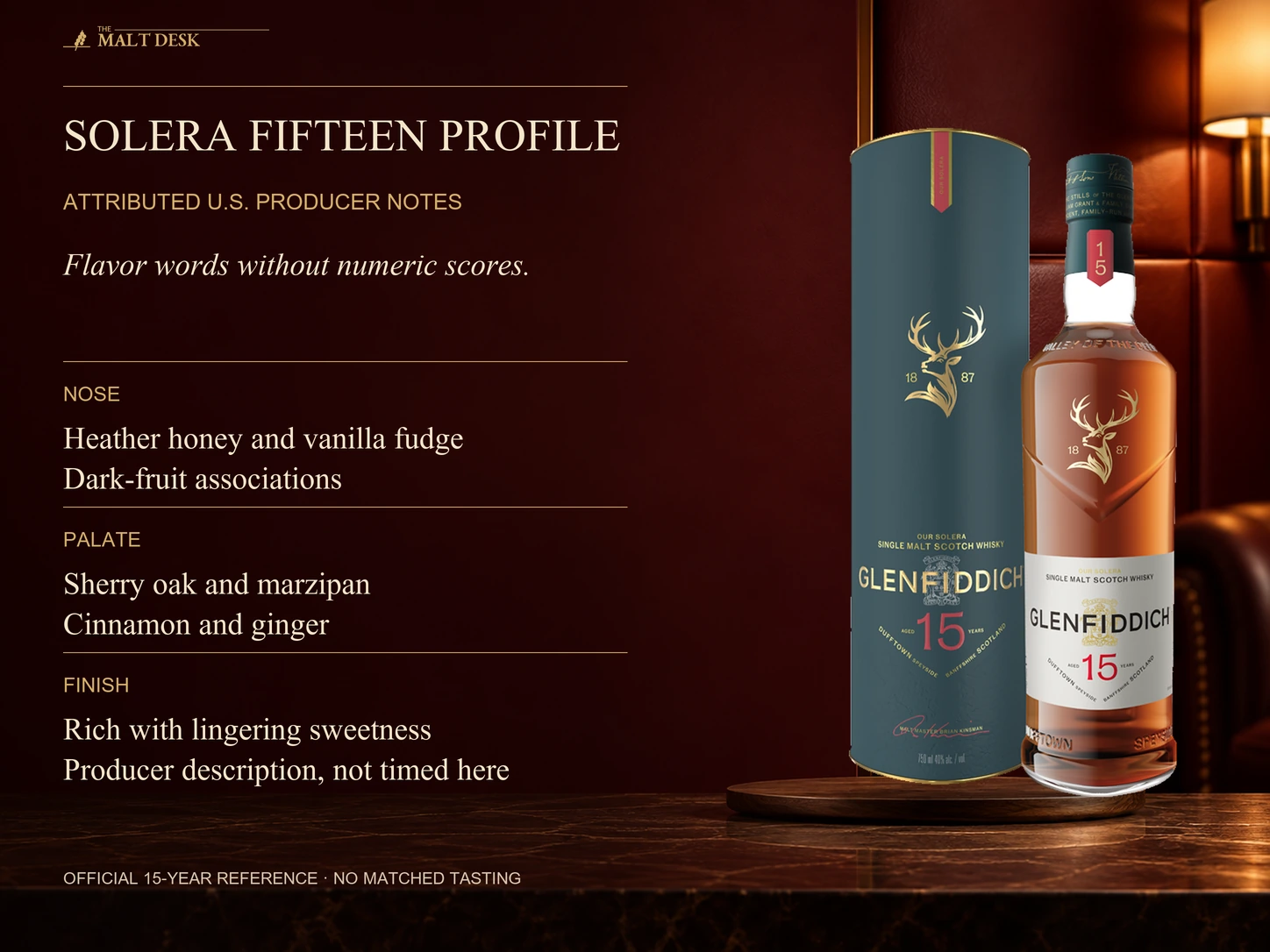
The reference card groups Glenfiddich’s U.S. producer notes. Readers comparing Glenfiddich 12 should distinguish those published words from the results of a matched tasting.
Nose
Heather honey, vanilla fudge and dark fruit form the recurring aromatic core.
Palate
Published notes emphasize sherry oak, marzipan, cinnamon and ginger. The listed strength is 40% ABV.
Finish
The U.S. producer notes describe a rich finish with lingering sweetness. The whiskey flavor map provides a wider framework for comparing these descriptors.
Comparing U.S. Bottle Costs
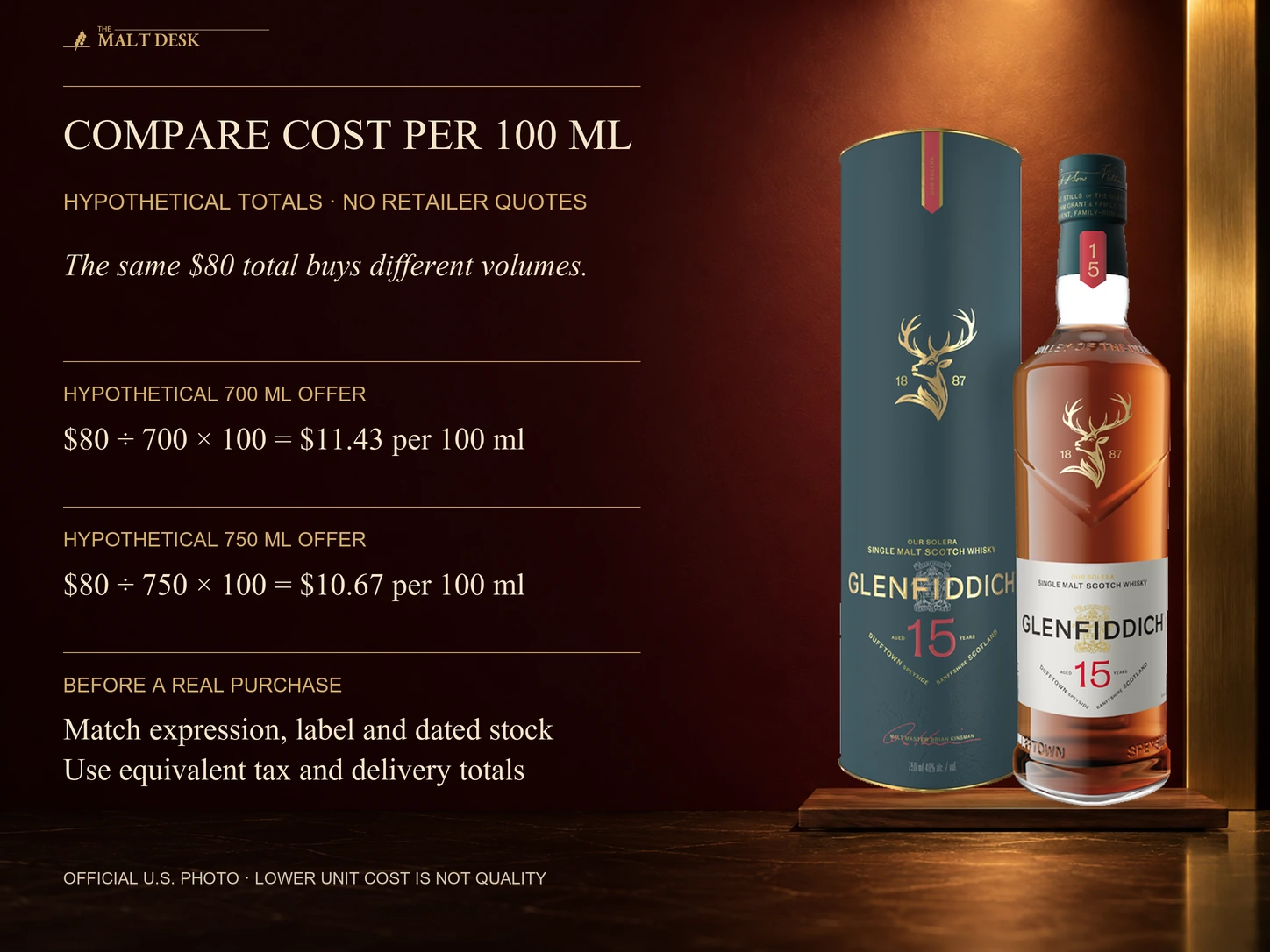
A current U.S. offer needs the exact 15-year expression, printed strength, bottle volume, seller, state, date and stock status. The producer storefront asks for a delivery location before showing price and availability. No current retailer price range is established in this guide.
The illustrative $80 total works out to $11.43 per 100 ml for 700 ml and $10.67 per 100 ml for 750 ml, rounded to cents. These explicitly hypothetical inputs show how bottle size changes unit cost.
Continuity Can Survive While an Earlier Share Becomes Small
Use a deliberately hypothetical 100-liter vat. Start entirely with one labeled original cohort. At each cycle, mix fully, withdraw 50 liters, then replace those 50 with a new cohort that contains none of the original. Ignore evaporation and other volume changes. After the first refill, 50 liters of the original remain; after the second, 25; after the fourth, 6.25. The vessel was never emptied, yet the original no longer accounts for most of its contents.
| Hypothetical completed half-replacement cycles | Original cohort remaining in the full 100-liter vat | Original cohort share |
|---|---|---|
| 1 | 50 liters | 50% |
| 2 | 25 liters | 25% |
| 4 | 6.25 liters | 6.25% |
| 10 | About 0.098 liter | About 0.098% |
In this hypothetical model, original share = (one-half) raised to the number of completed replacement cycles. Its assumptions are a fully mixed 100-liter vat, half replaced at each cycle, refill liquid containing none of the original cohort, and zero losses. Calculating an actual vat’s composition would require its own withdrawal and refill records.
The model does establish one logical result: never empty and mostly original are different claims. Continuity with earlier fillings can coexist with a very small share of one specific earlier cohort. Calendar years since a vessel began operating do not supply the number or size of replacement cycles either. A long history cannot be turned into a complete age distribution by subtraction.
Place the Solera Vat After the Disclosed Cask Stages
The current U.S. overview names bourbon, new oak and sherry before the vat. Glenfiddich’s more detailed mentoring account places sherry- and bourbon-cask maturation first, new-American-oak finishing next, and the Solera Vat afterward. That order matters: three cask names do not establish three equally sized stocks independently matured for fifteen years, and they do not establish fifteen years in each wood.
| Stage in the detailed producer account | Named environment | What remains unreported |
|---|---|---|
| Initial maturation | Spanish sherry and American bourbon casks | Complete component proportions and cask histories |
| Finishing | New American oak | Exact duration and complete transfer schedule |
| Subsequent marrying | Solera Vat | Actual withdrawals, replenishment intervals and earlier-cohort shares |
I would keep the fifteen-year minimum attached to the finished whisky and the refill history attached to the marrying process. Cycles are not years, and a vat’s operating history is not a new minimum-age statement. The old tasting-notes sheet and the more detailed mentoring document also serve different explanatory purposes; this arithmetic is not evidence that the producer changed the recipe between them.
What the Fifteen-Year Label and Solera Program Offer
For someone curious about how Glenfiddich maintains continuity between selected vattings, the retained-vat program is a concrete reason to investigate the fifteen. For someone seeking a guaranteed older maturation minimum or a known large share of much earlier stock, the fifteen-year label and public vat account cannot supply that different promise. I would assess the actual price as the cost of this named expression, rather than as a discount on an invented older bottle.
Compare the complete fifteen-year program with the standard twelve when deciding which expression fits your interest. Keep the label’s age floor, the cask sequence and the Solera Vat step as three distinct comparison fields.
How It Compares
- Compared with Glenfiddich 12: the age statement and disclosed Solera Vat step provide concrete comparison points with Glenfiddich 12.
- Compared with Balvenie DoubleWood 12: Balvenie DoubleWood 12 uses a two-stage maturation and finishing approach. Glenfiddich 15 adds new oak and the Solera Vat as separate structural elements.
- Compared with Aberlour 12: Aberlour 12 uses traditional oak and sherry casks. Its 12-year statement differs from Glenfiddich’s 15-year statement; check the exact market strength before comparing.
- Compared with GlenAllachie 12: GlenAllachie 12 lists 46% ABV compared with the U.S. Glenfiddich 15 reference at 40%. Their cask programs also differ.
Questions the Solera Process Helps Answer
- How are the three maturation-cask inputs different from the later marrying vat?
- Why does the vat’s name not replace the youngest-whisky age statement?
- How does a three-cask account plus marrying differ from a sequential cask finish?
- Which market strength, volume and dated offer must be matched for a cost comparison?
Choose Glenfiddich Fifteen for Its Disclosed Program
Choose Glenfiddich 15 when a fifteen-year minimum and its maturation, new-oak finishing and retained-vat marrying sequence match the brief. The half-replacement example explains how continuity survives as an earlier share shrinks. For an older minimum-age requirement, compare the printed age statements of other expressions; for a Solera-process inquiry, the fifteen provides the specifically documented program.
Common Questions
Is Glenfiddich 15 made with a true solera system?
The producer identifies a Solera Vat that harmonizes the cask components. The word “Solera” describes the process, while the Scotch age statement refers to the youngest whisky in the product; the vat name does not add another 15 years.
Is it heavily sherried?
Sherry is one of the three disclosed cask types.
Is 40% ABV a drawback?
It depends on the priority. This is not a cask-strength bottling. A higher-strength whisky leaves more room to add water while retaining a similar final ABV. The types of whiskey guide provides broader context for comparing whisky styles.
Final Verdict
Glenfiddich 15 Solera combines a 15-year age statement, three disclosed cask types and a separate Solera Vat marrying stage. Its U.S. reference strength is 40% ABV, and its published notes include honey, dark fruit and spice. These details distinguish its production story from a two-cask finish. Use a matched tasting for sensory comparisons and exact dated offers for a price judgment.
Sources and Price Date
Product details and flavor words were checked against the Glenfiddich U.S. producer storefront on October 3, 2026. Age-statement meaning was checked against the Scotch Whisky Association’s 2025 guidance for bottlers and producers. The price illustration is a calculation from explicitly hypothetical totals.
Solera analysis checked October 8, 2026: Glenfiddich’s producer-authored press-kit tasting-notes sheet supplies the retained-vat description; its official mentoring document and U.S. storefront supply the cask-stage accounts. The article’s calculation uses a hypothetical, fully mixed 100-liter half-replacement model with zero losses.