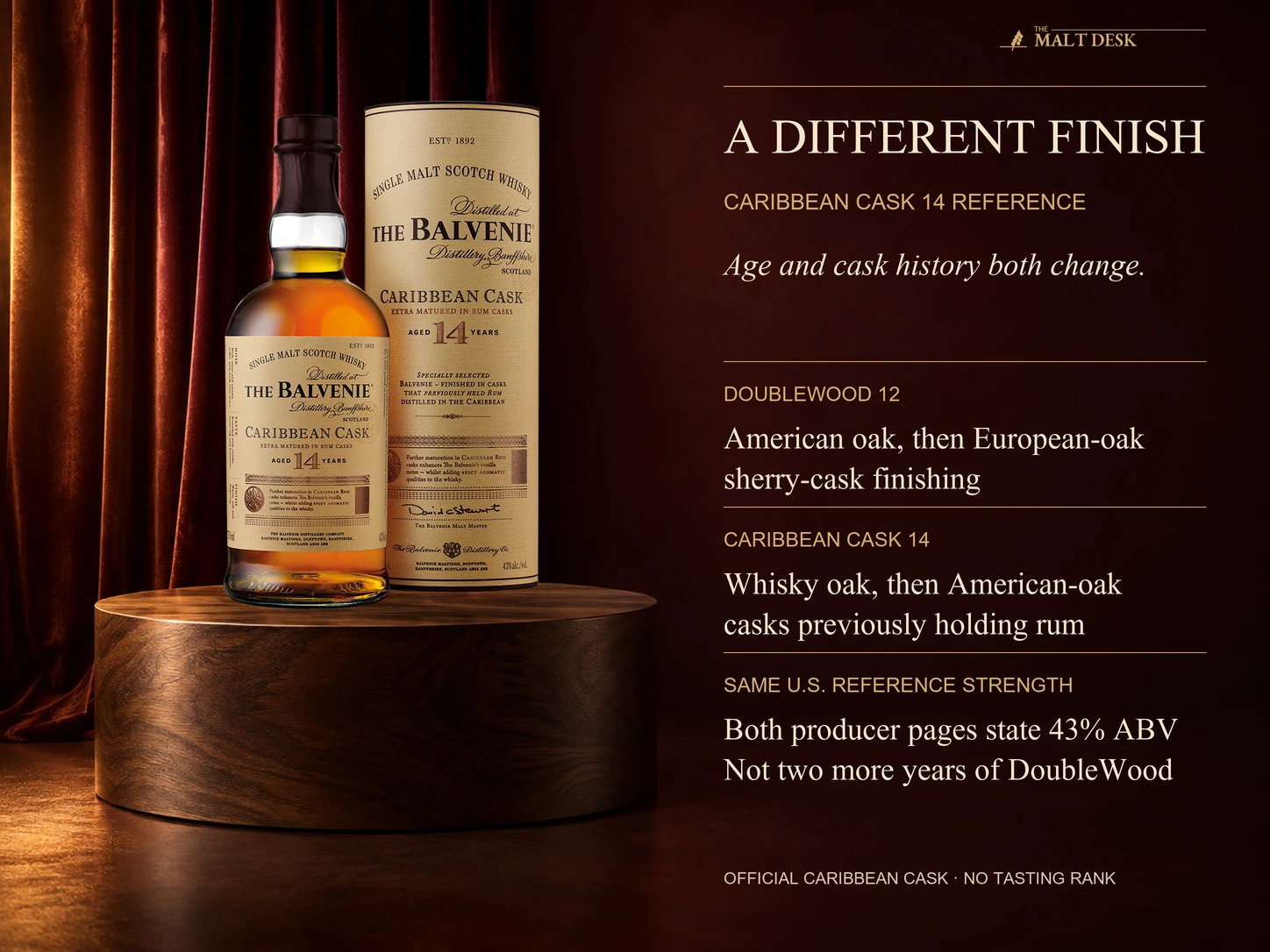
Balvenie DoubleWood 12 and Caribbean Cask 14 share the producer’s U.S. reference of 43% ABV, but the larger age number does not describe simply two more years of the same sherry-finished program. DoubleWood’s finishing account names European-oak sherry casks; Caribbean Cask’s names American oak that previously held a selected blend of West Indian rums.
This gives a DoubleWood reader a precise next-bottle question: is the interest in a different finishing history, or in an older version of the same one? Caribbean Cask addresses the first. Treating it as “older DoubleWood” would hide the changed prior contents and wood account behind the age numbers.
Balvenie DoubleWood 12 is a Speyside single malt built around a clear two-stage maturation idea. The whisky first matures in traditional whisky oak casks, then spends additional time in former sherry casks before marrying in oak tuns.
This guide explains the published sequence of primary maturation and finishing, the 12-year age label and the producer’s flavor vocabulary. It also distinguishes DoubleWood from similarly named two-cask products and sets out how to record exact local offers.
Quick Answer
The U.S. producer storefront identifies 43% ABV and describes 12 years in American oak followed by an additional nine months in European-oak sherry casks. The bottle carries a 12-year age statement. Honey, fruit and spice terms elsewhere in this guide are producer descriptions.
Product Overview
| Category | Speyside single malt Scotch whisky |
|---|---|
| Age statement | 12 years |
| Strength | 43% ABV in the U.S. |
| Typical bottle size | 750 ml in the U.S. |
| Maturation | Traditional whisky oak, followed by a sherry-cask finish |
| Flavor information | Producer flavor descriptions |
DoubleWood describes sequential cask environments. It does not mean the same process as every product called Double Cask, nor does it establish the flavor contribution of each stage. Keep the published sequence separate from the attributed nose, palate and finish notes.
How DoubleWood Maturation Works
First maturation in whisky oak
The U.S. producer storefront describes 12 years in American oak as the first stage. That account is a production disclosure. The age printed on the bottle remains a minimum-age statement rather than an average.
Finishing in sherry casks
The same U.S. account specifies an additional nine months in European-oak sherry casks. Finishing is secondary maturation after the first cask stage; it does not mean all of the whisky’s age was spent in sherry casks. The sherry-cask vs bourbon-cask guide explains those independent fields.
Published Flavor Profile
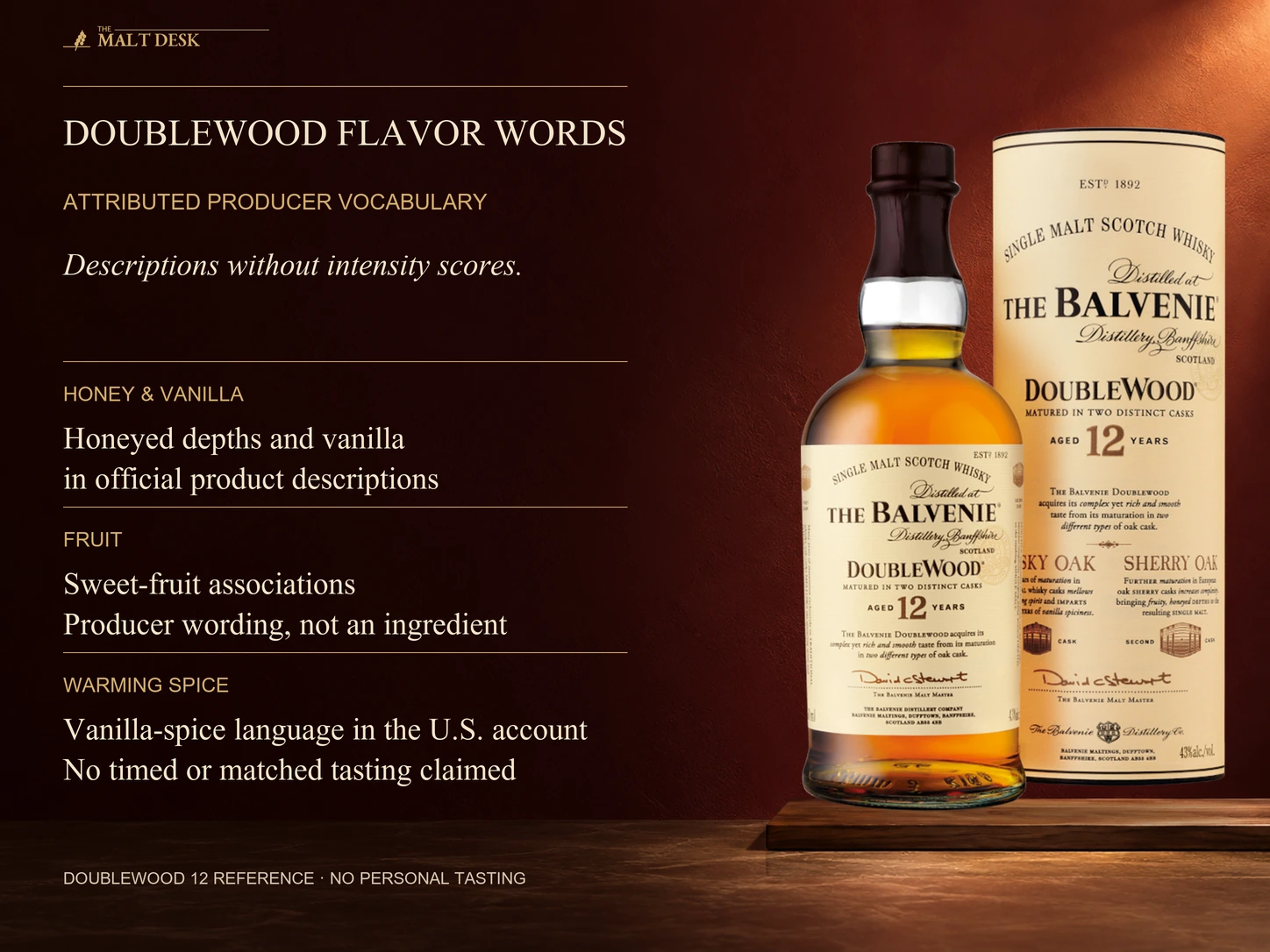
The reference card groups the producer’s flavor words by nose, palate and finish.
Nose
The producer’s aroma description combines sweet fruit and Oloroso-sherry associations with honey and vanilla. These are descriptive terms rather than a measured sweetness ranking.
Palate
The published palate description emphasizes nutty sweetness, cinnamon and a balanced sherry layer. The U.S. producer storefront lists 43% ABV.
Finish
The producer describes the finish as lasting and warming. Readers can use the whiskey flavor map to compare these descriptors with other common style families.
Comparing U.S. Bottle Costs
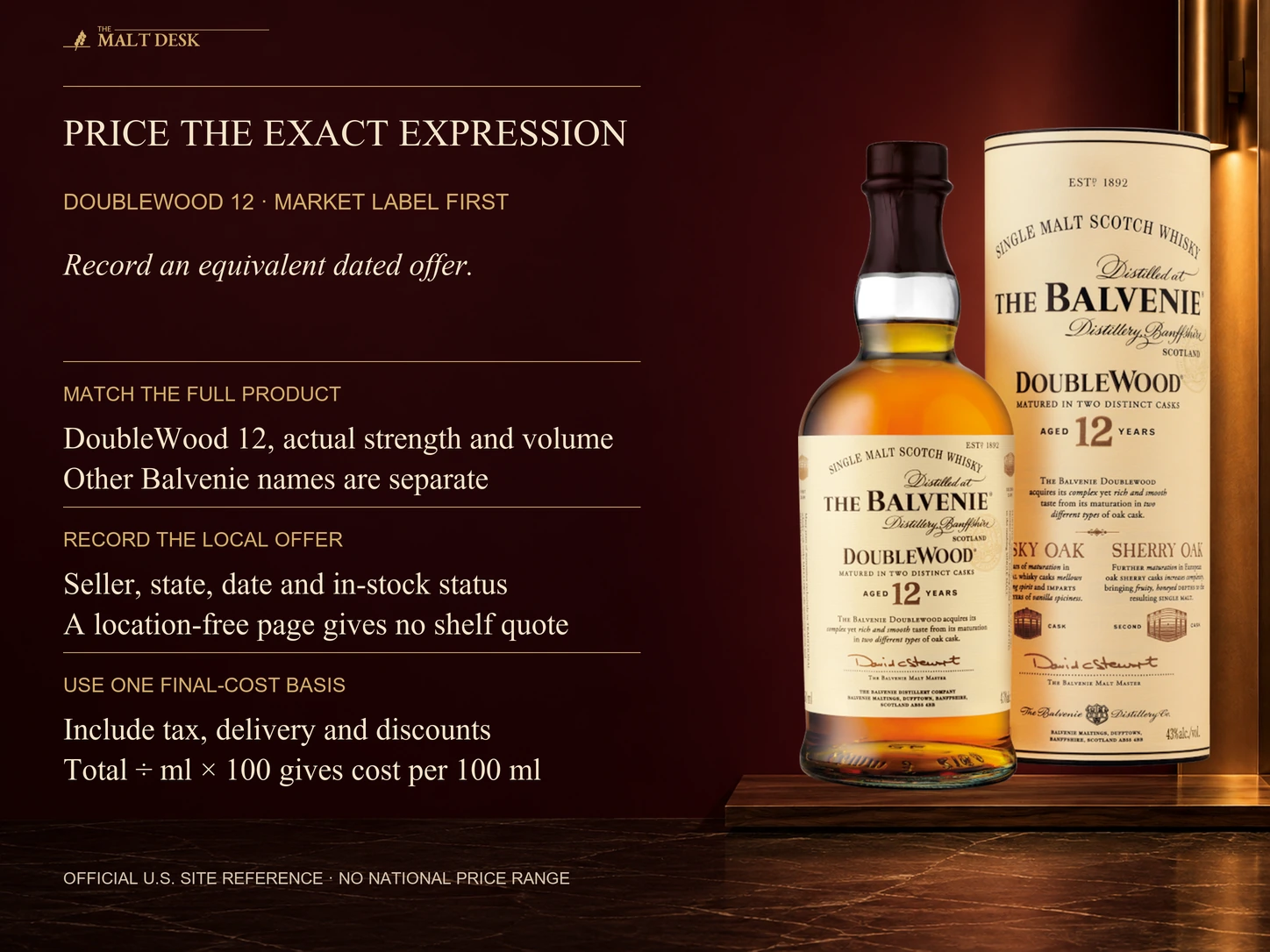
A current U.S. comparison needs dated, in-stock offers for DoubleWood 12 with the same printed strength and bottle volume. The producer storefront requires a delivery location before showing price and availability, so a general product page does not establish a national shelf price.
Record seller, state, date, volume and total cost after tax, delivery and discounts. If the volumes differ, compare cost per 100 ml: total price divided by bottle volume in ml, multiplied by 100. Keep the exact expression separate from other Balvenie bottlings. No current U.S. price range is established here.
Twelve-to-Fourteen Changes the Finish as Well as the Age
| U.S. producer reference | Primary stage as described | Subsequent finishing account | Bottling strength |
|---|---|---|---|
| DoubleWood 12 | Twelve years in American oak | Additional nine months in European-oak sherry casks | 43% |
| Caribbean Cask 14 | Fourteen years in traditional whisky oak | American-oak casks previously filled with selected West Indian rums | 43% |
Equal initial 30 ml measures at these references each contain 12.9 ml pure alcohol. The shared bottling strength removes that one starting difference from a neat, equal-volume comparison. The age minimum, cask histories and barrel selections still differ, so a preference cannot be attributed solely to rum versus sherry or solely to the extra two years printed on the labels.
The Caribbean Cask page describes a blend of rums as the former contents used for the finishing casks. It does not describe blending rum into the single malt. The SWA requires eligible maturation and finishing casks to be empty of their previous contents before Scotch filling. Read “rum blend” at the cask-preparation stage, not as a disclosed percentage of another spirit in the finished whisky.
DoubleWood’s additional nine months also cannot be assigned to Caribbean Cask. The consulted U.S. Caribbean description does not supply that same finishing duration. Fourteen on its label is not evidence of fourteen years in rum casks, or of a two-year rum finish after the DoubleWood program. The named stages and their disclosed durations need their own records rather than subtraction between different expression ages.
How It Compares
- Glenfiddich 12: Glenfiddich 12 discloses bourbon and sherry casks; DoubleWood’s account specifically describes a sequence of primary maturation and finishing.
- Macallan 12 Double Cask: Macallan 12 Double Cask combines American- and European-oak casks both seasoned with sherry. Its two-oak account should not be replaced by DoubleWood’s finishing sequence.
- Aberlour 12: Aberlour 12 lists traditional oak and sherry casks. Double Cask is a product description, not a universal formula identical to DoubleWood; check the market strength separately.
- GlenAllachie 12: GlenAllachie 12 lists four cask inputs and 46% ABV versus the U.S. DoubleWood reference of 43%.
Questions This Production Sequence Helps Answer
- Which stage is primary maturation, and which is a finish?
- Why does a published stage account not replace the 12-year minimum-age label?
- How does DoubleWood differ from Macallan’s two sherry-seasoned oak origins?
- Which strength and bottle volume must be matched in a dated local quote?
Choose the Balvenie Finish You Want to Explore
Keep DoubleWood 12 for its documented sherry-finishing sequence. Investigate Caribbean Cask 14 when the rum-cask stage is the feature you want to explore; both cited U.S. references are 43%. Compare their complete cask programs and exact local prices, treating the move from twelve to fourteen as a change in finish as well as minimum age.
Common Questions
Is Balvenie DoubleWood 12 heavily sherried?
The published sequence establishes a sherry-cask finish.
Is 43% ABV the only version?
The U.S. release is commonly listed at 43% ABV. Strength and bottle size can vary by market, so the label on the specific bottle remains the best reference.
Is it a good first single malt?
Use DoubleWood’s producer profile and cask sequence to decide whether its sherry-finished style fits your interests. The single malt vs blended Scotch guide explains the production category.
Production Summary
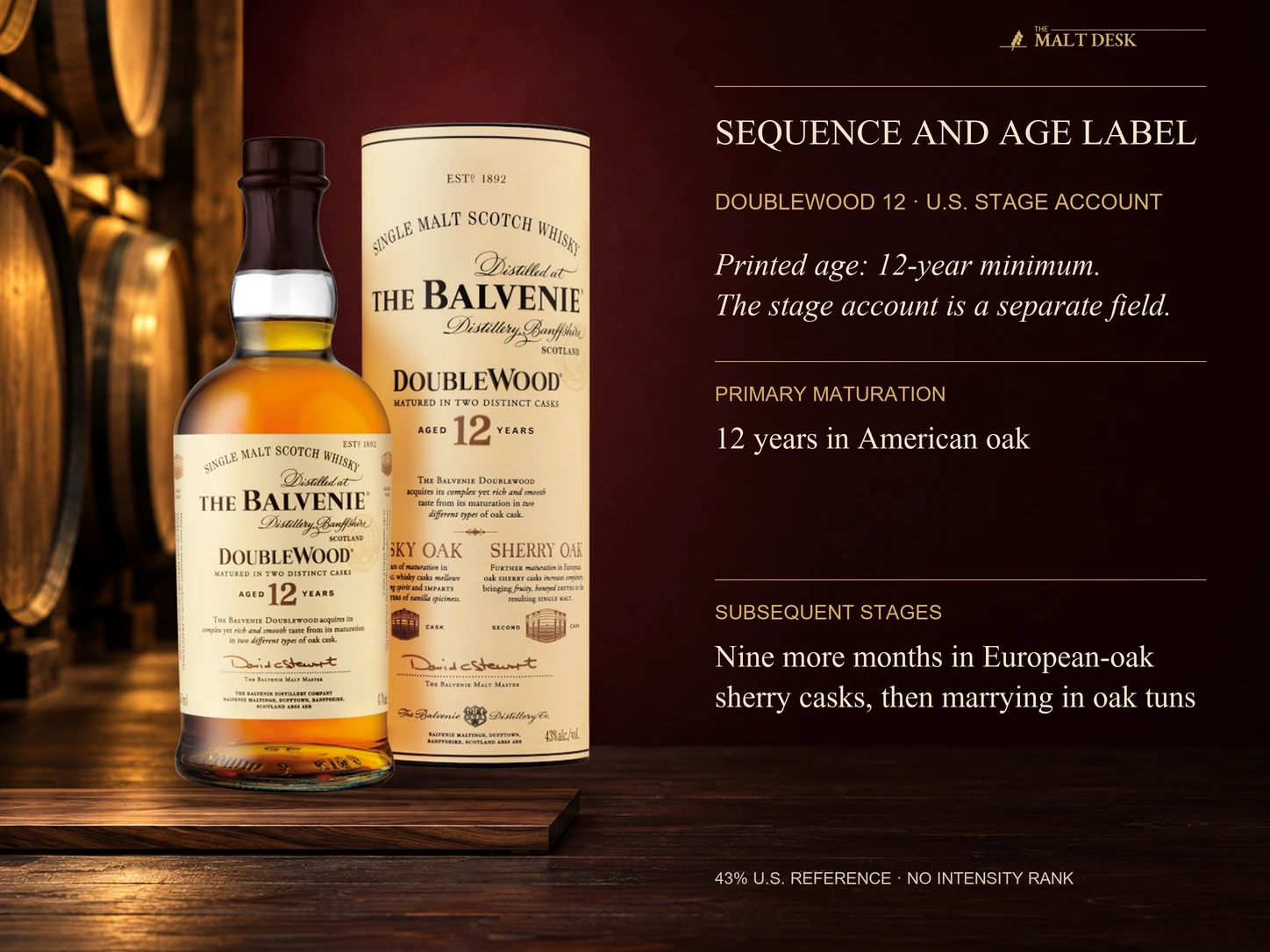
DoubleWood 12’s U.S. production account describes American-oak maturation followed by a European-oak sherry-cask finish. The 12-year label and 43% reference strength are different specifications from that sequence. Use attributed producer notes for flavor vocabulary, a matched method for sensory comparisons and equivalent dated local offers for cost; no universal value or flavor winner is established here.
Sources and Price Date
Balvenie’s U.S. producer storefront was rechecked October 4, 2026 for 43% ABV and its 12-year American-oak stage followed by an additional nine months in European-oak sherry casks. The producer’s DoubleWood information sheet was checked October 3 for flavor wording and marrying. These sources establish the stated production account and descriptions.
Additional range-comparison sources: The Balvenie’s U.S. DoubleWood 12 and Caribbean Cask 14 pages and SWA allowable-cask guidance, checked October 7, 2026. The shared 43% calculation does not isolate age or cask history. Rum is described as former cask contents, and DoubleWood’s nine-month finishing disclosure is not transferred to the separate fourteen-year expression.