Aberlour 12: Quick Answer
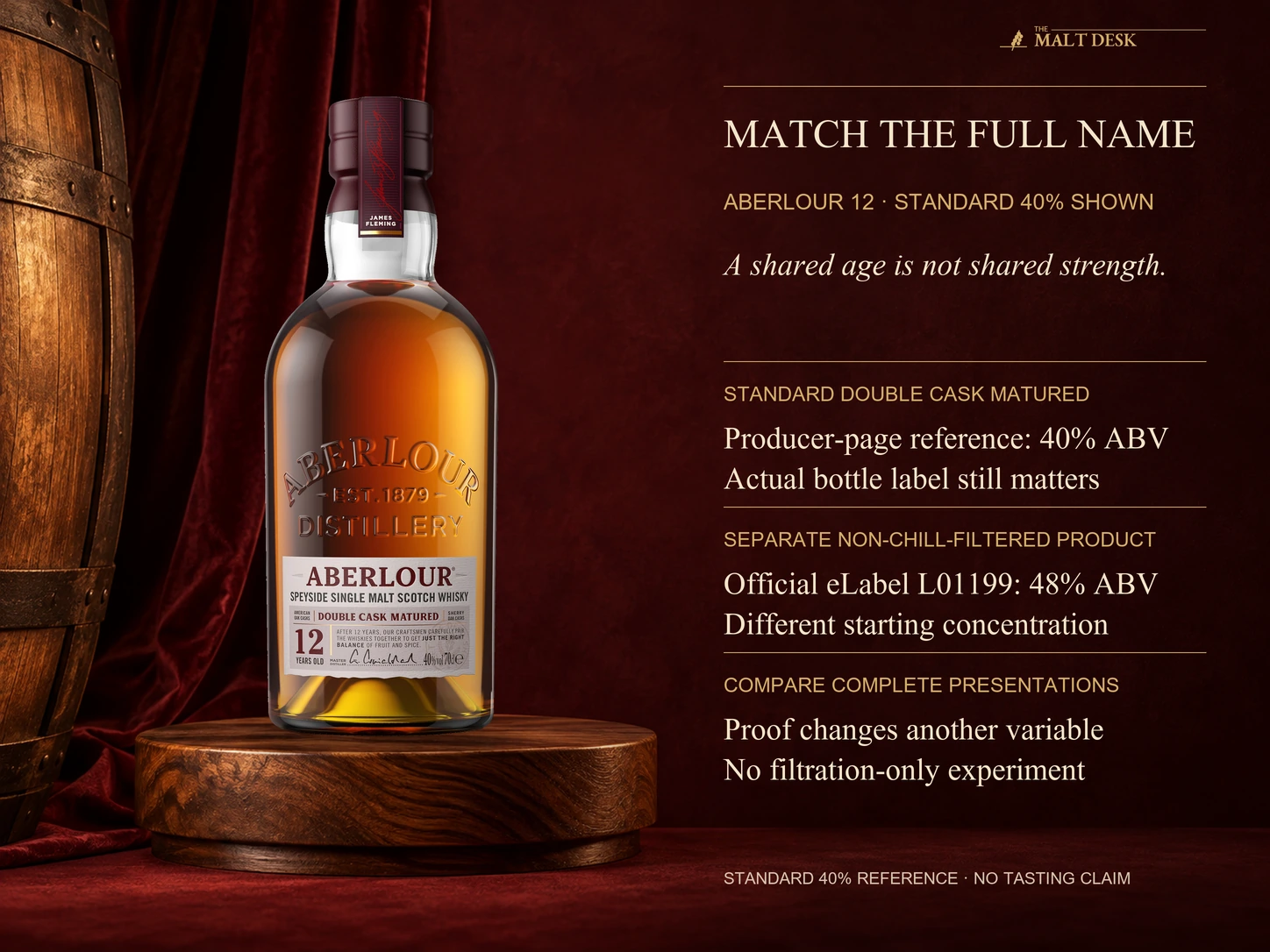
Aberlour’s own product-information directory lists two separate twelve-year entries: Double Cask Matured and Non-Chill Filtered Double Cask Matured. The latter’s official electronic label identifies 48% ABV. That is a materially different starting concentration from the standard producer-page reference of 40%, despite the shared age and much of the name.
This gives the reader a specific comparison question: does a preference concern two whole presentations, or is it being attributed solely to filtration? The two retail expressions do not isolate that one process. Their label strengths already change another variable before either whisky reaches a glass.
Aberlour 12 Year Old Double Cask Matured is a Speyside single malt built around maturation in two cask types: traditional oak and sherry butts. The current producer page lists it at 40% ABV and describes a fruit-led profile of honeyed pear, vanilla toffee, orange, red apple, liquorice, almond and gentle spice.
The useful comparison is between the stated cask program and the producer’s fruit, nut and spice vocabulary. The website reference is not a substitute for the strength and volume printed on a local bottle.
Product Specifications
| Category | Speyside single malt Scotch whisky |
|---|---|
| Age statement | 12 years |
| Producer website reference ABV | 40%; check the exact market label |
| Maturation | Traditional oak and sherry butts |
| Producer-listed size | 70 cl; bottle size varies by market |
| Colour description | Golden amber with a touch of red |
| Profile emphasis | Honeyed fruit, citrus, toffee, almond and spice |
The age statement means the youngest whisky in the bottle has matured for at least 12 years. It does not mean every component spent exactly the same length of time in one cask. The stated cask types and final blend are therefore more informative than age alone when comparing Aberlour 12 with other bottles in the same category.
What Double Cask Matured Means
“Double Cask Matured” describes the use of traditional oak casks alongside sherry butts. Traditional oak can support vanilla, honey and a rounded structure, while sherry-seasoned wood commonly contributes dried-fruit, nutty and warming-spice associations. Aberlour combines those influences before bottling rather than presenting either cask style in isolation.
The phrase should not be confused with double maturation as a universal technical category. Producers use cask language in different ways, so the clearest approach is to read the bottle’s own maturation statement. For a broader framework, see sherry cask vs bourbon cask whisky and the guide to Scotch whisky regions.
Published Flavor Profile
Nose
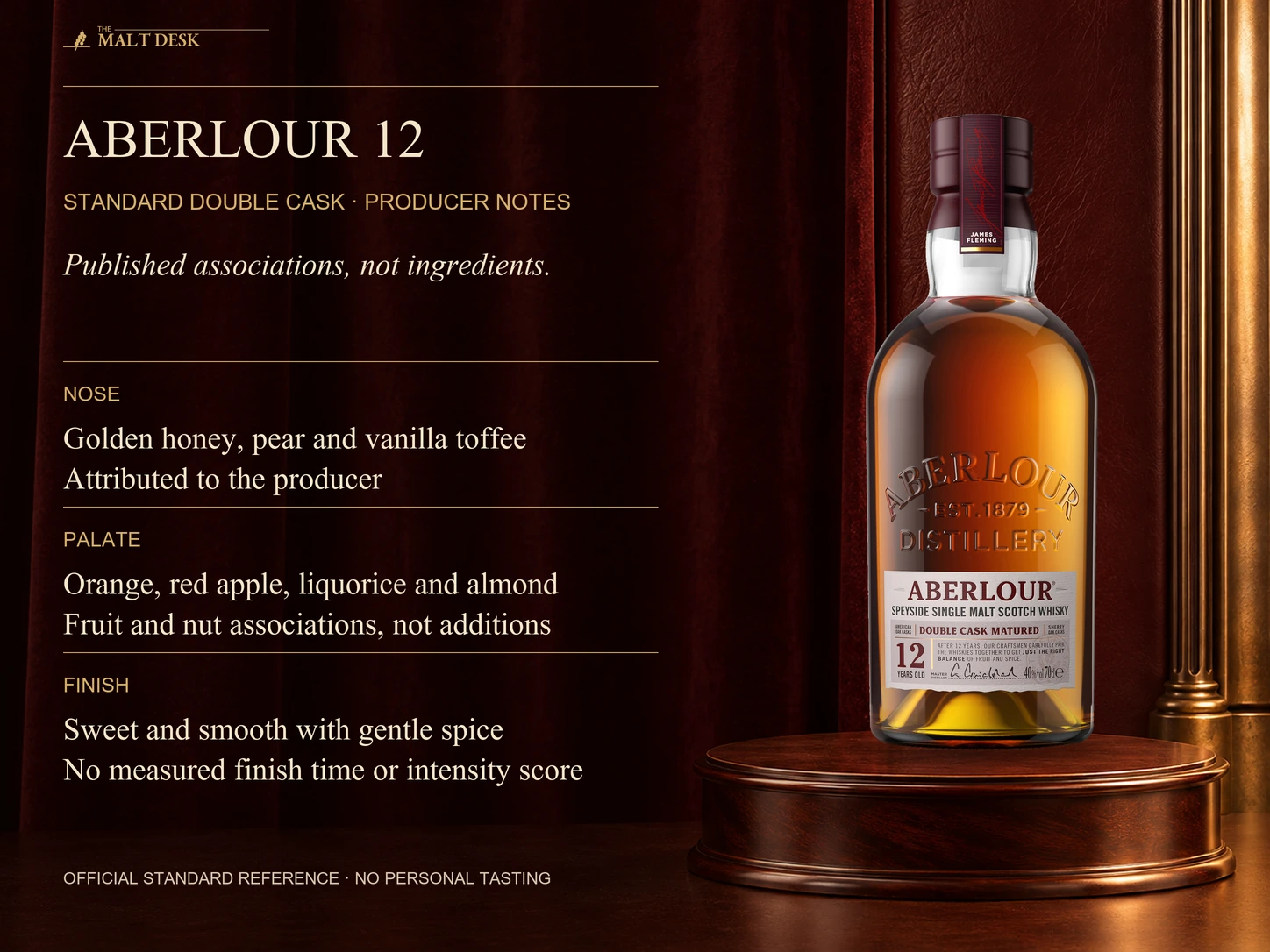
The producer highlights golden honey, fruity pear and vanilla toffee. These descriptors place the aroma on the sweet and orchard-fruit side of Speyside rather than on smoke, coastal salinity or sharp oak. Honey and toffee suggest a rounded opening, while pear keeps the profile from reading as purely dessert-like.
Palate
Orange and red apple provide the main fruit references, followed by liquorice and almond. The citrus note adds contrast to the sweeter opening, while almond gives the sherry-cask side a nutty marker. Liquorice introduces a darker accent without changing the overall fruit-led direction.
Finish
The finish is described as smooth and sweet with a hint of spice. Flavor words are sensory references, not a list of ingredients. The whisky flavor map explains how these terms relate across common style families.
U.S. Price Context
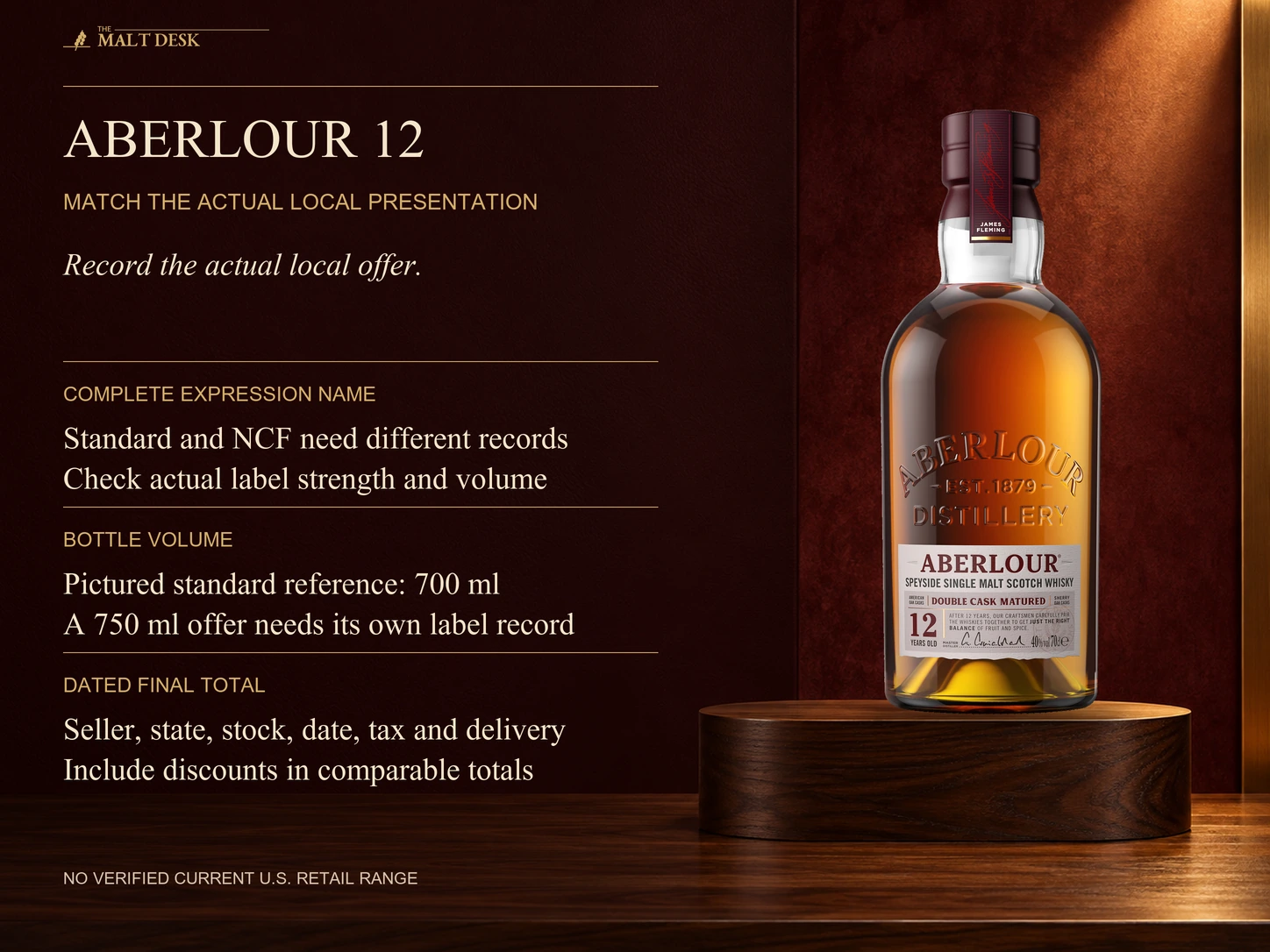
A current U.S. comparison requires dated, in-stock offers for the exact Double Cask Matured expression. Record printed strength, bottle volume, seller, state, date and total after tax, delivery and discounts. No verified current U.S. price range is established here.
When comparing prices, check bottle volume as well as the headline number. The producer’s international and U.S. pages display a 40% ABV, 70 cl reference. Confirm the actual U.S. bottle label rather than treating website specifications as a local retail offer. For different bottle sizes, divide total price by bottle ml and multiply by 100 to compare unit cost.
The Non-Chill-Filtered Name Also Identifies a Different Strength
| Producer-listed presentation | Documented reference | What a shared twelve-year name does not establish |
|---|---|---|
| 12 Year Old Double Cask Matured | Standard consulted product page: 40% ABV | Identical proof in every market or variant |
| 12 Years Old Non Chill Filtered | Official electronic label L01199: 48% ABV | An otherwise identical liquid with only filtration changed |
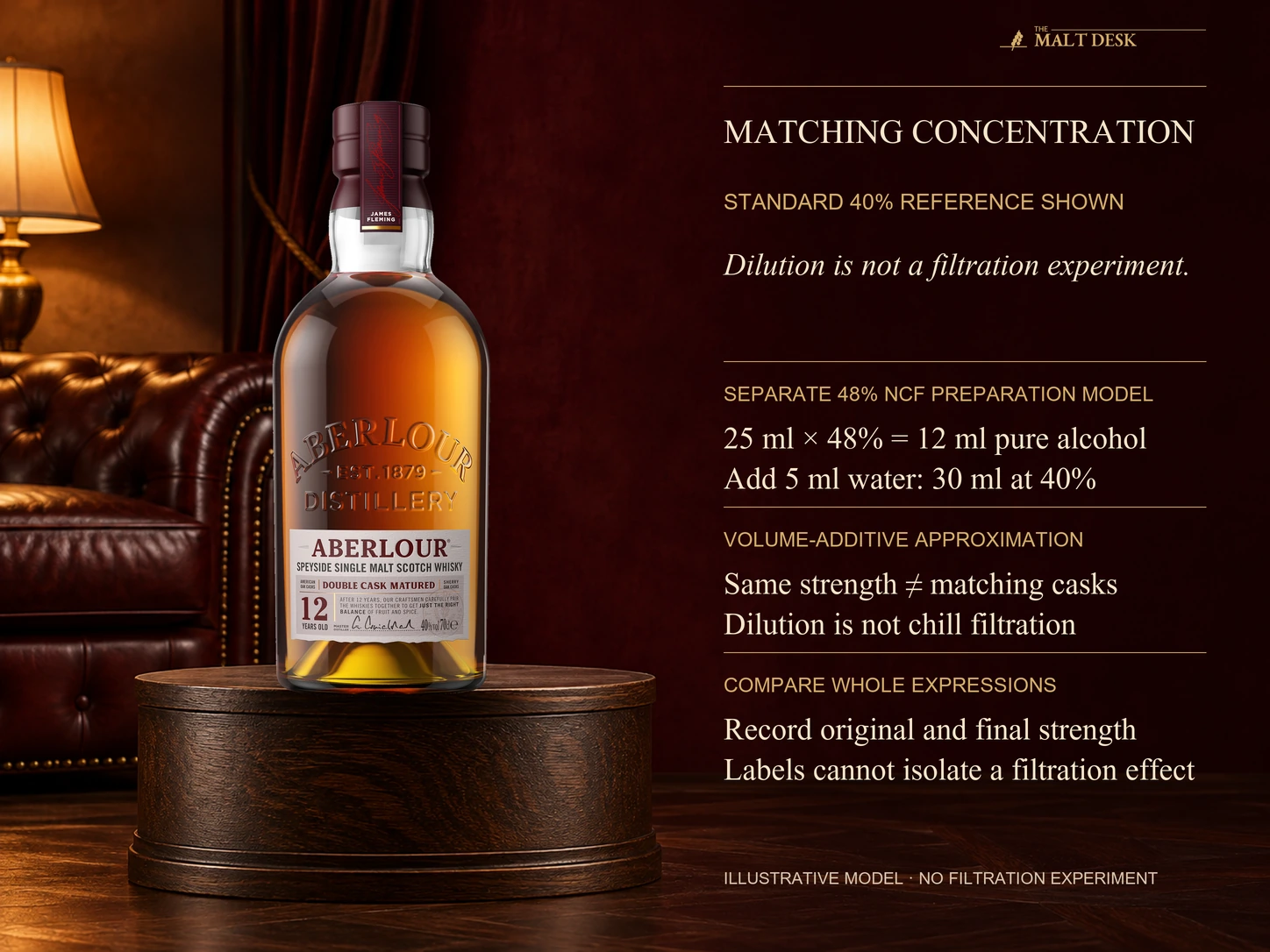
For equal initial 30 ml measures, 40% supplies 12 ml pure alcohol and 48% supplies 14.4 ml. The higher-strength presentation contributes 2.4 ml more, a 20% increase relative to the lower-strength measure. The concentration gap is eight percentage points. This arithmetic is enough to show that a neat comparison changes more than the filtration wording.
Under a simple volume-additive approximation, 25 ml of the 48% variant plus 5 ml water makes a 30 ml final sample at 40%, beside 30 ml of a 40% standard reference. That could define a common-concentration preparation, but it still would not certify matching cask selection, vatting, maturation histories or processing before bottling. Diluting a non-chill-filtered whisky is not the same operation as chill filtering it.
The directory and electronic label establish the separate presentation; they do not establish today’s local stock, price or an otherwise identical recipe. Match the complete product name and actual label when reading a review or store listing. If a local standard bottle is printed at another strength, recalculate from that label instead of applying the 40% website figure to it.
How It Compares With Related 12-Year Malts
GlenAllachie 12 is bottled at 46% ABV, providing a different strength reference. GlenDronach 12 identifies Pedro Ximénez and Oloroso sherry casks. Macallan 12 Double Cask also uses a two-cask name, while specifying sherry-seasoned American and European oak. Compare the disclosed cask fields rather than inferring a sensory balance from the names.
The age statement, cask description and exact label strength are concrete comparison points.
Serving Variables
A tulip glass narrows toward the rim and is commonly used for aroma-focused tasting; a tumbler has a wider opening. Water lowers alcohol concentration, while ice also changes temperature. Keep glass shape, initial pour, additions and temperature consistent when comparing samples, and record observations without assuming that a fixed dose reveals fruit or sweetness. The guide to how to drink whisky covers these variables without treating one method as mandatory.
Choose the Aberlour Twelve-Year Presentation Explicitly
Match the standard Double Cask Matured or the separately named Non-Chill Filtered Double Cask Matured before comparing prices. The cited 48% presentation answers a different strength brief from the standard 40% reference. When comparing the two, record both strength and processing designation so the next choice addresses the specific presentation you want.
Questions About Aberlour 12
Is Aberlour 12 smoky?
Smoke is not a leading feature in the producer’s published profile. The stated notes concentrate on honey, pear, vanilla toffee, orange, red apple, liquorice, almond and spice.
What does Double Cask Matured mean here?
For Aberlour 12, it refers to whisky matured in traditional oak casks and sherry butts, then brought together for the final bottling.
What is a reasonable U.S. price?
No universal price or buying threshold is established here. Compare equivalent bottles using dated local offers, including volume, tax and delivery on the same basis.
Is the specification identical in every market?
The producer’s website reference lists 40% ABV and 70 cl, but local bottle labels and other 12-year variants should be checked separately. Check the physical label when comparing editions from different regions.
Final Verdict
Aberlour 12 Double Cask Matured offers a 12-year Speyside reference with traditional oak and sherry-butts maturation. The producer’s notes emphasize honey, pear, citrus, apple, almond and spice. Use those published details to choose a comparison, then check exact local labels and dated prices before drawing a value conclusion.
Sources
Aberlour 12 Year Old Double Cask Matured international and U.S. product pages, checked October 3, 2026. The age-statement explanation follows Scotch Whisky Association guidance. Current local prices are not established by those sources.
Additional comparison source: Glenmorangie’s current U.S. The Original 12 Years Old product page, checked October 5, 2026, for the twelve-year, bourbon-cask and 40% references. The fruit-direction comparison uses producer descriptions rather than a matched tasting.
Additional variant sources: Aberlour’s official Product Information directory and its linked electronic label L01199, viewed October 7, 2026. The electronic label identifies the non-chill-filtered twelve-year presentation at 48%. The 40%-matching dilution is a proposed calculation, not a filtration experiment, a local stock report or proof that both variants otherwise share an identical vatting.