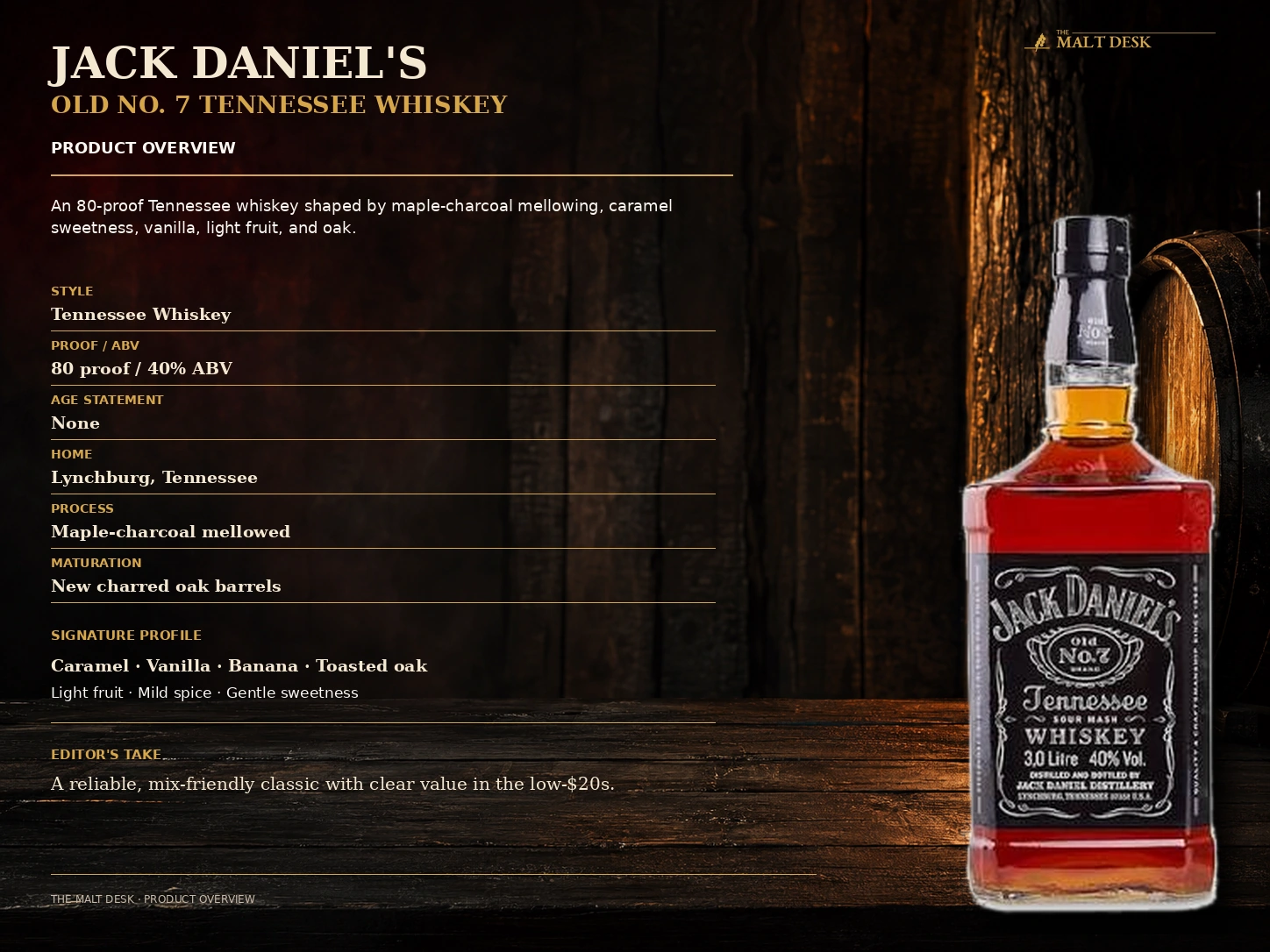
Jack Daniel’s Old No. 7: Tennessee Whiskey and Charcoal Mellowing
Jack Daniel’s Old No. 7 is Tennessee whiskey from Lynchburg, bottled at 40% ABV or 80 US proof. Its production includes charcoal mellowing before maturation in new charred oak. The standard expression has no age statement.
Product Facts
| Expression | Old No. 7 Black Label |
|---|---|
| Category | Tennessee whiskey |
| Producer | Jack Daniel Distillery |
| Location | Lynchburg, Tennessee |
| ABV / US proof | 40% / 80 |
| Grains | Corn, rye and malted barley |
| Age statement | None |
A Sequence of Separate Production Stages
The producer’s Old No. 7 fact sheet identifies corn, rye and malted barley, double distillation, charcoal mellowing and maturation in new charred white oak. It names the limestone Cave Spring as the water source. These are production details, separate from the producer’s sensory descriptions.
Charcoal mellowing takes place before maturation for Old No. 7. It should not be confused with the charred surface inside the aging barrel: one is a filtration-related production step, while the other is the prepared interior of a maturation vessel.
The maple-charcoal process is often called the Lincoln County Process. It is not the same as adding maple syrup, and a charcoal-mellowed whiskey is not automatically a maple-flavored whiskey.
Tennessee Whiskey and Bourbon
Old No. 7 is labeled Tennessee whiskey. Its corn-led recipe and new charred oak maturation overlap with central bourbon production characteristics. The Tennessee designation adds a geographic and production context; it should not be explained merely as “bourbon with a different name.”
For product identification, use the category actually printed on the bottle. The label is clearer than trying to infer the category from a square bottle, black label or a familiar mixed-drink name.
Producer Flavor Notes
Jack Daniel’s official fact sheet describes caramel, vanilla, wood and a fruit-associated aroma. These are the producer’s notes. They do not establish a numerical intensity, finish duration or ranking against another whiskey.
A fruit descriptor does not mean fruit was added. In particular, standard Old No. 7 must be distinguished from the brand’s flavored products. Tennessee Honey, for example, includes a honey liqueur according to the producer; that is a different composition from a whiskey merely described with a honey-like note.
Old No. 7, Gentleman Jack and Single Barrel
The producer describes Gentleman Jack as receiving charcoal mellowing before and after aging. That is a specific process difference from Old No. 7, not proof that every reader will prefer its texture.
Single Barrel expressions identify another product format, and barrel-proof versions can have substantially different strengths. Do not apply the standard Old No. 7 specification of 40% to every product carrying the Jack Daniel’s name.
Use the complete name, volume and ABV when comparing bottles. A brand-only reference can accidentally combine a flavored product, a standard whiskey and a barrel-proof release in one misleading comparison.
What No Age Statement Means
The standard bottle does not declare a fixed age. General descriptions of barrel selection should not be converted into a guaranteed youngest age. Neither the color nor the price reveals an exact maturation period.
Keeping a sealed bottle for several years does not add cask age. Storage affects condition, but the whiskey is no longer maturing in the charred barrel. Keep the bottle upright and protect it from excessive heat and strong light.
Strength and Dilution
Eighty US proof equals 40% ABV. Thirty milliliters contains 12 ml of pure alcohol. If 90 ml of a non-alcoholic mixer is added, the approximate concentration is 10% before ice melt, assuming additive volumes.
Adding mixer does not remove that original alcohol quantity. A sweetened mixer and a sugar-free mixer can also taste different at the same ratio, while carbonation and garnish change the recipe further.
The highball guide explains these variables. The familiarity of whiskey and cola does not establish that it is objectively the best way to serve the expression.
Comparing With a Higher-Proof Whiskey
Wild Turkey 101 is bottled at 50.5%, so it contributes more alcohol at equal volume. It also comes from a different production process. A perceived difference cannot be attributed to proof alone.
The beginner guide separates categories and label terms. Neither low proof nor charcoal mellowing guarantees a particular level of perceived smoothness.
Price and Package Checks
A historical price in a fact sheet or retailer listing is not a current market quote. Compare the same bottle volume and expression, with the date and any offer conditions recorded. A price range without those details can become misleading as products and markets change.
The budget guide explains unit prices. Cost per 100 ml measures quantity, not complexity or likely enjoyment.
Common Questions
Is Old No. 7 seven years old?
No. The product name is not a seven-year age statement.
Does charcoal mellowing mean maple syrup is added?
No. Maple charcoal is used in the production process; it is not a syrup addition.
Is every Jack Daniel’s product 40% ABV?
No. Different expressions have different strengths. Read the specific bottle label.
Is Old No. 7 the same as Tennessee Honey?
No. The producer identifies Tennessee Honey as a combination with honey liqueur, while Old No. 7 is the standard Tennessee whiskey.
Does adding cola reduce the alcohol already poured?
It reduces concentration by increasing total volume, but the original alcohol quantity remains.