Ardbeg’s purifier story has an unusually concrete companion: Heavy Vapours, an expression the producer says was distilled without that apparatus. Instead of trying to imagine the effect from Ten’s tasting vocabulary alone, a reader can examine a documented change within the same distillery. The useful question becomes what was changed in the spirit’s route, and which other differences remain.
Heavy Vapours also exists in two presentations. The producer lists its Limited Edition at 46% and its Committee Release at 50.2%, both without an age statement. Choosing the 46% version alongside Ten keeps the published bottling strength equal; choosing the Committee Release introduces another difference. Neither should be mistaken for a ten-year version of exactly the same casks.
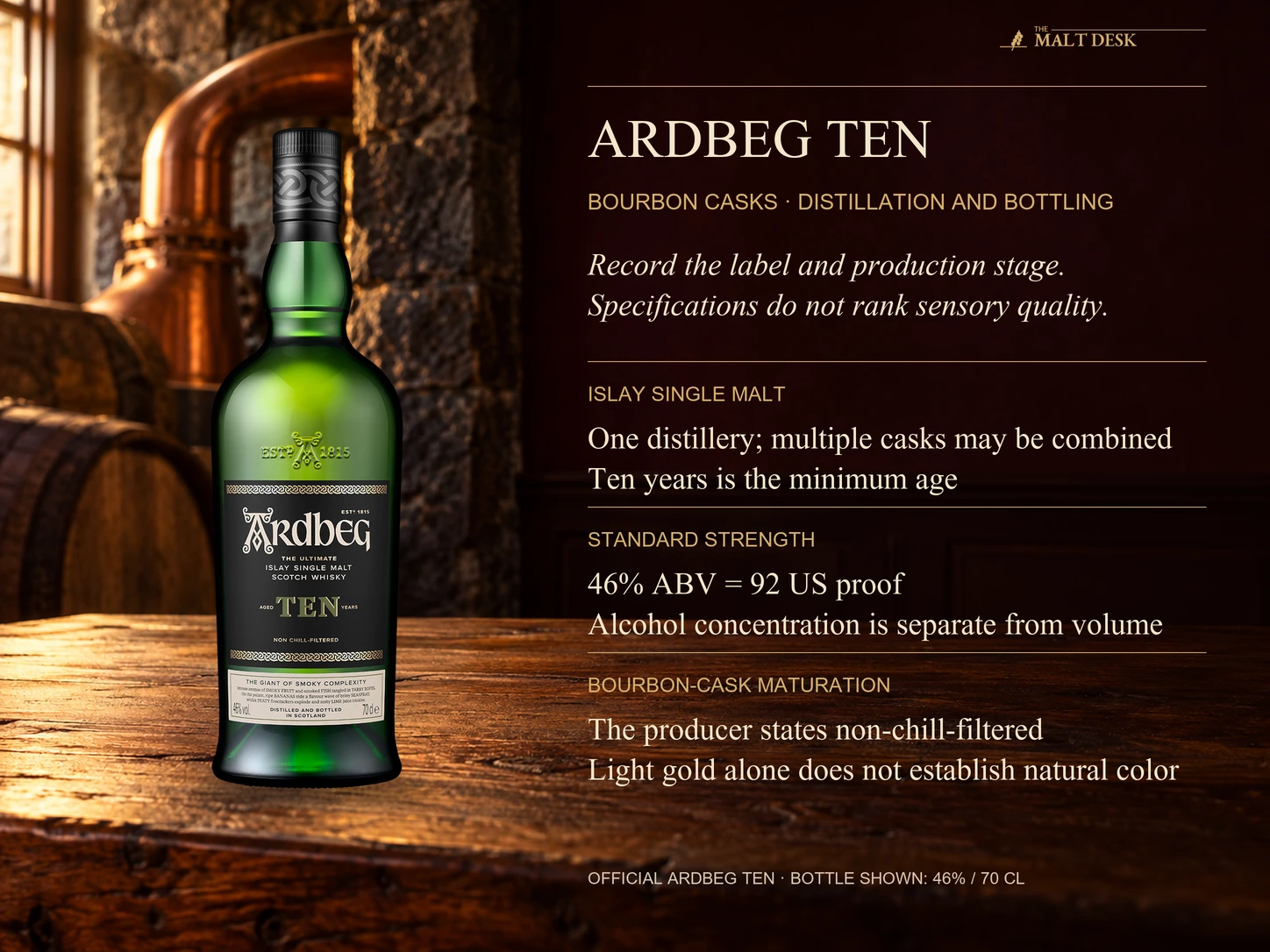
Ardbeg Ten Years Old is an Islay single malt Scotch whisky bottled at 46% ABV. The producer identifies bourbon-cask maturation and non-chill filtration. Its official flavor description combines smoky and maritime associations with lemon, lime, menthol and fruit.
The standard Ten is a useful expression for explaining three separate ideas: how peated malt contributes smoke, how distillation shapes the spirit, and how bottling specifications differ from tasting judgments. Its age, strength and filtration statement can be recorded directly; preference and perceived intensity require a different kind of evidence.
Ardbeg Ten Years Old Specifications
| Item | Standard Ardbeg Ten |
|---|---|
| Category | Single malt Scotch whisky |
| Region | Islay |
| Age statement | 10 years |
| Bottling strength | 46% ABV / 92 US proof |
| Casks | Bourbon casks |
| Filtration | Producer states non-chill-filtered |
| Official color description | Light gold |
Single Malt and the Age Statement
Single malt identifies whisky made at one distillery from malted barley using pot still production. It can contain whisky from multiple casks. The ten-year age statement sets the minimum maturation age of the contents rather than an average or a requirement that all components be exactly the same age.
The label therefore supplies distinct pieces of information: one-distillery origin, category and minimum age. A fuller explanation appears in the single malt and blended Scotch guide.
The Purifier in Ardbeg’s Distillation Process
Ardbeg’s production account describes a purifier on the spirit still’s lyne arm. Heavier vapors cool and return to the pot for further distillation. The producer connects this recycling with additional reflux and copper contact.
Reflux means vapor condenses and returns within the distillation system instead of all passing onward at once. This changes how compounds move through the process. Ardbeg associates the purifier with fruit and floral characteristics alongside the smoke; that is the producer’s explanation of its house style.
A purifier should not be confused with chill filtration of the finished whisky. They operate at different production stages. One is part of the still system; the other concerns treatment of the matured liquid before bottling.
Bourbon-Cask Maturation
The Ten’s official cask description is bourbon maturation. The cask has a previous use, while the age statement concerns the Scotch whisky’s maturation. Bourbon-cask terminology does not make Ardbeg bourbon: the grain, production category and origin remain those of single malt Scotch.
A cask description also does not disclose every component of a vatting. Exact proportions, refill histories and individual cask ages should not be invented from a broad product specification.
Reading the Producer’s Flavor Notes
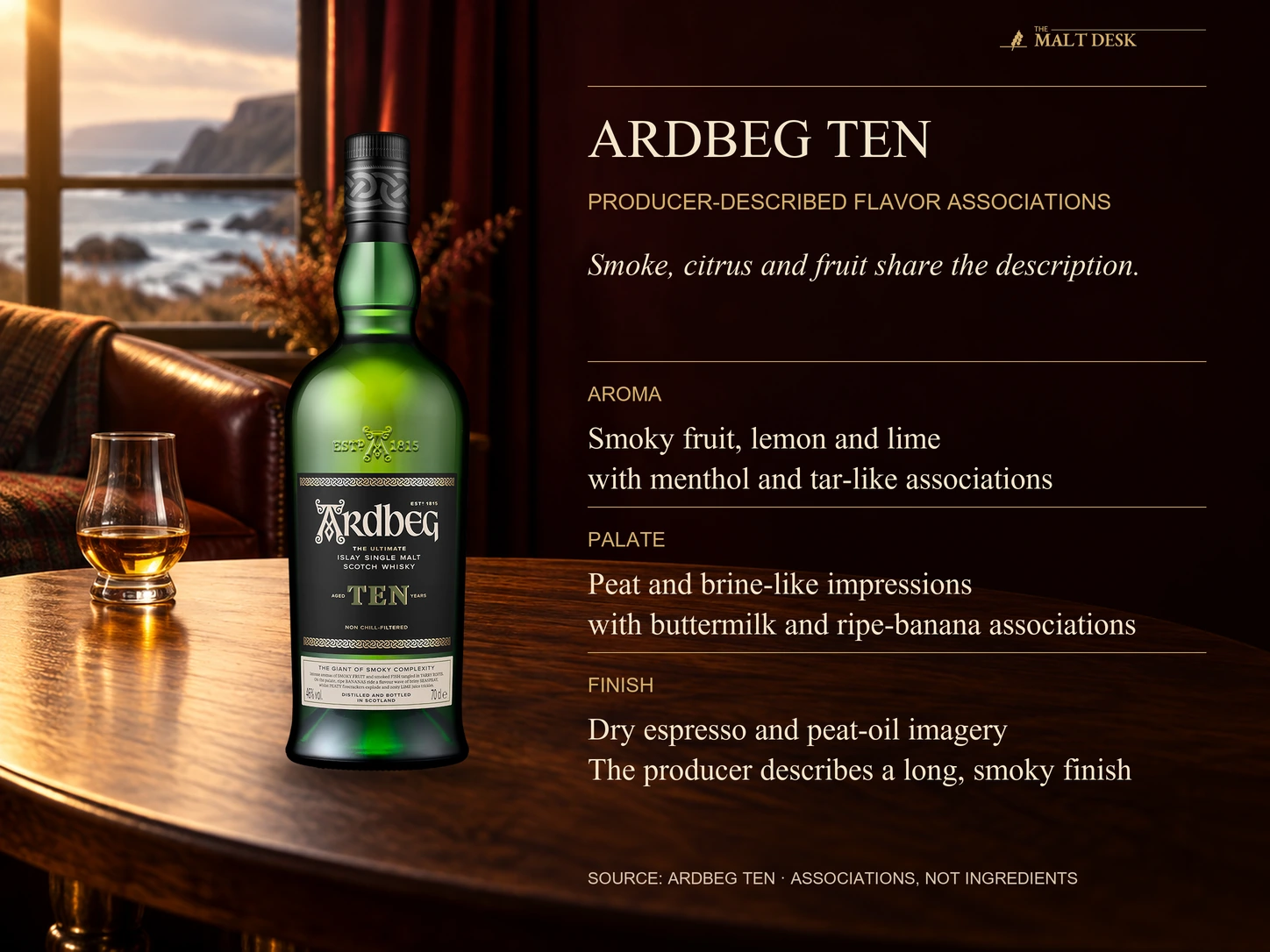
Aroma
The official aroma notes bring together smoky fruit, lemon and lime, menthol and tar-like associations. These comparisons describe aroma rather than added citrus, mint or tar.
Palate
The producer’s palate description combines peat with brine-like, buttermilk and ripe-banana associations. It illustrates that a smoky profile can include fruit and creamy comparisons at the same time.
Finish
Ardbeg describes the finish using dry espresso and peat-oil imagery, and characterizes it as long and smoky. The description is attributed to the producer.
What 46% and Non-Chill-Filtered Tell You
The ABV is the alcohol concentration by volume. Under the US proof convention, 46% corresponds to 92 proof. Read ABV and bottle capacity as separate fields.
Non-chill-filtered is an explicit producer disclosure for this expression. It is separate from the light-gold color description, which does not by itself establish a natural-color claim. A visual description and a statement about coloring are different pieces of information.
Those are useful specifications to compare, but a claim that one whisky has a better mouthfeel requires its own assessment.
The Purifier Returns Material Rather Than Filtering the Bottle
In Ardbeg’s production account, heavier vapors cool in the purifier on the spirit still’s lyne arm and return to the pot for redistillation. That is a return path during distillation. It is not a filter drawing oil or particles out of mature whisky, and it is not a separate third full pass for the entire batch. The phrase about an extra part of a distillation describes recycling within the system.
This distinction explains how Ten can have both a purifier-led spirit account and a non-chill-filtered bottling disclosure. Those decisions concern different stages. The purifier helps determine what reaches the spirit receiver; the filtration statement describes treatment of the matured liquid. Reading them as opposite claims about how thoroughly one finished liquid was filtered would confuse the process.
Heavy Vapours Makes a Specific Comparison Possible
| Producer-listed expression | Purifier account | Age and bottle strength |
|---|---|---|
| Ten Years Old | Normal house process includes the purifier | 10-year minimum; 46% |
| Heavy Vapours Limited Edition | Distilled without the purifier | No age statement; 46% |
| Heavy Vapours Committee Release | Distilled without the purifier | No age statement; 50.2% |
Ten and the 46% Heavy Vapours release also share a broad bourbon-cask description. That makes the pair more focused than comparing Ten with any unrelated smoky whisky, but it does not make the maturation programs identical. The Ten has a disclosed minimum age while Heavy Vapours does not; the public accounts do not establish matched cask ages, histories or selections.
A side-by-side observation could therefore ask whether the producer’s described fruit-and-smoke balance in Ten differs from the dark-chocolate, peppermint and aniseed direction described for Heavy Vapours. It could not assign every difference solely to removing the purifier. The experiment’s production origin is documented; a controlled bottle-level causal result is not supplied by those labels.
Peat Information and Sensory Intensity
A phenol figure must identify what was measured and at which stage. Malt, new-make spirit and bottled whisky are different samples. A value quoted for malt should not be treated as the concentration in a bottle of Ardbeg Ten.
The character of smoke also depends on which compounds are perceptible and on the surrounding flavors. A citrus-and-smoke description communicates a different emphasis from a medicinal-and-seaweed description.
Ardbeg Ten and Other Islay Expressions
Lagavulin 16 provides a comparison with an older minimum age and a standard 43% ABV. Its producer describes peat, sweetness and wood. Those facts support comparison without proving that it is more rounded or that Ardbeg is more energetic for every taster.
Within Ardbeg’s range, Ten Years Old and Ten Cask Strength are distinct expressions. Other named releases have their own cask programs and strengths. A similar bottle shape or shared brand name is not enough to transfer specifications.
Keeping a Product and Price Record
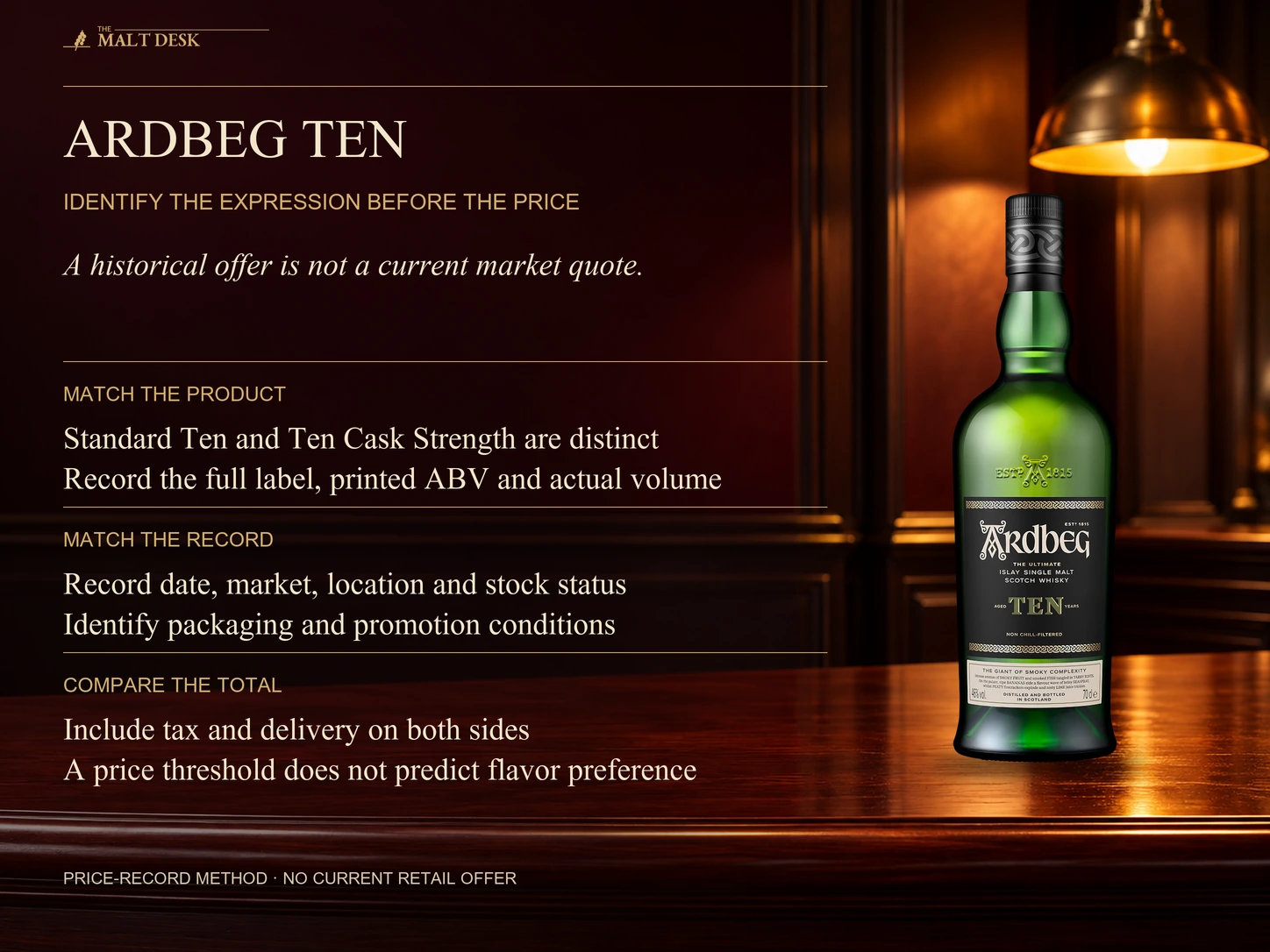
Identify the full expression, printed ABV, bottle volume and market first. For price data, add the date, location, tax treatment and stock status. That makes a record reproducible and avoids comparing the standard Ten with a differently specified release.
A historical offer is not a current nationwide price, and a price threshold cannot prove that a flavor will suit a particular person. The expression’s production details remain useful even when local prices change.
In Brief
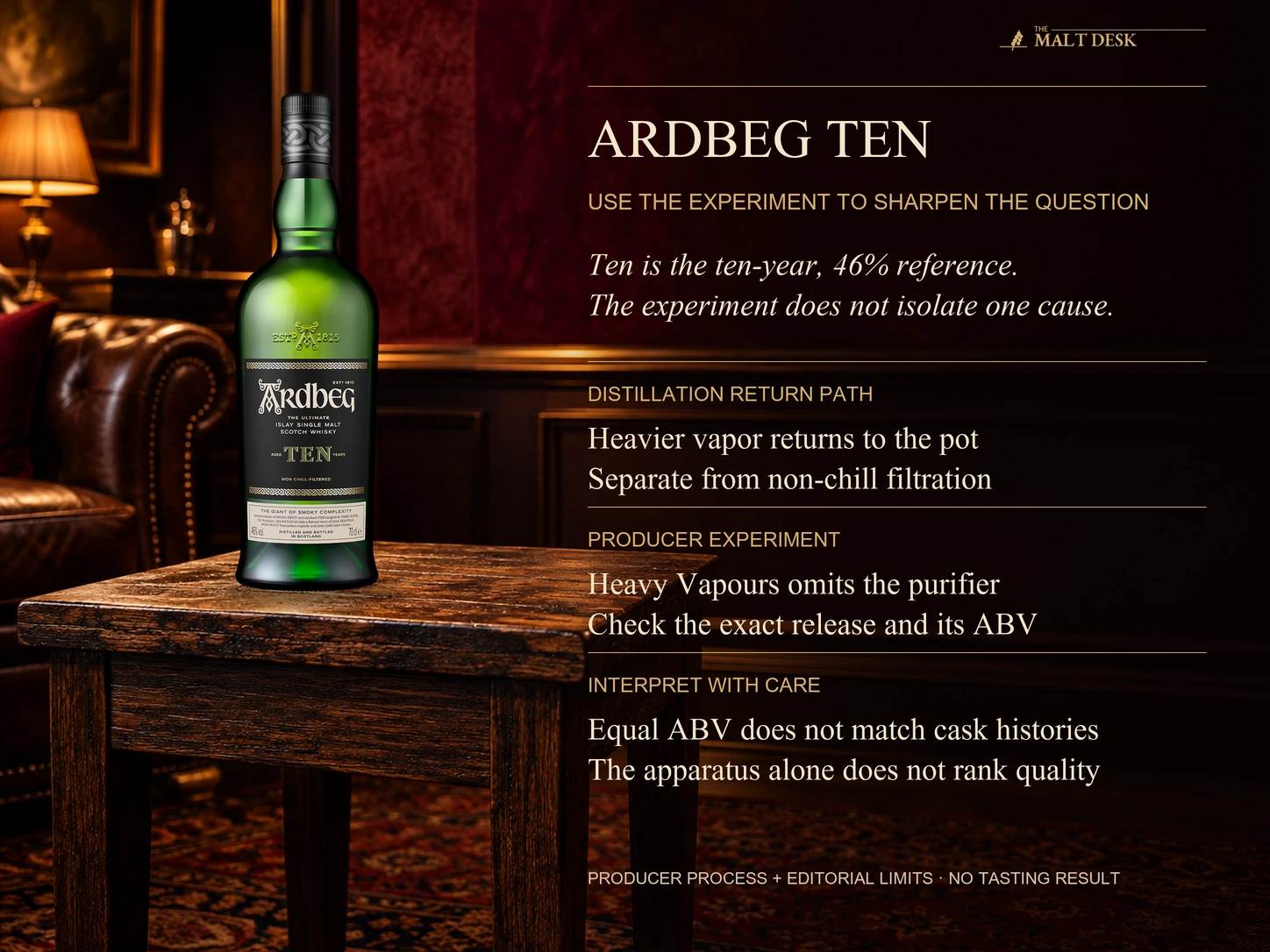
Ardbeg Ten is a peated Islay single malt bottled at 46% ABV. Its bourbon-cask maturation and published non-chill-filtered presentation are useful comparison points alongside the producer’s flavor description.
Use Ardbeg's Purifier Story as a Specific Comparison
Keep Ardbeg Ten as the core expression for its disclosed production and producer profile. Investigate Heavy Vapours when the purifier change is the feature that interests you, while recording the other specifications of each release. This turns an abstract equipment story into a focused expression comparison with a clear reason for choosing the next sample.
Frequently Asked Questions
Is Ardbeg Ten peated?
Yes. Peated malt is central to its production and official flavor profile.
Is it non-chill-filtered?
Yes. The producer explicitly makes that claim for standard Ardbeg Ten Years Old.
Is light gold the same as a natural-color statement?
No. It is a color description. The official product information used here does not explicitly establish a natural-color claim.
Is standard Ten the same as Ten Cask Strength?
No. Match the full expression name and printed ABV; they have separate specifications.
Sources
Ardbeg official Ten Years Old product page and production-process account; Scotch Whisky Association category information; official Lagavulin 16 product information. Flavor descriptions are attributed to Ardbeg.
Distillation comparison note: Heavy Vapours release specifications and the purifier account are attributed to Ardbeg. No present availability is inferred.