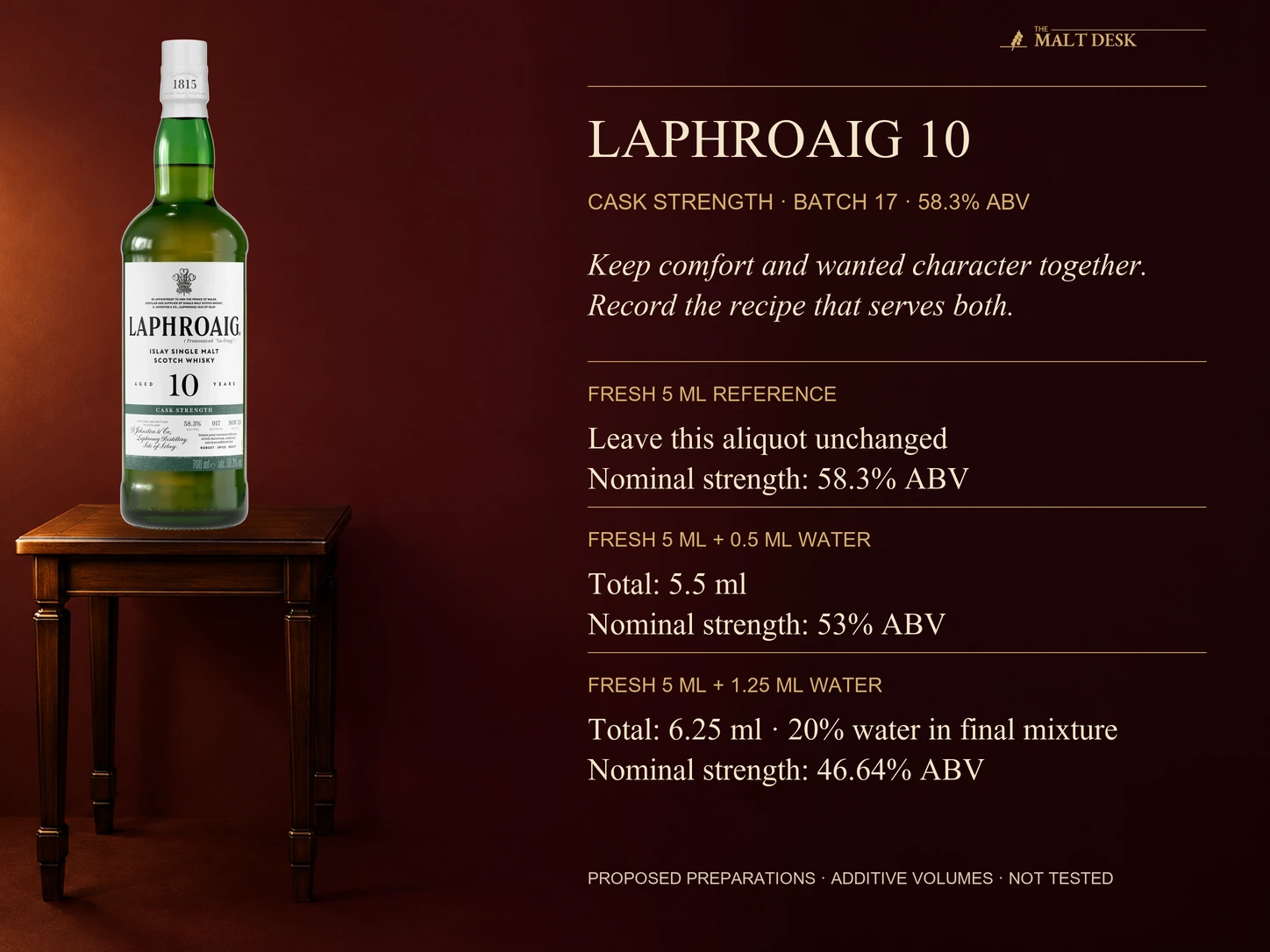
The useful freedom in Laphroaig 10 Cask Strength is being able to explore concentration within one identified batch. I would judge a water addition by two questions together: does the preparation become more comfortable, and does it retain the smoke, fruit or texture that made this batch interesting? If adding more water improves only the first while losing the second, further dilution has stopped serving the intended purpose. Less alcohol concentration is a calculation; the preferred balance still needs an actual observation.
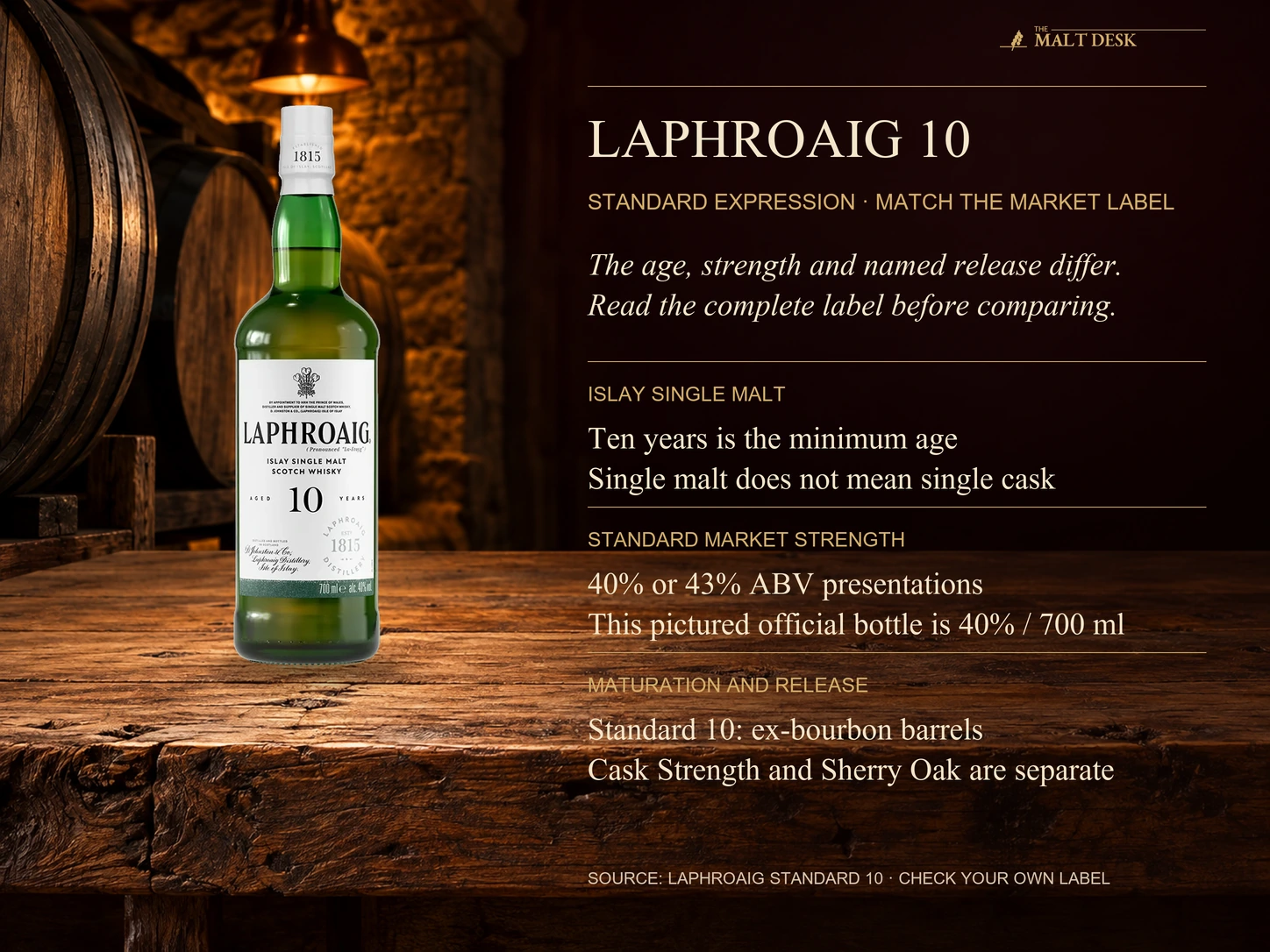
Laphroaig 10 Year Old is a peated Islay single malt Scotch whisky matured in ex-bourbon barrels. Its producer describes a combination of peat smoke, seaweed, medicinal aromas and sweetness. The ten-year age statement and the complete expression name identify the standard bottle; Cask Strength and Sherry Oak Finish are separate releases.
Bottling strength varies by market. Standard labels include 40% and 43% ABV presentations, so the printed strength and bottle volume should be recorded together. A review or specification for one presentation should not silently be applied to another.
Product Details
| Detail | Standard Laphroaig 10 |
|---|---|
| Category | Single malt Scotch whisky |
| Origin | Islay, Scotland |
| Age statement | 10 years |
| Cask description | Ex-bourbon barrels |
| Strength | 40% or 43% ABV according to market presentation |
| Smoke source | Peated malt |
| Filtration and color | The standard product page used here does not establish special claims |
How Its Peated Malt Is Prepared
Laphroaig’s account of its traditional malting process describes barley being soaked, germinated and turned on a malting floor. Damp malt is exposed to peat smoke in the kiln before drying is completed. The producer describes roughly ten to twelve hours of smoke contact in that process.
This sequence explains why a smoky aroma is connected with malt preparation. It does not require peat, iodine or another smoke flavoring to be added to the finished bottle. Malt preparation happens before mashing, fermentation and distillation.
Fermentation and Distillation
The distillery describes milling the malt, extracting a sugary liquid through mashing and fermenting it with yeast. It then uses double distillation in copper pot stills. The selected spirit is matured in wood before casks are combined and the whisky is bottled.
Distillation is a selection process as well as a concentration step. The spirit collected for maturation contains only part of what was present in the fermented wash.
What the Ten-Year Statement Means
The number on the label identifies the minimum age of the whisky in the bottle. Components can come from multiple casks, and some may be older. Single malt indicates one distillery and the category; it does not mean that every bottle was filled from one individual barrel.
A ten-year statement is therefore useful evidence about maturation, while texture, finish and preference remain separate questions. For the wider label distinction, see single malt and blended Scotch explained.
Reading the Official Flavor Description
Aroma
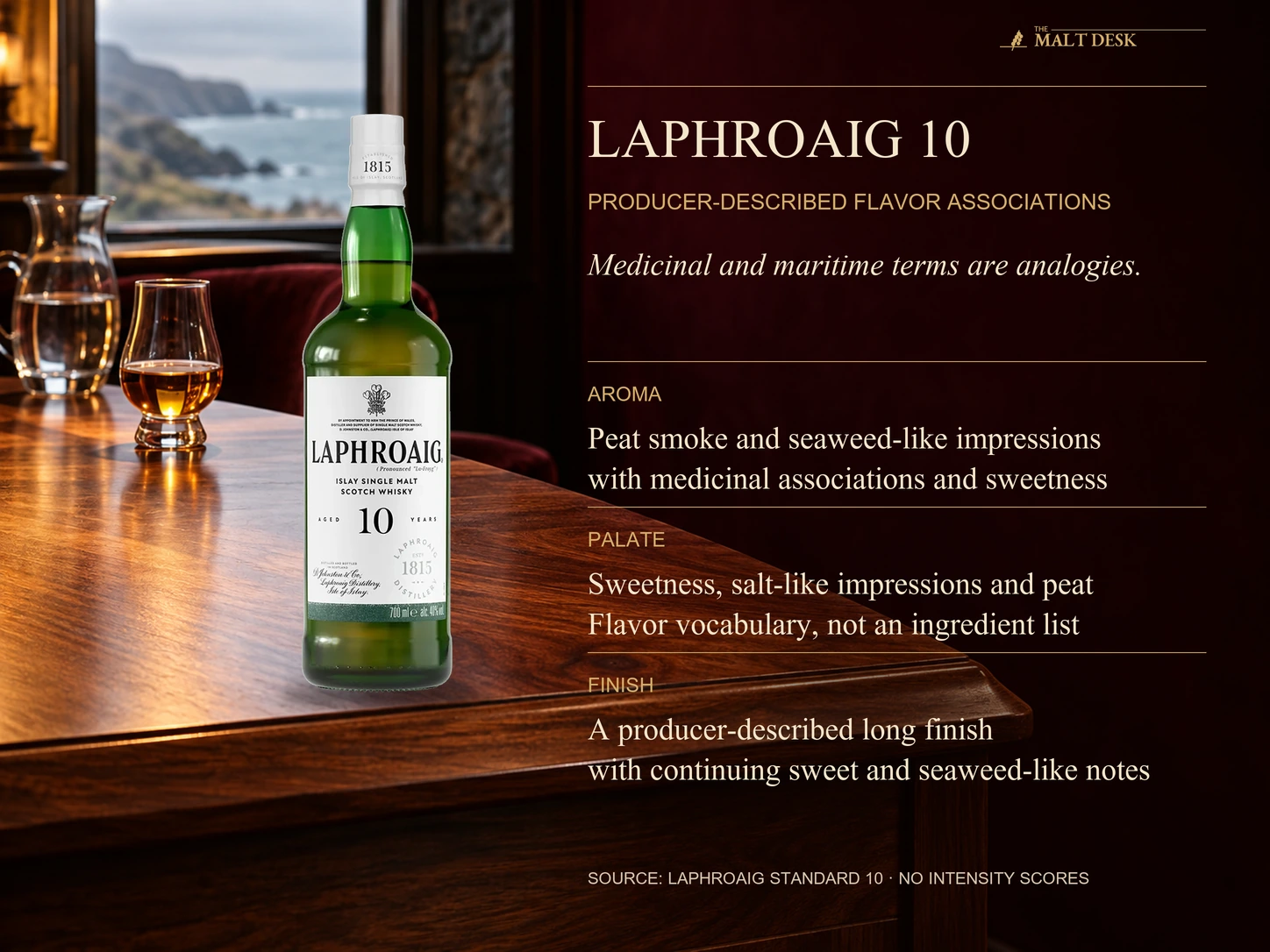
Laphroaig’s producer places smoke, seaweed-like impressions and medicinal associations at the center of its aroma description, with some sweetness. These terms identify recognizable sensory comparisons rather than ingredients.
Palate and finish
The official palate description combines sweetness, salt-like impressions and peat. The finish is described by the producer as long, with continuing sweet and seaweed-like associations. These are attributed notes.
Smoke, medicinal aromas and sweetness describe different aspects of the profile. Consider them together when comparing Laphroaig with other peated whiskies.
Why “Medicinal” Appears in Whisky Notes
Some smoke-derived aroma compounds can evoke antiseptic or bandage-like associations. A taster may use medicinal as shorthand for that resemblance. The word does not indicate that the whisky contains medicine or that it has medicinal benefits.
Maritime descriptors work similarly. Seaweed-like or briny impressions belong to sensory language. Keeping analogy separate from composition makes a tasting description easier to interpret.
Market Strength and Bottle Size
A 40% ABV version is 80 proof under the US convention; 43% ABV corresponds to 86 proof. Those values describe alcohol concentration. Bottle volume describes quantity, so it should be listed separately.
When comparing published notes, check which version the author describes. A strength difference may affect perception, but it does not establish that one version has objectively better structure or a longer finish. That conclusion would need its own stated evidence.
Start with the Batch’s Character, Then Ask What Water Preserves
Laphroaig’s Batch 17 account identifies 58.3% ABV, no dilution before bottling, and barrier filtration to remove char particles rather than chill filtration. Its notes pair peat and coastal associations with stewed apple, vanilla cream, pear and menthol. These are the producer’s descriptors. They give a reader more to look for than the size of the alcohol percentage alone.
For an initial comparison, I would keep an unchanged small reference and prepare one or two fresh small aliquots from the same batch with recorded water additions. Glass, temperature and observation interval should stay comparable. The purpose is to find a preparation of this liquid, rather than claim that water turns it into the separately selected standard ten-year expression. A 40% or 43% standard label is not a target that every Batch 17 owner must reach.
The Study’s Twenty Percent Is Water in the Final Mixture
Ashmore and colleagues’ 2023 Foods study chemically examined twenty-five whiskies at several dilution levels; a twenty-person trained panel assessed a six-whisky subset, starting at 43% ABV. Dilution altered aroma profiles, and the authors reported decreasing distinctions within whisky styles around and beyond an 80% whisky / 20% water mixture. The study did not establish Batch 17’s preferred drinking strength. It also did not say to reduce every whisky to 20% ABV.
Those percentages describe the relative volumes of already bottled whisky and added water. Under an additive-volume approximation, 5 ml of Batch 17 plus 1.25 ml water contains 80% original whisky in the final 6.25 ml and has a nominal 46.64% ABV. Adding water equal to 20% of the starting whisky volume would instead mean 5 ml plus 1 ml, giving about 48.58%. The two instructions are different even before any tasting judgment is made.
I would use the research as a reason to pay attention to what becomes less distinctive, alongside what becomes easier to perceive. It is not a universal stop line at 46.64%, nor evidence that a more diluted sample cannot be preferred. The study’s aroma discrimination question and a reader’s enjoyment question are different. The arithmetic translates its terminology; it does not transfer its results from the studied samples to this 58.3% batch.
Keep a Way Back to the Preparation You Preferred
A practical comparison can be very small. Starting with separate 5 ml aliquots, one could leave the first unchanged, add approximately 0.5 ml water to the second, and 1.25 ml to the third. Their nominal strengths are 58.3%, 53% and 46.64%, respectively. The final volumes differ, so this is a within-batch preparation exercise, not an equal-volume alcohol-dose comparison. These are proposed preparations, not servings or results we have tested.
For each preparation, record any real change in comfort and whether the feature sought remains apparent. A useful result could be the middle preparation if the lower concentration adds little comfort but obscures the desired character. It could equally be the unchanged or more diluted reference. This criterion permits stopping before an arbitrary standard-bottle strength and makes the chosen recipe repeatable from a fresh aliquot.
Continually adding water to one glass cannot restore an earlier concentration. Adding more whisky can raise it again, but creates another volume and recipe instead of recovering the original comparison sample. Keeping the unchanged reference and recording the preferred small preparation avoids that problem. Round the water addition to the precision of the measuring equipment you can actually use.
If medicinal associations are the feature the reader does not want, lower concentration is not evidence that they have disappeared. That calls for an observation of the unwanted feature or a different expression inquiry. Cask strength is most relevant here when the reader wants the latitude to find a useful preparation of this particular peat-led batch, rather than a promise that dilution will remove its identity.
Related Expressions and Comparisons
Ardbeg 10 is another ten-year Islay single malt, with a standard 46% ABV and an explicit non-chill-filtration statement. Its producer uses citrus and tar-like vocabulary alongside smoke.
Lagavulin 16 carries an older minimum age and a standard 43% ABV. Its producer describes peat, sweetness and wood. Age and published flavor emphasis provide comparison points; they do not make one bottle the universal next step after another.
Within Laphroaig’s own range, standard 10 Year Old, 10 Year Old Cask Strength and 10 Year Old Sherry Oak Finish have distinct specifications. Match the complete label before transferring strength or cask information.
Price Records and Product Identification
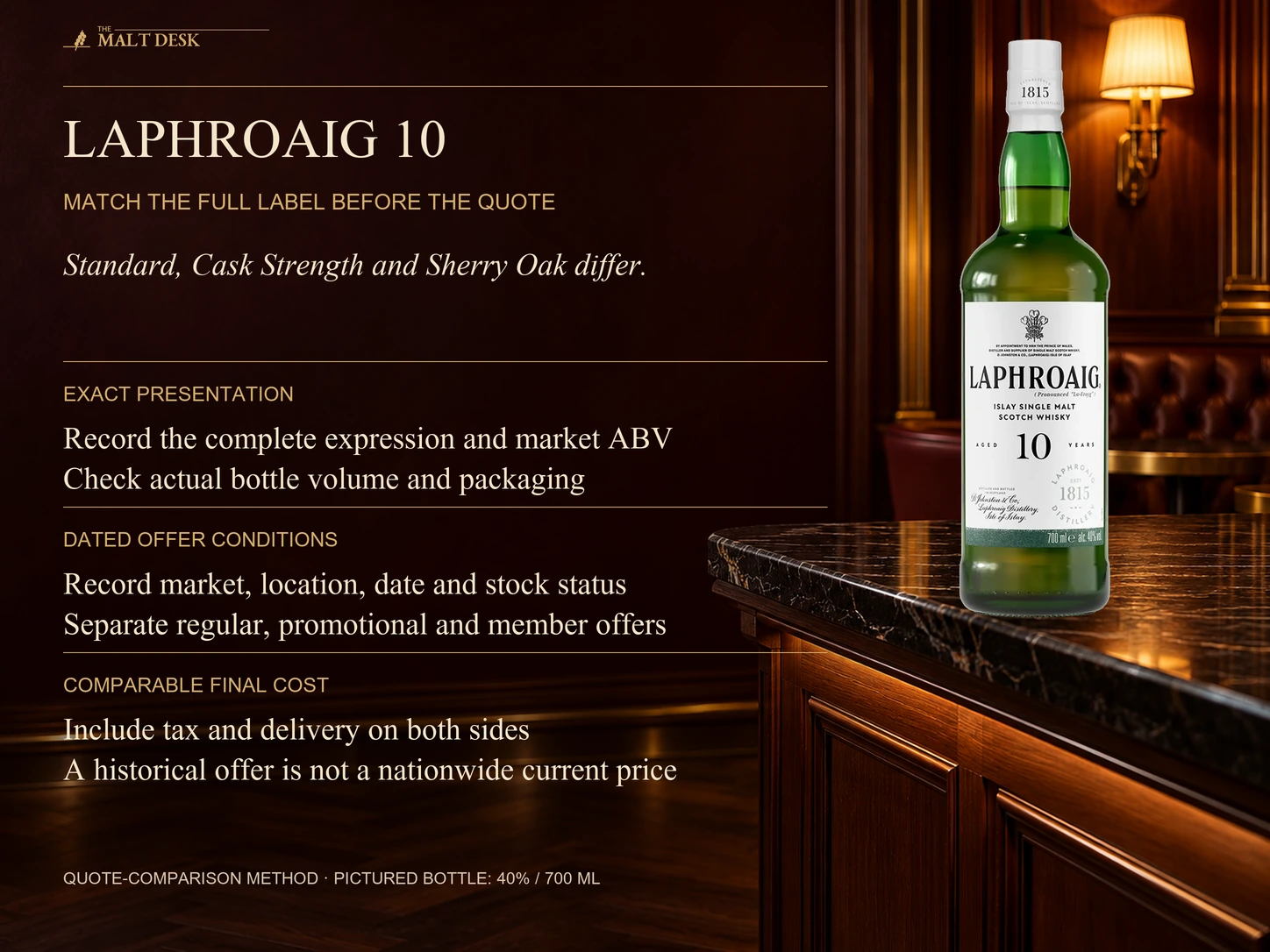
Useful price data identifies the date, market, bottle volume, exact expression, stock status and tax treatment. A historical listing is not a current nationwide price. A promotion also cannot establish a permanent fair-price threshold.
The same care applies to images and retailer headings: a photograph of a similarly named Cask Strength or Sherry Oak bottle should not be used as evidence for the standard expression. Start with the full label and then compare equivalent records.
In Brief
Laphroaig 10 combines a ten-year Islay single-malt age statement with a peat-led producer profile. Check the bottle’s market-specific strength and full expression name when comparing it with other Islay whiskies.
Find a Repeatable Balance for Laphroaig
For the cited Cask Strength batch, add measured water in small steps and record both concentration and the smoke, fruit or texture you want to retain. Stop at a preparation that balances comfort with those features, then keep that recipe for the same batch. Use standard Laphroaig 10 when its fixed bottled presentation is the reference you want to revisit.
Frequently Asked Questions
Is Laphroaig 10 peated?
Yes. Peat-smoked malt is central to its production and producer-described profile.
Is the standard bottle always 43% ABV?
No. Market presentations differ; check the bottle’s printed ABV and volume.
Does medicinal mean anything has been added?
No. In this context it describes an aroma association rather than an added ingredient.
Does single malt mean single cask?
No. Multiple casks from the same distillery can be combined in a single malt expression.
Sources
Laphroaig official 10 Year Old product page and whisky-making process guide; official Ardbeg Ten Years Old and Lagavulin 16 product information. Product details and producer-described flavors are distinguished throughout.
Dilution research checked October 7, 2026: Laphroaig’s Batch 17 account; Ashmore et al., Impact of Dilution on Whisky Aroma: A Sensory and Volatile Composition Analysis, Foods 12(6):1276, published March 17, 2023. The study concerns aroma and discrimination. The two-part stopping criterion is The Malt Desk’s editorial analysis.