Quick Answer
A peat figure can be correctly quoted and still support the wrong calculation. Dividing a spirit phenol number by a malt phenol number does not, by itself, tell us the percentage of the starting phenols that survived. Concentration describes an amount relative to a sample; a survival calculation needs the total amount in each relevant stream.
This matters when a producer helpfully reports more than one stage. For a complete material balance, record both concentrations and the total amount of the tracked material in each relevant stream. I would ask whether the samples, unit bases, methods and quantities are known before describing a loss or retention percentage.
Peated whisky is made with malted barley dried in smoke from burning peat. The smoke deposits phenolic compounds on the damp malt, and part of that character survives mashing, fermentation, distillation and maturation. Nothing needs to be added to the finished whisky to make it taste smoky.
The result can suggest bonfire ash, damp earth, tar, iodine, sea air, smoked fruit or sweet wood smoke. Those descriptions are sensory associations. The style is famous on Islay, but peated whisky is not limited to Islay and not every Islay whisky is heavily peated.
Key Takeaways
- Peat is an accumulation of partially decomposed plant material from wetland environments.
- In whisky production, peat smoke is most important while damp malted barley is being dried in a kiln.
- PPM usually describes total phenols in the peated malt.
- Distillation, spirit cuts, cask type, maturation time, proof and competing flavors all change how smoky a whisky feels.
- Peated does not automatically mean medicinal; the spectrum can be sweet, earthy, ashy, maritime, herbal or tarry.
- Islay is a region. Peated is a production and flavor style.
- Ardbeg 10, Laphroaig 10 and Lagavulin 16 are all peated Islay malts, but they express smoke very differently.
What Is Peated Whisky?
Peated whisky begins with malt, not with a flavoring added after distillation.
Barley is soaked and allowed to germinate so that enzymes can prepare its starch for conversion into fermentable sugar. Germination then has to be stopped by drying the malt. When burning peat supplies part of the kiln smoke, the damp grain absorbs phenolic compounds that can later produce smoky aromas in the spirit.
Laphroaig describes smoke rising through a perforated drying floor for roughly 10 to 12 hours during its traditional floor-malting process. Ardbeg likewise explains that its peated malt is kilned over burning peat so smoke can penetrate the grain. These are producer-specific examples, but they show the core mechanism clearly: smoke contacts wet malt before mashing and distillation.
Peated whisky can be single malt, part of a blend or made outside Scotland. The word describes a production choice and resulting flavor family, not one legal whisky category.
Peat, Smoke and Phenols: What Is the Difference?
The three terms answer different questions.
- Peat is the material burned.
- Peat smoke is the carrier that contacts the malt.
- Phenols are a family of smoke-derived compounds associated with aromas such as smoke, tar, ash, earth and medicinal notes.
The word phenolic is descriptive. Different phenolic compounds have different aroma thresholds and behaviors. A lower-concentration compound can sometimes matter more to aroma than a more abundant but less active one.
That is why two whiskies with similar malt specifications can smell different. The mix of compounds, not just their total, matters.
How Does Peat Smoke Get Into Whisky?
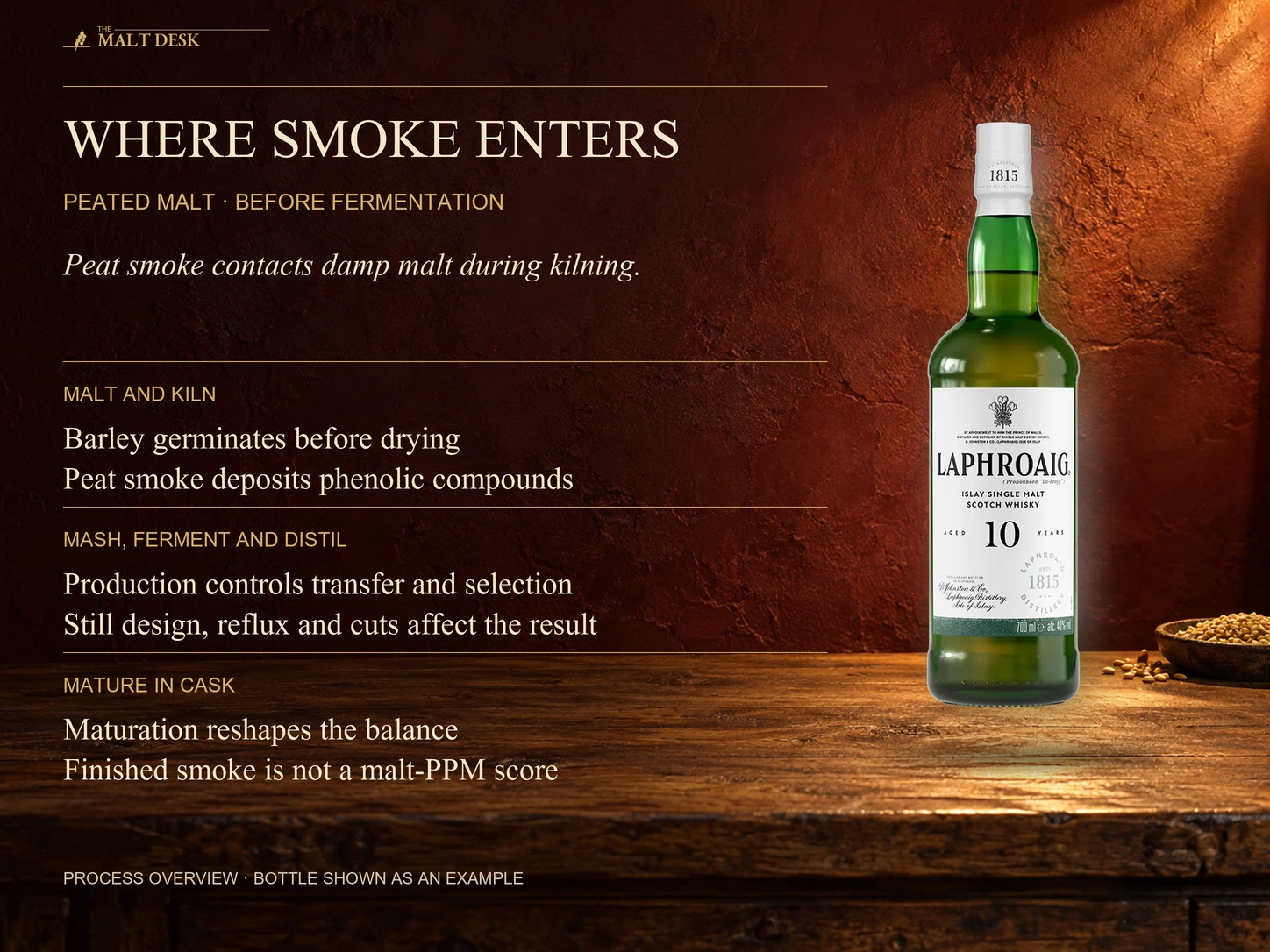
1. Barley germinates
Water starts germination and activates the grain. The maltster stops the process at the required point by drying the barley.
2. Peat smoke dries the damp malt
Peat is allowed to smolder rather than burn as a clean, hot flame. Smoke rises through the kiln floor and contacts the moist grain. Longer smoke exposure and the nature of the peat can change the malt’s phenolic profile.
3. Production selects what survives
Mashing dissolves sugars and smoke-derived compounds into the wort. Fermentation adds new fruit, cereal and acid-driven aromas. Distillation then separates and concentrates compounds selectively. Still shape, reflux, copper contact and the spirit cut influence how much heavy, oily or smoky character reaches the new make spirit.
4. Cask maturation changes the balance
Oak brings vanilla, fruit, caramel, spice, tannin and texture. Some peat-derived compounds decline or transform during maturation, while the growing cask profile changes their relative prominence. Age does not guarantee weaker smoke, and youth does not guarantee harsher smoke.
What Does Peated Whisky Taste Like?
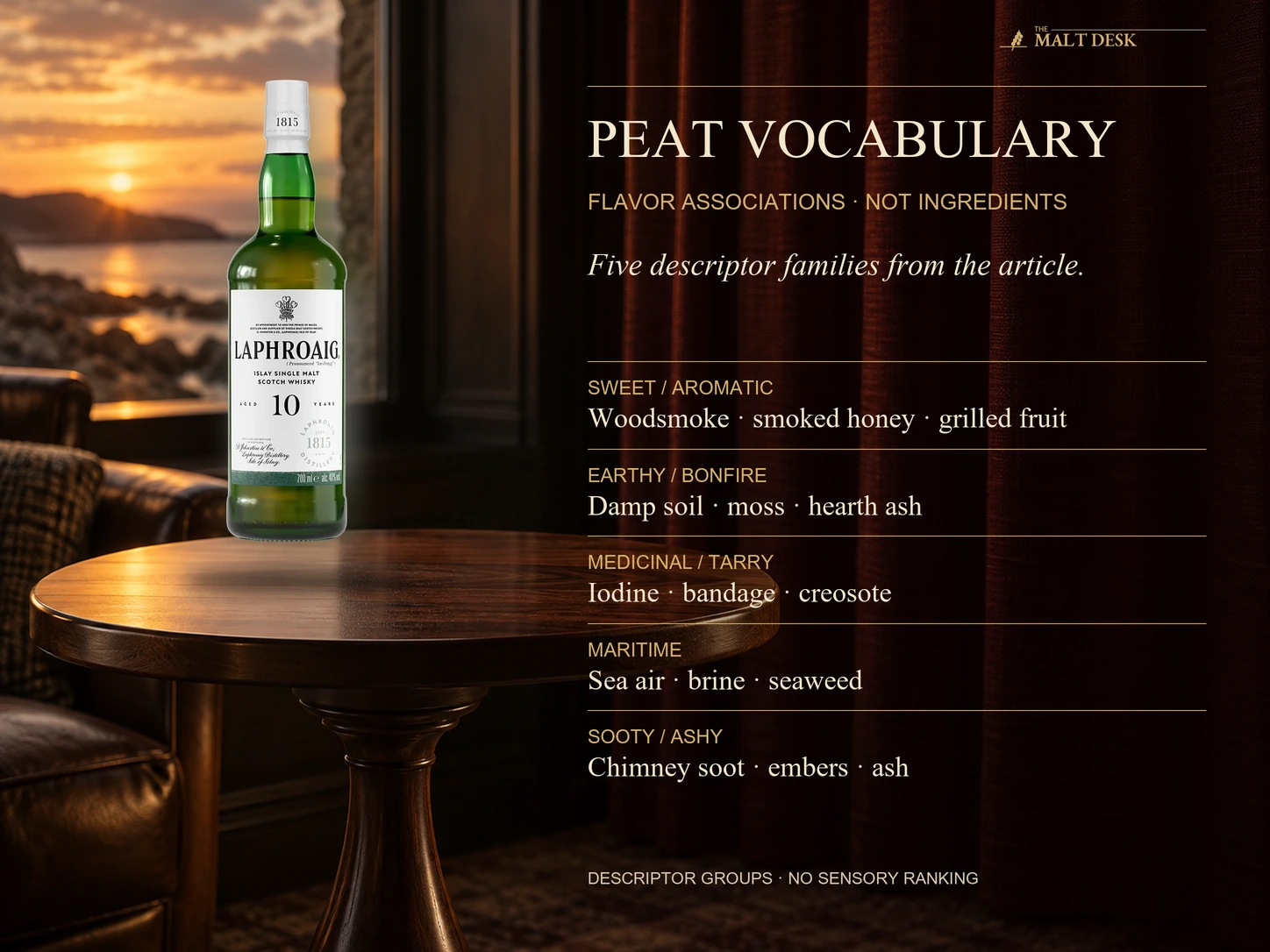
Peated whisky is broader than burnt flavor. Common sensory directions include:
| Smoke direction | Common descriptors | Flavors that may sit beside it |
|---|---|---|
| Sweet and aromatic | Wood smoke, smoked honey, grilled fruit | Vanilla, citrus, tropical fruit |
| Earthy and bonfire-like | Damp soil, moss, hearth ash, charcoal | Malt, pepper, toasted oak |
| Medicinal and tarry | Iodine, bandage, antiseptic, creosote | Vanilla, licorice, black pepper |
| Maritime | Sea air, brine, seaweed, shell | Lemon, mineral notes, wax |
| Sooty and ashy | Chimney soot, dying embers, ash | Coffee, dark chocolate, oak |
No bottle has to show every family. These are associations used to communicate aroma, not literal additives. One drinker may call the same note coastal while another calls it medicinal or mineral. For a wider aroma framework, see the whisky flavor map.
What Does PPM Mean in Peated Whisky?
PPM means parts per million. In peated-whisky marketing, the quoted figure often refers to the total phenol concentration of the malted barley, not the final concentration in the bottle. Torabhaig’s technical overview makes this distinction explicit and explains that more than one analytical method remains in use.
A phenol figure measured in malt describes a raw material before fermentation, distillation and maturation. Check the measurement stage and method before comparing figures.
Does higher ppm always mean smokier whisky?
Higher malt ppm is useful evidence of a more heavily peated starting point.
- Producers may report figures measured at different points or by different methods.
- Phenolic compounds do not all transfer through distillation at the same rate.
- Spirit cuts and copper contact reshape the profile.
- Casks and maturation add competing sweetness, fruit and oak.
- Bottling strength and texture affect how clearly smoke is delivered.
- Drinkers vary in sensitivity to ash, iodine, tar and sweet smoke.
Use ppm as context, then read the actual tasting profile. Whisky Magazine’s production overview makes the same practical point: peat level is technical, while perceived smoke depends on the range and balance of phenolic compounds and how the whisky develops.
Concentration Is Not the Same as Total Amount
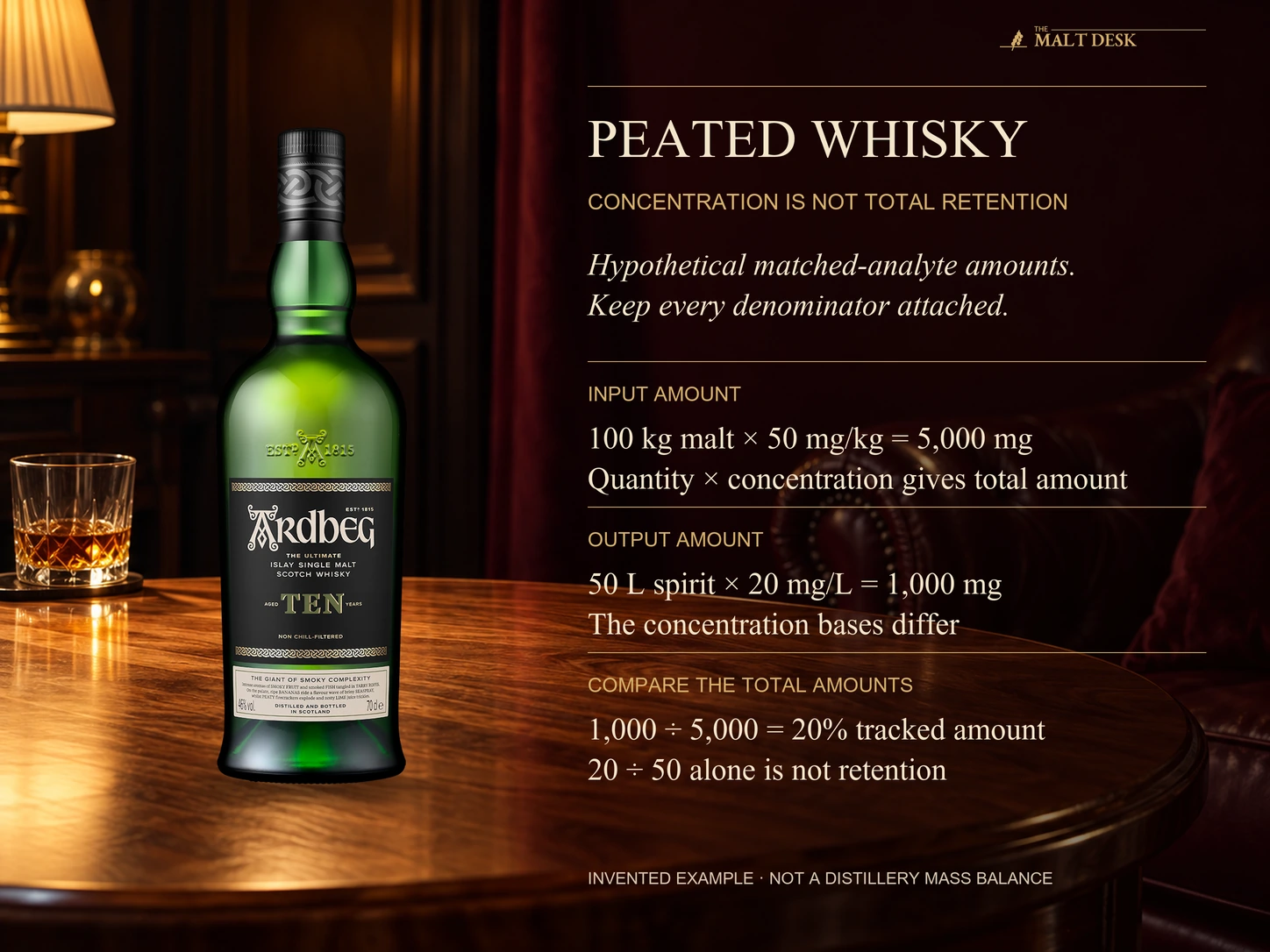
Consider a hypothetical, simplified tracked phenol amount. An input of 100 kg malt measured at 50 mg per kg contains 5,000 mg. An output of 50 liters spirit measured at 20 mg per liter contains 1,000 mg. Under this invented bookkeeping example, the output holds 20% of the input amount, even though dividing the two bare concentration numbers gives 20 ÷ 50 = 40%. The denominators and stream sizes changed.
This is not a whisky-production estimate. It assumes the same tracked analyte, comparable methods and a deliberately simple accounting boundary. A real process can have additional streams and compounds can change. The example only demonstrates why concentration ratios cannot substitute for total-amount accounting: the units and quantities must travel with the numbers.
A Real Two-Stage Disclosure Still Needs Its Labels
Torabhaig’s Exploring Phenols article describes in-grain and residual spirit figures as distinct records. It also contrasts the colorimetric Macfarlane approach with HPLC and notes that more than one method remains in use. Reporting two stages is valuable transparency, but the article does not supply a complete production mass balance from which a reader could calculate a universal survival rate.
There is another reason not to treat the final total as a pure peat-survival meter. A total-phenol result groups compounds; it is not a unique tracer for every molecule deposited by kiln smoke. Changes in the mixture and contributions from later production cannot be sorted into a single origin story by looking at the total alone. A claim about one compound or family needs its own identified measurement.
For a bottle decision, this leaves two useful records rather than one compromised score. Keep the producer’s figures exactly labeled, with missing unit or method information visible. Then use the expression’s attributed smoke vocabulary and any actual tasting notes to investigate preference. The numerical record answers a production question; the sensory record answers how that specific preparation is experienced.
Is Peated Whisky the Same as Islay Whisky?
No. Islay is a Scottish whisky region; peated is a production and flavor style.
Islay is closely associated with peat because several of its best-known distilleries make strongly peated malt. But distillers outside Islay also use peated malt, and Islay producers can release unpeated or lightly peated whisky.
The distinction also cuts across production categories. A single malt may be peated or unpeated. A blended Scotch can include smoky malt components without becoming a single malt. Peat tells you about one flavor-making choice, not how many distilleries or grain types sit behind the label.
Examples of Producer-Described Profiles
All three are peated Islay single malts. To compare them side by side, see our Ardbeg 10, Laphroaig 10 and Lagavulin 16 guide.
Ardbeg 10
The producer of Ardbeg 10 describes citrus, smoke, menthol and maritime associations, with espresso-like dryness in the finish.
Laphroaig 10
The official profile of Laphroaig 10 emphasizes peat smoke, seaweed and medicinal associations, with sweetness and salt-like impressions. These are descriptive comparisons rather than added ingredients.
Lagavulin 16
The producer describes Lagavulin 16 through peat, coastal associations, sweetness and wood. Its sixteen-year statement identifies maturation time.
Describing Smoke Without a Progression Ladder
A guide can distinguish medicinal, earthy, maritime and hearth-like associations. It cannot establish that everyone should begin with one expression and progress toward heavier peat.
When comparing published accounts, note the source and complete expression.
Conditions That Affect Sensory Descriptions
Glass shape, temperature, dilution and sample order can influence perception. Useful notes record those conditions and separate aroma, texture and finish. A change in perceived smoke after dilution does not mean the original malt specification has changed.
There is no universal resting time or fixed water dose that guarantees a clearer profile. Changes should be described as observations under particular conditions.
Common Peated-Whisky Myths
All peated whisky comes from Islay
False. Peat is a style choice; Islay is a place.
The highest ppm bottle is the best
False.
Older whisky loses all peat character
False. Maturation can integrate and reshape peat, but age alone does not erase it.
Smoke comes only from charred casks
False. Charred oak can contribute toast, char and smoke-like notes, but peated malt receives its defining smoke before fermentation.
Peated always means medicinal
False. Medicinal character is one branch of a much wider spectrum that includes aromatic, earthy, maritime, ashy and sweet smoke.
Putting Peat Information in Context
Peat smoke contacts malt before fermentation and distillation. The resulting sensory profile reflects what passes through production and how it interacts with maturation. Technical measurements describe different properties from quality or preference.
Keep the Peat Number With Its Sample
Before comparing peat figures, identify whether each describes malt, new spirit or mature whisky, along with its unit and source. For a survival calculation, obtain the relevant total quantities as well as concentrations. For choosing a whisky style, use expression-specific peat information and attributed aroma descriptions to place that number in a practical context.
Frequently Asked Questions
What exactly is peated whisky?
It is whisky made with malt dried in smoke from burning peat. The smoke deposits phenolic compounds on the damp grain before mashing and distillation.
Is peat added to finished whisky?
No. The defining peat character enters during malt drying. Peat soil or flavoring is not stirred into the mature whisky.
Does peated whisky taste like antiseptic?
Some does, especially in a medicinal style associated with iodine, bandage or tar. Other peated whisky can emphasize bonfire, earth, heather, fruit, ash or sweet smoke instead.
Does higher ppm mean more smoke?
It indicates a more heavily peated malt specification. Distillation, maturation, proof and the mix of phenolic compounds change perception.
Is all Islay whisky peated?
No. Islay is a region, while peated is a style. Peated whisky is also made outside Islay.
What is a good first peated whisky?
There is no universal first expression. Published profiles explain different smoke associations, but a production specification cannot establish which one an individual will prefer.
Should you add water to peated whisky?
Water changes alcohol concentration and can alter the balance of perceived aromas. The effect depends on the whisky and dilution.
Is smoky whisky always peated?
No. Charred oak and other production choices can create smoke-like aromas. Peated specifically refers to peat smoke used during malt preparation.
Sources
Ardbeg production information; Laphroaig whisky-making guide; Dr Mike Billett’s Exploring Phenols article published by Torabhaig; official product profiles for Ardbeg 10, Laphroaig 10 and Lagavulin 16.
The arithmetic concerns total amounts of a hypothetically consistent tracked analyte.