Understanding a Whiskey Budget
A larger bottle can be cheaper per milliliter while being the wrong purchase for a $50 limit. The useful budget comparison needs two totals: the cash required now and the quantity that actually has an identified use. A unit-price discount cannot answer either question on its own.
I would separate a planned recipe requirement from an open-ended wish to stock a shelf. The first can be calculated. The second may justify extra quantity, but only if that quantity has value to the buyer rather than merely making the unit-price column look attractive.
A $50 ceiling is a planning budget, not a whisky category or a verified shelf price. It does not establish availability in every state or which style offers the most enjoyment. This guide separates bottle quantity, strength, production category and the total of a dated local offer.
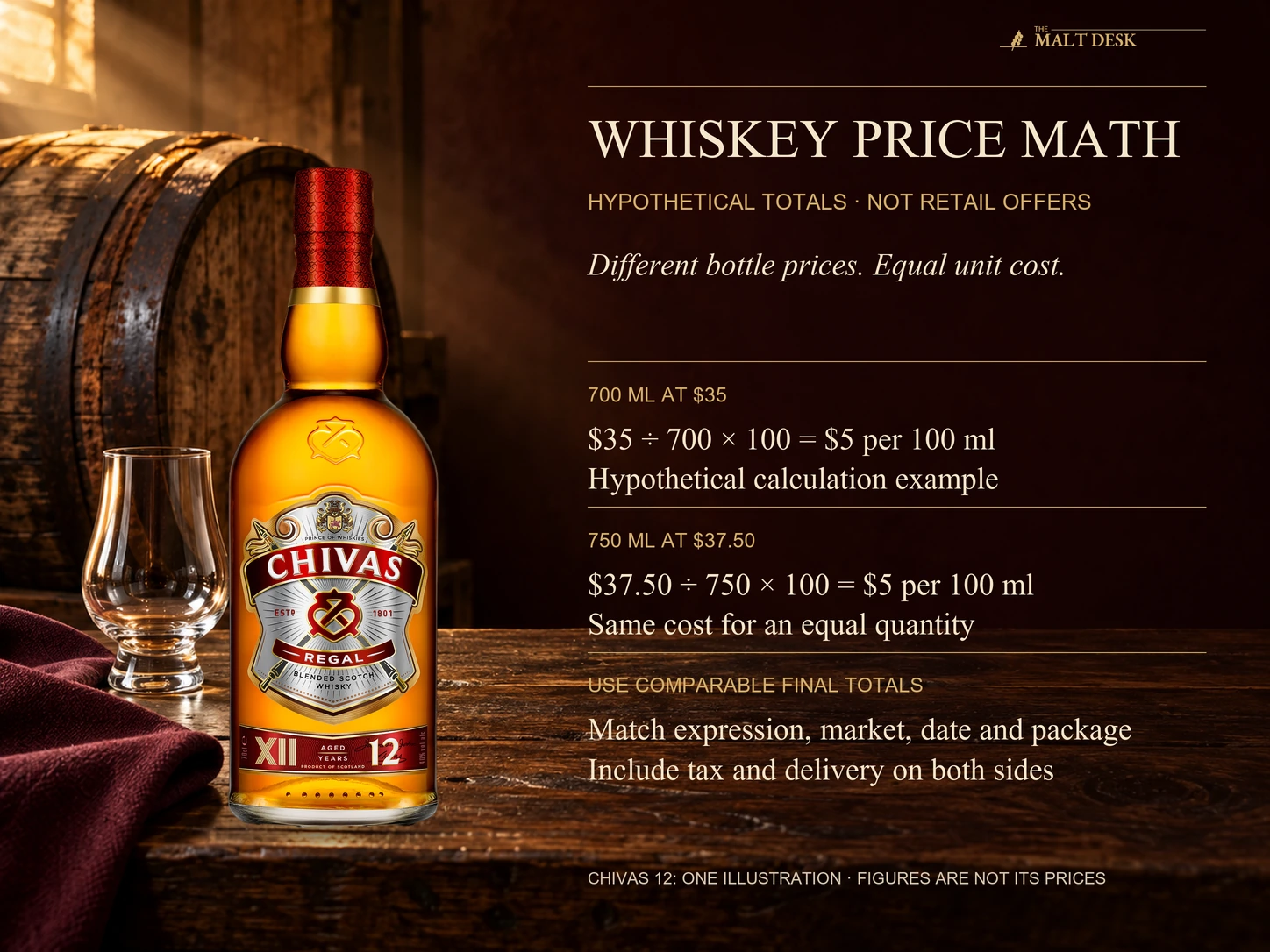
The illustration above shows how two different bottle prices can have the same cost per 100 ml. Its figures are hypothetical calculation examples, not current store offers. The eight expressions below illustrate label and production differences; the table does not establish that any bottle currently costs less than $50.
Compare the Same Quantity First
Bottle prices are meaningful only when their volumes match. A 700 ml bottle contains about 6.7% less liquid than a 750 ml bottle. A 1-liter bottle contains one-third more than a 750 ml bottle. Photographs and familiar brand names can make these format differences easy to overlook.
For a neutral comparison, calculate price per 100 ml: divide the price by bottle volume in milliliters, then multiply by 100. A hypothetical $35 price for 700 ml equals $5 per 100 ml; $37.50 for 750 ml gives the same unit price. These figures are calculation examples, not market quotes.
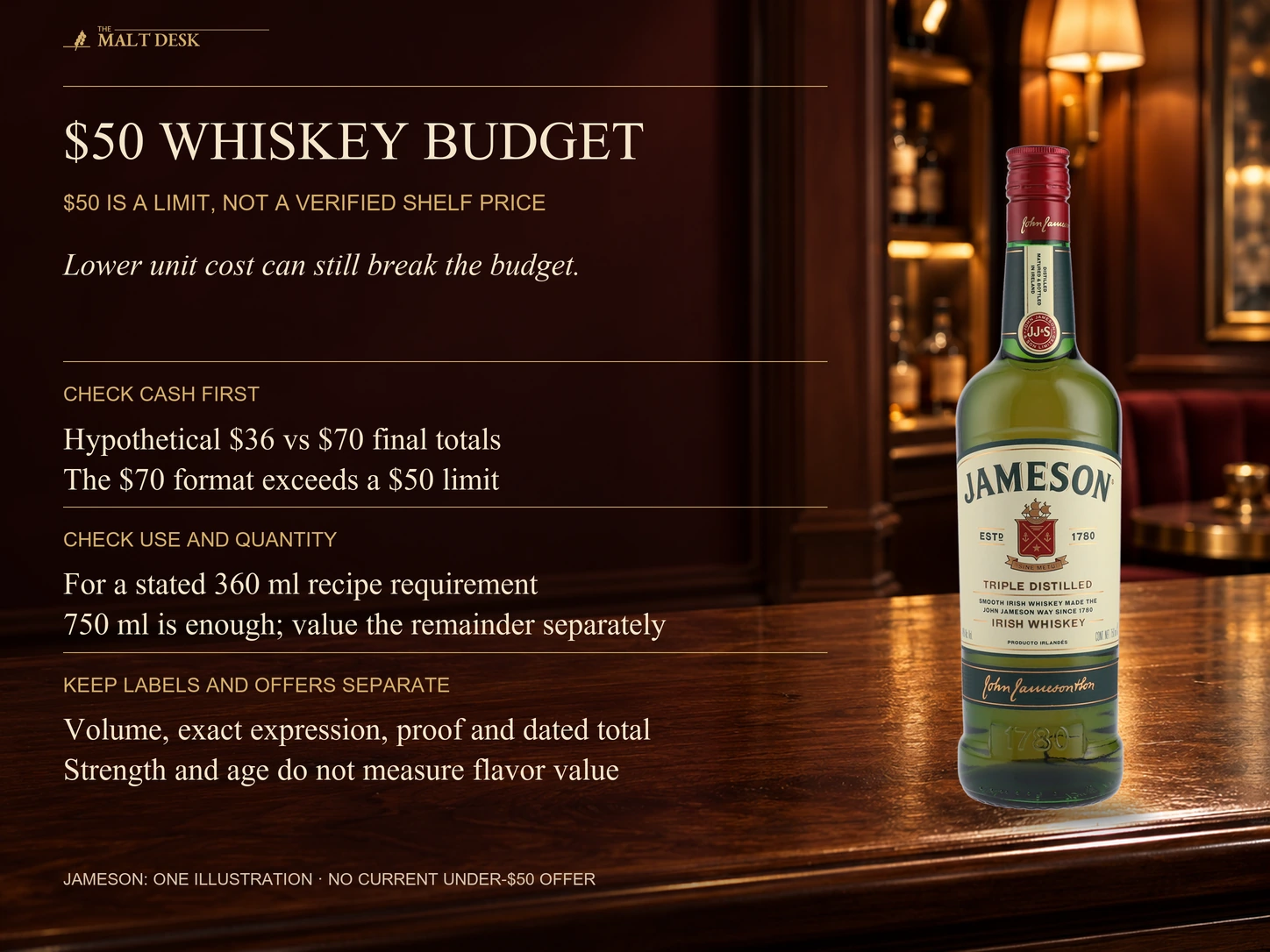
If the budget includes tax or other charges, compare final totals. A shelf price just below $50 can still exceed a $50 all-in limit. A membership offer or one-time promotion also has different conditions from a regular listed price.
Eight Expressions and What Their Labels Establish
| Expression | Category | Common ABV | Factual distinction |
|---|---|---|---|
| Wild Turkey 101 | Bourbon | 50.5% | 101 US proof |
| Maker’s Mark | Bourbon | 45% | Wheated grain recipe |
| Buffalo Trace | Bourbon | 45% | 90 US proof |
| Jameson Original | Blended Irish whiskey | 40% | Pot still and grain whiskey blend |
| Jack Daniel’s Old No. 7 | Tennessee whiskey | 40% | Charcoal mellowing before maturation |
| Chivas Regal 12 | Blended Scotch | 40% | 12-year age statement |
| Glenfiddich 12 | Single malt Scotch | 40% | Single-distillery, 12-year expression |
| The Glenlivet 12 | Single malt Scotch | 40% | Single-distillery, 12-year expression |
The table identifies products; it does not claim they currently cost less than $50. Check the exact expression, strength and size on the bottle in the relevant market. Other releases carrying the same brand name can have substantially different specifications.
Comparing Proof and Bottle Cost
US proof is twice ABV. Thus 80 proof is 40%, 90 proof is 45%, and 101 proof is 50.5%. At a fixed 30 ml pour, these strengths contribute 12 ml, 13.5 ml and 15.15 ml of pure alcohol respectively.
That makes Wild Turkey 101 the highest-strength expression in the table, but it does not make it an objective winner for flavor, texture or cocktail performance. A lower-strength whiskey can have a distinctive aroma, and a higher-strength one can still be unsuitable for a particular preference.
Adding water changes concentration without removing the alcohol already poured. For example, 30 ml of 50.5% whiskey plus 10 ml water is approximately 37.9% ABV before any ice melt. This arithmetic can explain dilution.
Bourbon: Compare Recipe and Expression
Maker’s Mark uses wheat in its grain recipe. The brand’s product notes describe vanilla and fruit. This is useful information about the producer’s intended style, but wheat alone does not prove that every reader will find it softer or sweeter than every rye-containing bourbon.
Buffalo Trace shares the standard 45% strength of Maker’s Mark. Its producer describes vanilla, mint and molasses.
Use the complete name when comparing Wild Turkey 101 with another Wild Turkey bottling or standard Maker’s Mark with a cask-strength release. A brand-wide claim can easily substitute one product’s specifications for another’s.
Irish and Tennessee Whiskey: Different Production Examples
Jameson Original combines pot still and grain whiskey. Its common 40% strength is shared by many products, but its Irish blend category is different from bourbon and Scotch. Jameson Black Barrel and other releases should be treated as separate expressions.
Jack Daniel’s Old No. 7 provides a Tennessee whiskey example, including charcoal mellowing before cask maturation. The process is a production distinction. Its suitability for a mixed drink depends on the recipe and personal preference.
Scotch: Blends and Single Malts Are Parallel Categories
Chivas Regal 12 is a blend of malt and grain Scotch. Its age statement means the youngest whisky is at least 12 years old. It is not an average age and does not describe one distillery’s production.
Glenfiddich 12 and The Glenlivet 12 are single malts. Each comes from its own distillery, but may combine many casks. A single malt is not a “higher category” than a blend, and its category does not establish a universal price premium.
The producers describe different fruit profiles: Glenfiddich emphasizes pear, while The Glenlivet includes banana, pineapple and orchard fruit in its notes.
A Bulk Discount Can Fail the Actual Budget
Take two purely hypothetical offers for the same expression: 750 ml at a final total of $36, and 1,750 ml at $70. Their costs per 100 ml are $4.80 and $4.00. The larger bottle is about 16.7% cheaper per unit, yet it exceeds a $50 cash ceiling by $20. Calling it the value winner without that cash check would recommend a purchase the stated budget cannot fund.
Now suppose an already planned set of recipes requires twelve measured 30 ml portions, totaling 360 ml. Either format contains enough. The first leaves 390 ml and the second leaves 1,390 ml. Both remainders are still usable whisky, not automatically waste, but the larger remainder needs a reason to be wanted. The calculation is about an existing recipe requirement, not a suggestion to create more occasions to use the bottle.
| Hypothetical option | Cash paid now | Cost per 100 ml | Liquid beyond the 360 ml requirement |
|---|---|---|---|
| 750 ml bottle | $36 | $4.80 | 390 ml |
| 1,750 ml bottle | $70 | $4.00 | 1,390 ml |
If the twelve portions are the only use the buyer currently values, allocating the whole outlay to that purpose gives $3.00 versus about $5.83 per planned portion. Those figures deliberately assign no value to the remainder. They are not the physical liquid cost per pour, which is $1.44 versus $1.20 at 30 ml. The two calculations answer different questions: unit consumption cost and cash committed to the known purpose.
If a buyer already values the remaining whisky, that zero-remainder-value assumption is inappropriate. Compare the formats against the buyer’s actual continuing need while retaining the immediate budget check. It is perfectly consistent to call the larger format cheaper per unit and still select the smaller one for this purchase.
A Practical Comparison Record
Record the full expression, volume, ABV, total cost, location and date. Note whether the price depends on a membership or promotion. This creates a comparison that can be understood later instead of turning a temporary observation into a permanent price claim.
Keep subjective observations in separate fields from specifications. “45% ABV” is a label fact. “I prefer this aroma” is an individual response. “Best value” combines a preference with a particular cost and cannot be treated as a universal property of the bottle.
For mixed drinks, the mixer, garnish and recipe affect the result as well as the whiskey. Comparing one bottle neat with another in cola does not isolate their differences. Consistent glassware, measured amounts and a single changed ingredient make a comparison easier to interpret.
In Brief
Treat $50 as a planning limit and record dated local offers for equivalent bottles. Proof, age statement and category explain the label; they do not establish current availability or better value.
Make the Bottle Size Fit the Actual Budget
Set the maximum checkout amount and the quantity you expect to use before comparing formats. A larger bottle earns its place only when both the cash outlay and that quantity fit the plan. When the aim is learning about an unfamiliar expression, compare the cost of a smaller format with the cost of committing to unused liquid in a larger one.
Common Questions
Does higher proof mean more quality for the money?
No. It means more alcohol per equal volume.
Can an older price establish that a bottle is under $50 today?
No. It establishes only a historical observation under its recorded conditions. A current budget comparison needs current local information.
Should the full budget always be used?
A budget is a limit, not evidence that a higher-priced expression is necessary. Understanding the product and the intended use is more useful than treating the most expensive option within the limit as the winner.
Why can two bottles with the same name have different prices?
Check volume, expression, ABV and package contents first. Then consider the date, market and offer conditions. A different asking price alone does not prove a different formulation or authenticity.
Budget analysis note: all offers and recipe requirements in the bulk-format example are hypothetical. The arithmetic uses final totals and stated volumes.
Sources
Producer product information for the eight named expressions, U.S. distilled-spirits labeling principles for proof and bourbon terminology, and Scotch Whisky Association guidance on Scotch categories and age statements. The guide provides a method for comparing exact dated local offers.