Woodford’s standard bourbon, Double Oaked and Double Double Oaked let a reader follow a barrel question without automatically moving to higher bottle strength. The producer lists 90.4 proof for both oak-focused variants, matching the standard bourbon’s 45.2% ABV. The useful distinction is what happens after the first barrel, rather than how many times the word double appears.
Double Double Oaked is a particularly revealing name: it sounds as though it could mean four barrels, yet the producer describes a double-barreled bourbon with extended time in the second barrel. I would use that documented sequence to navigate the range. Repeating a marketing word is not a reliable way to count either casks or years.
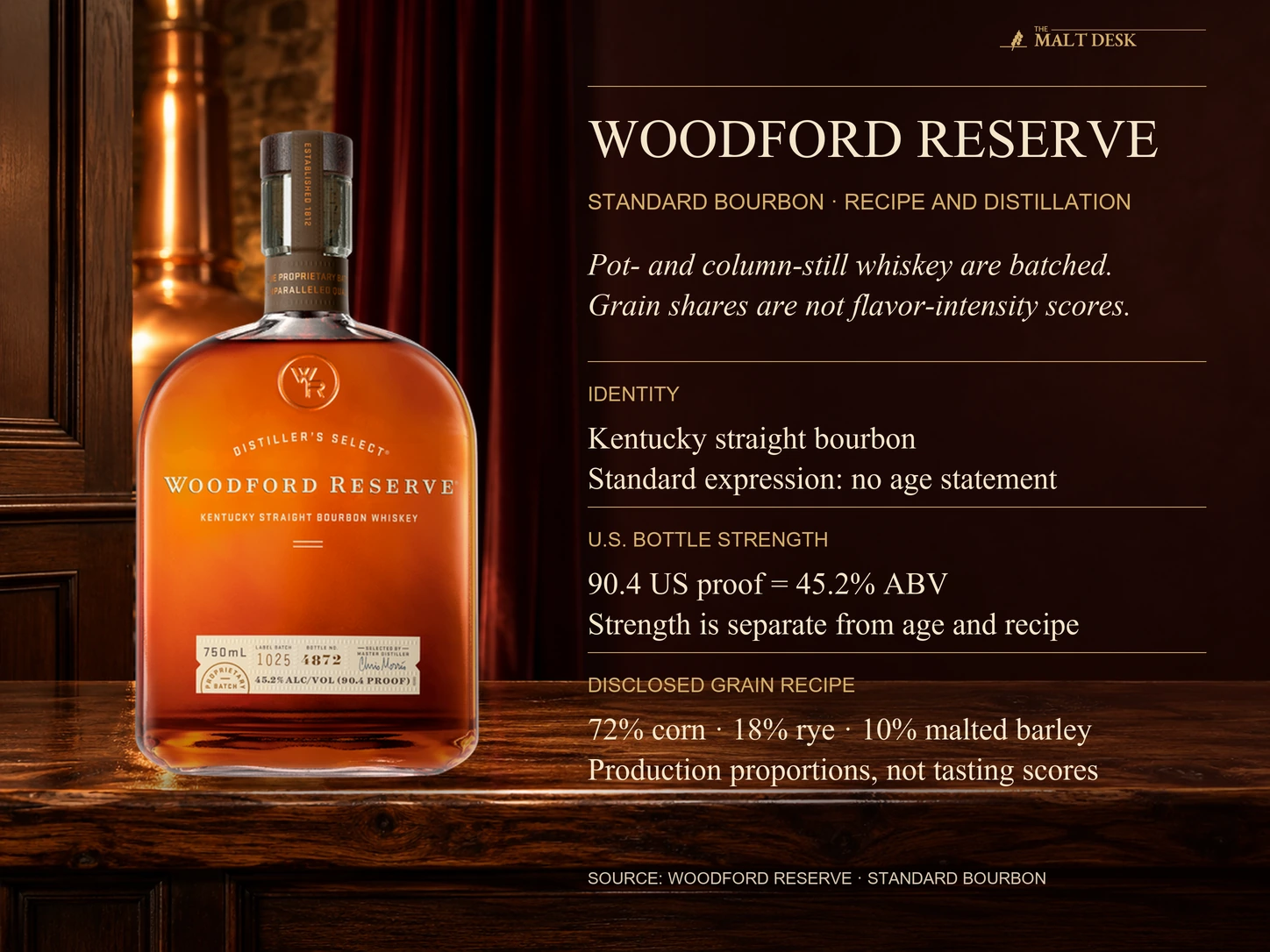
Woodford Reserve Kentucky Straight Bourbon is bottled at 90.4 proof, or 45.2% ABV, in its standard US presentation. The producer discloses a grain recipe of 72% corn, 18% rye and 10% malted barley and describes batching whiskey from both pot stills and column stills.
The combination of a disclosed recipe and two distillation methods gives the expression a specific production identity. Its official flavor notes emphasize dried fruit, citrus, cocoa, sweet-associated aromas and spice.
Standard Bourbon Specifications
| Item | Woodford Reserve Kentucky Straight Bourbon |
|---|---|
| US bottling strength | 90.4 proof / 45.2% ABV |
| Age statement | None |
| Corn | 72% of the grain recipe |
| Rye | 18% |
| Malted barley | 10% |
| Distillation account | Batching of pot-still and column-still whiskey |
| Maturation | New charred white-oak barrels |
Reading the Grain Recipe
The mash bill records the proportions of grains used in production. Corn is the largest component, while rye and malted barley make up the rest. The producer connects this combination with sweet, spicy and nutty characteristics.
Eighteen percent rye does not make the product rye whiskey. Category and grain recipe are related, but the category depends on the applicable production requirements as a whole. The bottle identifies this expression as Kentucky straight bourbon.
Why Both Still Types Matter
Woodford’s official account describes combining pot-still whiskey and column-still whiskey. This is more precise than describing every part of the standard expression as exclusively pot-distilled. It also differs from simply counting the number of distillations performed on one component.
The combination remains a straight bourbon expression. The presence of different still types should not be confused with the definition of blended Scotch, which uses a different classification system. A useful production account names the methods without importing category meanings from another country.
Maturation and the Age Disclosure
The producer describes new charred white-oak barrels and heat-cycled warehouses. The standard bottle does not carry a specific age statement. Under US labeling requirements, whiskey younger than four years generally requires an age statement; that supports a minimum-age inference for this standard straight bourbon, not a claim about its exact batch age.
A report that a brand typically uses a particular range of ages is different from a minimum age printed on every bottle. For a precise product record, keep “no age statement” separate from any independently documented batch information.
The Official Flavor Profile
Aroma
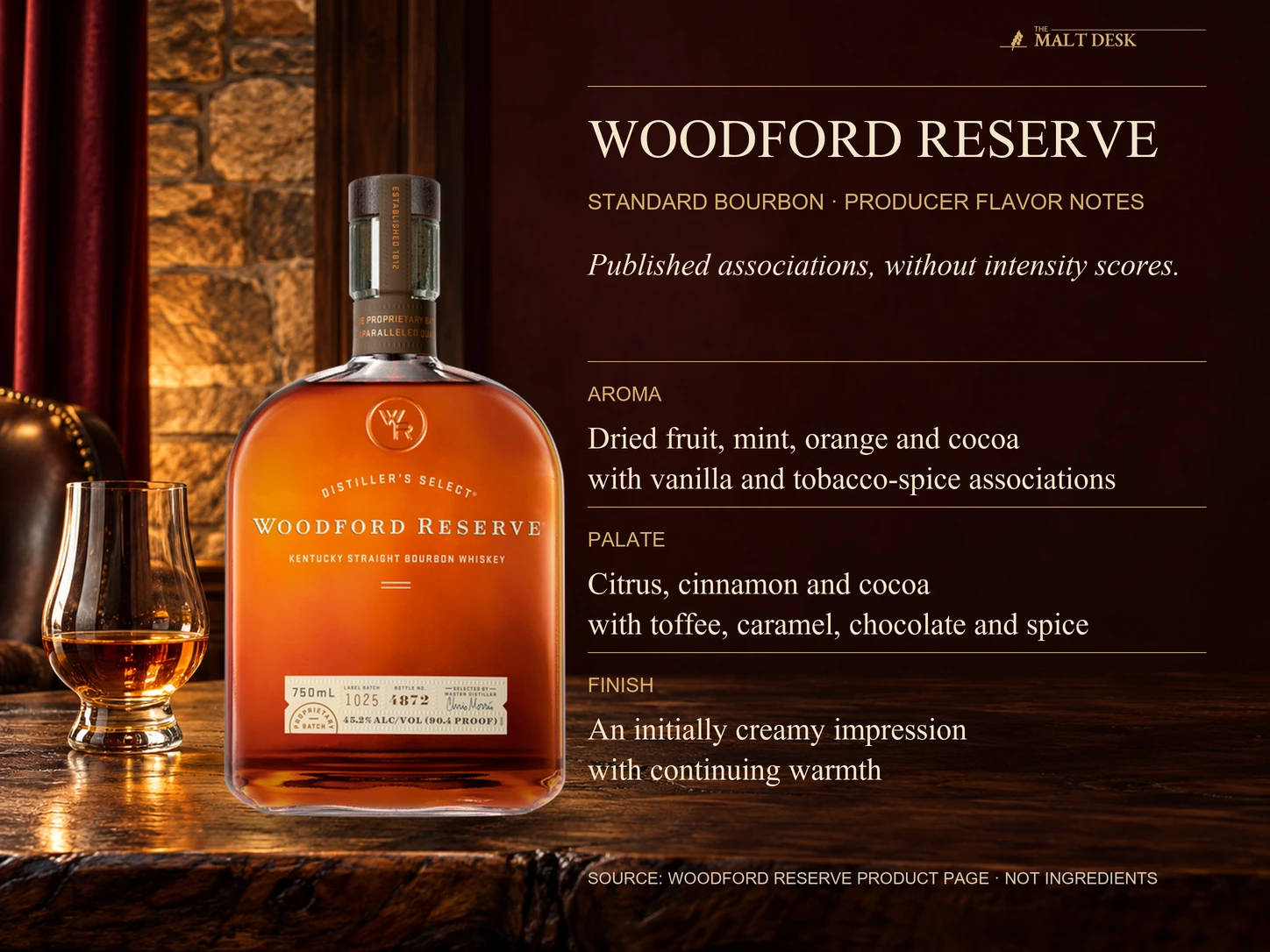
Woodford’s published aroma description combines dried fruit with orange, mint, cocoa, vanilla and spice. These terms describe sensory associations, not flavorings added to the bourbon.
Palate
The producer highlights citrus, cinnamon and cocoa alongside toffee, caramel and chocolate-like notes. It describes the texture as rounded and substantial. Texture is a separate sensory dimension from the presence of a particular aroma.
Finish
The official finish description emphasizes a creamy impression and continuing warmth. A comparative judgment about whether that finish is longer or shorter than another bourbon would require a stated evaluation of both expressions.
What 90.4 Proof Measures
Under the US convention, proof is twice the ABV percentage, so 90.4 proof corresponds to 45.2% ABV. It describes alcohol concentration by volume. A bottle’s capacity, age statement and mash bill are separate specifications.
Comparing labels can identify a concentration difference, while sensory preference remains individual.
Follow the Second Barrel, Not the Repeated Name
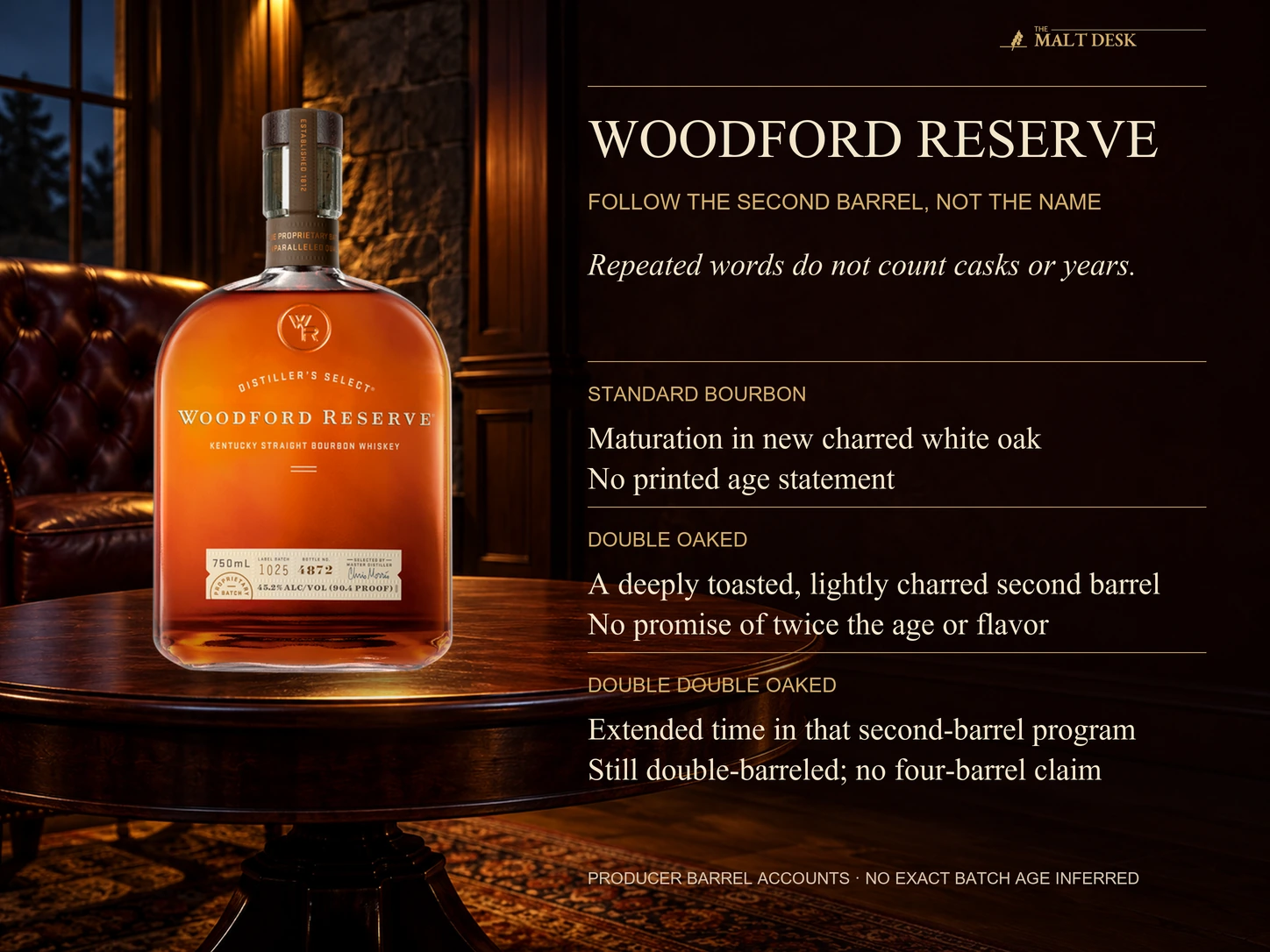
The first stage belongs to the bourbon’s maturation in new charred oak. For Double Oaked, Woodford describes a second barrel that is deeply toasted and then lightly charred. Toasting and charring are separate treatment descriptions; this is not simply a promise that twice the wood produces twice the flavor. The barrel history is the disclosed change, while its sensory effect remains the producer’s account or a question for an actual comparison.
| Expression | Documented barrel path | What the name does not establish |
|---|---|---|
| Standard bourbon | New charred white oak | An exact age for this non-age-stated expression |
| Double Oaked | An additional deeply toasted, lightly charred barrel | Twice the first-stage age or twice the flavor |
| Double Double Oaked | Extended time in the second barrel; described as double-barreled | Four barrels, a third-barrel stage, or a numerical age statement |
That last distinction matters when someone wants a more developed version of the second-barrel treatment. The current Double Double Oaked product page identifies extended second-barrel maturation, which answers the structural question. It does not give enough timing detail to calculate a precise total age for a bottle on a shelf.
A Duration Limit Cannot Be Added as a Minimum Age
The January 2025 launch announcement also needs careful reading. Its master-distiller account describes five to seven years in the first barrel, then up to two in the second. Another passage describes finishing the fully mature Double Oaked for an additional two years. Those formulations do not establish one unambiguous timeline. I would retain the shared two-barrel account and leave the exact duration unresolved, rather than silently turn the announcement into a batch age.
Even the first formulation cannot justify a seven-year minimum: five years plus up to two years is not five years plus at least two. A ceiling on one stage does not become a floor for the complete whiskey. Similarly, adding an extra stage to the process does not create a printed age statement. This keeps the comparison useful without making the range sound older than its disclosures support.
Standard Bourbon, Double Oaked and Batch Proof
Woodford Reserve is a range rather than one interchangeable specification. Double Oaked includes an additional barrel-maturation stage. Batch Proof releases carry their own strengths. The 90.4-proof standard bourbon described here should not be used as the specification for either of those expressions.
The same rule applies to special packaging and limited editions: use the full product name and label before transferring an age, barrel treatment or ABV from one bottle to another.
Comparing Related Bourbons
Maker’s Mark uses wheat in place of rye as a secondary grain, providing a concrete recipe comparison. That difference does not prove that one bourbon is always sweeter or gentler.
Wild Turkey 101 supplies a clear proof comparison at 101 proof. Buffalo Trace is bottled at 90 proof. Strength and disclosed production details can be compared directly; a flavor or value ranking needs additional evidence.
Price and Availability Records
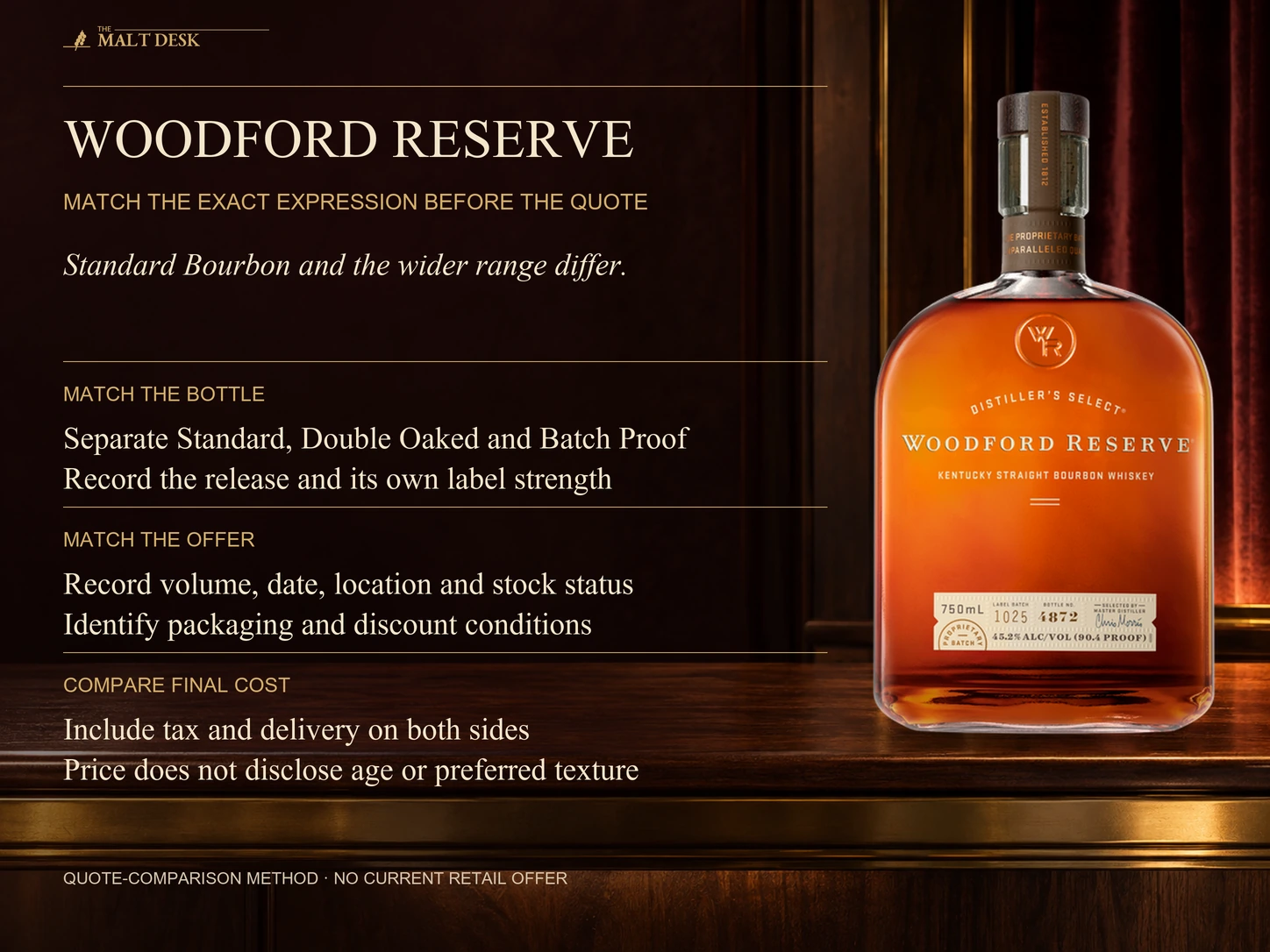
A useful price comparison identifies the exact expression, date, location, volume, stock status and taxes. Standard bourbon, Double Oaked and Batch Proof should be separate rows. A historical retailer offer is not a current nationwide price.
Price also reflects factors beyond the liquid’s measurable specifications. A higher price does not demonstrate longer maturation or a preferred texture unless those claims have their own support.
In Brief
Woodford Reserve’s standard bourbon is identified by its 72% corn, 18% rye and 10% malted-barley mash bill and 45.2% ABV. Keep it separate from Double Oaked and Batch Proof when comparing bottles.
Choose the Woodford Barrel Stage You Want to Explore
Use standard Woodford Reserve as the reference bourbon, Double Oaked for the documented second-barrel treatment, and Double Double Oaked for the additional time described in that program. Their shared 90.4-proof references make the barrel sequence a particularly relevant comparison. Decide which stage interests you before paying for another expression in the family.
Frequently Asked Questions
What is the mash bill?
The producer discloses 72% corn, 18% rye and 10% malted barley for its standard bourbon recipe.
Is all of it distilled only in pot stills?
The producer’s account describes batching whiskey made in pot stills with whiskey made in column stills.
How old is it?
The standard expression has no age statement. A labeling-based minimum-age inference should not be presented as an exact age for the batch.
Is 90.4 proof the same as 90.4% alcohol?
No. It corresponds to 45.2% ABV under the US proof convention.
Sources
Woodford Reserve official Bourbon Whiskey product page and Our Story production account; US whiskey age-statement requirements; official product information for Maker’s Mark, Wild Turkey 101 and Buffalo Trace. Flavor descriptions are attributed to Woodford Reserve.
Range analysis note: barrel descriptions come from Woodford Reserve’s product pages and its January 2025 launch announcement. The announcement’s different timing formulations are kept distinct; no exact batch age or additional barrel is inferred.