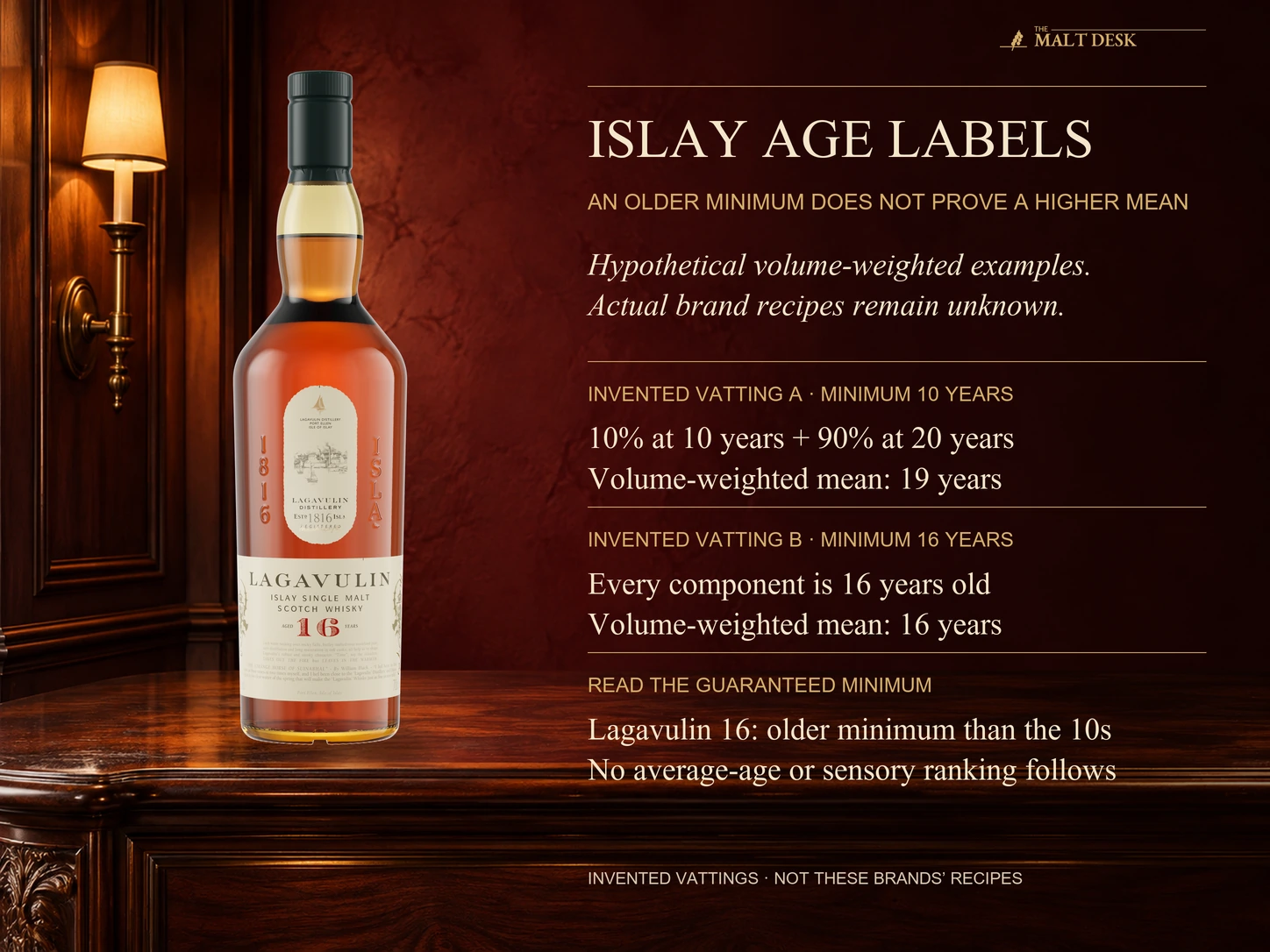
Lagavulin 16 guarantees an older minimum than Ardbeg 10 or Laphroaig 10. It does not prove that the average age of its contents is older than theirs. That distinction is easy to miss when the three bottles are arranged in numerical order, and it changes what a reader can reasonably call an age upgrade.
The comparison still offers three useful, different identities. The age statement supplies a floor for each; the distillery and published profile supply other information. I would keep the minimum-age advantage visible without making it stand in for an undisclosed average, a guaranteed softer smoke profile or a price-per-extra-year calculation.
Ardbeg 10, Laphroaig 10 and Lagavulin 16 are peated single malt Scotch whiskies from Islay. Their age statements, bottling strengths and published production details make a useful comparison, but they are not three fixed steps on a mild-to-strong scale.
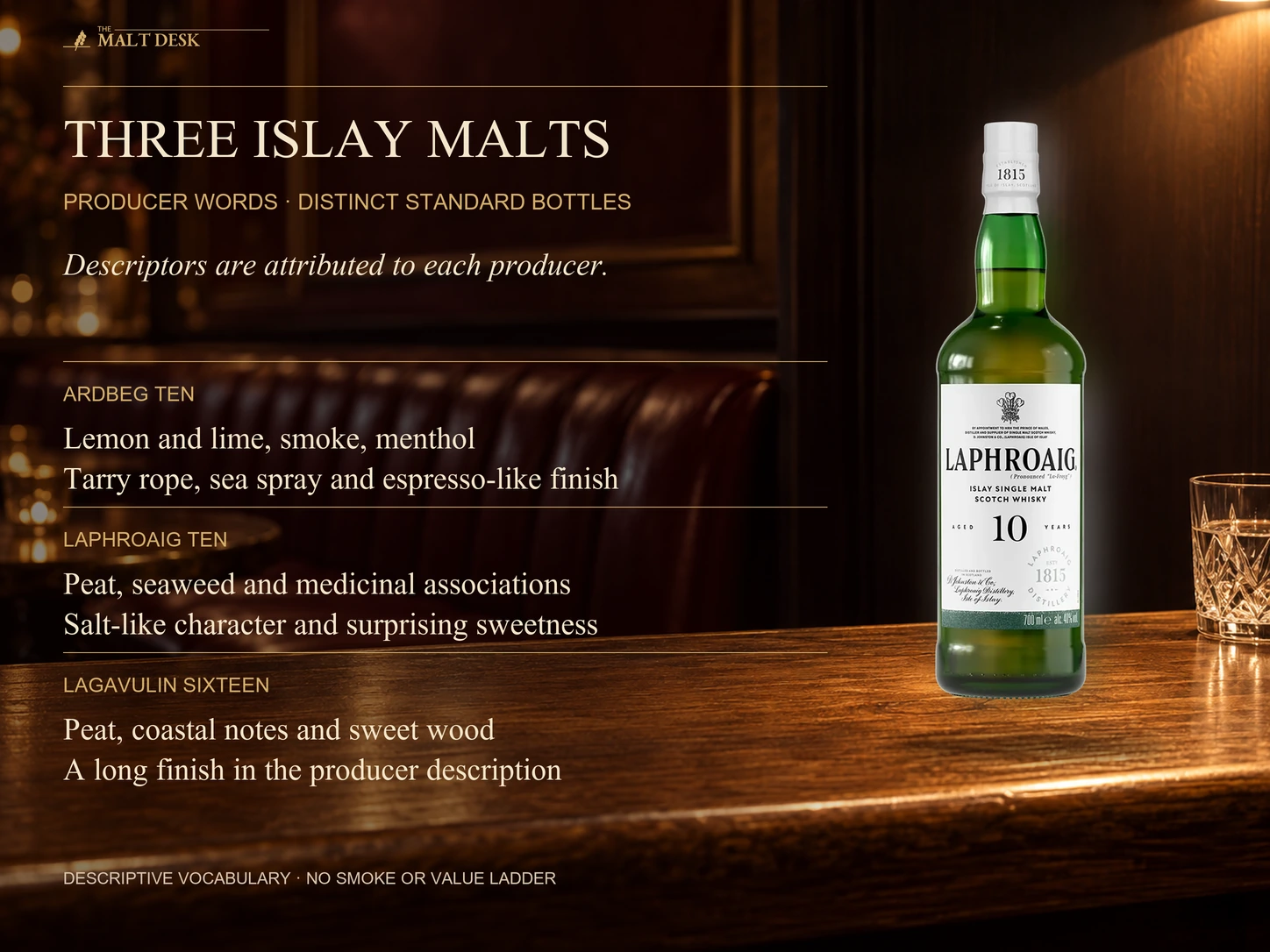
Ardbeg’s official description combines citrus and smoky maritime associations. Laphroaig emphasizes peat, seaweed and medicinal aromas alongside sweetness. Lagavulin describes peat, coastal notes, sweetness and wood. These are the producers’ descriptions of different expressions, rather than a universal ranking of intensity or quality.
Specifications Side by Side
| Feature | Ardbeg 10 | Laphroaig 10 | Lagavulin 16 |
|---|---|---|---|
| Origin | Islay, Scotland | Islay, Scotland | Islay, Scotland |
| Category | Single malt Scotch | Single malt Scotch | Single malt Scotch |
| Age statement | 10 years | 10 years | 16 years |
| Bottling strength | 46% ABV | Market-dependent; check 40% or 43% label | 43% ABV |
| Published cask description | Bourbon casks | Ex-bourbon barrels | Oak maturation for at least 16 years |
| Filtration detail | Producer states non-chill-filtered | No filtration claim established here | No filtration claim established here |
What Their Shared Islay Origin Means
Islay identifies geographical origin. Single malt describes whisky made at one distillery from malted barley, using pot still production. The three bottles come from different distilleries and have their own production and maturation choices.
Peat smoke used during malt preparation contributes compounds associated with smoky aromas. The final sensory character also reflects distillation, casks, maturation and bottling strength. Sharing an island and a production category therefore does not make the expressions interchangeable.
The Producers’ Flavor Descriptions
Ardbeg 10: citrus within a smoky profile
Ardbeg’s official notes describe lemon and lime with smoke, menthol and tar-like maritime associations. Its palate description includes brine and fruit, while its finish description uses espresso and peat-oil comparisons. The point of the vocabulary is contrast: fruit and smoke appear together.
The 46% ABV and non-chill-filtration statement are verifiable presentation details.
Laphroaig 10: medicinal and maritime vocabulary
Laphroaig’s published profile places peat smoke, seaweed and medicinal associations near the center, with salt-like impressions and sweetness. Medicinal is a sensory analogy; it is not a claim that medicine or iodine was added to the bottle.
Laphroaig 10 appears at different strengths in different markets. Record the printed ABV and volume of the exact bottle under discussion. A comparison using a 40% bottling should not silently borrow the specification of a 43% version.
Lagavulin 16: peat, sweetness and wood
Lagavulin’s official profile combines peat smoke and coastal associations with sweetness and wood. The producer describes a long finish. Its sixteen-year minimum age is a documented distinction from the two ten-year expressions, while greater smoothness or integration would be a sensory judgment requiring attribution.
The Lagavulin 16 product guide explains its specification separately. The standard product page’s broad oak-maturation description should not be expanded into an exact bourbon-to-sherry cask ratio.
Read the Sample Behind a Peat Number
Parts per million, or ppm, may describe a measurement at a particular production stage, commonly the malt. A malt specification and a measurement of finished whisky are different records. Comparing numbers from different stages or methods can create a misleading ranking.
Perception also depends on the kind of smoky association and on the rest of the flavor profile. A medicinal note may stand out strongly to one person, while another notices ash or tar more readily. Sweetness and fruit can coexist with smoke without eliminating it.
A useful comparison therefore names the reported descriptors before trying to rank intensity. “Citrus and smoke” and “medicinal and seaweed-like” communicate different profiles without asserting that one must be stronger.
Age, Strength and Texture Are Separate Questions
Lagavulin 16 has an older minimum age, while Ardbeg 10 has the highest stated ABV in the standard versions compared here. These facts describe different properties.
Texture terms such as oily, silky or drying describe perception. Non-chill filtration is a production disclosure. Comparing the label facts separately from the tasting language keeps the evidence clear.
An Older Minimum Does Not Establish an Older Average
A hypothetical ten-year single-malt vatting could contain 10% whisky aged ten years and 90% aged twenty. Its volume-weighted arithmetic average would be nineteen years, yet its youngest component requires a ten-year statement. A hypothetical vatting whose components were all sixteen years old would have both a sixteen-year minimum and a sixteen-year average. The ordering of the printed minima would be opposite to the ordering of these calculated averages.
| Invented vatting | Youngest component | Volume-weighted illustrative average |
|---|---|---|
| 10% at 10 years; 90% at 20 years | 10 years | 19 years |
| All components at 16 years | 16 years | 16 years |
These examples are not recipes for Ardbeg, Laphroaig or Lagavulin. They show a logical limit of the information on their labels. We do not need to guess that older components are present to reach it: without the actual age distribution, the average simply remains unknown. A larger stated minimum is real additional assurance, but it is assurance about the youngest whisky.
Do Not Price Six Extra Years as a Uniform Ingredient
The labels do not establish that each component in Lagavulin spent exactly six more years in wood than a component in either ten-year expression. Prices also do not disclose the marginal cost of maturation. The calculation would turn two minimum guarantees into a manufacturing account they cannot supply.
A useful price decision instead compares the complete offers: exact expression, bottle volume, local total and the documented minimum-age guarantee the reader values. An actual sensory decision can compare the producers’ citrus-and-smoke, medicinal-and-seaweed, and peat-sweetness-wood directions. These are different reasons for choosing, and neither needs a fictitious average age to be coherent.
Price Comparisons Need Matched Details
A comparable price record needs the same market, date, bottle volume and tax treatment, as well as the correct expression and stock status. Similar names can conceal important differences: standard Ardbeg 10 and a Ten Cask Strength release are distinct products, as are standard Laphroaig 10 and its Cask Strength edition.
Historical retailer snapshots do not establish current nationwide prices. An age premium also cannot be interpreted as payment for a guaranteed increase in smoky intensity. Market pricing and sensory preference answer different questions.
How to Keep Comparative Notes Useful
Separate the source of each statement: printed label, producer description, named reviewer or personal observation. Product information can establish an age or ABV.
For sensory comparisons, keep aroma, palate, texture and finish distinct and record conditions such as glassware, temperature and dilution. A note about medicinal aroma is not the same as a note about alcohol heat. A finish described as long does not necessarily contain more peat compounds.
In Brief
The three bottles are peated Islay single malts, but their published profiles describe different balances of smoke, fruit, sweetness and oak. Compare matching bottle formats and dated price records when considering value.
Choose the Islay Age Guarantee You Actually Need
If the requirement is a sixteen-year minimum, Lagavulin 16 supplies that label promise; Ardbeg 10 and Laphroaig 10 supply ten-year minimums and their own distillery profiles. If the main interest is a particular smoke character, start with those expression-specific notes instead. Decide whether age assurance or style is driving the choice before comparing the price premium.
Frequently Asked Questions
Which is objectively the smokiest?
A defensible measured comparison would need a defined metric and comparable samples; perceived intensity also varies by descriptor and individual.
Does Lagavulin’s age mean it is less peated?
The age statement alone cannot answer that. It identifies minimum maturation time, not the peat level of the malt or the sensory intensity of the finished whisky.
Why do Laphroaig 10 labels show different strengths?
Market presentations differ. Use the ABV printed on the exact bottle rather than assuming that every standard 10-year release is identical across markets.
Are they all single cask whiskies?
No. Single malt refers to one distillery and the production category, not to one cask. The standard expressions can combine whisky from multiple casks.
Sources
Official standard-expression product pages from Ardbeg, Laphroaig and Malts for Lagavulin 16.
Age comparison note: the two vatting recipes are hypothetical mathematical counterexamples, not producer disclosures for these bottles. Label ages are minimum guarantees.