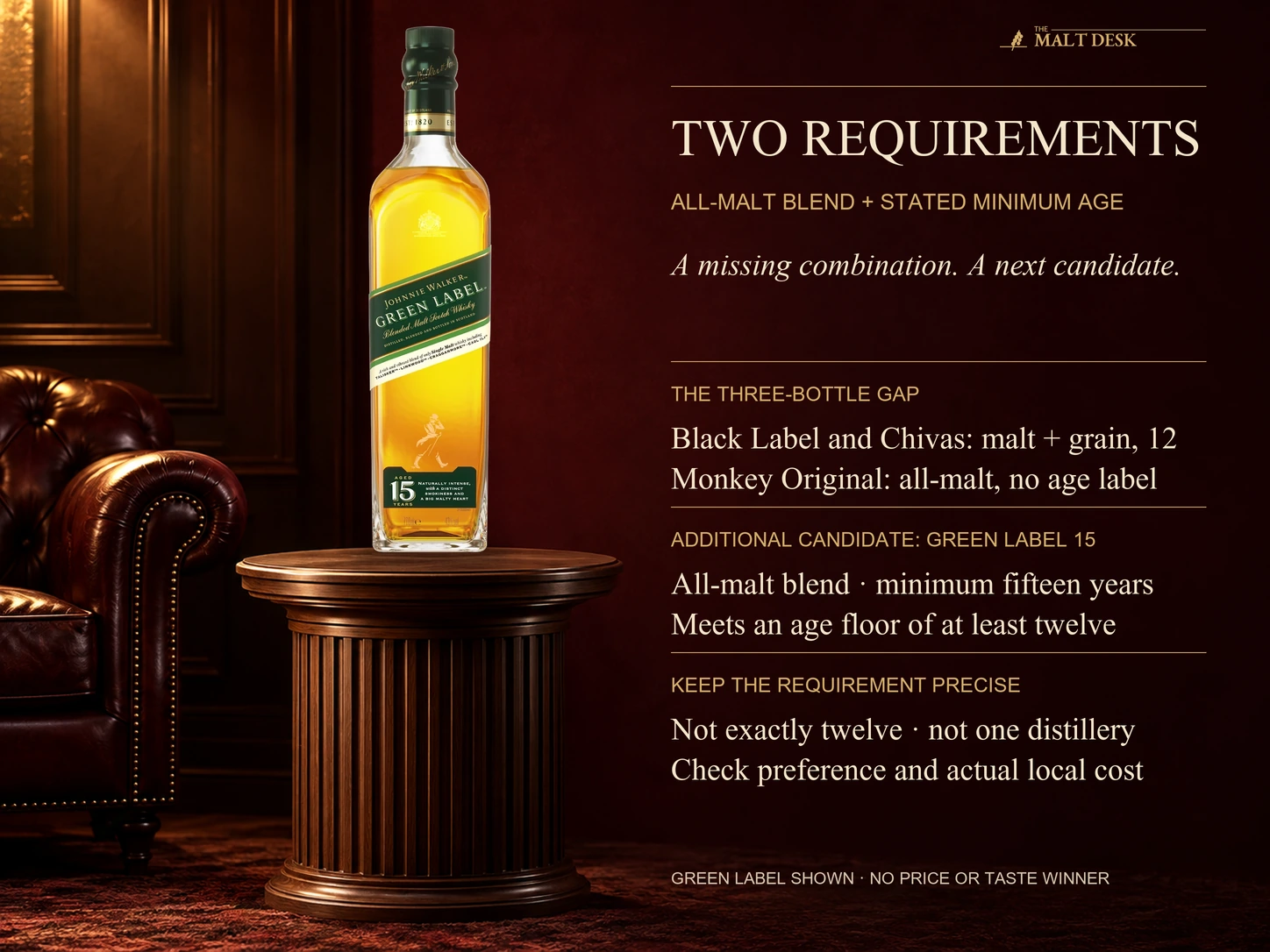
If your requirements are an all-malt blend and a stated minimum of at least twelve years, this three-bottle comparison leaves a gap. Monkey Shoulder supplies the all-malt category; Black Label and Chivas 12 supply the stated age. There is a concrete next expression to investigate: Johnnie Walker Green Label 15 combines an all-malt blend with a fifteen-year minimum.
That extra option does not replace the three profiles below or establish a winner. It answers the question that a shortlist can otherwise leave unfinished: where can the reader go when the desired combination is absent? It also shows why the Johnnie Walker brand name cannot stand in for one fixed Scotch category.
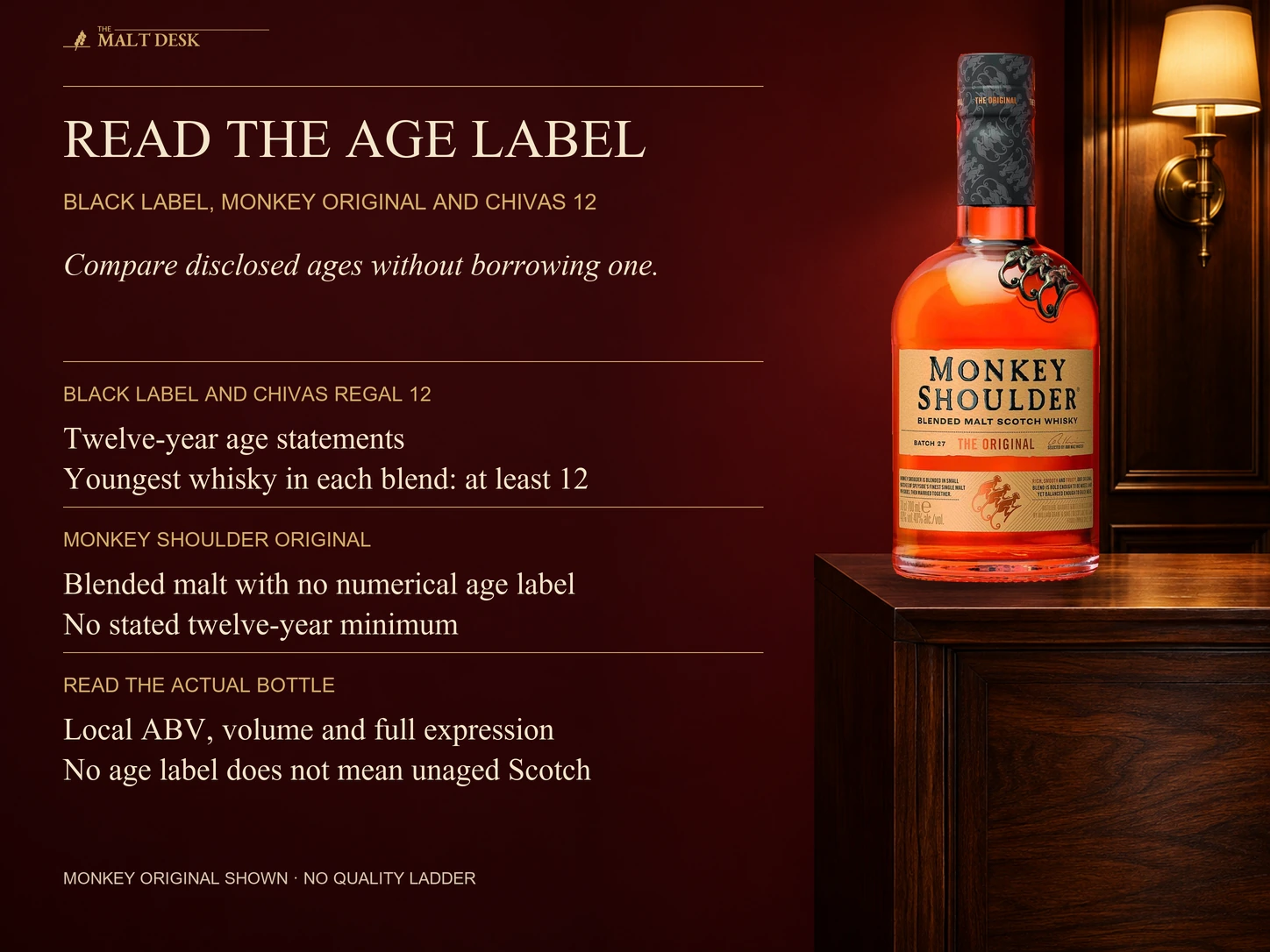
Johnnie Walker Black Label, Monkey Shoulder and Chivas Regal 12 differ first in category. Black Label and Chivas 12 blend malt and grain Scotch whiskies and carry twelve-year age statements. Monkey Shoulder is a blended malt, combining malt whiskies from more than one distillery without a published age statement.
Their producer descriptions also emphasize different aroma families: smoke and fruit for Black Label, vanilla and orange for Monkey Shoulder, and honey and orchard fruit for Chivas 12. These differences offer a basis for comparison without treating one expression as the winner for every serving method.
Category, age and strength
| Expression | Scotch category | Age statement | Reference ABV |
|---|---|---|---|
| Johnnie Walker Black Label | Blended Scotch | 12 years | 40% |
| Monkey Shoulder Original | Blended malt Scotch | None | 40% regional reference; check actual market label |
| Chivas Regal 12 | Blended Scotch | 12 years | 40% |
Blended malt does not mean a single distillery, and blended Scotch does not mean unaged grain spirit. The twelve-year statements apply to the youngest whisky included in each age-stated blend. An expression without an age statement does not disclose a comparable minimum beyond the requirements of the Scotch category.
The single malt and blended Scotch guide explains why those terms describe composition rather than a simple quality ladder.
Johnnie Walker Black Label: fruit and smoke
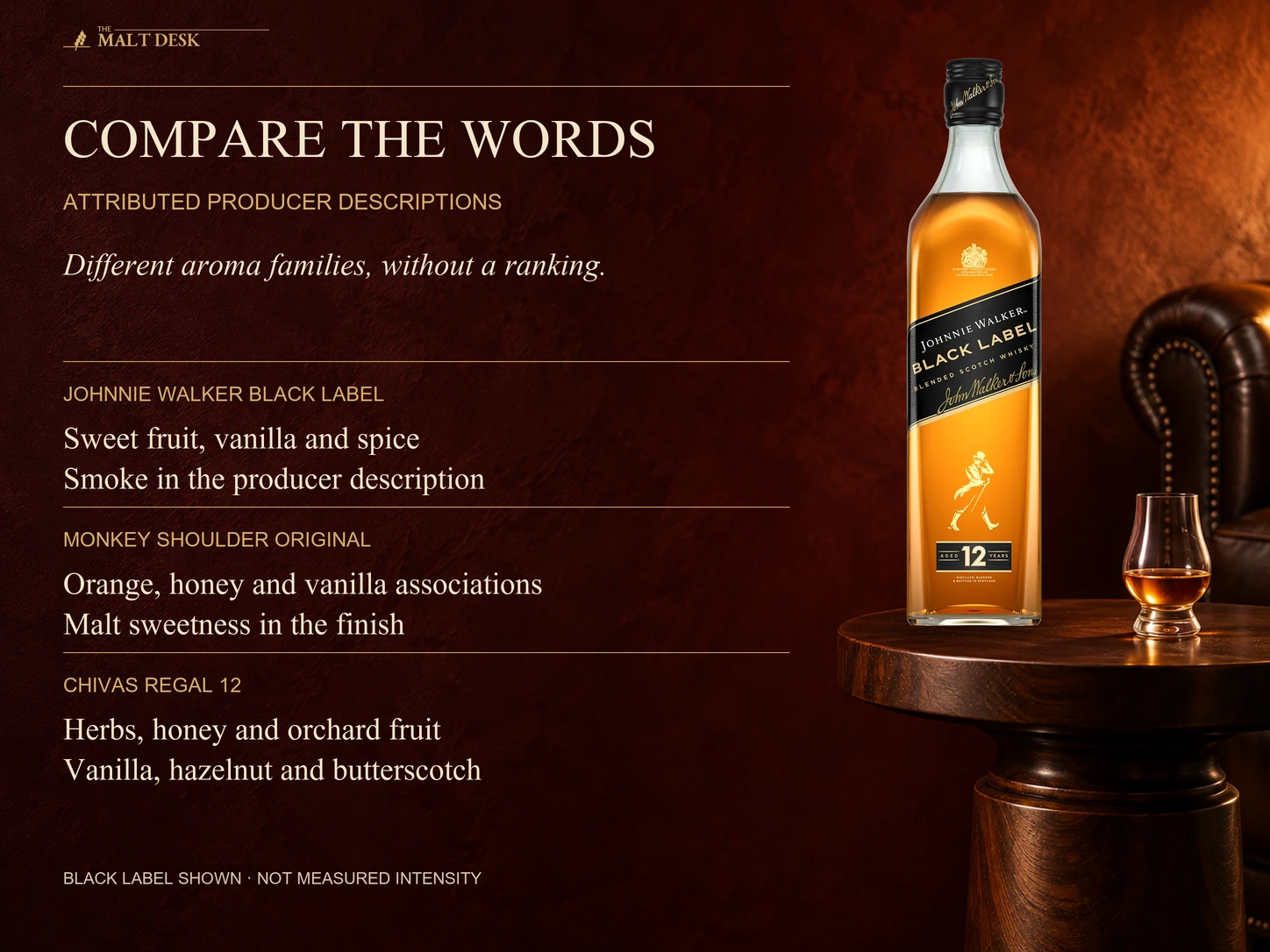
The official Black Label description combines fruit and vanilla with spice and smoke. Its twelve-year statement and malt-and-grain composition are the key label facts. Smoke is a useful comparison point for readers choosing among these three, but its perceived intensity remains a sensory judgment.
Do not confuse Black Label with Double Black or other Johnnie Walker expressions. The shared brand does not establish identical age, casks or flavor. The Black Label guide focuses on the standard twelve-year bottle.
Monkey Shoulder: blended malt and cocktail positioning
Monkey Shoulder’s current producer material names orange, honey, vanilla and malt associations, and presents the Original for mixing. Its all-malt category is a factual distinction from the two malt-and-grain blends; it does not prove superior cocktail performance.
Use the exact Original label when comparing. Market strength and bottle size can differ, and other Monkey Shoulder products have their own specifications. The Monkey Shoulder guide explains the reference expression.
Chivas Regal 12: honey and orchard fruit
Chivas describes its twelve-year blend with honey, orchard fruit and herbal aromas, followed by vanilla, hazelnut and butterscotch associations. The brand also presents it in highballs and cocktails, so it should not be restricted to neat service on the assumption that mixing is unsuitable.
A published description such as round or creamy is useful vocabulary, but it does not establish that Chivas is objectively smoother than the other two. The Chivas Regal 12 guide covers its product information separately.
How to compare serving methods
| Preparation | Variable to keep consistent | What the comparison can show |
|---|---|---|
| Neat | Glass, temperature and measure | Aroma and flavor preferences without added ingredients |
| With water | Measured addition and starting volume | How dilution changes each sample |
| With ice | Ice size, temperature and elapsed time | A combined effect of cooling and dilution |
| Highball | Whisky-to-mixer ratio and carbonation | Preference within that particular recipe |
A highball result depends on more than the whisky. Different soda volumes, warm glassware or melting ice can change the drink before the bottle choice is considered. Keep the recipe fixed when comparing, and record the result as a preference within that preparation.
The checked William Grant regional table lists Monkey Shoulder at 40%; this does not establish every U.S. market presentation. Read each actual label before comparing. Equal whisky and soda volumes finish at different concentrations only when their starting strengths differ; the category itself does not set that difference.
See the highball guide for preparation details and how to drink whiskey for serving terminology.
The Missing Combination Has a Real Next Candidate
Johnnie Walker’s U.S. whisky guide describes Green Label as made entirely from single malts aged at least fifteen years. Diageo’s U.S. brand information explicitly identifies it as blended malt. Black Label’s malt-and-grain composition and Green Label’s all-malt composition belong to the same brand but to different Scotch categories.
| Expression | All-malt blend? | Stated minimum of at least twelve years? |
|---|---|---|
| Black Label 12 | No: malt and grain | Yes: twelve years |
| Monkey Shoulder Original | Yes: blended malt | Not established by its standard age label |
| Chivas Regal 12 | No: malt and grain | Yes: twelve years |
| Green Label 15, additional reference | Yes: blended malt | Yes: fifteen years |
The wording of the requirement matters. Green Label meets ‘at least twelve years’ because fifteen is above that floor. It does not meet a request for an expression labeled exactly twelve years. Likewise, blended malt meets an all-malt blend requirement but not a one-distillery single-malt requirement. Changing either phrase would change the answer.
Combining Black Label and Monkey Shoulder at home cannot manufacture the missing all-malt condition: any Black Label included also contributes its grain whisky. Removing the age-stated blend would remove that grain contribution, but it would still leave Monkey Shoulder’s undisclosed label age. The problem cannot be solved by averaging names or borrowing one bottle’s age statement for another.
Green Label’s producer description includes fruit, grassy notes and smoke, so it is a relevant direction to examine if the category-and-age combination interests you. It is not proof of a particular smoke intensity relative to Black Label or of a better cocktail. Its actual offer must still fit the reader’s budget; no equal-price substitution is assumed here.
Price comparison without a fixed winner
The earlier approximate price bands lack consistent retailer, location, stock and final-cost records, so they are not used as a current or historical market range. Match the full expression, printed volume and strength, and dated final local cost.
For a useful local comparison, record the exact bottle size, ABV and final cost on the same date. Compare unit prices if one expression is available only in a larger bottle. An age statement and a category label explain what the product is; they do not establish a universal price premium.
Dewar’s 12 is another twelve-year blended Scotch reference. Adding it to a comparison can help separate a preference for a particular published style from a preference for familiar packaging. The budget guide provides wider category context.
In Brief
Johnnie Walker Black Label and Chivas Regal 12 are age-stated blended Scotch whiskies; Monkey Shoulder is a blended malt. Their published flavor notes describe different styles, with no single objective winner.
Choose the Blend That Meets Both Requirements
For an all-malt blend with a stated minimum of at least twelve years, investigate Green Label 15 as the additional candidate identified here. Monkey Shoulder supplies the all-malt category, while Black Label and Chivas 12 supply twelve-year statements in malt-and-grain blends. Decide which requirement is essential, or keep both and extend the shortlist to the relevant category-and-age combination.
Common questions
Is Monkey Shoulder a single malt?
No. It is a blended malt, combining malt Scotch whiskies from more than one distillery.
Does twelve years apply only to the malt component of Black Label and Chivas?
No. The age statement applies to the youngest whisky in the blend, including the grain whisky component.
Which is best for a highball?
There is no universal answer. The producer descriptors help identify styles to compare, while the mixer, ratio and individual preference determine the result.
Is blended malt automatically better than blended Scotch?
No. The categories describe ingredients and distillery origins.
Sources
Current Johnnie Walker Black Label and Chivas 12 U.S. pages; Monkey Shoulder Original producer descriptions; William Grant regional product-information table; Scotch Whisky Association category and age guidance, checked October 4, 2026. Monkey Shoulder’s regional 40% reference is not generalized to every U.S. label.
Additional comparison checked October 7, 2026: Green Label 15 is an age-stated blended-malt reference. It meets a minimum of at least twelve years, not an exactly-twelve label condition.