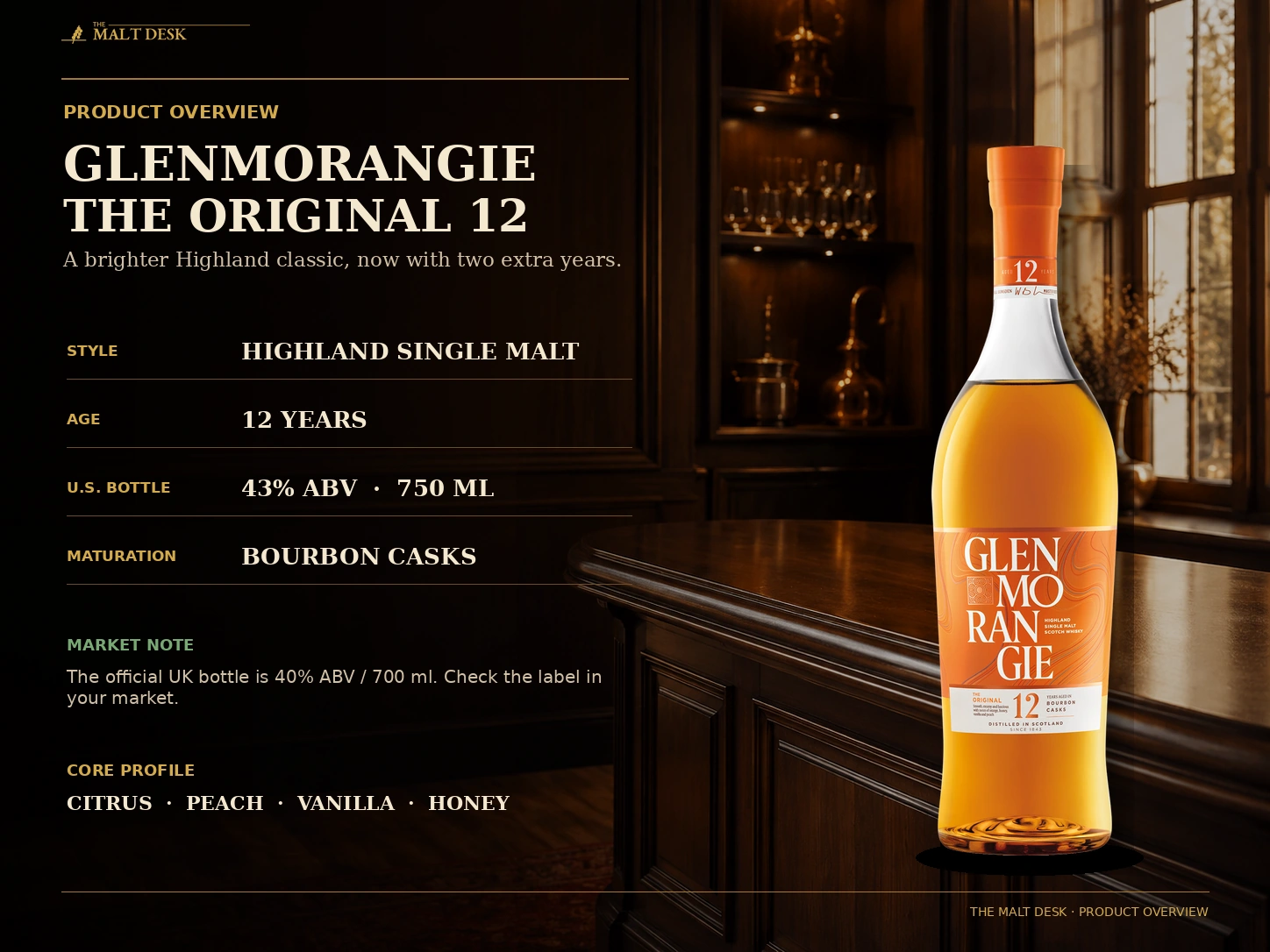
Glenmorangie The Original 12 is a Highland single malt matured in bourbon casks. The twelve-year expression continues the Original name with a higher age statement than the former ten-year bottling. Its producer describes a fruit-and-vanilla style with citrus, peach and honey.
When comparing bottles, read the age and strength together. An older ten-year bottle and the current twelve-year expression are different references, and a product page from one market may not describe the size or ABV sold in another.
The Original 12 at a glance
| Detail | Information |
|---|---|
| Category | Highland single malt Scotch whisky |
| Age statement | 12 years |
| Maturation | Bourbon casks |
| Official UK product reference | 700ml, 40% ABV |
| Published flavor direction | Citrus, peach, vanilla and honey |
Single malt identifies whisky made at one distillery from malted barley; it does not mean one cask. An age statement identifies the youngest whisky included. The single malt and blended Scotch guide explains how those label terms fit together.
The change from ten to twelve years
The producer presents The Original 12 as a development of its established Original expression. The concrete change is the twelve-year minimum maturation. A claim that the new bottle is necessarily creamier, smoother or better than an older ten-year version is a separate sensory comparison.
Old and new bottles can also differ in market presentation. Before comparing an older review or price, check the age printed on the bottle, volume and alcohol strength. An online title that says only “Glenmorangie Original” does not resolve those details.
Bourbon casks and the flavor vocabulary
The official product information specifies twelve years in bourbon casks. That describes previous cask use, rather than a bourbon component added to the final Scotch. The whisky remains a Scottish single malt.
Glenmorangie’s published aroma description pairs citrus and ripe peach with vanilla. The palate notes move from vanilla toward floral fruit; the finish description includes almond, coconut and maple. These are the brand’s sensory descriptions, not added ingredients or measured sweetness levels.
For a useful reading of those notes, distinguish fresh fruit from dried fruit, and vanilla-like aromas from sugary taste. This helps explain why two products both described as “sweet” can still be presented in different ways. It also avoids reducing every approachable whisky to the single word “smooth.”
Strength and bottle size: check the market
The official UK page checked for this guide lists 70cl at 40% ABV. That is 700ml. It should not be used to certify the specification of every U.S. bottle or an older release. Use the actual local label for an exact comparison.
A 750ml bottle contains about 7.1% more liquid than a 700ml bottle. At the same shelf price, the smaller bottle therefore has a higher cost per milliliter. Where ABVs differ too, the products are not identical presentations even if they share the same expression name.
Historical U.S. price records
The site’s August 27, 2026 notes recorded 750ml U.S. listings at $41.99 from Total Wine, $45.99 from BevMo and $47.51 from Walmart. They are historical references, not newly checked offers. The underlying notes do not consistently document location, tax, delivery charges or the bottle-label ABV.
The difference between the lowest and highest of those figures was $5.52. That spread is useful context for comparing equivalent listings, but it does not establish a nationwide fair-price threshold. A current comparison needs the exact expression and size, plus local availability and final cost.
The whiskey budget guide offers broader category context. Treat any budget boundary as dependent on the market rather than a permanent property of the bottle.
Related styles to compare
Glenfiddich 12 and The Glenlivet 12 are other age-stated single malt references. Compare their documented casks and published flavor notes rather than assuming that all twelve-year single malts share a recipe.
Monkey Shoulder provides a category contrast: it is a blended malt, while Glenmorangie is a single malt. That difference concerns the distillery origins of the malt whiskies, not an automatic quality hierarchy.
Serving and recording your own observations
A small neat measure provides one starting point. If you add water, record the amount and compare against the unchanged sample. Ice changes temperature while also diluting as it melts, so the result is different from adding the same volume of room-temperature water.
Keep the preparation consistent when comparing bottles. You can describe an aroma in ordinary language without reproducing the producer’s exact notes. The serving guide explains common preparation terms, and the beginner guide introduces category differences.
Common questions
Does bourbon-cask maturation make this a bourbon?
No. The cask history and the whisky category are separate. The Original 12 is single malt Scotch.
Does the number twelve include time in the bottle?
No. It refers to maturation before bottling. Keeping an unopened bottle longer does not increase its labeled age.
Is every Original 12 bottle 40% ABV?
The checked official UK product is 40% ABV. Check the local bottle rather than extending that specification to every market.
Sources
Glenmorangie: The Original 12 Years Old official product information and UK specification. Scotch Whisky Association: category and age-statement guidance. Historical prices: the site’s August 27, 2026 listing notes, not current verified offers.