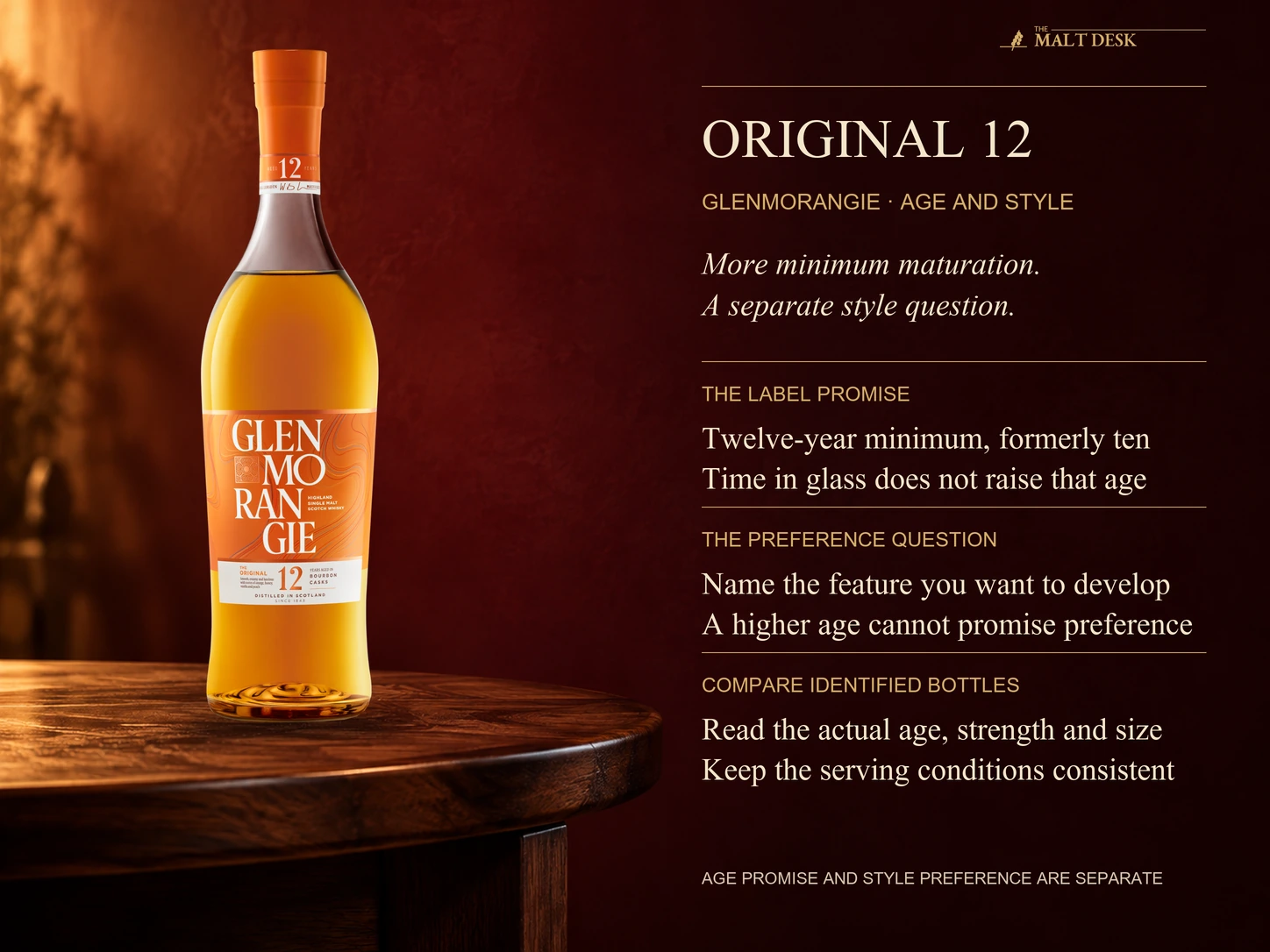
Two more years in the age statement are a real maturation guarantee, but they do not say whether Glenmorangie Original 12 develops the feature a reader liked in the former ten. Published 2024 comparisons describe more ripe fruit, cream and oak emphasis, while noting less of the older presentation’s light floral emphasis. I would treat that as a change of direction to assess, rather than assume that liking Original 10 makes the new minimum an automatic personal upgrade.
Glenmorangie The Original 12 is a Highland single malt matured in bourbon casks. The twelve-year expression continues the Original name with a higher age statement than the former ten-year bottling. Its producer describes a fruit-and-vanilla style with citrus, peach and honey.
When comparing bottles, read the age and strength together. An older ten-year bottle and the current twelve-year expression are different references, and a product page from one market may not describe the size or ABV sold in another.
The Original 12 at a glance
| Detail | Information |
|---|---|
| Category | Highland single malt Scotch whisky |
| Age statement | 12 years |
| Maturation | Bourbon casks |
| Current producer page references | U.S.: 750ml, 40%; U.K.: 700ml, 40% |
| Published flavor direction | Citrus, peach, vanilla and honey |
Single malt identifies whisky made at one distillery from malted barley; it does not mean one cask. An age statement identifies the youngest whisky included. The single malt and blended Scotch guide explains how those label terms fit together.
The change from ten to twelve years
The producer presents The Original 12 as a development of its established Original expression. The concrete change is the twelve-year minimum maturation. A claim that the new bottle is necessarily creamier, smoother or better than an older ten-year version is a separate sensory comparison.
Old and new bottles can also differ in market presentation. Before comparing an older review or price, check the age printed on the bottle, volume and alcohol strength. An online title that says only “Glenmorangie Original” does not resolve those details.
Bourbon casks and the flavor vocabulary
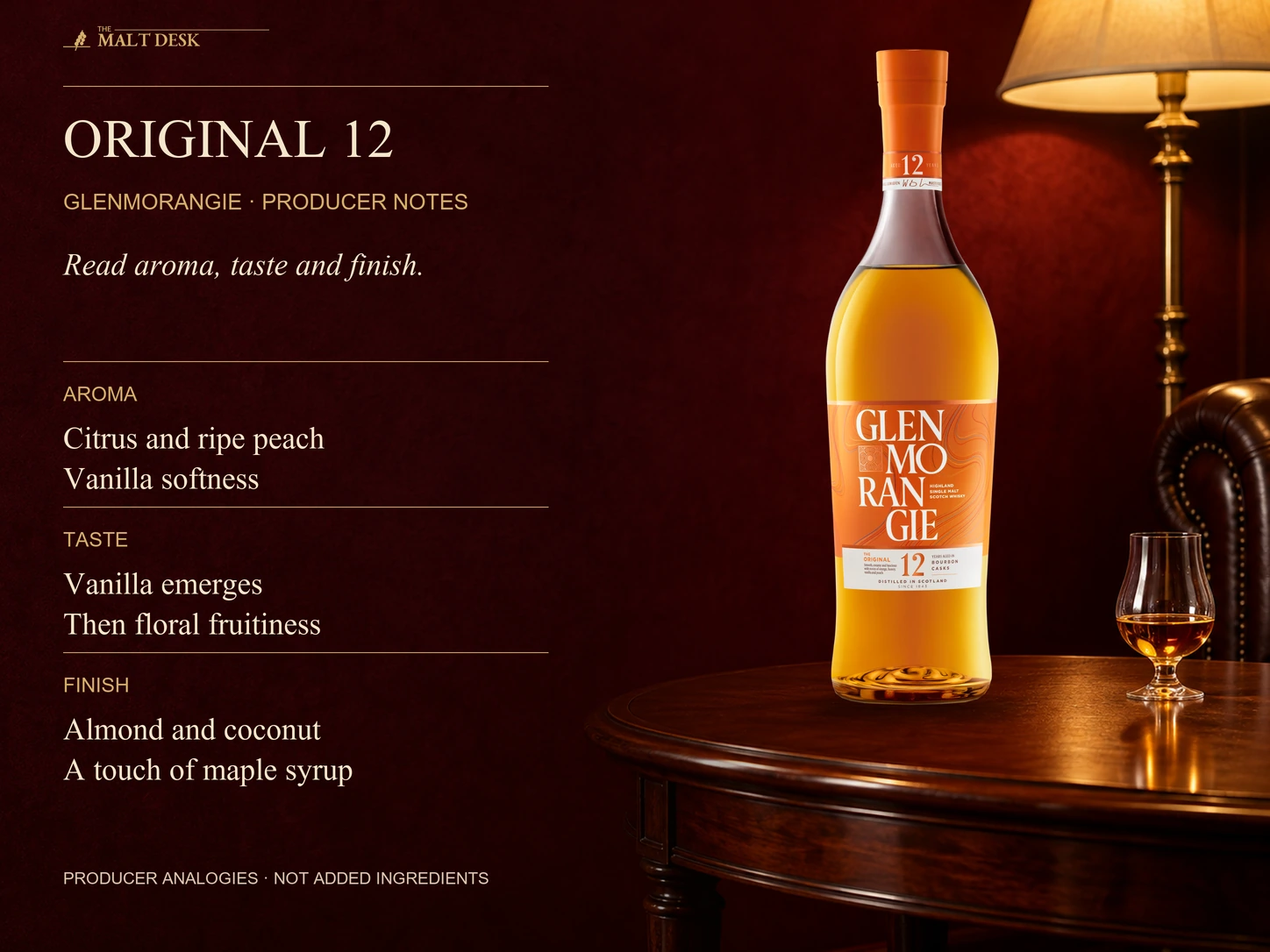
The official product information specifies twelve years in bourbon casks. That describes previous cask use, rather than a bourbon component added to the final Scotch. The whisky remains a Scottish single malt.
Glenmorangie’s published aroma description pairs citrus and ripe peach with vanilla. The palate notes move from vanilla toward floral fruit; the finish description includes almond, coconut and maple. These are the brand’s sensory descriptions.
For a useful reading of those notes, distinguish fresh fruit from dried fruit, and vanilla-like aromas from sugary taste. This helps explain why two products both described as “sweet” can still be presented in different ways. It also avoids reducing every approachable whisky to the single word “smooth.”
Strength and bottle size: check the market
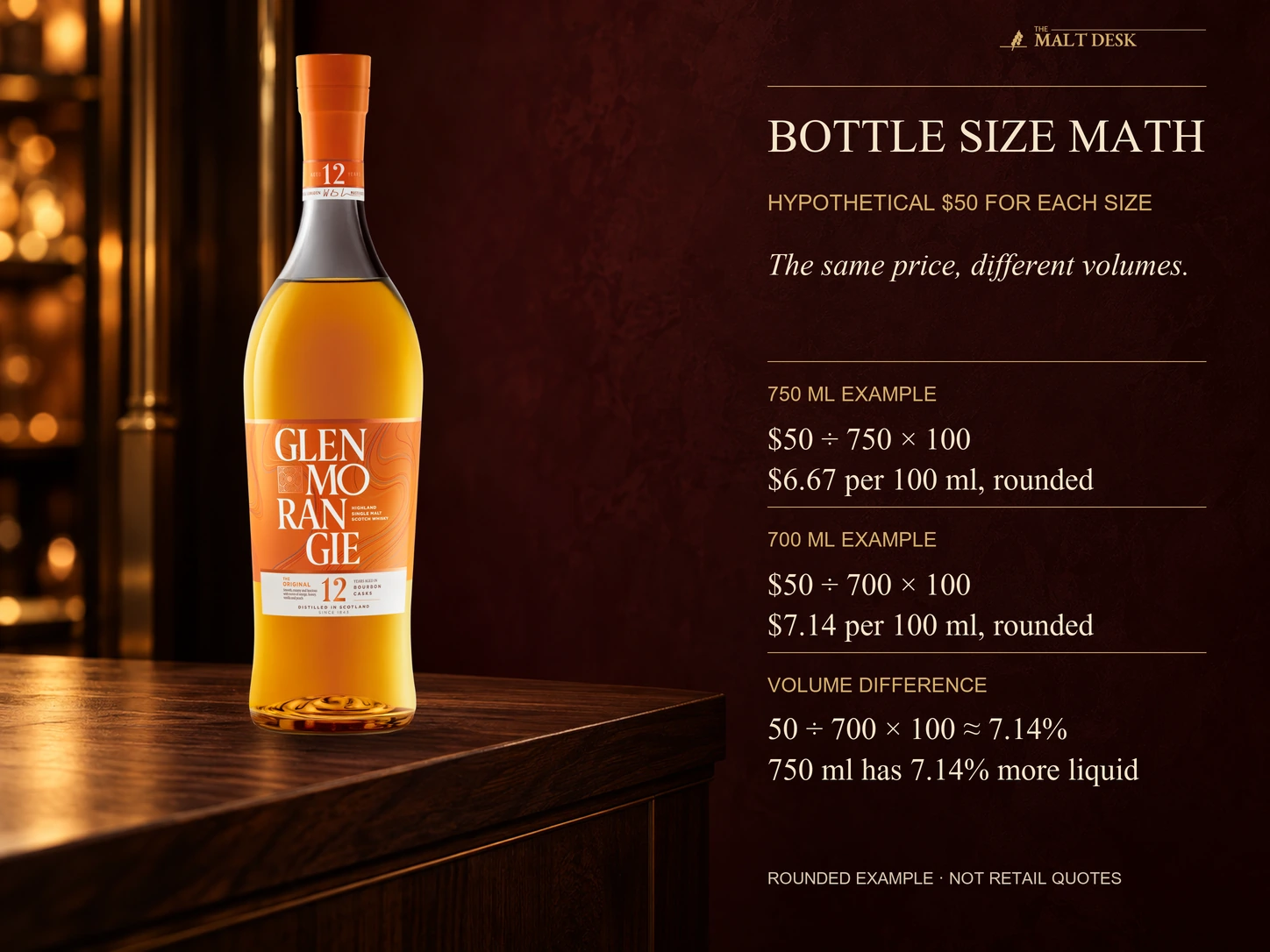
The current official U.S. product page lists 75 cl (750 ml) at 40% ABV, while the U.K. page lists 70 cl (700 ml) at 40%. Both were checked October 3, 2026. These are product-page references; use the actual local bottle to identify a particular offer or an older release.
A 750 ml bottle contains about 7.14% more liquid than 700 ml: 50 divided by 700, multiplied by 100. In a hypothetical same-price example at $50, 750 ml costs about $6.67 per 100 ml and 700 ml about $7.14. These are rounded illustrations, not retailer quotations. Where age or ABV also differs, the offers are not identical presentations.
An Improvement Can Be a Shift of Emphasis
Jonny McCormick’s fall 2024 Whisky Advocate review identifies fruit ripeness and creaminess as the twelve’s distinguishing features, contrasting them with the former ten’s floral and vanilla emphasis. His favorable assessment supplies a specific reason to investigate Original 12 if those are the developments wanted. It does not mean every feature of the ten has simply become stronger.
William Morrison’s October 7, 2024 Scotch Malt Whisky review likewise welcomed the change. He described more bourbon-like oak and gentle spice while retaining the recognizable citrus and vanilla direction. Taken together, these two firsthand accounts make the buying question narrower: would more ripe fruit, cream or oak serve the role the old Original occupied? These are attributed reviewers’ observations.
Choose the Development You Want to Follow
For someone who liked Original 10 but wished for more fruit ripeness or cream, I would investigate the twelve directly. McCormick’s account addresses that aim. For someone wanting more oak and mild spice within the familiar citrus-and-vanilla direction, Morrison’s account gives another relevant reason. The new age floor is useful evidence about maturation; the reviews explain why that change might interest these particular readers.
For someone whose favorite feature was the former ten’s lighter floral emphasis, the same praise raises a different question. More cream and oak may be welcome, but do not automatically satisfy the wish to retain that emphasis. I would compare a modest serving of the identified twelve with the ten if a properly identified reference is already available, rather than buy a scarce old bottle solely to conduct the exercise. No current stock or price for the ten is assumed here.
The useful choice is therefore about the feature being developed, not just the age ladder. A reader could prefer the new twelve overall and still prefer one quality in the ten. That outcome would not contradict the higher maturation minimum or either reviewer’s favorable verdict. It would explain why the usual question, is the new one better, is too broad to settle a bottle’s intended role.
Keep the Age Promise Separate from the Style Preference
An identified Original 12 supplies a twelve-year minimum; a stored Original 10 does not acquire that guarantee by spending two more years in glass. The ten might contain older components, but its label alone does not establish a twelve-year floor. When age itself is essential, the twelve directly addresses the requirement. When preserving an earlier style is essential, the sensory comparison is a different task.
The consulted producer-page references are 40%, while actual market labels remain necessary for a particular bottle. The reviewers’ 40% comparisons are evidence about those presentations.
Nor does the move to Original 12 synchronize the rest of Glenmorangie’s range. The previously checked regional Lasanta and Quinta Ruban accounts identify separate age and cask programs. Subtracting Original’s twelve from another expression’s total age cannot establish its finishing duration. Choose the named sherry or port branch when that cask inquiry is wanted; it is a different development from the Original’s bourbon-cask change.
Price and Label Comparisons
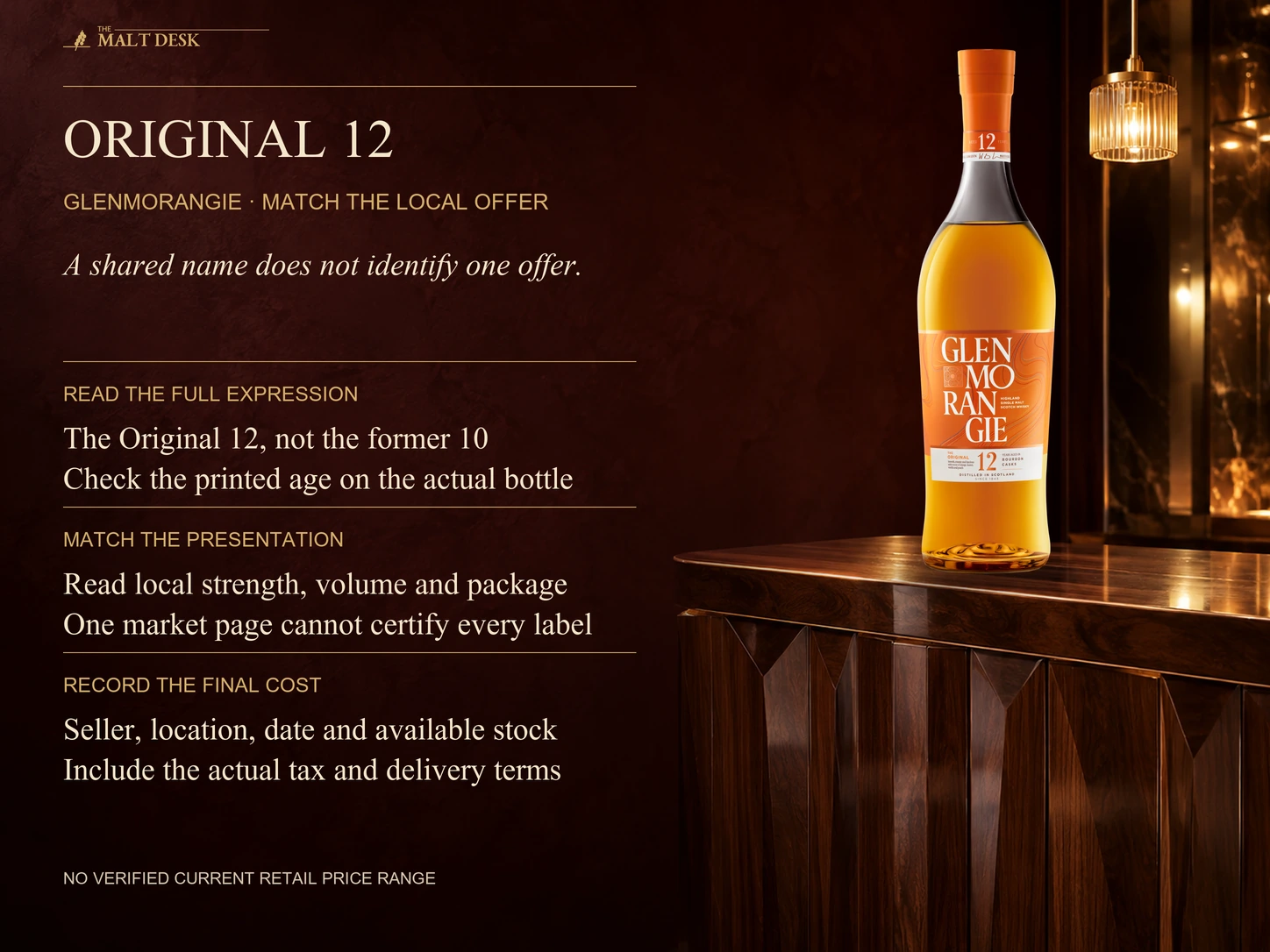
Check that a quote names The Original 12 rather than the earlier Original 10. Record the printed strength, volume, location, date and final total. A shared brand name does not identify the same age-stated expression; no verified retail range is established here.
The whiskey budget guide offers broader category context. Treat any budget boundary as dependent on the market rather than a permanent property of the bottle.
Related styles to compare
Glenfiddich 12 and The Glenlivet 12 are other age-stated single malt references. Compare their documented casks and published flavor notes rather than assuming that all twelve-year single malts share a recipe.
Monkey Shoulder provides a category contrast: it is a blended malt, while Glenmorangie is a single malt. That difference concerns the distillery origins of the malt whiskies, not an automatic quality hierarchy.
Serving and recording your own observations
A small neat measure provides one starting point. If you add water, record the amount and compare against the unchanged sample. Ice changes temperature while also diluting as it melts, so the result is different from adding the same volume of room-temperature water.
Keep the preparation consistent when comparing bottles. You can describe an aroma in ordinary language without reproducing the producer’s exact notes. The serving guide explains common preparation terms, and the beginner guide introduces category differences.
In Brief
Glenmorangie Original 12 is a Highland single malt matured in bourbon casks. Its twelve-year age statement, producer flavor descriptions and market-specific bottle sizes are separate comparison attributes.
Choose the Glenmorangie Development You Want
For someone who enjoyed Original 10, use the cited comparisons to decide whether the newer twelve’s fruit, cream and oak emphasis addresses what they liked. Seek the former presentation when its particular profile is the point of the comparison; use Original 12 when exploring the current expression. Keep the age guarantee and the desired style development as separate reasons for the choice.
Common questions
Does bourbon-cask maturation make this a bourbon?
No. The cask history and the whisky category are separate. The Original 12 is single malt Scotch.
Does the number twelve include time in the bottle?
No. It refers to maturation before bottling. Keeping an unopened bottle longer does not increase its labeled age.
Is every Original 12 bottle 40% ABV?
Both current U.S. and U.K. producer pages checked here list 40% ABV. Their sizes differ, and the actual local label remains the reference for a particular bottle.
Sources
Glenmorangie’s current U.S. and U.K. Original 12 product pages, checked October 3, 2026; Scotch Whisky Association category and age guidance. Flavor words are producer descriptions. The $50 unit-price comparison is hypothetical; no current retailer price or national fair-value range is asserted.
Style-change research checked October 7, 2026: Glenmorangie’s current Original 12 producer account; Jonny McCormick’s fall 2024 Whisky Advocate review; William Morrison’s Scotch Malt Whisky review dated October 7, 2024; SWA guidance distinguishing maturation age from bottle storage. Review notes are attributed historical observations at 40%. Regional Lasanta and Quinta Ruban details retain their earlier check dates. The feature-specific purchase reasoning is The Malt Desk’s editorial analysis.