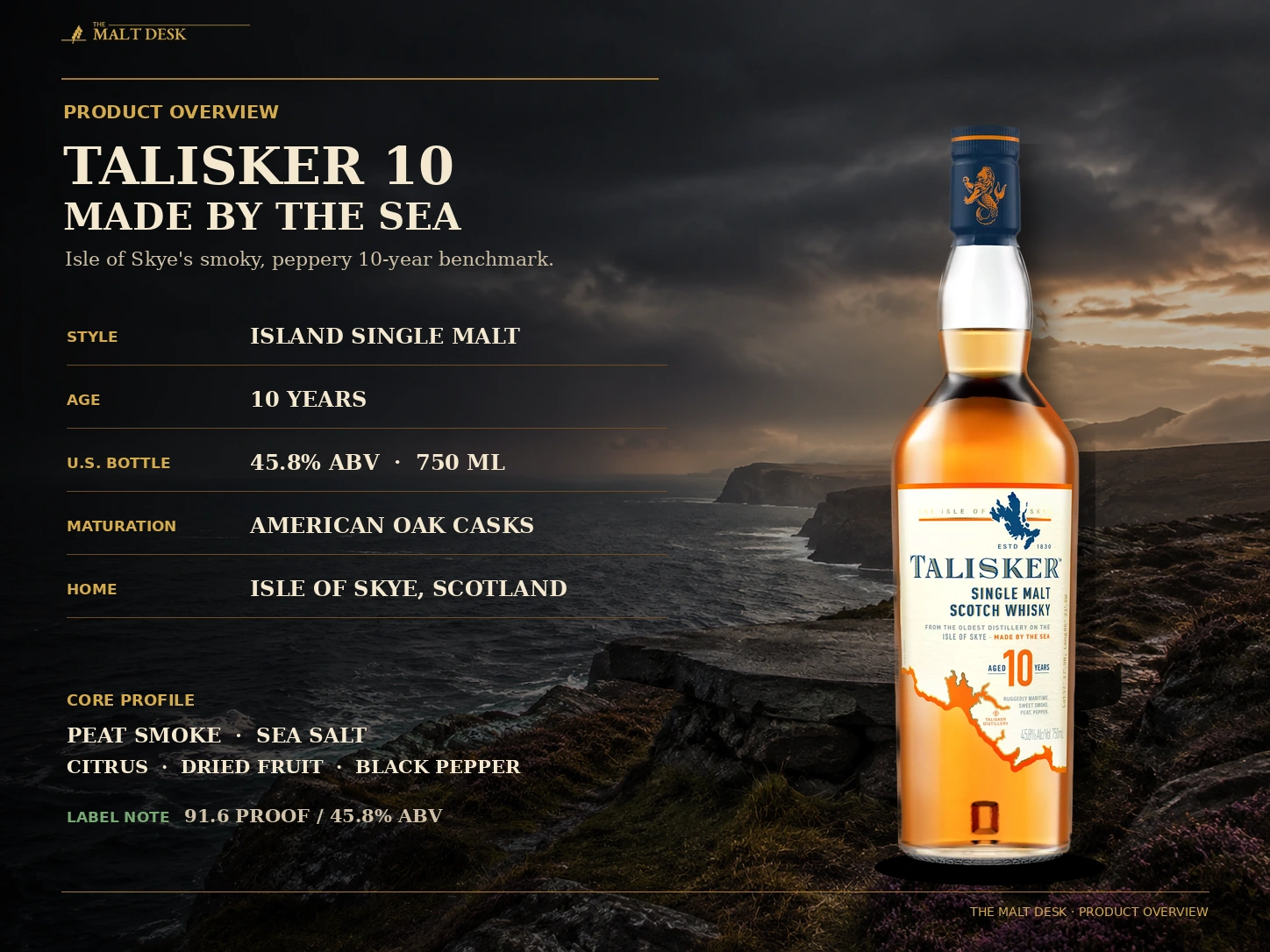
Talisker 10 is a single malt Scotch from the Isle of Skye, bottled at a reference strength of 45.8% ABV. Its ten-year age statement and the producer’s pepper-and-smoke description distinguish it from both unpeated Scotch and other smoky island malts.
Skye and Islay are different islands. Talisker should not be labeled an Islay whisky simply because smoke appears in its flavor description. Location, maturation and aroma vocabulary each provide a different part of the picture.
Talisker 10 specifications
| Label or production detail | Information |
|---|---|
| Category | Single malt Scotch whisky |
| Origin | Isle of Skye, Scotland |
| Age statement | 10 years |
| Reference strength | 45.8% ABV / 91.6 U.S. proof |
| Distillation | Double distilled |
| Published maturation information | At least ten years in American oak casks |
The age statement refers to the youngest whisky in the bottle. The standard ten-year expression should also be distinguished from other Talisker releases, which may have different ages, strengths or cask programs. Compare the complete expression name rather than the distillery name alone.
What the official flavor description says
Diageo’s Malts page describes Talisker 10 through peat, maritime notes, fruit and malt, followed by a peppery finish. Those are producer descriptors rather than a numerical intensity ranking. “Pepper” describes a sensation; it does not mean pepper is an added ingredient.
The distinction between smoke and pepper is useful. A reader might enjoy one and dislike the other, so collapsing both into “strong” loses information. Similarly, maritime language is an aroma association; it should not be read as evidence that seawater is part of the bottled whisky.
Use separate headings for aroma, sweetness, spice and finish when comparing published notes. The whiskey flavor map explains how a broad term such as smoky can be broken into more specific descriptions.
Why 45.8% ABV matters—and what it cannot tell you
U.S. proof is twice the ABV, so 45.8% corresponds to 91.6 proof. At equal serving volumes, it contains more alcohol than a 40% whisky. That calculation is separate from judgments about texture, complexity or quality.
Bottling strength is also not a peat rating. Two whiskies with the same ABV can have very different smoke descriptions. Conversely, a lower-strength whisky can still have a pronounced smoky aroma. The peated whisky guide explains the production terminology behind the label.
Claims about natural color and chill filtration need an explicit product statement. They should not be inferred from the number on the ABV label, a photograph’s color or assumptions about other expressions from the distillery.
Maturation information and its limits
American oak identifies the wood described in the producer’s maturation information. It does not, by itself, specify a complete cask recipe, a first-fill percentage or the history of every barrel. Those details require separate confirmation.
Likewise, ten years is a minimum age statement rather than a claim that every cask had identical conditions. Casks and blending decisions can vary within a consistent labeled expression. A packaging revision alone is insufficient evidence of a changed recipe.
Historical U.S. prices
The site’s August 27, 2026 notes recorded three 750ml U.S. listings: Walmart at $69.33, marked out of stock; Total Wine at $77.99; and BevMo at $81.99. These historical figures have not been rechecked as current offers. Store location, taxes and delivery costs were not consistently captured.
The out-of-stock listing should not establish an available market price. The other two records differed by $4.00 before any additional costs, illustrating why a single nationwide figure can be misleading. Compare actual local availability and the same bottle size before using a historical record as context.
Price comparisons with Lagavulin 16, Ardbeg 10 or Laphroaig 10 should keep style separate from cost. A lower price, older age or higher proof does not automatically resolve a preference for one smoke profile.
A structured way to explore serving differences
Begin with a small unchanged reference measure. If adding water, use measured increments and record the amount. This makes observations easier to compare than an unspecified splash. A fixed number of drops is not a universal recipe because the initial pour size and drop volume can vary.
Ice introduces cooling as well as water. Comparing a cold diluted sample with a room-temperature undiluted one tests both variables at once. The serving guide explains the practical difference between neat, water-added and iced preparations.
When comparing another whisky, use matching glasses and preparation. Record what you notice before reading flavor descriptions if you want to reduce the influence of suggested words. Personal notes can be descriptive without turning them into a quality score.
Common questions
Is Talisker 10 an Islay single malt?
No. It is made on Skye. “Island whisky” is a broad geographic description and is not synonymous with Islay.
Is 91.6 proof the same as 45.8% ABV?
Yes, under the U.S. proof convention. Check the label for the exact expression and market.
Does a ten-year age statement measure time after bottling?
No. It describes maturation before bottling. Keeping a sealed bottle for another year does not make it Talisker 11.
Does adding water always reduce the pepper?
Water lowers the alcohol concentration, but a particular sensory result is not guaranteed. Initial quantity, dilution and individual perception all affect the comparison.
Sources
Diageo Malts: Talisker 10 Year Old product information. Scotch Whisky Association: category and age-statement guidance. Historical U.S. prices: the site’s August 27, 2026 listing notes, not current verified offers.