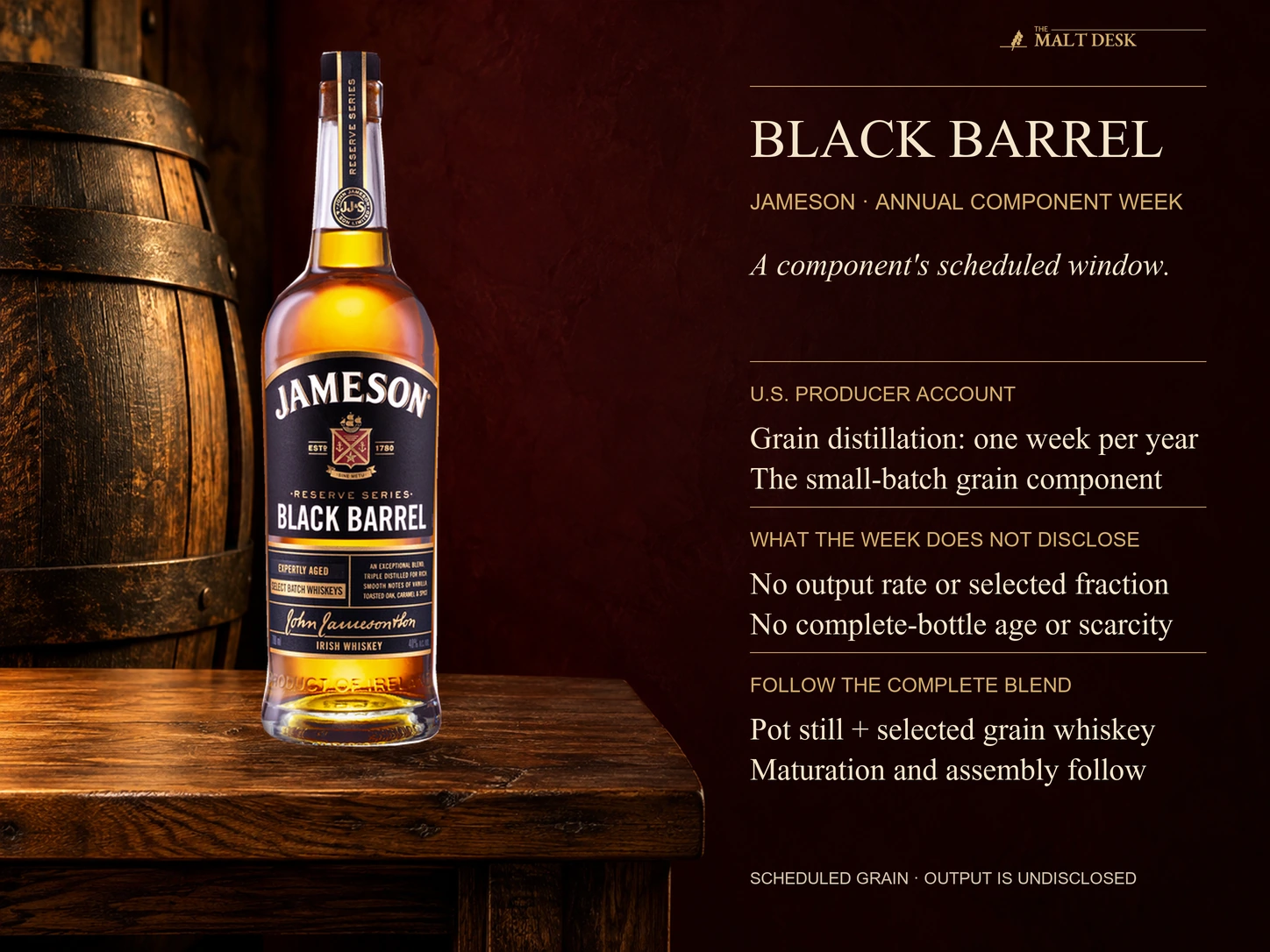
Jameson’s U.S. Black Barrel account says its particular small-batch grain whiskey is distilled during one week per year. That is a production-scheduling detail about a component. It does not say the complete blend spends only a week in production or maturation, and it does not disclose how many Black Barrel bottles that week can ultimately supply.
The distinction matters when deciding what a premium is buying. A short annual production window can identify a specially selected component without proving a small total output, a tiny grain proportion or a limited annual bottling. I would follow the component through the process before treating the week as a scarcity claim.
Jameson Black Barrel is a blended Irish whiskey built around grain whiskey, pot still whiskey and double-charred barrels. Its key distinction from Jameson Original is the composition of the blend and treatment of the wood. Both reference bottlings are 40% ABV, so Black Barrel is not a higher-proof version of Original.
Jameson describes Black Barrel with toffee, nuts, vanilla and toasted wood. Those producer notes provide a useful guide to its intended style; whether that style is preferable to Original depends on individual taste and how the whiskey is served.
Black Barrel at a glance
The standard label has no numerical age statement. The current U.S. FAQ describes a 9–12-year barrel range, but the same FAQ also calls the blend single malt plus grain and claims higher strength. The single-malt and higher-strength statements conflict with Jameson’s global pot still/grain description and its 40% regional nutrition reference. This guide keeps those sources distinct and does not turn the FAQ range into a guaranteed age printed on every standard bottle.
Category: blended Irish whiskey. Components: grain and pot still whiskey. Distillation: triple distilled. Reference strength: 40% ABV, or 80 U.S. proof. Age statement: none on the standard Black Barrel label. Distinguishing feature: a higher pot still proportion than Original and double-charred barrel maturation.
What double-charred barrels mean
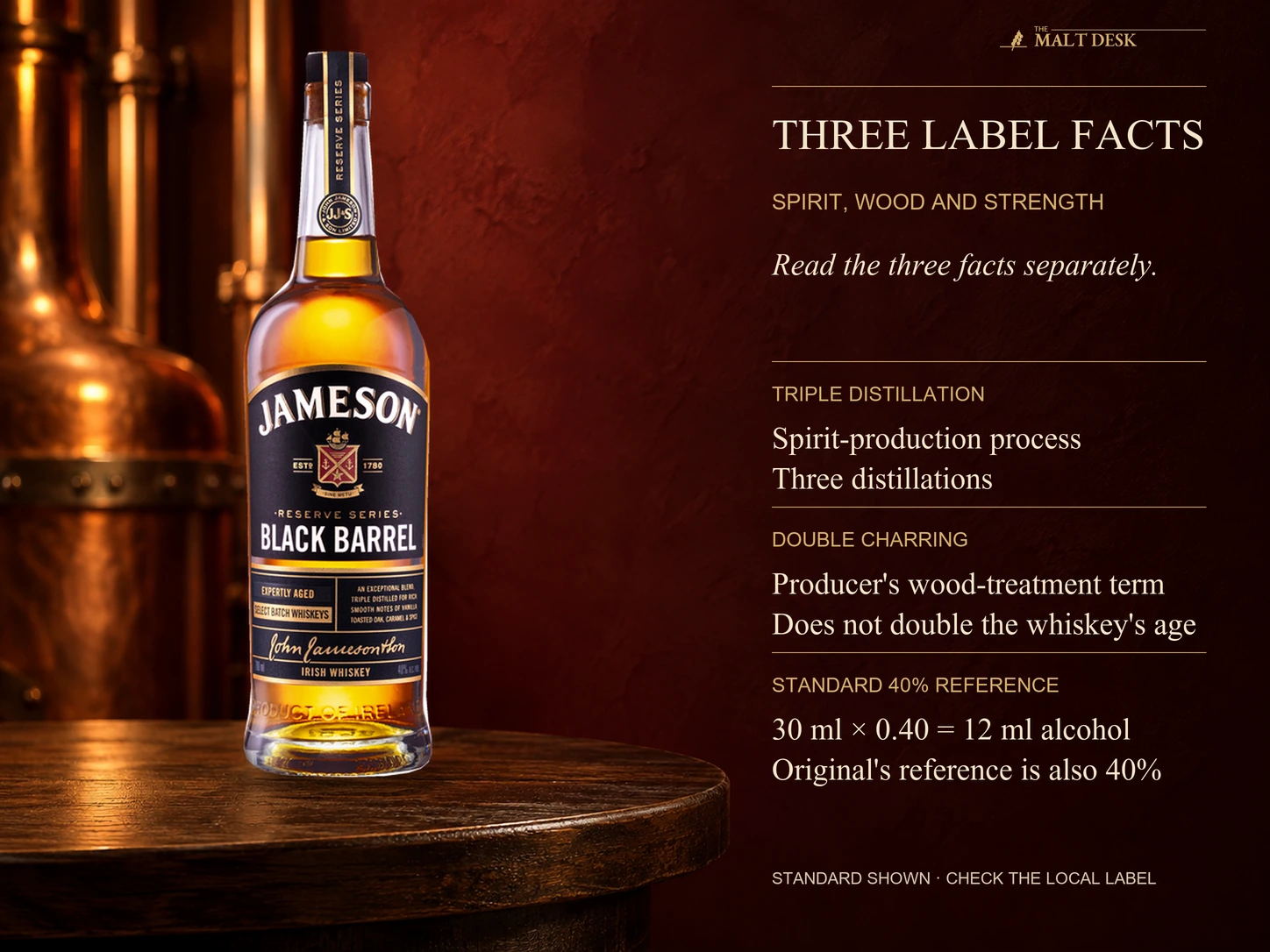
The name refers to barrel treatment, not to two distillations. Jameson identifies double charring as a defining part of Black Barrel production. Heating and charring oak changes the wood surface that interacts with the maturing spirit. It is a different process from drying malt with peat smoke.
Jameson’s current 2026 bartender-series page names bourbon, sherry, double-charred and virgin oak barrels, alongside an American-oak/sherry/double-charred account. These descriptions give cask categories without a complete batch recipe or stage lengths. Double charring identifies wood treatment; it does not double the whiskey’s age.
Cask history, the spirit entering it and blending decisions all matter. The most useful interpretation is that Black Barrel places particular emphasis on toasted wood and sweet oak-associated aromas.
How the blend differs from Jameson Original
Both expressions combine pot still and grain whiskey. Jameson identifies a higher proportion of pot still whiskey in Black Barrel, but a precise percentage is not provided in the product information used here. It would be misleading to assign one or assume that the blend is entirely pot still whiskey.
This distinction matters when comparing categories. A blend containing pot still whiskey is not the same designation as single pot still Irish whiskey. Our single pot still guide explains the category, while the Jameson Original guide covers the baseline blend.
Jameson’s regional nutrition table lists both standard Black Barrel and Original at 40% ABV. Equal 30 ml measures therefore each contain 12 ml pure alcohol. The separate Black Barrel Proof release is 50%; do not transfer that strength to the standard expression. Read the local label when identifying a particular market bottle.
The producer’s flavor description
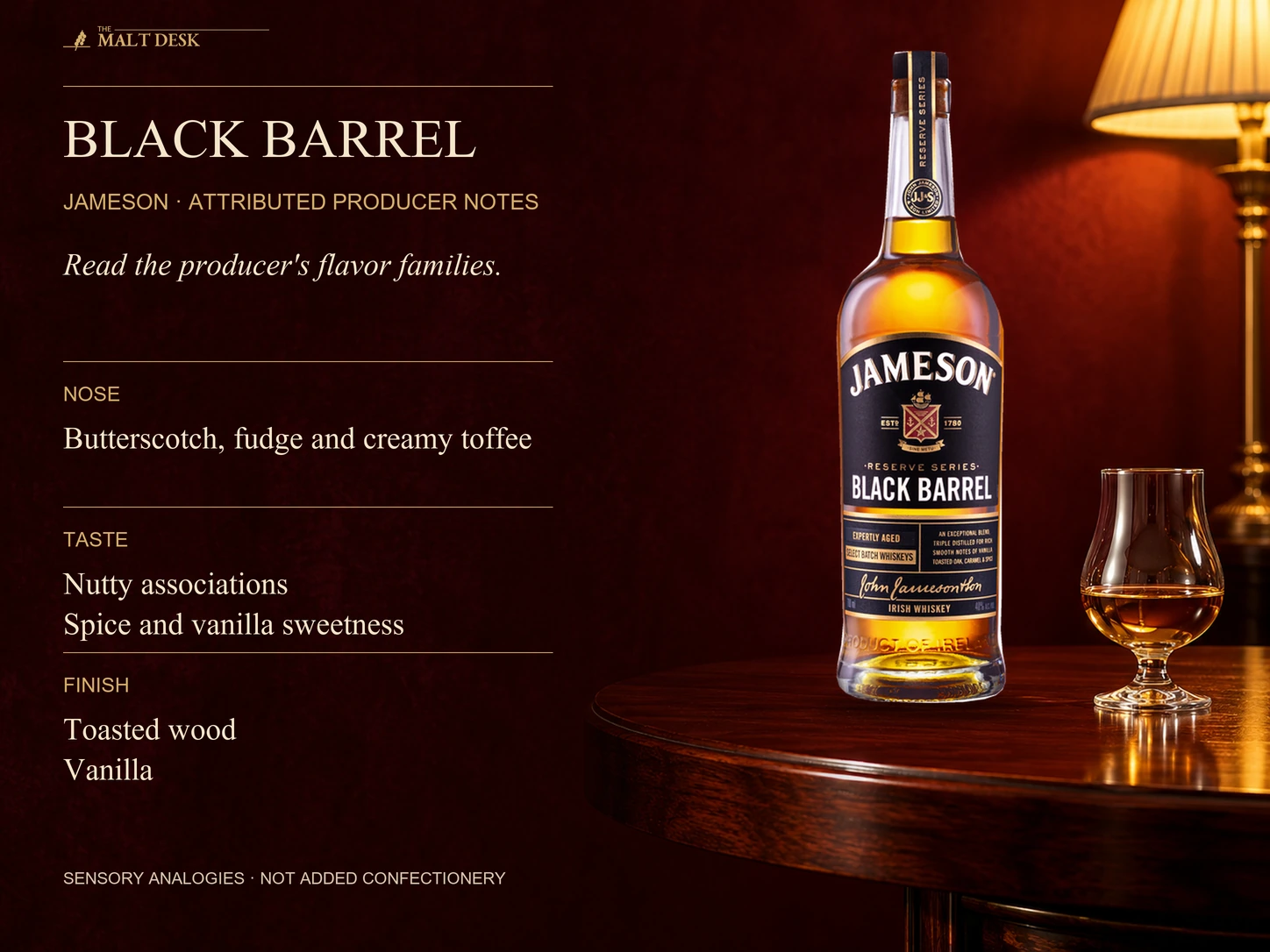
Aroma: Jameson emphasizes butterscotch, fudge and creamy toffee. Palate: the published description moves toward nuts, spice and vanilla sweetness. Finish: toasted wood and vanilla are the main reference points.
These are sensory descriptors, not a list of added confectionery ingredients. Toffee and vanilla language helps communicate an aroma family; it does not establish sugar content. Likewise, toasted wood should not automatically be equated with the medicinal or earthy peat descriptions common in some Scotch whisky.
Group toffee and fudge under caramelized sweetness, nuts in a separate family, and toasted wood under oak. The whiskey flavor map explains these aroma families.
Price and Label Comparisons
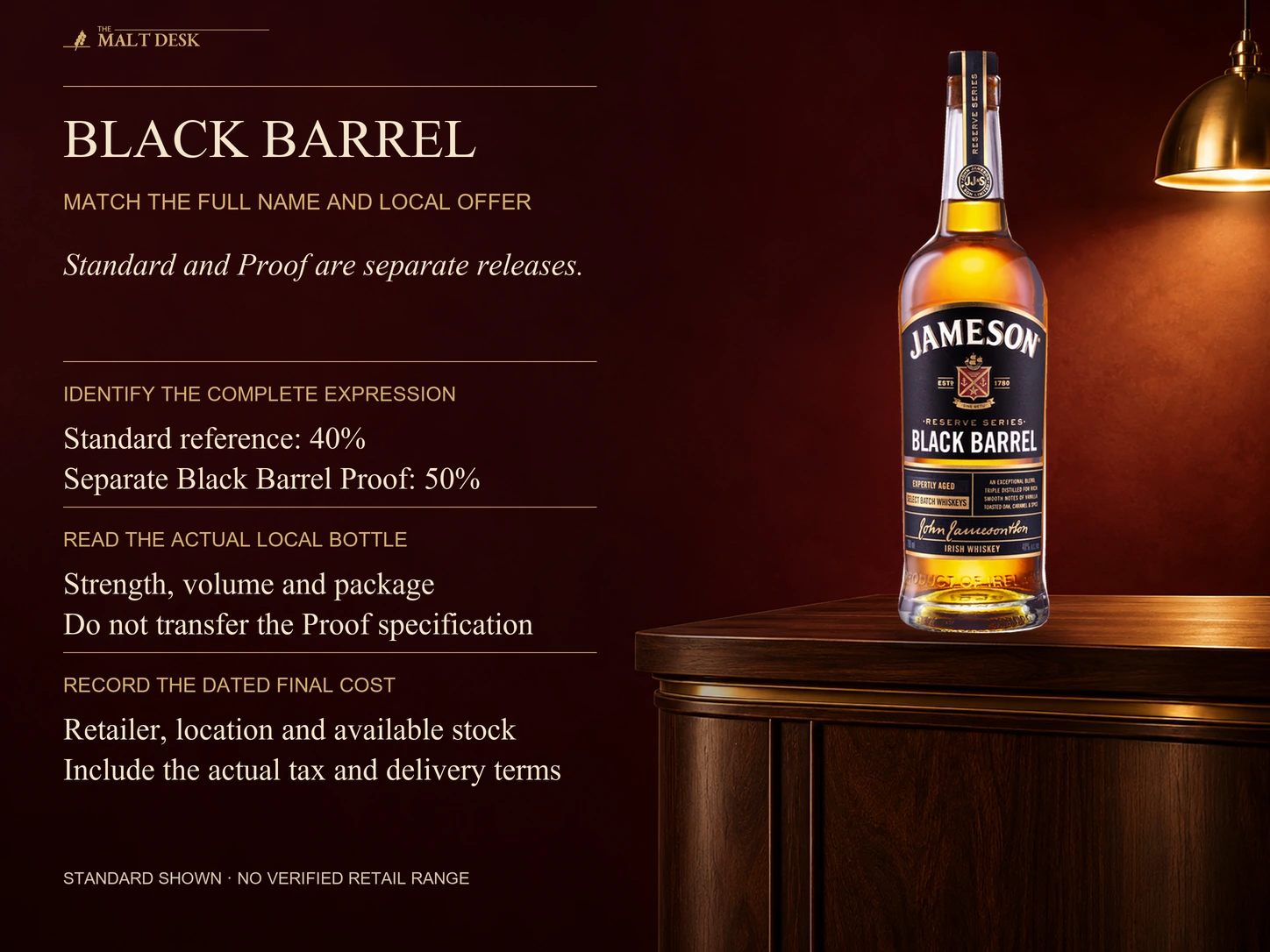
Match Jameson Black Barrel separately from Black Barrel Proof: the consulted producer references are 40% and 50% ABV respectively. A shorter listing name can hide that difference. Record the printed strength, volume and dated local total; no verified retailer range is established here.
The premium purchases a different blend and maturation approach; it does not purchase extra proof. Readers comparing categories can also consult the whiskey budget guide, allowing for local price changes.
One Week Describes a Component’s Production Window
The same U.S. producer account describes Black Barrel as a blend of small-batch grain whiskey and pot still whiskey, with a higher pot still proportion than Jameson Original. The annual-week statement applies to that grain distillation account. It does not establish that the pot still portion is made in the same week or that all whiskey in a bottle was distilled in one calendar year.
| Disclosure | What it tells us | What else would be needed |
|---|---|---|
| Grain distillation during one week per year | A scheduled window for that component | Output per hour or week to calculate spirit quantity |
| Higher pot still proportion than Original | A relative composition statement | Both actual proportions to calculate the increase |
| Whiskies matured in different batches and casks | Distillation and bottling are separated by maturation and assembly | Batch records to reconstruct a particular bottle |
| Double-charred barrel emphasis | A wood-treatment feature | A controlled comparison to isolate its sensory effect |
For a simple hypothetical, a seven-day run at twice another run’s daily output produces the same amount as fourteen days at the lower rate. Output comparisons require production volume and scheduling information for the relevant components. Real quantities would also require actual operating hours, production rates and the fraction selected for Black Barrel, none of which is supplied by the one-week phrase.
Maturation creates a second separation. Grain spirit made during annual windows can enter casks and be selected later alongside pot still whiskey from other production periods. The bottle is the assembled result; a component’s distillation week is not the bottle’s age or a promise that it comes from one cask. The standard label remains without a numerical age statement.
The undisclosed blend shares leave another useful limit. ‘Higher pot still proportion’ does not establish whether the grain contribution is large or small in absolute terms. For example, hypothetical changes from 30% to 40% pot still and from 70% to 80% would both be increases, but would leave very different grain shares. Those numbers illustrate the language and are not Jameson’s recipe.
The positive reason to investigate standard Black Barrel is consequently its selected grain component, changed pot still balance and double-charred-barrel account together. The one-week detail adds specificity to that construction. It does not require a claim that scarcity guarantees better flavor or a justification for any unverified current price.
Serving methods and comparison
A small undiluted measure provides one reference point. If adding water, make one small adjustment at a time and keep the original sample available for comparison. There is no guaranteed number of drops that will reveal a particular aroma.
Jameson also presents Black Barrel as a cocktail whiskey. In an Old Fashioned, sugar and bitters become part of the flavor; in a Whiskey Sour, acidity and sweetener change the balance. Keep the recipe constant when comparing two whiskeys, otherwise differences in preparation can be mistaken for differences between bottles.
For practical preparation details, see how to drink whiskey. A preferred serving method is personal and need not follow a price-based hierarchy.
In Brief
Jameson Black Barrel combines pot still and grain whiskey, with a higher pot still share than Original and an emphasis on double-charred barrels. Its producer notes describe toffee, nuts, vanilla and toasted wood; the standard 40% reference is separate from the 50% Proof release.
Follow Black Barrel's Component Into the Blend
Investigate Black Barrel for its documented component and barrel-treatment story, and compare it with Jameson Original as a complete expression. The one-week production detail belongs to the named small-batch grain component; use it to understand the production schedule. Let the blend’s disclosed construction and intended serving role guide the choice between the two expressions.
Common questions
Is Black Barrel a single pot still whiskey?
No. It is a blend containing pot still and grain whiskey. The higher pot still proportion does not change its blended designation.
Does Black Barrel have an age statement?
The standard label does not specify one. Double charring describes wood treatment, not a stated maturation period.
Is it stronger than Jameson Original?
The reference versions of both are 40% ABV. Check the actual bottle label when comparing different markets or special releases.
Does char mean peat smoke?
No. Barrel charring and peat use are different production steps. Jameson’s Black Barrel description centers on toffee, nuts, vanilla and toasted wood rather than presenting it as a peated whiskey.
Sources
Jameson’s global Black Barrel page, current U.S. FAQ, regional nutrition table and 2026 bartender-series page, checked October 4, 2026; separate Black Barrel Proof product information. Conflicting regional FAQ details are identified above. Producer notes are attributed, and no current retail range or standard-label age guarantee is established.
Production-window analysis checked October 7, 2026: the one-week-per-year statement refers to Black Barrel’s small-batch grain component. Output-rate and blend-share examples are hypothetical and do not reconstruct Jameson’s quantities, recipe or age.