Knob Creek 9: Age, Strength, and Product Identity
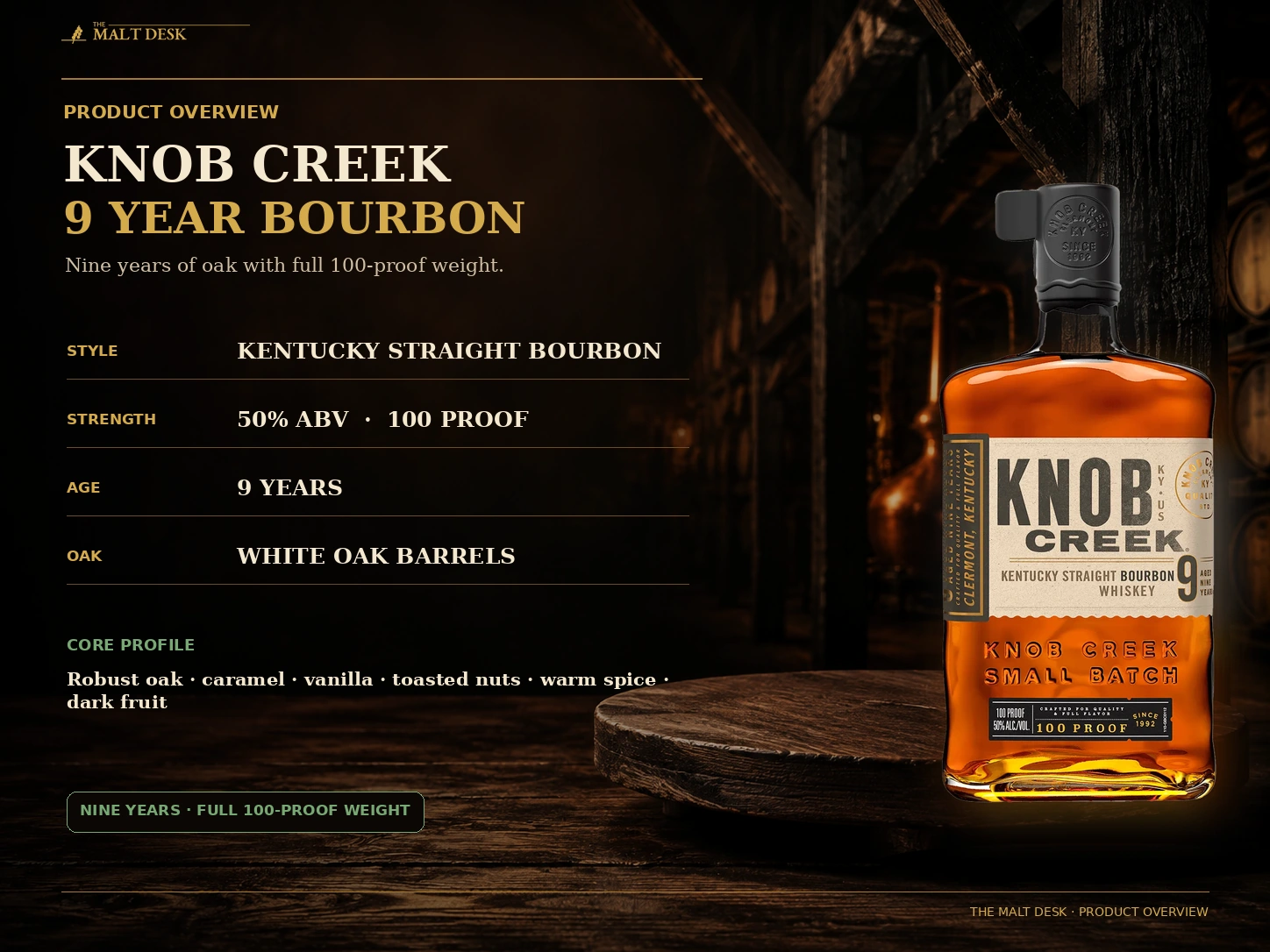
Knob Creek 9 is the standard nine-year bourbon in the Knob Creek range, bottled at 100 proof, or 50% ABV. This guide explains those label facts, the producer’s description, and the historical U.S. price references in the article. It is not a firsthand tasting review.
What Nine Years Means
The producer identifies nine years of maturation in white oak barrels. The age statement is a minimum maturation claim for the whisky, not a numerical measure of oak flavor or finish length. Storage conditions, barrel history, and production decisions affect the result, so age alone cannot substantiate a sensory ranking.
A nine-year statement also distinguishes this expression from bottles sold without an age statement. That distinction is useful factual information without implying that either category is automatically better.
What 100 Proof Means
In U.S. labeling, 100 proof corresponds to 50% alcohol by volume. This establishes alcohol concentration, not the amount of caramel flavor, perceived body, or suitability for a particular cocktail. An equal-volume serving contains more alcohol than one at 90 proof.
The standard 100-proof bourbon should not be confused with Single Barrel Reserve, a rye expression, or an older age-stated Knob Creek release. Check the complete expression name, proof, age, and volume before comparing a local bottle with any product description.
Interpreting the Published Profile
Knob Creek’s product material identifies the standard nine-year bourbon as an oak-matured expression. The age statement and proof are label facts; descriptions of texture, dryness, or finish length are sensory interpretations that should be attributed to a particular source.
An oak descriptor is sensory language; it is not a laboratory reading of tannin or a direct calculation from nine years of age. Likewise, the strength cannot establish whether a finish feels balanced, hot, gentle, or drying to a particular reader.
The Whiskey Flavor Map explains how descriptive categories can organize published notes. Such categories should be kept separate from unsupported 1–10 intensity scores.
Historical U.S. Price References
The site’s historical notes record 750 ml listings for August 31, 2026: $36.99 at Total Wine, $38.72 at Walmart, and $42.99 at Target. Those records have not been rechecked as current offers. They provide a dated comparison, not live inventory, a national average, or a promised checkout amount.
Taxes, location, delivery, and promotions can change the final cost. Verify that a listing is for the standard nine-year bourbon rather than a single-barrel or other expression. Compare equal bottle volumes; a lower sticker price on a smaller bottle may represent a higher unit cost.
A fixed “strong buy below $38” threshold cannot be established from the age and strength alone. The recorded price spread is useful context, but personal preference and the accuracy of the local listing remain separate questions.
Serving and Dilution
Neat means no added water or ice. A cube cools the liquid while melting adds water. These changes may alter perception, but they do not guarantee that vanilla will become stronger or oak will become softer. No controlled serving trial is reported here.
For equal initial volumes, dilution lowers concentration while leaving the amount of alcohol from the bourbon unchanged. A higher initial proof therefore does not make a mixed drink safer or establish that its flavor will necessarily persist longer. The serving guide explains these distinctions.
Comparing Other Bourbons
A useful comparison separates proof, age statement, and disclosed production details. Wild Turkey 101 is near this expression in proof; that does not make its maturation or flavor identical. Woodford Reserve, Four Roses Small Batch, and Elijah Craig Small Batch have different reference strengths and product descriptions.
The budget comparison guide provides broader context, while bourbon versus rye explains the categories. Neither a higher proof nor a longer age statement is a substitute for evidence about an individual expression.
Questions About Knob Creek 9
Is it 100 proof?
Yes. The producer identifies the standard nine-year bourbon as 100 proof, equivalent to 50% ABV.
Is the age statement nine years?
Yes. Confirm that the bottle is the standard nine-year expression, since the range includes other ages and product types.
Has its Old Fashioned performance been tested here?
No. The site explains proof and serving variables without claiming a firsthand cocktail-performance result.
Are the retailer amounts current?
No. They are the August 31, 2026 historical records and have not been refreshed as current offers.
Sources and Scope
Knob Creek, 9 Year Old Bourbon Whiskey product information. Retailer names and historical amounts are retained from the site’s dated listing notes and identified by date. This guide separates label specifications from sensory interpretation and includes no retailer purchase links.