Knob Creek 9: Age, Strength, and Product Identity
Knob Creek 9 can lead to a specific blending question within the same producer’s range. Bourbon x Rye is described as 30% nine-year bourbon and 70% seven-year rye, bottled at 113 proof. Those are component-whiskey proportions, not a claim that 70% of its original grain recipe was rye. More surprisingly, the two standard bottles carrying those ages are each listed at 100 proof.
That creates a useful check before attempting a home approximation: following the named ages and percentages cannot reproduce the commercial blend’s strength with those two standard bottled expressions.
Knob Creek 9 is the standard nine-year bourbon in the Knob Creek range, bottled at 100 proof, or 50% ABV. This guide explains those label facts, the producer’s description, and a method for comparing exact local bottles.
What Nine Years Means
A nine-year bottle stored unopened for another three years remains nine-year barrel-matured bourbon. Time in glass does not add three years of oak maturation. Record bottling and storage information separately from the age statement when describing an older bottle.
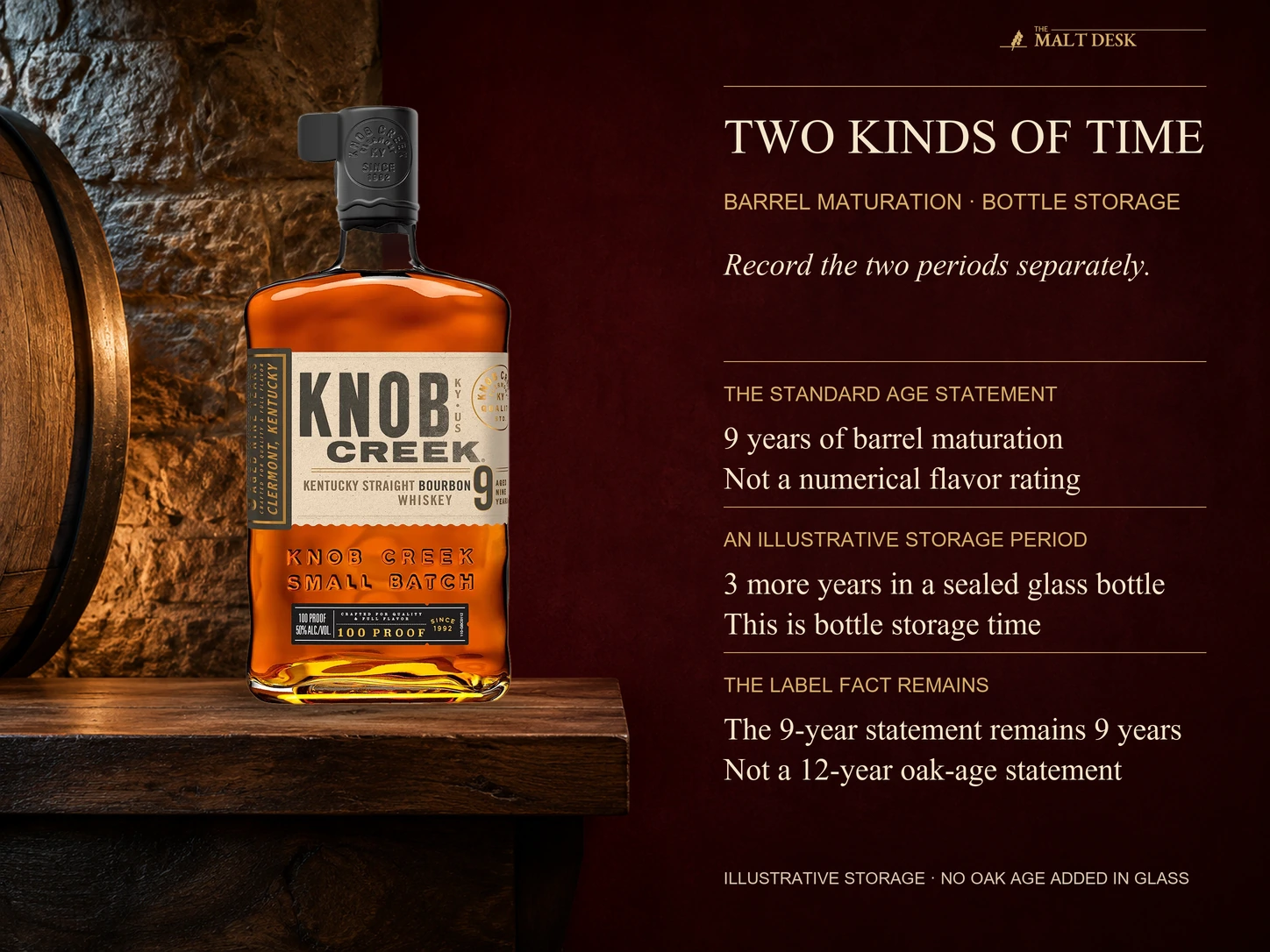
The producer identifies nine years of maturation in white oak barrels. The age statement is a minimum maturation claim for the whisky.
A nine-year statement also distinguishes this expression from bottles sold without an age statement. That distinction is useful factual information without implying that either category is automatically better.
What 100 Proof Means
In U.S. labeling, 100 proof corresponds to 50% alcohol by volume. This establishes alcohol concentration, not the amount of caramel flavor, perceived body, or suitability for a particular cocktail. An equal-volume serving contains more alcohol than one at 90 proof.
The standard 100-proof bourbon should not be confused with Single Barrel Reserve, a rye expression, or an older age-stated Knob Creek release. Check the complete expression name, proof, age, and volume before comparing a local bottle with any product description.
Interpreting the Published Profile
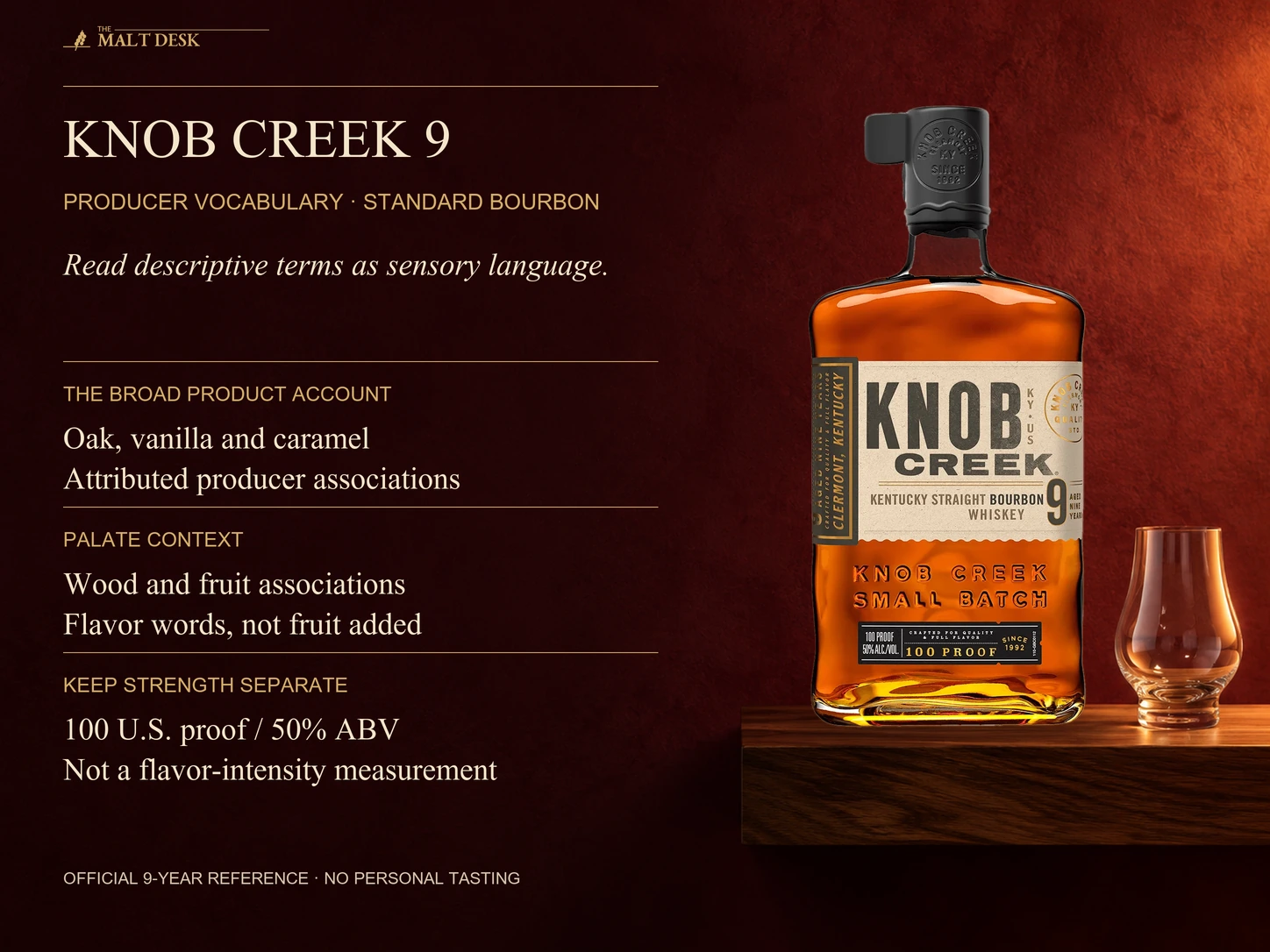
The current nine-year product page describes toasted nuts, grain and oak on the nose, a sweet and woody palate with fruit associations, and a persistent rich finish. Its broader product description also names vanilla and caramel. These are producer sensory descriptions. The seven-year rye wording elsewhere on the page belongs to a separate product and is not a note for the nine-year bourbon.
An oak descriptor is sensory language. Likewise, the strength cannot establish whether a finish feels balanced, hot, gentle, or drying to a particular reader.
The Whiskey Flavor Map explains how descriptive categories can organize published notes.
Price and Label Comparisons
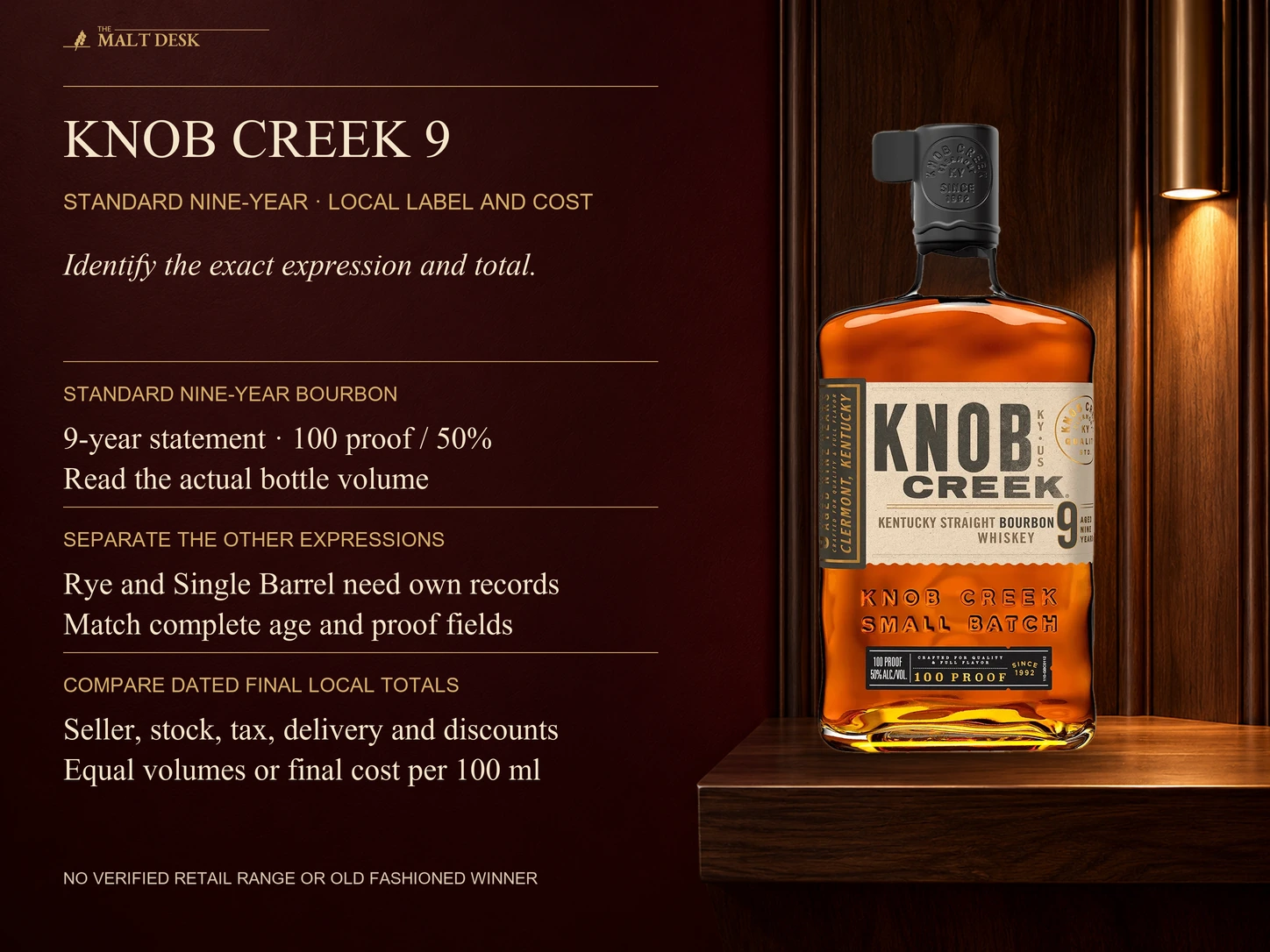
Match the standard nine-year, 100-proof bourbon before recording a dated local quote. Knob Creek rye and single-barrel expressions require their own label records. This guide does not establish a verified current or historical retailer range.
Taxes, location, delivery, and promotions can change the final cost. Verify that a listing is for the standard nine-year bourbon rather than a single-barrel or other expression. Compare equal bottle volumes; a lower sticker price on a smaller bottle may represent a higher unit cost.
Serving and Dilution
Neat means no added water or ice. A cube cools the liquid while melting adds water. These changes may alter perception, but they do not guarantee that vanilla will become stronger or oak will become softer. No controlled serving trial is reported here.
For equal initial volumes, dilution lowers concentration while leaving the amount of alcohol from the bourbon unchanged. A higher initial proof therefore does not make a mixed drink safer or establish that its flavor will necessarily persist longer. The serving guide explains these distinctions.
The Right Component Names Can Still Give the Wrong Final Proof
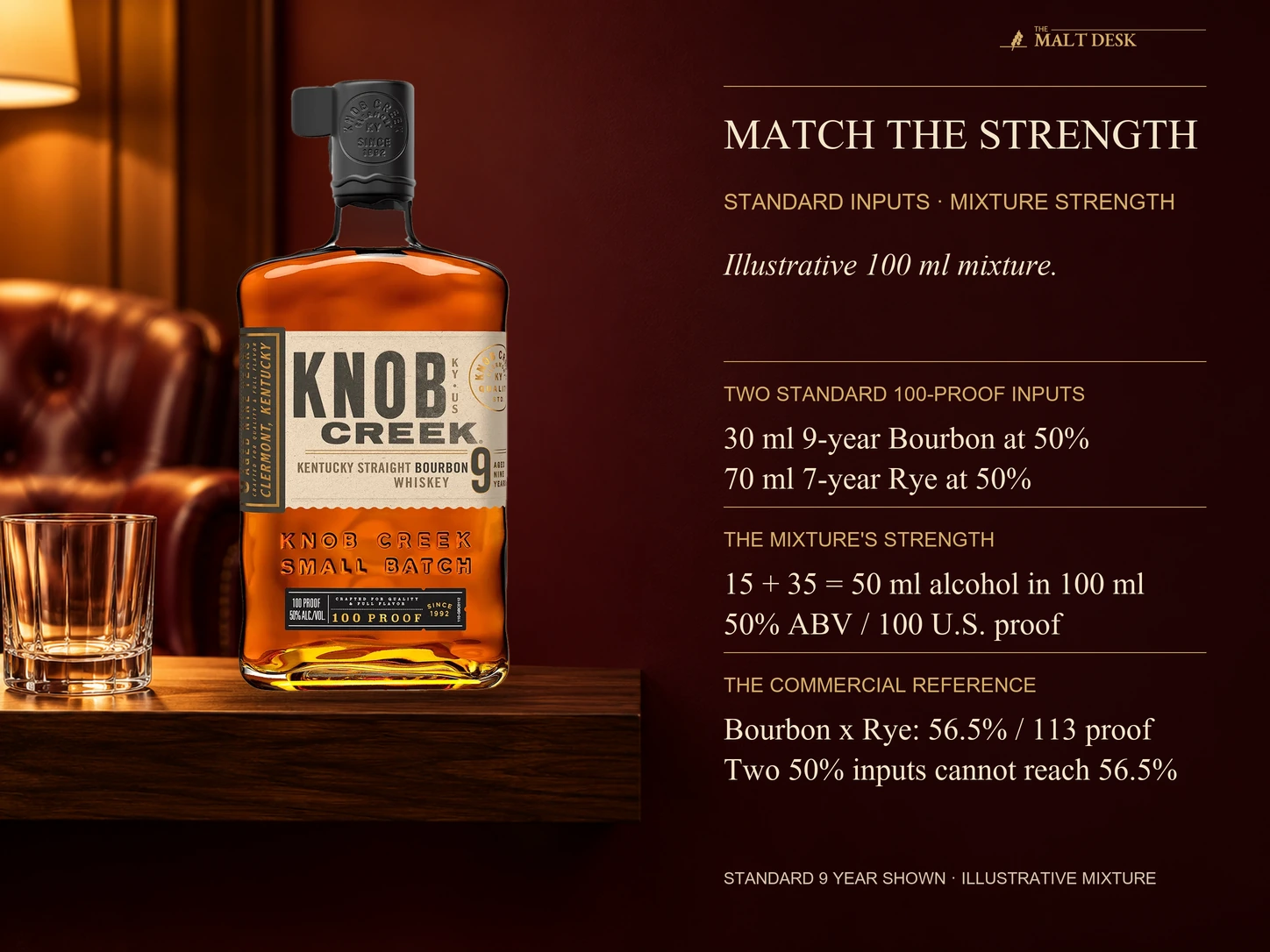
In an illustrative 100 ml mixture, combine 30 ml standard Knob Creek 9 at 50% with 70 ml standard seven-year Rye at 50%. They contribute 15 ml and 35 ml pure alcohol respectively. With the ordinary volume-additive approximation, the result remains 50% ABV, or 100 proof. No choice of their relative shares can raise it to the commercial Bourbon x Rye reference of 56.5%, or 113 proof, because both inputs start at the same lower concentration.
| Reference or illustrative mixture | Age information | Strength |
|---|---|---|
| Standard Knob Creek 9 bourbon | Nine-year statement | 100 proof / 50% |
| Standard Knob Creek seven-year Rye | Seven-year statement | 100 proof / 50% |
| Commercial Bourbon x Rye | Producer describes 30% nine-year bourbon and 70% seven-year rye | 113 proof / 56.5% |
| Illustrative 30 ml + 70 ml standard-bottle mixture | Combines whiskey carrying those two ages | Approximately 100 proof / 50%; not a commercial replica |
The published descriptions therefore do not establish that the producer blends these two already diluted retail bottles. Higher-strength stocks before bottling could reconcile the figures, but the product page does not disclose all incoming-stock proofs and production details. The firm answer is narrower: the 113-proof result cannot be obtained simply by mixing the two 100-proof standard bottles. This is a constraint on reconstruction, not proof of a particular undisclosed factory method.
The 30/70 split also does not make the result “8.4-year bourbon.” Multiplying nine by 0.30 and seven by 0.70 produces a numerical mean of stated ages, not a new minimum age, and the younger component remains seven-year rye. Likewise, 70% rye whiskey is a share of a matured whiskey category, not 70% rye grain: that whiskey’s own grain recipe contains other grains. Keep stock proportions, grain proportions, maturation minima and final concentration as four different quantities.
Comparing Other Bourbons
A useful comparison separates proof, age statement, and disclosed production details. Wild Turkey 101 is near this expression in proof; that does not make its maturation or flavor identical. Woodford Reserve, Four Roses Small Batch, and Elijah Craig Small Batch have different reference strengths and product descriptions.
The budget comparison guide provides broader context, while bourbon versus rye explains the categories. Neither a higher proof nor a longer age statement is a substitute for evidence about an individual expression.
In Brief
Knob Creek 9 carries a nine-year age statement and 100-proof reference strength. The producer describes oak, toasted nuts, grain, sweetness and fruit associations, with vanilla and caramel in the wider description. Bottle storage is separate from the stated barrel maturation.
Treat a Knob Creek Home Blend as Its Own Recipe
If the aim is exploring bourbon-and-rye proportions, record the chosen standard bottles, measured amounts and calculated final strength as a home recipe. If the aim is the producer’s Bourbon x Rye expression, use its own 30:70 component account and 113-proof specification. Choose the experiment or the finished expression according to the question you want answered.
Questions About Knob Creek 9
Is it 100 proof?
Yes. The producer identifies the standard nine-year bourbon as 100 proof, equivalent to 50% ABV.
Is the age statement nine years?
Yes. Confirm that the bottle is the standard nine-year expression, since the range includes other ages and product types.
Has its Old Fashioned performance been tested here?
No. Cocktail results depend on the recipe, dilution and serving conditions.
Does this guide establish a current price?
No. Identify the standard nine-year, 100-proof bourbon and compare equivalent dated local offers, including volume and final-cost conditions.
Sources
Knob Creek’s current 9 Year Old Bourbon Whiskey page, checked October 4, 2026; U.S. whiskey age-label rules for barrel maturation. The nine-year bourbon description is kept separate from the seven-year rye panel appearing on the same page.
Additional label-comparison sources: 27 CFR 5.88, Bottled in bond, in the current eCFR, and Wild Turkey’s official 101 product description, checked October 5, 2026. Matching age and proof alone does not establish the full bottled-in-bond designation; the equal-pour difference is arithmetic at the stated reference strengths.
Additional blending sources: Knob Creek’s current Bourbon x Rye and seven-year Rye pages and standard range references, plus Suntory Global Spirits’ July 17, 2024 launch announcement, checked October 7, 2026. The home-mixture arithmetic uses the standard 100-proof bottled inputs and does not claim the commercial producer uses those inputs or disclose its private stock proofs.