Elijah Craig Small Batch: Product Guide
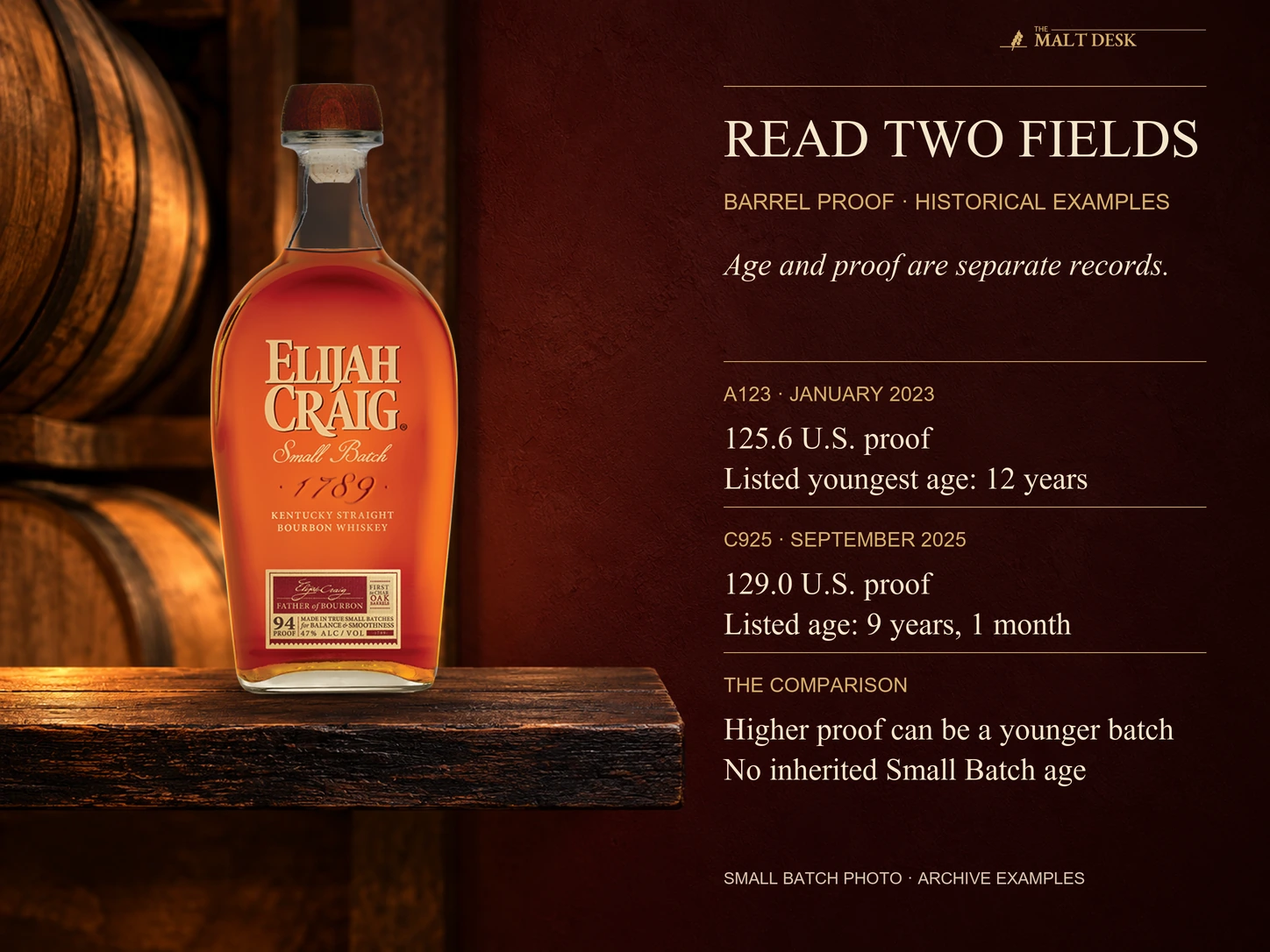
Elijah Craig Small Batch’s 94-proof reference is straightforward; the Barrel Proof bottles beside it require a different kind of reading. A123 and C925 are release identifiers with separate age and proof fields, not stronger versions of one fixed twelve-year specification. The producer’s own historical batch table shows why a review of one batch cannot supply the facts for another.
That distinction also protects the standard bottle from a common shortcut. A twelve-year entry in the Barrel Proof archive cannot establish twelve years for today’s non-age-stated Small Batch. The useful comparison begins with the exact expression and batch, then asks whether age and concentration actually move together in the published examples.
Elijah Craig Small Batch is a Kentucky straight bourbon bottled at 94 proof, equivalent to 47% ABV. Its producer identifies Level 3 charred new oak and publishes a profile built around vanilla, fruit, mint, wood, and spice. This guide separates those product descriptions from price context and explains what is not disclosed.
Specifications and the Age Question
The Small Batch product page consulted for this guide confirms 94 proof and Level 3 charred new oak barrels. It does not establish a guaranteed eight-to-twelve-year barrel range. Consult the actual label and a dated producer statement for the age details of a particular release.
It identifies the expression. Distinguish it from Elijah Craig Barrel Proof and Toasted Barrel, which are separate products with different production details.
What the Char Description Explains
Elijah Craig associates its Level 3 char with wood-derived flavor compounds. This provides production context.
The bourbon and rye guide explains the category terms. Product-specific barrel information should remain separate from general category rules.
Producer Tasting Notes
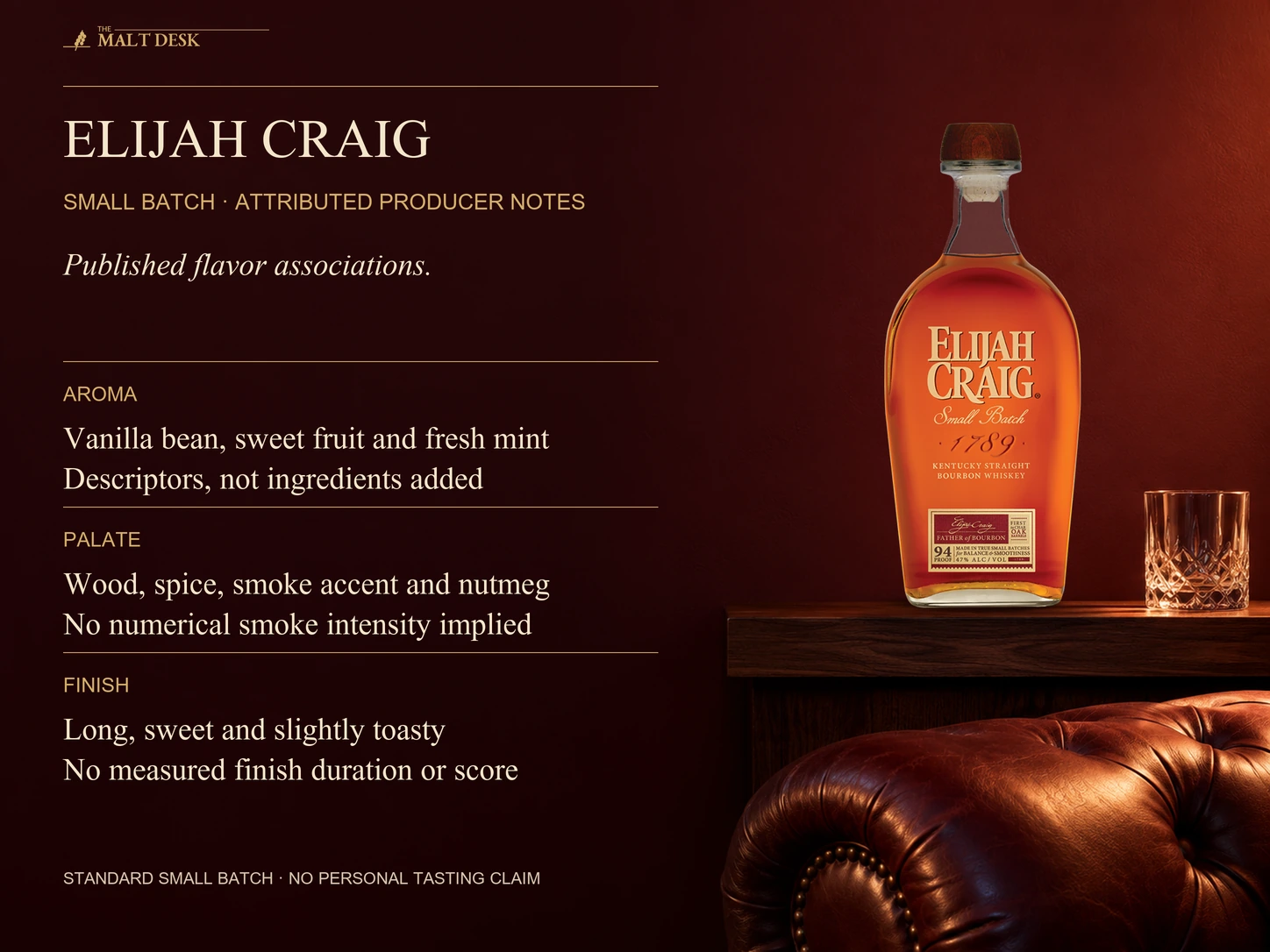
The official aroma description includes vanilla, fruit, and mint. Its palate description emphasizes wood, spice, a smoke accent, and nutmeg; the finish is described as sweet and toasted. These are attributed producer notes.
Terms such as long, smooth, or warm express sensory impressions.
The Whiskey Flavor Map provides vocabulary for organizing descriptions.
Price and Label Comparisons
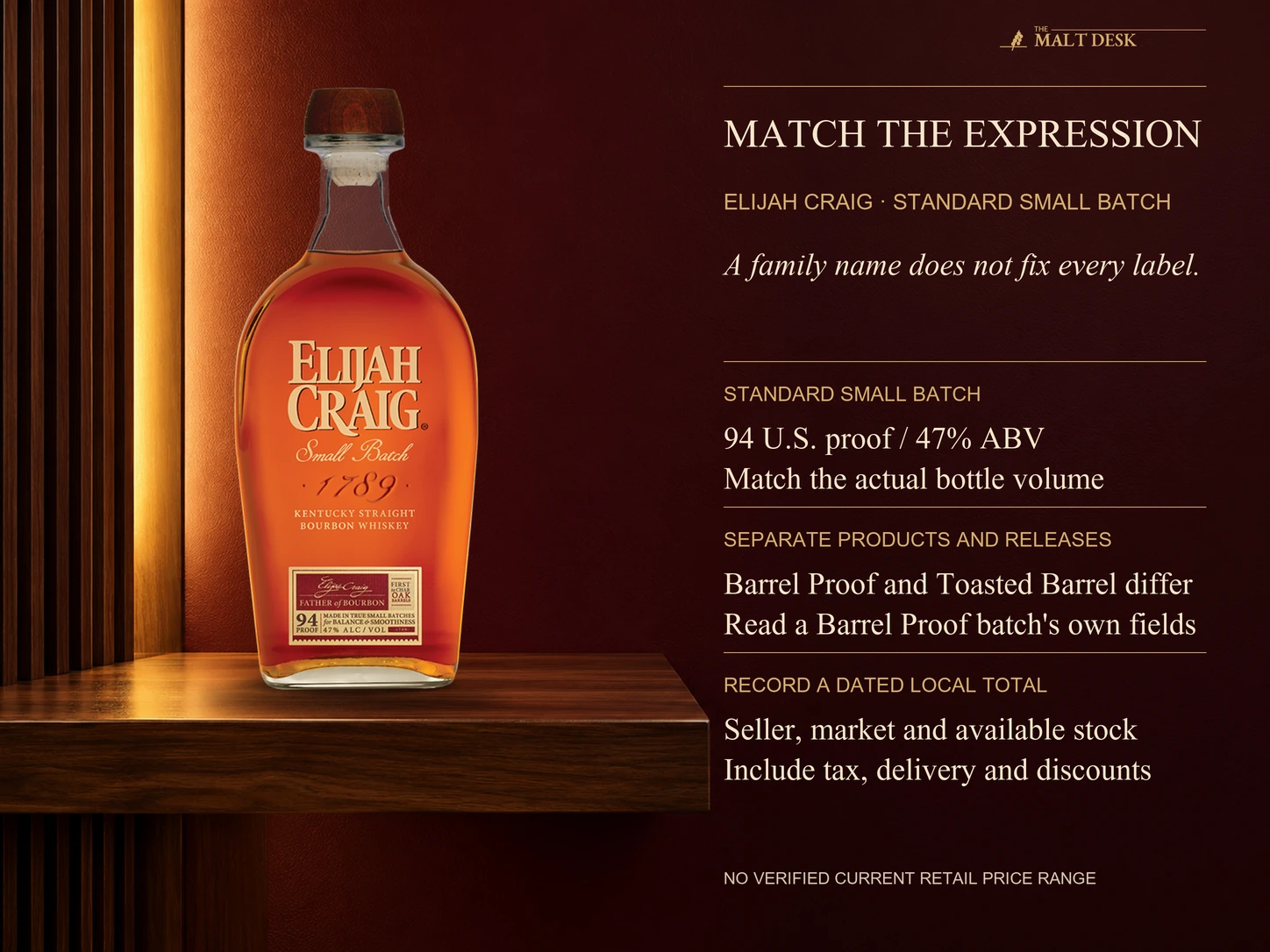
Identify Elijah Craig Small Batch separately from Barrel Proof or Toasted Barrel. The 94-proof reference in this guide should not be transferred to another release. Compare exact labels, volumes and dated local totals including offer conditions; no verified retailer range is established here.
Serving Information
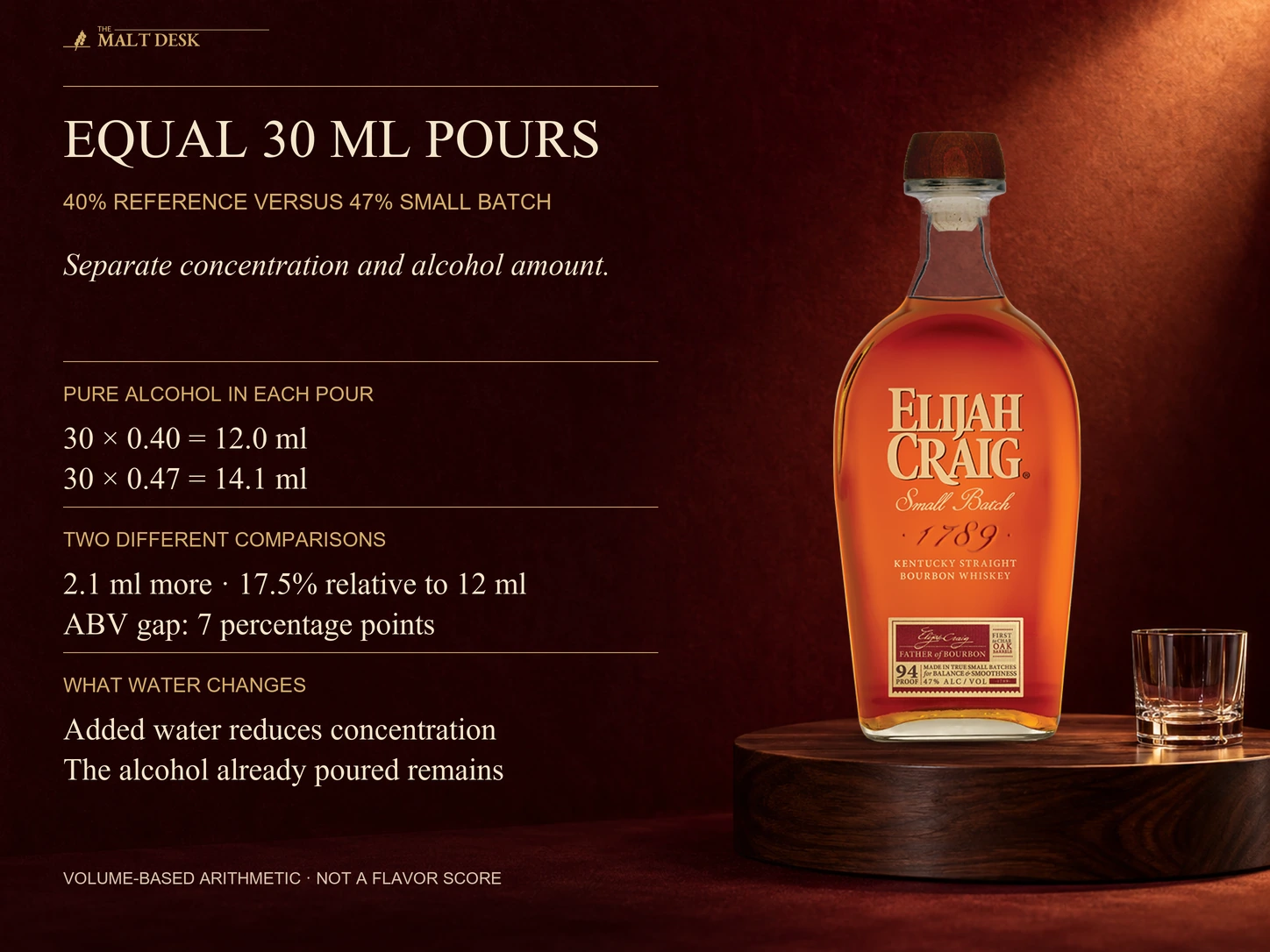
For equal 30 ml measures, an 80-proof reference (40%) contains 12 ml pure alcohol and 94 proof (47%) contains 14.1 ml. That is 2.1 ml, or 17.5%, more alcohol relative to the 40% measure. The ABV difference is 7 percentage points. Added water lowers concentration without removing that alcohol.
Neat, water-added, and ice-cooled servings differ in concentration and temperature.
The serving guide explains the terminology. For an equal starting volume, 94-proof bourbon contains more alcohol than an 80-proof bourbon; adding water changes concentration rather than removing the alcohol.
Read the Batch Code Before Carrying Over an Age or Proof
The producer explains the first letter as release order within the year, the following number as release month, and the final two digits as year. B523 therefore identifies the second release of 2023, in May; it does not mean five years old or a barrel distilled in 2023. The separate age field supplies the youngest-barrel age for that batch. The following are historical examples, not a claim about the latest release or current store stock.
| Historical batch | Release | Listed proof | Listed youngest age |
|---|---|---|---|
| A123 | January 2023 | 125.6 | 12 years |
| B523 | May 2023 | 124.2 | 11 years, 5 months |
| C923 | September 2023 | 133.0 | 13 years, 7 months |
| A125 | January 2025 | 118.2 | 10 years, 7 months |
| C925 | September 2025 | 129.0 | 9 years, 1 month |
C925 is younger than A123 on the listed age minimum but higher in proof: 129.0 versus 125.6. C923 is both older and stronger than B523. These observations defeat a simple rule that the higher-proof batch must be older, without implying the opposite rule. Proof is alcohol concentration after that batch’s maturation and selection; age is elapsed barrel time. Neither column can be calculated reliably from the other.
The archive also shows the age description changing between the twelve-year A123 entry and the eleven-year-five-month B523 entry. A historical review saying “Elijah Craig Barrel Proof is twelve years old” needs its batch context. If comparing a local Barrel Proof premium with standard 94-proof Small Batch, first record the Barrel Proof bottle’s own batch, age and proof. Otherwise the price comparison may be attached to a specification the offered bottle does not have.
Comparing Nearby Expressions
Four Roses Small Batch, Woodford Reserve, Wild Turkey 101, and Buffalo Trace provide different reference strengths and production descriptions. These facts can be compared without declaring one fruitier, more mature, or more polished on the basis of an undocumented tasting.
Use the budget guide for broader context. A lower historical price or a higher proof is not a substitute for an individual expression’s documented specifications.
In Brief
Elijah Craig Small Batch is bottled at 94 proof, with no age statement on the standard expression. Its Level 3 char describes new-oak barrel treatment; the checked product page does not guarantee an eight-to-twelve-year range or a numerical smoke intensity.
Match the Elijah Craig Batch Before Using Its Review
Use standard Small Batch’s 94-proof reference for the core expression. For Barrel Proof, match the release code first, then record that batch’s age and proof from its own table entry. A reader comparing A123 with C925 can then assess two documented releases rather than carry a familiar age or strength across the whole range.
Frequently Asked Questions
What strength is Elijah Craig Small Batch?
The producer lists 94 proof, or 47% ABV, for this expression.
Is its age confirmed as eight to twelve years?
That range is not established by the official Small Batch page consulted for this guide. Do not treat it as a guaranteed age specification.
Does Level 3 char mean heavily smoky whisky?
No numerical smoke level follows from the char number. It describes a barrel treatment, while the producer’s sensory description mentions a smoke accent.
Does this guide establish a current price?
No. Compare dated local offers for standard Small Batch with matching strength and volume, including stock, tax, delivery and discount conditions.
Sources
Elijah Craig’s current Small Batch and How It’s Made pages, checked October 4, 2026. The product page supplies 94 proof and attributed sensory notes; the production account identifies Level 3 charred new oak. No current retail range or guaranteed 8–12-year age is established.
Additional comparison source: Elijah Craig’s current Toasted Barrel product page, checked October 5, 2026. It identifies the second custom toasted barrel and the separate 94-proof expression.
Additional batch source: Elijah Craig’s Barrel Proof label guide and historical release table, checked October 7, 2026. The five named archive entries are kept separate from standard 94-proof Small Batch. The age/proof comparison is an analysis of published batch records.